Explore9 min read
The Beginner's Guide to Kelp Forest Diving
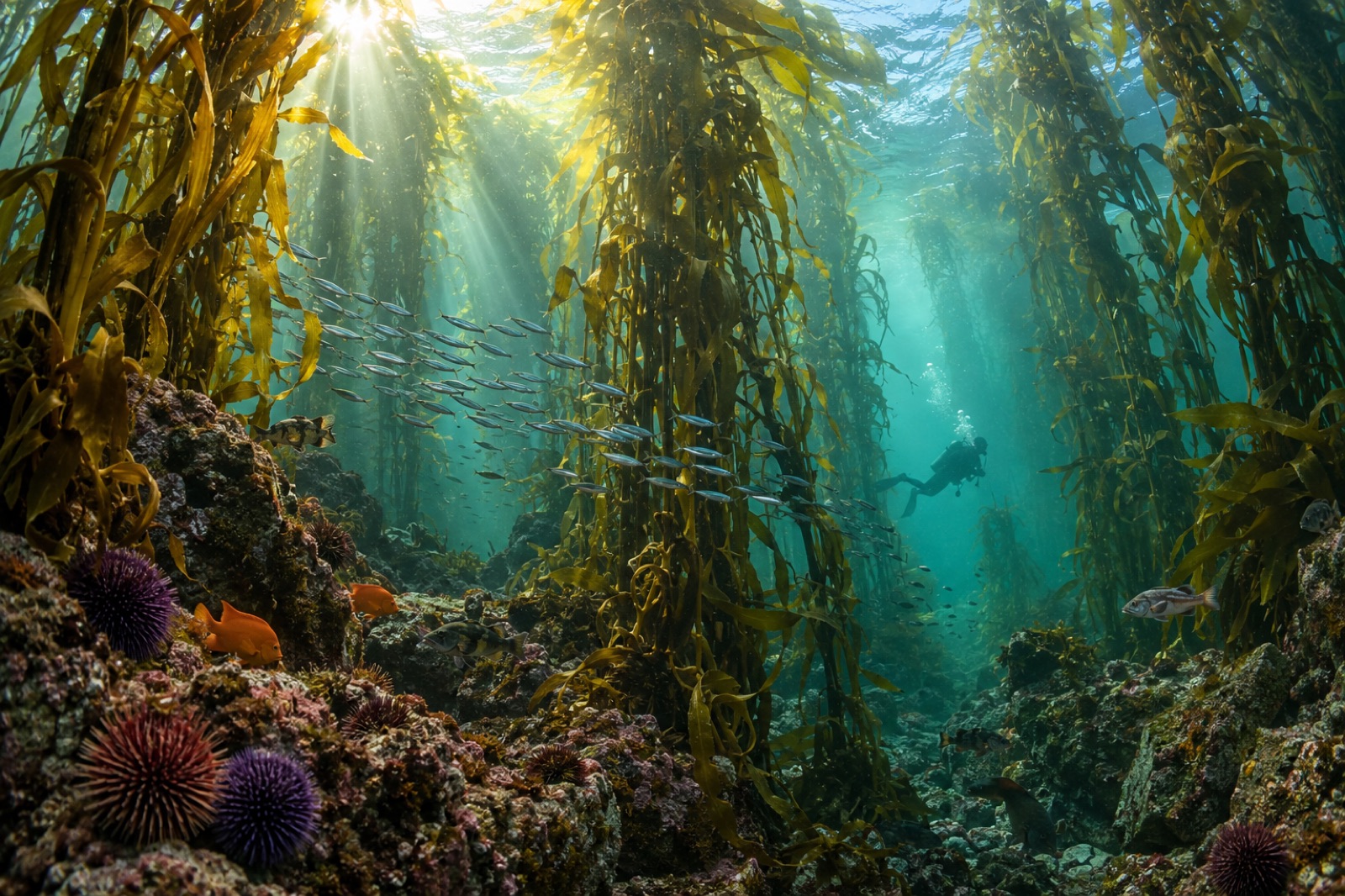
Your first kelp forest dive is easier — and more magical — than you think. Gear, skills, marine life and etiquette for new divers entering the green cathedral.
Tom Okafor ·
How to assess a shore dive site step by step: wind, swell, entry and exit points, surge and kelp layout — plus the bailout plan every beach dive needs.
Part of a learning path
This article is stop 4 of 9 on Into the Canopy — A cold-water diver’s route from first kelp dive to night forest.
Most of the world's great kelp reefs are shore dives. They lie within fin-kick distance of a car park, a cobble beach, a boat ramp — which is exactly why they humble divers so reliably. Shore diving strips away the safety scaffolding a boat provides: no deckhand watching the bubbles, no ladder back to a warm cabin, no skipper deciding conditions for you. Everything — site selection, timing, entry, bailout — is your call. The reward is total freedom: some of the best temperate diving on Earth costs nothing but planning. And planning is a craft. This guide walks through how experienced shore divers assess a beach before committing: reading swell and wind from the car park, choosing entries and exits, managing kelp and surf, and building the bailout plan that turns a sketchy day into an honest "not today."
Every assessment starts days earlier, at home.
Shore diving is weather work. You are reading four variables, and the skill is knowing which one matters most at your site.
Swell decides nearly everything on an exposed shore. Read the forecast by height, period and direction:
Onshore wind builds short, steep chop on top of any swell and destroys surface swims and visibility. Many coasts have a diurnal rhythm — calm mornings, sea breeze by early afternoon — which is why experienced shore divers dive early almost as a religion. Offshore mornings can be glorious; a strong katabatic offshore can also push surface water out and fog your judgment about return conditions. Check the hourly wind forecast, not the daily summary.
Tide moves the entry line itself. At low tide, a rock platform may be a dry obstacle course and the reef a long underwater swim away; at high tide the same entry is a step off the rocks, but surge gets compressed into a narrower zone and exits get punchier. Sites adjacent to estuaries or heads may have current constraints that make them diveable only at slack. Check both tide height and phase for your specific site — and remember that spring tides amplify everything good and bad.
After heavy rain, coastal runoff drops visibility to nothing near river mouths and can carry real pollution. The rule of thumb: give a site 48–72 hours after serious rain, more near large estuaries.
Forecasts get you to the car park. Now the ocean gets a vote, and you should grant yourself at least twenty minutes of watching before anyone touches a cylinder.
The most common kelp-coast entry. Kitting at the waterline is the mistake; kit fully up the beach, then time a transit: mask on but reg in hand, watch the sets, walk in on the back of a set and get deep enough to swim before the next one. Fins on in waist-deep water — earlier and you waddle, later and a wave takes you sideways. On exit, time it in reverse: ride the back of a wave to standing depth, and walk out briskly while the water draws back. Never turn your back on the shorebreak while removing fins in the shallows.
Stride or seated entries from rock are clean when the platrorm is above the wash zone; a gully entry past kelp needs slow finning through gaps, never thrashing. On the exit, the crux is timing the surge up the rocks: ride the rise, grab dry rock (never weedy), and let the surge drain before standing. If the exit looks sporty, it is — and that knowledge should have changed your dive plan an hour earlier.
Easy entries with their own rules: give fishermen's lines a wide berth, watch for boat traffic, and expect the worst visibility of any site type but often the best small-life — jetties are vertical nurseries.
A shore dive plan has three layers, and the third is the one novices skip:
Brief it all on the surface, out loud, with your hands pointing at real features. A briefing given to the car park is superstition; a briefing given to the beach is seamanship.
Done well, shore diving turns every coastline into your coastline. Master the assessment and the bailout, and the rest — the gropers, the seadragons, the sunbeams in the canopy — becomes the reliable part. Newer divers can build these skills progressively by starting at sheltered, purpose-loved sites; our guides to Monterey's Breakwater and the wider beginner's kelp diving path are good next reads.
It depends on the site's exposure and the swell period more than the raw number, but as a rough rule: many open-coast sites get unpleasant above 1 m of swell and undiveable around 1.5 m — and a long-period 1 m can be worse than a short-period 1.5 m. Sheltered coves facing away from the swell direction can stay diveable when the open coast is closed, which is why local site lists matter.
Yes — under supervision and at the right sites. Many of the world's best training reefs are sheltered shore dives with sandy entries, which is precisely why sites like Monterey's Breakwater stay beloved. What beginners should avoid is unsupervised surf entries and rock exits; build up to those with a guide or experienced buddy.
Spot them from elevation before entering: darker, calmer lanes between breaking waves, often discoloured with sand, heading seaward. Enter and exit where waves are breaking gently rather than in the calm lane — counterintuitive but correct. If you are caught in one at the surface, swim parallel to shore until free rather than fighting it head-on.
Only at sites you know intimately by day, on small swell, with marked exits — see our night diving guide for the full protocol. A first-ever visit to a shore site at night combines the two hardest versions of two different challenges; do one difficulty at a time.
Execute the bailout: surface safely, assess, and swim to the alternate exit you identified during planning rather than fighting back to a closing-out beach. If separated from your buddy, follow the agreed procedure — one minute searching, then surface and reunite. A shore dive you abandon is a success; the statistic you never want to join is someone who tried to force the original exit because it was the car park.
Your first kelp forest dive is easier — and more magical — than you think. Gear, skills, marine life and etiquette for new divers entering the green cathedral.
Tom Okafor ·
The complete cold-water kit for kelp forest diving: wetsuit thicknesses, drysuits, hoods, gloves and the small accessories that save a dive.
Tom Okafor ·
Kelp forests are safe, magical snorkeling — if you respect cold water, surge and canopy. Skills, gear, hazards and spots for your first kelp snorkel.
Dr. Theo Nakamura ·