Explore10 min read
Planning a Shore Dive: Reading the Beach Before You Get In
How to assess a shore dive site step by step: wind, swell, entry and exit points, surge and kelp layout — plus the bailout plan every beach dive needs.
Tom Okafor ·
A field guide to choosing kelp shore-dive sites — what habitat makes kelp grow, four site archetypes and how to dive each, and what the canopy itself tells you.
Ask a kelp diver to name their favourite reef and the answer is rarely somewhere exotic. It's usually a beach with awkward parking, a scramble over rock, and a forest that starts fifty fin-kicks from dry land. That's the genius of kelp-country shore diving: the habitat literally maps itself onto the coastline — you can read, from the car park, where the forest should be. This guide is about that reading: the habitat logic that tells you which headlands hold kelp, the four archetypes of kelp shore dive and how to dive each, and the language of the canopy itself, which will tell you more about conditions than any forecast. For the mechanics of the dive day itself — forecasts, wave-set timing, bailout plans — our companion piece on shore dive planning covers it step by step.
Kelp is almost comically picky about real estate, and its pickiness is your site-selection tool:
Satellite imagery at lowest tide makes this practical: the dark canopy is visible from space. Before visiting any coast, spend an evening scanning the shoreline — forest patches, channels and rock edges all show clearly.
Rock armour piled to stop waves accidentally builds excellent reef: hard substrate, sheltered inner faces, and a depth contour that drops off fast. Breakwaters are where a coast's fish life concentrates — expect schooling fish overhead, octopus in the rubble, and kelp on the seaward side. Conditions are forgiving on the lee side in almost any weather, which is why sites like Monterey's Breakwater became the training reefs of entire generations of divers. Watch boat traffic (use a flag), fishermen's lines, and silty viz after rain.
Where a headland interrupts the longshore drift, you get reef, current and depth in one address. Point dives are the most rewarding and the most demanding: current accelerates around the tip, swell wraps and intensifies, and the exit is rarely where the entry is. Plan them as one-way dives — enter up-current, ride the wrap, exit around the corner — or make conservative there-and-backs at slack. The kelp on points is often the healthiest on the coast, because it gets the cleanest, coolest, most nutrient-rich water. Think of it as the reef's front row.
A cove between two headlands with reef at both ends and a sandy middle is the classic social shore dive — easy entries for everyone, kelp gardens a short swim away in either direction, and natural "room" geography (swim out along one side, back along the other) that makes navigation nearly automatic. Sites like Rickett's Point near Melbourne or many Tasmanian coves such as Fortescue Bay follow this pattern. The trap: the easy sand entry makes people lazy about watching the sets. Fringing reefs catch surge.
On exposed coasts the kelp often forms a nearly continuous surface band, with the entry through a natural gully — a deeper, kelp-free lane cut through the reef by sand scour or a fault in the rock. Gullies are gifts: a defined, current-flushed corridor through the canopy that doubles as your reference line home. Learn to spot them from elevation as the dark, smooth lanes in the canopy field. Dive them by following the gully out, exploring the reef edge, and returning along the same lane. Never improvise a crossing through dense canopy when a gully exists fifty metres away.
The surface canopy broadcasts everything happening below:
None of this replaces the forecast rhythm in the planning guide; it's the final, local, right-now layer of truth that the forecast can't give you.
Technique detail lives in the planning guide, but three kelp-specific habits deserve emphasis:
When you evaluate a new-to-you site, local divers are silently running this list:
Begin with site archetype 1 or 3 — a breakwater or a pocket beach — and build outward. Ready-made walkthroughs of these site styles live in our atlas dive guides: the Breakwater at Monterey, Casino Point on Catalina (shore-accessed, and a masterclass in pocket-reef geography), and Fortescue Bay in Tasmania. Snorkellers: most of this logic holds at half the depth, with the safety adjustments in our kelp-country snorkel guide.
Mostly, yes. Combine satellite imagery at low tide (canopy is visible from space), marine charts for reef contours, and the habitat logic above. That's how divers pioneer new sites everywhere. Local knowledge then adds the things maps can't: parking etiquette, seasonal swell quirks, and which gully holds an octopus.
Generally, yes — the current acceleration and wrap-around swell make them the most demanding archetype. Build up through breakwaters and pocket beaches first, ideally with a guide or an experienced buddy who knows the point.
If you can't see water through it from the entry, it's too thick to swim through. Look for gullies and lanes instead. In kelp country, "around" is almost always faster than "through."
That's exactly why the two-exit rule exists. Use the alternate, accept the walk back to the car, and count the decision as good diving. Forcing a closing exit because it's convenient is how shore dives end in statistics.
Significantly — canopy, surge and gullies all read differently in torchlight, and familiar sites become halfway new. Only night-dive shore sites you know well by day; our night diving in kelp guide has the full protocol.
How to assess a shore dive site step by step: wind, swell, entry and exit points, surge and kelp layout — plus the bailout plan every beach dive needs.
Tom Okafor ·
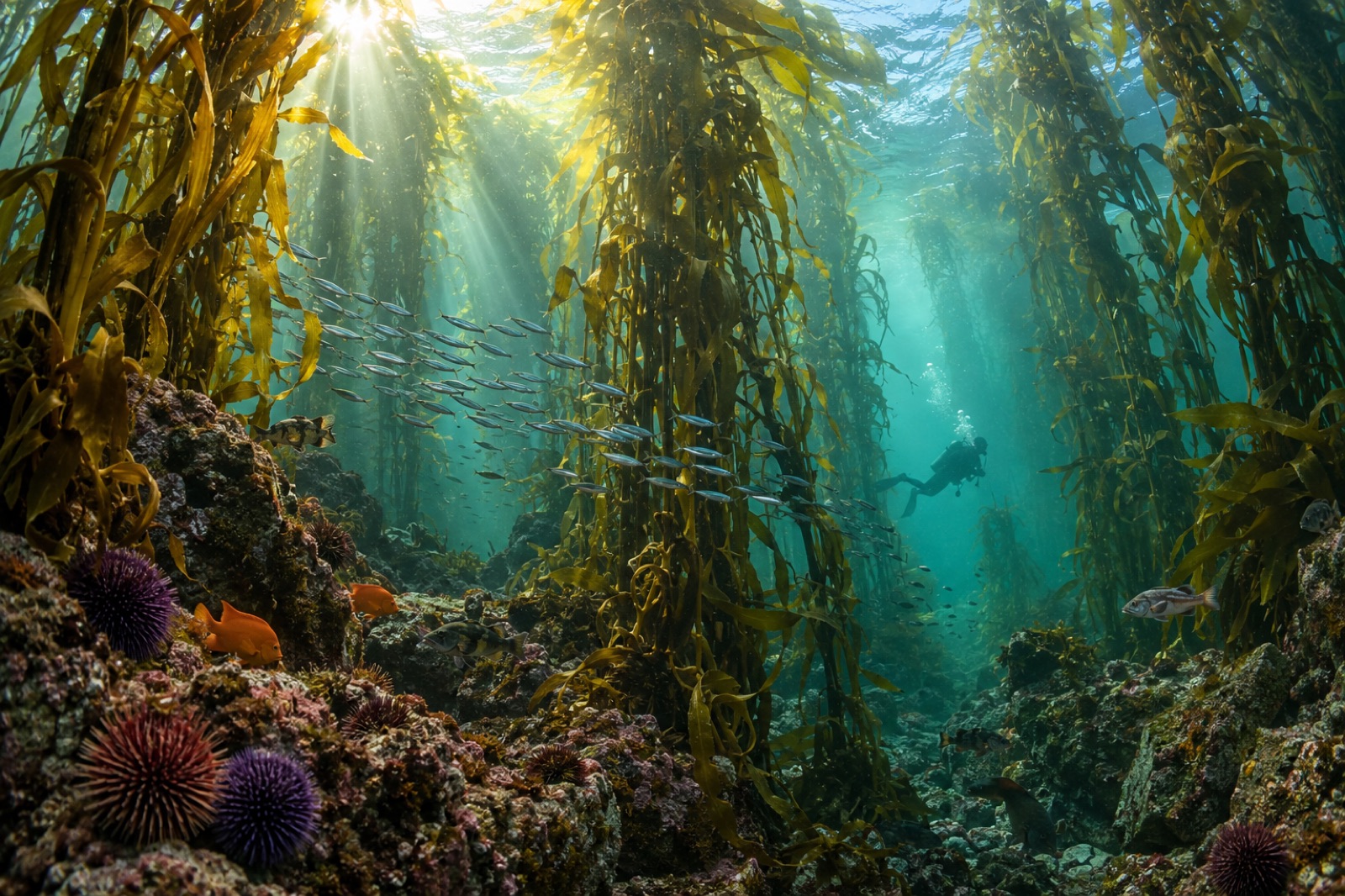
Your first kelp forest dive is easier — and more magical — than you think. Gear, skills, marine life and etiquette for new divers entering the green cathedral.
Tom Okafor ·
Kelp forests are safe, magical snorkeling — if you respect cold water, surge and canopy. Skills, gear, hazards and spots for your first kelp snorkel.
Dr. Theo Nakamura ·