Explore9 min read
Drysuit vs Wetsuit for Kelp Diving: An Honest Comparison
Drysuit or wetsuit for cold-water kelp diving? A straight comparison of warmth, buoyancy, cost and upkeep — plus the water temperature where each makes sense.
Tom Okafor ·
The complete cold-water kit for kelp forest diving: wetsuit thicknesses, drysuits, hoods, gloves and the small accessories that save a dive.
Part of a learning path
This article is stop 3 of 9 on Into the Canopy — A cold-water diver’s route from first kelp dive to night forest.
Kelp forests live in cold water — that is the whole point. The same refrigeration that lets giant kelp photosynthesise at full tilt makes the human body a liability: water conducts heat away roughly twenty times faster than air, and a temperate reef at 10 °C will strip the warmth out of an unprepared diver long before the air in the tank runs out. The good news is that modern exposure has solved the problem entirely. The complete cold-water kit is not a matter of endurance; it is a matter of system design. Here is the full list, with warmth-honest advice for each piece.
Our drysuit vs wetsuit comparison debates the core architecture choice; this article is the full assembly list once you have made it.
The fork in the road, briefly:
The head and hands lose heat disproportionately — the head because of blood supply, the hands because they work hard in cold water and have almost no fat insulation.
Hard-soled 5–7 mm dive boots serve kelp diving particularly well: shore entries over rock demand grip and foot protection, and the boot–fin relationship matters for finning posture in surge. Avoid tropical slipper-style boots entirely on a kelp coast; rocky entries will correct that decision fast.
Cold water demands a cold-rated regulator — environmentally sealed first stages are built to avoid first-stage freeze freeflow in cold water, and the entire regulator should be rated by the manufacturer for cold-water service. This is not a spec-sheet footnote: freeflows are a real cold-water failure mode, and a warm-water regulator at 8 °C is gambling. Check the stated rating, service annually and dive with a properly routed redundant air supply (an accessible octopus or, in overhead-style cold water, an independent pony).
Wetsuit divers: your suit is compressing fifteen metres of neoprene's worth of buoyancy at every depth change; a decent BCD with adequate lift and a well-rigged delayed surface marker buoy (DSMB) are mandatory equipment, not accessories. Drysuit divers: the suit is part of the buoyancy system and demands its own training — do it properly.
Carry, every dive:
Kelp forests are the best light-and-structure photography environment in diving, and they reward a very specific setup. If you intend to shoot, read our dedicated underwater photography in kelp guide; the summary version is: wide angle, big dome, powerful strobes, and more patience than you think you need. A backup mask, a modest save-a-dive kit and thermal layers for surface intervals (windproof shell, warm hat, thermos) round out the sensible boat bag.
Every piece of equipment in this article is easier to replace than the skills underneath it. Buy training before equipment. The cold-water skill set that turns gear into a system:
If you are assembling from scratch, buy in the order that matters:
Rent the heavy items on your first few temperate trips; the right time to buy a drysuit is after you have dived one, in the cold, enough times to know.
For classic California-style kelp diving (roughly 12–16 °C), a 7 mm suit — often a 7/7 two-piece — is the standard answer, with 5 mm hood and gloves. Below 12 °C, look hard at a drysuit; below 10 °C, accept it. Our drysuit vs wetsuit piece walks the decision.
Yes — a model rated by the manufacturer for cold-water service, ideally with an environmentally sealed first stage to resist freeze freeflow. If the spec sheet does not name a cold-water rating, treat that as a no.
Rarely — if managed calmly. Kelp grips gently; the correct response is to stop moving, reach down, and part the stipe that caught you (or cut it with your cutting tool if it is stubborn). Panic and thrashing entangle; calm exits. Good buoyancy means you simply do not sink into the forest.
Windproof shell over everything the moment you surface; warm hat; thermos of something hot; a deck coat on rough boats; and get out of the wet suit as early as the boat allows. Most "cold dives" are ended by cold surface intervals, not cold water.
The hood (skirt fit matters more than millimetres), regulator cold-rating, and the DSMB skill. Everything else has a serviceable budget version; those three are the places where cheaping out is cold, unsafe or both.
Drysuit or wetsuit for cold-water kelp diving? A straight comparison of warmth, buoyancy, cost and upkeep — plus the water temperature where each makes sense.
Tom Okafor ·
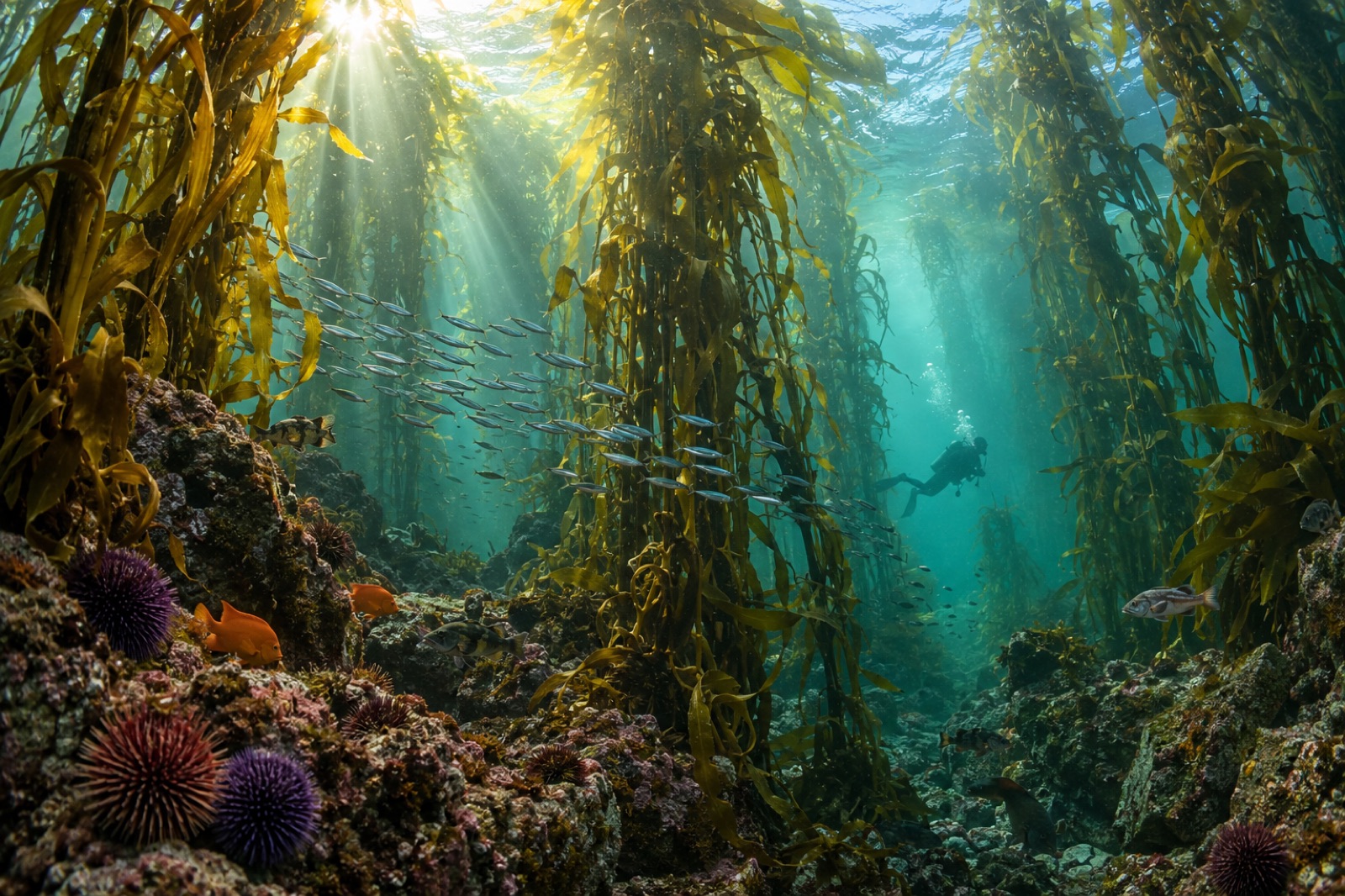
Your first kelp forest dive is easier — and more magical — than you think. Gear, skills, marine life and etiquette for new divers entering the green cathedral.
Tom Okafor ·
When is kelp diving best? A hemisphere-by-hemisphere, month-by-month guide to visibility, water temperature and kelp condition in the world's temperate forests.
Tom Okafor ·