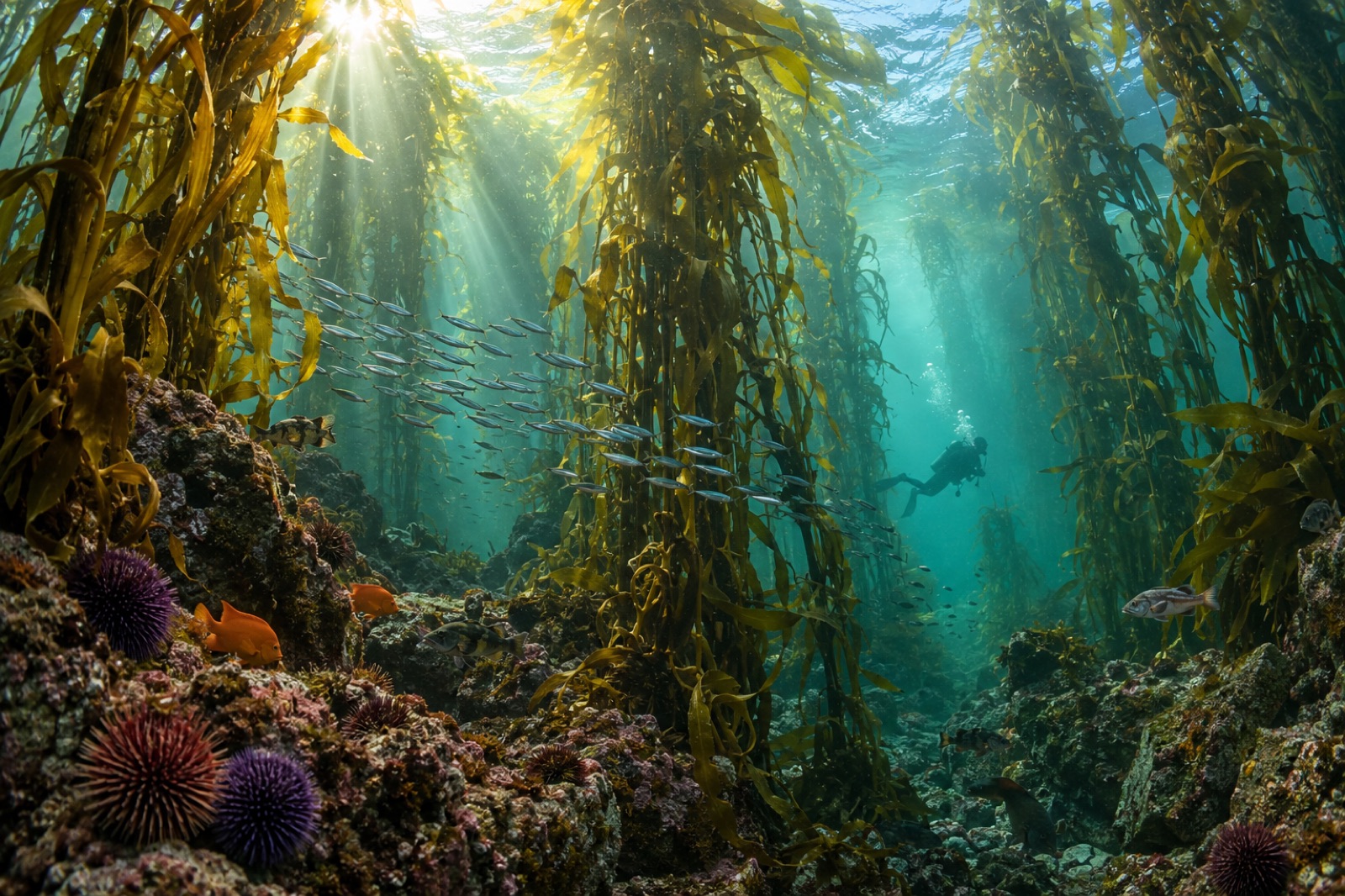
Scuba divers visit the kelp forest; freedivers dissolve into it. Without bubbles you move through the canopy like a local — fish close the distance, seals investigate, and the forest's quieter residents ignore you entirely. It is the most intimate way to experience a kelp reef, and also the discipline with the least margin for sloppy safety. Breath-hold diving's central risk — blackout — gives no warning to the person it happens to. Everything in this guide flows from that fact: the training, the buddy protocols, and the etiquette that keeps you welcome in the forest and alive on the surface.
Why kelp is freediving's perfect terrain
Kelp forests concentrate everything a freediver wants within ten metres: vertical structure for reference, a sunlit ceiling that keeps orientation trivial, and wildlife that behaves completely differently toward a bubble-less visitor. In scuba gear, a garibaldi holds its ground at arm's length; on a quiet breath-hold, it may garden within arm's reach of your mask. Eastern blue gropers and California sheephead trail calm freedivers like curious dogs. The forest's verticality is also a training gift: the stipes let you gauge depth and ascent speed visually, which builds the body-position awareness that transfers to open-water depth diving.
And the water is the water — cold, but that is solveable with the same exposure logic scuba divers use; our cold-water essentials guide applies wholesale, right down to the changing robe.
The physiology you must respect
The urge to breathe is not the limit — and that is the danger
The drive to breathe comes from rising carbon dioxide in the blood, not falling oxygen. That gap — between what your body reports and what your oxygen actually is — is where all freediving danger lives. A diver can suppress or delay the CO₂ alarm while silently spending oxygen, and cross the blackout threshold with no subjective warning whatsoever.
Shallow-water blackout
Blackout in recreational freediving most often happens in the last few metres of ascent or just after surfacing, when falling water pressure drops the partial pressure of oxygen in the lungs below the level needed to sustain consciousness. It is sudden, silent and — without a watching buddy — frequently fatal. Two things follow directly:
- Never freedive alone. Not "rarely," not "only shallow." Never. Your dive plan must include a person whose only job is watching you surface.
- Never hyperventilate before a dive. Rapid deep breathing purges CO₂, delaying the urge to breathe without adding meaningful oxygen. It is the single most common controllable factor in blackout incidents, and the practice the freediving community has spent decades teaching out of the sport.
Take a course
None of this is a substitute for a certified freediving course (all major agencies offer beginner levels). A weekend course teaches rescue technique, relaxation, equalisation and streamlining, and installs the safety habits as muscle memory rather than trivia. Consider this article orientation, not instruction; the course is where habits form.
Buddying: the non-negotiable protocol
The freediving buddy system is more demanding than scuba's. The working convention:
- One up, one down. When your buddy dives, you stay on the surface, face in the water, tracking their dive. When they surface, you watch them complete the recovery — clear breathing, an "OK" signal — before your turn.
- Meet them partway on longer dives. Protocols in line and depth freediving have the buddy descend to meet the diver around 10 metres or a third of the target depth, escorting the most dangerous segment of the ascent. Adapt proportionally for recreational depth: on anything past your easy range, be descending as they ascend.
- Recovery breathing at the surface. Quick exhale-inhale cycles, hook your arm on a float if you carry one, and signal OK with a hand gesture your buddy confirms. Make it ritual every single dive, shallow or deep. Blackouts cluster at the surface; the ritual is designed to catch the prodrome.
- Dive within a shared plan. Depth, bottom time, number of dives, and what happens if conditions change. If your buddy wants to "just try one deeper one," that is a plan change — renegotiate it standing on the boat, not mid-session.
A snorkeller who duck-dives recreationally is freediving, and these rules apply at any depth. If you came to this from snorkelling, our snorkelling safety guide covers conditions and entries; this article covers the breath-hold half of your day.
Technique for vertical forests
Streamline like you mean it
Drag is the enemy of bottom time. Legs together, long slow kicks from the hip, arms parked at your sides or one arm guiding the descent line of a stipe without grabbing it. Every thrash costs oxygen; the freedivers who make kelp forests look effortless are mostly just not wasteful.
Equalise early and often
Cold water and hoods make equalisation slightly harder, and head-down descents demand it constantly. Start on the surface, equalise every metre or two on the way down, and never push through pressure — a forced equalisation at depth is how eardrum injuries happen.
Use the stipes as reference, not as handrails
Dropping alongside a stipe gives your brain depth and speed feedback, which reduces the narcosis-adjacent disorientation new freedivers feel on descents. But treat the forest as untouchable: stipes are living tissue, holdfasts shelter small life, and the rule from our kelp diving beginner's guide holds doubly for freedivers — look, never hang. If you need to hold something stationary, that is what your surface float is for.
Bottom time is spent where the life is
On the reef, slow is a technique: arrive at depth already relaxed, then be still. The behaviour of giant Pacific octopus, gropers and schooling baitfish toward a motionless freediver is categorically different from how they treat a finning visitor. You are not observing the reef's normal behaviour until you stop behaving like a predator.
Forest etiquette and wildlife encounters
- Never chase. Pursuit on a breath-hold burns your oxygen, teaches animals fear of silhouettes, and is poor craft. The encounters you will remember will come to you.
- Give the mammals room. Seals, sea lions and sea otters may approach you — that is their choice and a gift. Do not pursue, touch, or get between mothers and pups, and check local rules: marine mammal approach distances are law in most jurisdictions.
- Respect the grazers' battlefield. Reefs edged by purple sea urchin aggregations are ecosystems mid-negotiation — our explainer on trophic cascades unpacks why. Watch from above; don't kneel into urchin fields, partly for the reef and partly for your knees.
- Watch the canopy on ascent. Ascend in open water or beside the forest edge where you can see the surface. Mid-canopy ascents through dense fronds are disorienting and risk surfacing tangled at the exact moment you most need a clear airway.
Conditions: when not to freedive kelp
Skip the session in poor visibility (your buddy cannot track you — the whole system fails), heavy surge (blackout recovery in breaking water against rock is a rescue nobody wants to perform), or strong current. Cold is manageable with gear; darkness and motion are not. Morning, slack tide, calm seas, clear water: those are kelp freediving days, and patient divers get plenty of them. Regions like Catalina Island, with its lee-side coves and steep kelp walls, or the sheltered bays across our Coastal Atlas guides, regularly serve up exactly those conditions in season.
Building a practice
A sensible progression for a new kelp freediver: complete a beginner course; log a dozen shallow sessions with a consistent buddy, working on streamlining and relaxation rather than depth; then extend depth and bottom time gradually, in metres and seconds, not leaps. Track how dives feel, not just numbers — freediving progress shows up first as relaxation at depths that used to feel like work. The Explore section of this journal grows with technique pieces and site profiles, and many coastal clubs run pool training and ocean meets year-round; a club is the fastest route to buddies you trust, which in this sport is the same thing as staying alive.
Key takeaways
- Never freedive alone, and never hyperventilate — those two rules address the large majority of preventable breath-hold deaths.
- One up, one down: your buddy watches your entire dive and your surface recovery before diving themselves.
- The urge to breathe tracks CO₂, not oxygen — blackout can arrive without warning, usually near or at the surface.
- Take a certified freediving course before anything but shallow snorkel duck-dives; rescue skills must be practised, not read.
- In the forest: streamline, equalise constantly, use stipes as visual reference only, and let wildlife come to a still diver.
FAQ
Is freediving in kelp safe for beginners?
Shallow, relaxed breath-hold diving with a trained buddy is safe for most healthy people and is how nearly everyone starts. What is unsafe is diving alone, hyperventilating, or chasing depth without training. A beginner freediving course plus conservative depths plus strict buddying is a genuinely safe practice with an excellent record.
What is shallow-water blackout and how do I avoid it?
It is loss of consciousness caused by oxygen partial pressure dropping below the level the brain needs — most often in the last metres of ascent or at the surface, and often with no warning sensation. You avoid it by never hyperventilating, surfacing well within comfort, diving within your training, and always having a buddy watching your recovery.
How deep can freedivers go in kelp forests?
The forests themselves rarely exceed 20–30 metres. Certified intermediate freedivers commonly work the 10–20 metre band where most kelp life concentrates. There is no reason to dive deeper than the biology: the canopy ceiling, the holdfast understory and the mid-water lanes all reward time at modest depth over depth itself.
Do I need special gear for freediving in kelp?
The essentials are long freediving fins (a genuine efficiency upgrade), a low-volume mask, a snug wetsuit suited to water temperature, a weightbelt (quick-release, weighted for neutral buoyancy around 10 metres), and ideally a surface float with a dive flag. Our cold-water gear guide covers wetsuit and drysuit choices in detail.
Can I freedive over kelp while snorkelling recreationally?
You already are freediving when you duck-dive — and the same rules apply at any depth: no hyperventilation, buddy watching from the surface, ascend well before strain. Most snorkellers' dives are shallow enough that blackout risk is low but never zero, which is why the buddy rule has no depth threshold.