Explore7 min read
Reading the Swell Forecast: A Diver's Plain-English Guide
Swell height, period and direction decide whether your dive happens. A plain-English guide to reading wave forecasts like a diver, not a surfer.
Tom Okafor ·
Kelp coasts are world-class paddling and unforgiving water. Dress-for-immersion rules, self-rescue skills, weather reading and float plans for cold-water kayakers.
The finest paddling water on Earth is also the least forgiving. Kelp coasts — Monterey, the Salish Sea, Tasmania's east coast, the Lofoten islands — offer sheltered channels behind surf-washed reefs, wildlife that treats kayaks as driftwood, and water cold enough to disable a strong swimmer in minutes. That tension is the whole subject. Every year, paddlers who dressed for the air temperature discover that the water holds a different season. Cold-water sea kayaking is not dangerous if you treat immersion as a certainty to plan for rather than an accident to avoid; it is genuinely dangerous the day you don't. These are the rules that keep the distinction alive, written for paddlers exploring kelp country — the same coastlines our Coastal Atlas maps region by region.
Air temperature lies. On a calm spring day with 18°C air and 10°C water, the hazard isn't the sky — it's the 90 seconds after a capsize. Cold shock — the involuntary gasp and hyperventilation of sudden immersion — is the first killer, and it happens within the first minute, long before hypothermia enters the conversation. The standard cold-water survival sequence that instructors teach breaks down roughly like this: you have the first minute to control your breathing, something like ten minutes of meaningful muscle function for rescue, and perhaps an hour before consciousness is threatened in near-freezing water. The exact numbers vary with the person and the water; the order of events does not.
So the governing principle is simple: dress for immersion, every trip, no exceptions. In practice on kelp coasts that means:
Test your system before you trust it: deliberately capsize and re-enter in shallow, safe water at the start of the season. Discovering that your drysuit seal leaks at the beach is a lesson; discovering it a kilometre offshore is a headline.
A sea kayak with bulkheads and a practised paddler is a rescue system. The skill ladder, in order of importance:
Practise in realistic dress, in realistic water temperature, at a venue where failure is funny. A skill you've watched on video is not a skill.
Kelp coast paddling deaths are overwhelmingly weather stories. Build the forecast habit:
And file a float plan: route, launch and return times, boat colours, occupants, with a person ashore who will act if you're overdue. Then stick to it or report changes.
Kelp changes sea kayaking in ways both kind and unkind.
The kind: kelp beds are superb natural breakwaters. A forest of giant kelp or bull kelp measurably damps incoming swell, smoothing the water in its lee — which is why so many heritage paddling routes cross open water only to relax at the kelp line. Learn to see beds from a distance as calm-water highways and rest stops.
The unkind: kelp wraps paddles, rudders and hulls, and a dense raft of bull kelp stipes can stop a boat dead at exactly the wrong moment — in surge, near rocks. Rules of the forest: paddle around thick rafts rather than through them when near any hazard; carry a knife you can reach with either hand (for rope, leash or fishing line entanglement far more than kelp); and never let the lee of a kelp bed seduce you within striking distance of the rocks it's roped to.
The wildlife: kelp beds concentrate sea otters, seals and birds. Give sea otters generous space — a resting otter wrapped in kelp is conserving calories it needs — keep well off hauled-out seals, and follow local whale approach distances when whale-watching from the water. You are the quietest vessel on the coast, which makes you both privileged and responsible: you can sneak up on anything. Choose not to.
Guided trips are emphatically not cheating — a season hired out to a good local outfitter (look for certified instructors and a cold-water-specific safety talk) compresses years of lessons into days, and see the coast through the keeper-of-knowledge model our dive operator partners use on the water every day.
Rescue services generally treat water below roughly 15°C (60°F) as cold-water territory where immersion protection is needed; below about 10°C, cold shock becomes acute and a drysuit is the honest answer. Most classic kelp coasts run 8–14°C year-round — permanently in the cold-bracket.
No. A reliable assisted rescue, a practised paddle-float re-entry, conservative conditions and good partners cover recreational coastal paddling. A roll dramatically widens your margins and is worth learning — it just isn't the entry ticket.
Rarely — kelp itself is more an annoyance that stops you. The real risk is the situation around the kelp: being wrapped while in surge near rocks, or entangled in discarded fishing line within a bed. Keep a knife accessible with either hand and give thick rafts clearance near hazards.
Launching offshore/downwind outbound in the morning calm and facing the afternoon sea breeze head-on for the return. Check the hourly wind forecast, and design the route so the hard leg happens while conditions are best.
You can share kelp beds with them, at a distance: slow, quiet, no approach lines that make animals lift their heads repeatedly, and generous room around resting otters and hauled-out seals. If your presence is changing behaviour, you're already too close.
Swell height, period and direction decide whether your dive happens. A plain-English guide to reading wave forecasts like a diver, not a surfer.
Tom Okafor ·
Kelp forests are safe, magical snorkeling — if you respect cold water, surge and canopy. Skills, gear, hazards and spots for your first kelp snorkel.
Dr. Theo Nakamura ·
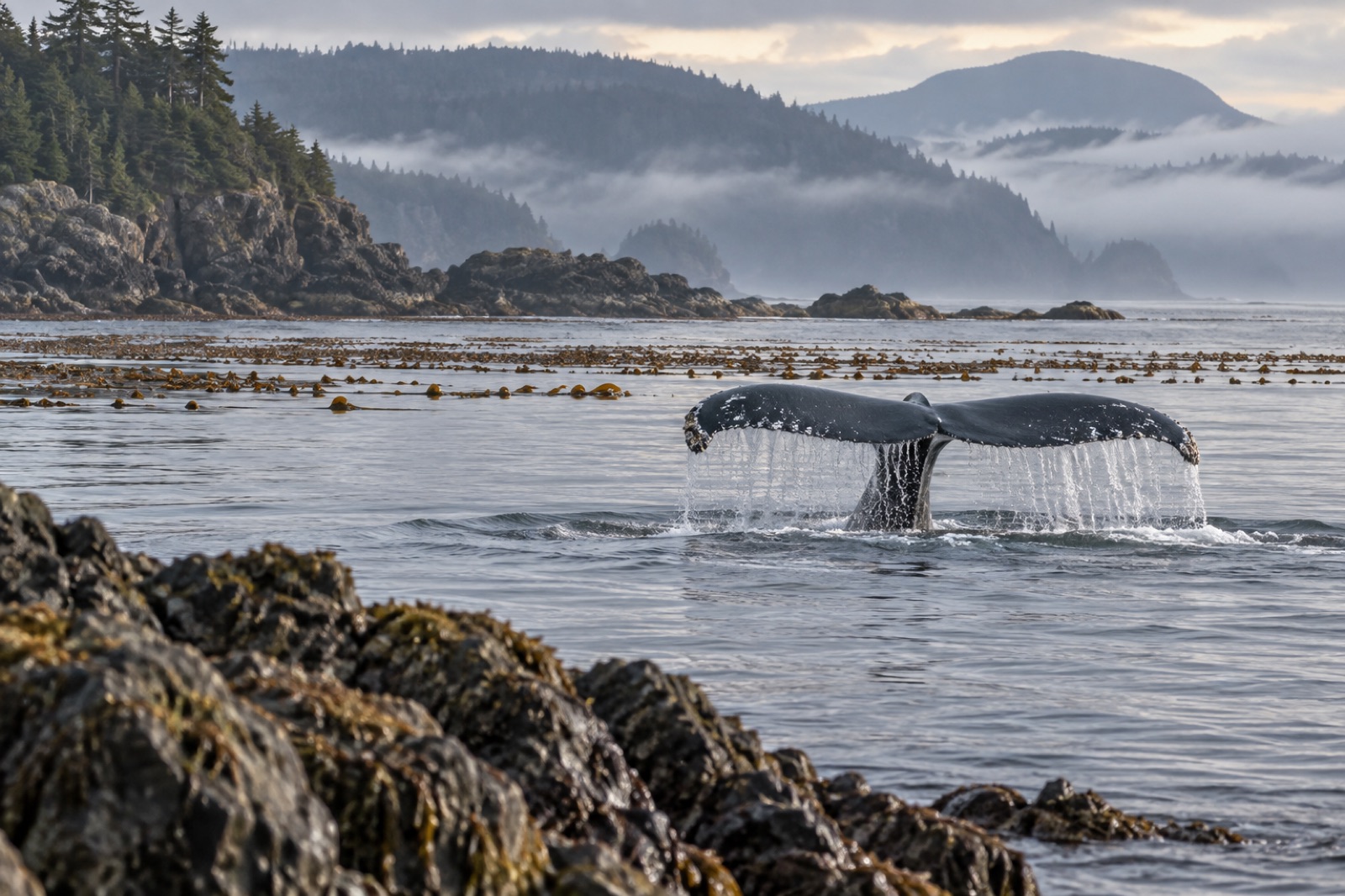
Where and when to watch whales along the world's kelp coasts, how to read blows and behaviour, and the ethics that keep whales calm and watchers welcome.
Tom Okafor ·