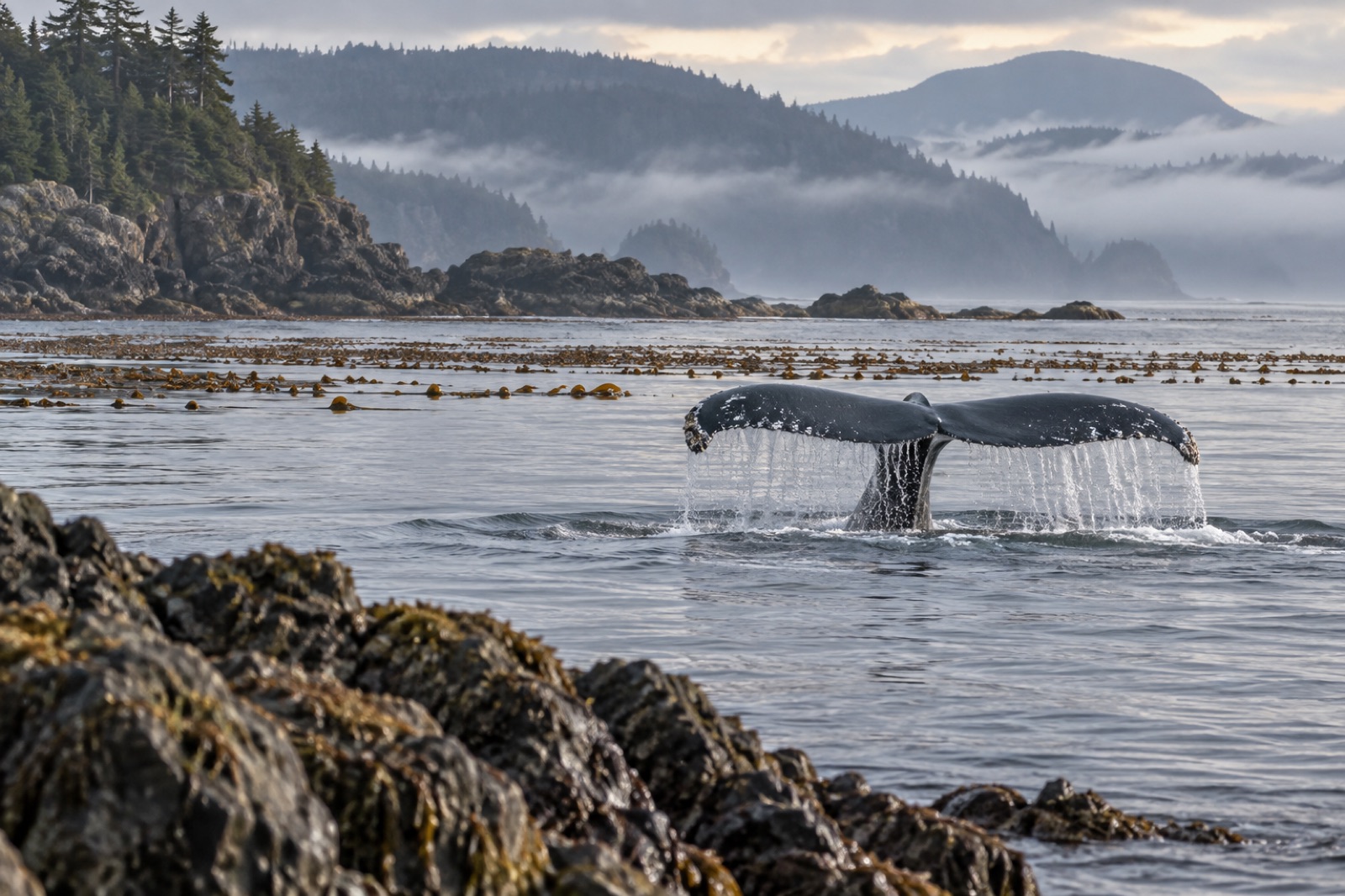
Kelp coasts and whales go together more often than most travel writing admits. The same cold, nutrient-rich, upwelling-fed water that grows kelp forests grows dense food — krill, schooling fish, squid — and dense food is what whales cross oceans for. The result: many of the world's great kelp-shore destinations, from Monterey Bay to the Head of Bight to the Otago Peninsula, double as genuinely world-class whale-watching venues, often with the whales visible from dry land.
This guide covers what to look for, when to go, and how to watch without making the whales pay for your afternoon.
Why kelp coasts concentrate whales
Two oceanographic habits make kelp and whales overlap:
- Upwelling. Cold, nutrient-rich water pushed to the surface drives plankton blooms that feed fish and krill — and, downstream, the kelp. The mechanics of upwelling are the same whether you are a giant-kelp stipe or a humpback mother teaching a calf to feed.
- Edge habitat. Kelp grows at the landward edge of continental shelves, and shelf edges are migration corridors. A gray whale moving 10,000 km between Baja and the Arctic doesn't swim a random line; it follows the productive, shallow, landmark-rich shelf — which, in the mid-latitudes, means the kelp line.
That is why dedicated watch sites look the way they do: a headland, a kelp bed below it, and a seaward horizon full of water that has recently been stirred by wind and current into food.
The species you're most likely to see
Gray whales: the kelp-coast regulars
No whale is more associated with kelp coastlines than the gray. Their coastal migration is the longest of any mammal on Earth, and parts of it — famously off California, Oregon and Vancouver Island — run directly along the bull-kelp fringe. Mothers with calves detour into kelp beds, apparently to raft up and rest out of the current; from shore you can often pick them out by their mottled backs and the small, heart-shaped blows. The full relationship is remarkable enough to deserve its own reading: gray whales and kelp forests.
Humpbacks: the show-stoppers
Humpbacks work upwelling-fed bait balls, which means late summer and autumn on many kelp coasts is humpback season. They are the acrobats — full breaches, pec-slaps, lunge-feeding that can put a whale's head above the surface beside a kelp-bed point. A feeding aggregation visible from shore is among the great free sights in natural history.
Southern right whales: the kelp players
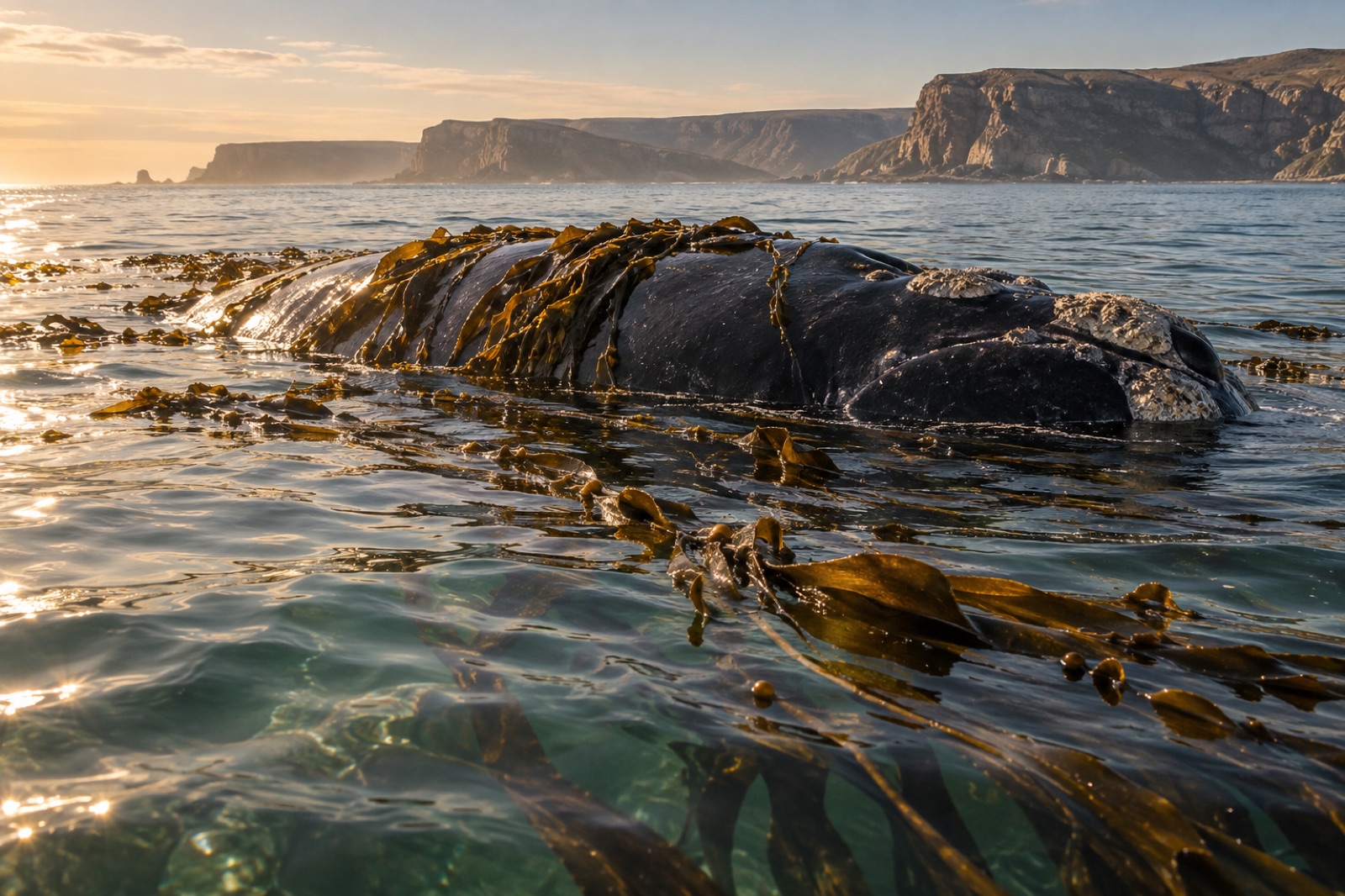
In the Southern Hemisphere winter and spring, southern right whales come astonishingly close — sometimes within body-lengths of the kelp line — and play with kelp itself, draping fronds across their backs in a behaviour (kelping) that researchers still don't fully understand. Head of Bight in South Australia, Península Valdés in Argentina and the New Zealand subantarctic-facing coasts are the classic venues.
The supporting cast
Kelp-coast watchers should also learn the small cetaceans: Dall's porpoise rooster-tailing through inside passages, harbour porpoises rolling quietly in kelp bays, and pod-visiting orcas in salient hotspots (the salmon-eating residents and mammal-hunting transients that work Pacific kelp coasts are reliably present in season).
Reading the water: a field technique
Good watchers don't scan randomly; they work a pattern.
- Find the food first. Look for diving birds — gannets, shearwaters, pelicans hitting the water. Australasian gannets plunge-diving in numbers means bait is balled at the surface, and bait at the surface means whales may be under it.
- Scan the disturbance. White water, an oily "footprint" slick in a calm sea, or a circle of seabirds sitting low all mark recent whale activity.
- Then look for the blow. Body warmth condenses in cool air, making blows most visible in the cool of morning, backlight or strong side-light. Learn signatures: humpback blows are tall columns, gray blows heart-shaped, right whales a distinctive V, orcas the angled bushy puff of a much bigger animal moving fast.
- Watch the pattern, not the event. A feeding humpback works an area; a transiting gray whale moves in a rhythm — three to five shallow blows, then a deeper dive of three to five minutes. Once you tune to the rhythm, you can predict where the next blow will be, 200–400 metres along the line of travel.
Binoculars at 8× or 10× are the sweet spot for whale watching; more magnification magnifies hand-shake more than whales.
Where and when: a hemisphere-aware calendar
Exact timing shifts year to year with prey and water temperature, but the repeating pattern:
- Northern Pacific coasts (California to Alaska): southbound grays December–February, northbound including mothers and calves February–May, humpbacks feeding June–November. Monterey Bay manages whales in almost every month.
- Southern Australia and New Zealand: southern right whales shore-close June–October, humpbacks on northern and southern legs May–November, blue whales at known upwelling bonanzas in summer.
- Southern South America: right whales at Península Valdés June–December, orcas in the famous intentional-stranding season around autumn.
- North Atlantic kelp coasts: humpbacks and minkes in summer around the Gulf of Maine and Norway's herring runs; Iceland's kelp-fringed fjords add feeding humpbacks nearly year-round. Scotland's Moray Firth is famous for resident bottlenose dolphins rather than baleen whales — proof that "kelp coast" and "whale coast" are cousins, not clones.
Ethics: watching without cost
Whales pay real energetic costs for our attention. A calf separated briefly from its mother by a boat, or a feeding whale displaced from a bait ball, burns calories that matter across a migration. The widely adopted minimums, which good operators exceed:
- Distance: at least 100 metres from most whales, 300 metres from mothers with calves, from boats. From shore, no legal minimum — but keep the same spirit: don't descend cliffs or fly drones low over whales.
- Approach: from the side-rear quadrant, never cutting across a whale's course; idle or drift when close. Kelp-line whales resting in canopy rafts are especially easy to disturb, because they are there precisely to rest.
- Time: cap close encounters at about 30 minutes and fewer than three vessels at a time.
- Shore etiquette: stay on formed paths (cliff-top vegetation is as fragile as the kelp below), keep dogs leashed, and never let a drone closer than regulations allow — most jurisdictions now treat drones near whales as aircraft near whales.
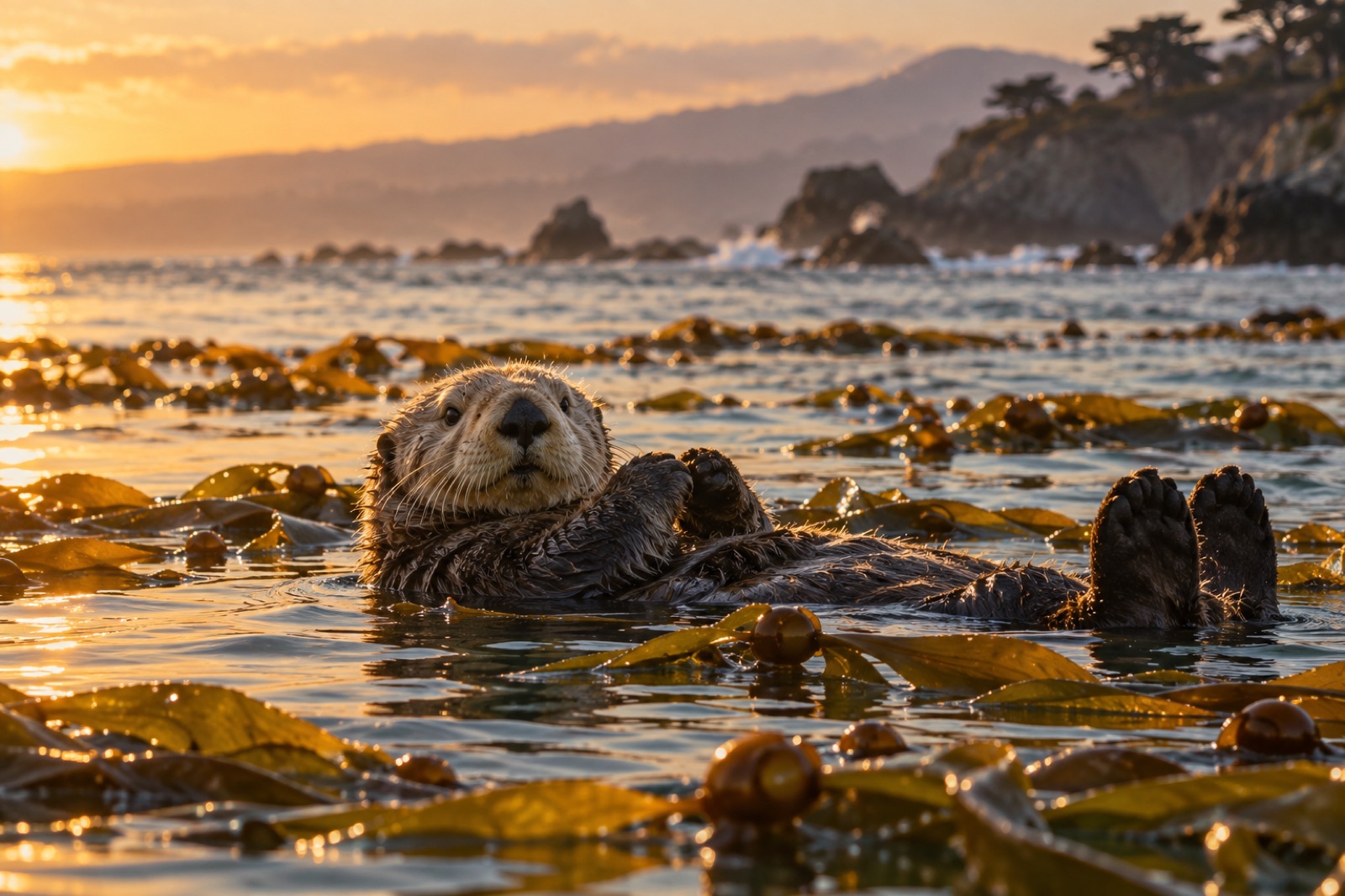
These are the same principles as responsible sea otter watching: watch, don't touch the moment.
Making the count: from visitor to contributor
Platforms such as community sighting apps and regional whale-census days turn an afternoon's watching into distribution data that scientists genuinely use. Combined snapshots — a weekend census — track returning populations over years. If your coast has one, join it; if not, log your sightings with time, location, species confidence and direction of travel to whatever national database applies.
The data matters more than ever. Kelp coasts are warming, prey distributions are shifting, and whale feeding grounds are visibly moving with them. Tidewright's restoration projects — visible on the global projects map — track how recovering kelp forests reseed the whole coastal food web the whales draw on, and Canopy Ledger monitoring layers canopies, temperatures and survey data into the same picture citizen sighting logs complement beautifully.
Key takeaways
- Kelp coasts are whale coasts because upwelling feeds both — look for the food (birds, bait, slick lines) and the whales will follow.
- Learn blow shapes and dive rhythms; pattern-reading beats scanning.
- Calendars are hemisphere-flipped: northern Pacific grays and humpbacks in winter-to-autumn, southern right whales shore-close in austral winter and spring.
- Keep distance minimums religiously, cap encounter time, and treat resting kelp-raft whales with extra care.
- Log what you see — organised citizen sightings are real data for tracking feeding-ground shifts on a warming coast.
FAQ
What is the best time of day for shore-based whale watching?
Early morning usually offers the calmest water, lowest glare and the most visible blows (warm breath condensing in cool air). That said, feeding aggregations can build all day, so bird activity beats clock-time as an indicator.
Do I need a boat, or can I really see whales from land?
From many kelp coasts, land is better. Deep-water canyons at Monterey, cliff platforms at Head of Bight, and headlands across Oregon all put whales within binocular range — sometimes within metres. Shore also means zero disturbance and no seasickness.
What does a whale "blow" look like?
A brief cloud of condensed water vapour and atomised seawater rising a few metres, lasting a second or two. Learn shape and timing: humpback tall-and-columnar, gray heart-shaped, southern right V-shaped, orca bushy-and-angled.
Is it safe to kayak near whales?
Only at legal distances and only with discipline — never paddle toward bait balls or put yourself between a mother and calf. Some jurisdictions prohibit approaching within 300 m in any vessel, including kayaks. Kelp-raft resting whales should be given the widest berth of all.
Can drones be used for whale photography?
In most countries, explicitly restricted. Drone minimum altitudes over whales are commonly 300 metres or more, where not banned outright. Assume it's prohibited until you have read the local rule; the harassment and noise concerns are well documented.