There is no gentle way to arrive at the Head of Bight. You cross hundreds of kilometres of Nullarbor limestone — a plain so flat the railway runs ruler-straight for nearly five hundred of them — and then the continent simply stops. The Bunda Cliffs drop away, in places as much as ninety metres, into the Southern Ocean. And between May and October, in the broad sweep of water below, southern right whales float at the surface with their calves like dark barges, so close to the cliffs you can hear them breathe.
It is one of the great wildlife spectacles of the Southern Hemisphere, and one of the strangest: a whale nursery at the foot of a desert.
Getting your bearings
Head of Bight sits at the northern apex of the Great Australian Bight, on the far west coast of South Australia. The whale watching area lies on Aboriginal land managed by the local Far West Coast community — entry permits are arranged at the signposted turn-off from the Eyre Highway, east of the Nullarbor Roadhouse. A boardwalk and viewing platforms step down toward the cliff edge; no boating, no drones without authorisation, no access to the water.
The season runs roughly May to October, with mothers and calves commonly visible through the winter months and numbers often peaking around midwinter. The whales come in astonishingly close — the nursery ground lies directly off the cliffs, and on still days the soundscape is blows, tail slaps and the low contact calls between cows and calves.
Why the whales choose a desert coast
The Bight's southern right whales were hunted to the edge of oblivion in the nineteenth century; the population has been rebuilding for decades, and Head of Bight is among its most important maternity sites in Australia. The habitat logic is simple: sheltered-ish, shallow, warm-enough water near the coast for newborn calves, with deep Southern Ocean feeding grounds elsewhere in the year. The desert above is irrelevant to them — what matters is the quiet sea below.
Long-term photo-identification work here — researchers learn to recognise whales by the unique patterns of callosities on their heads — has followed generations of mothers returning to calve, building one of the most valuable right whale datasets in the world. Watching a cow nurse beneath a cliff while a researcher calls out an ID across the platform is as close as most of us come to field conservation at work.
Two ecosystems, one horizon
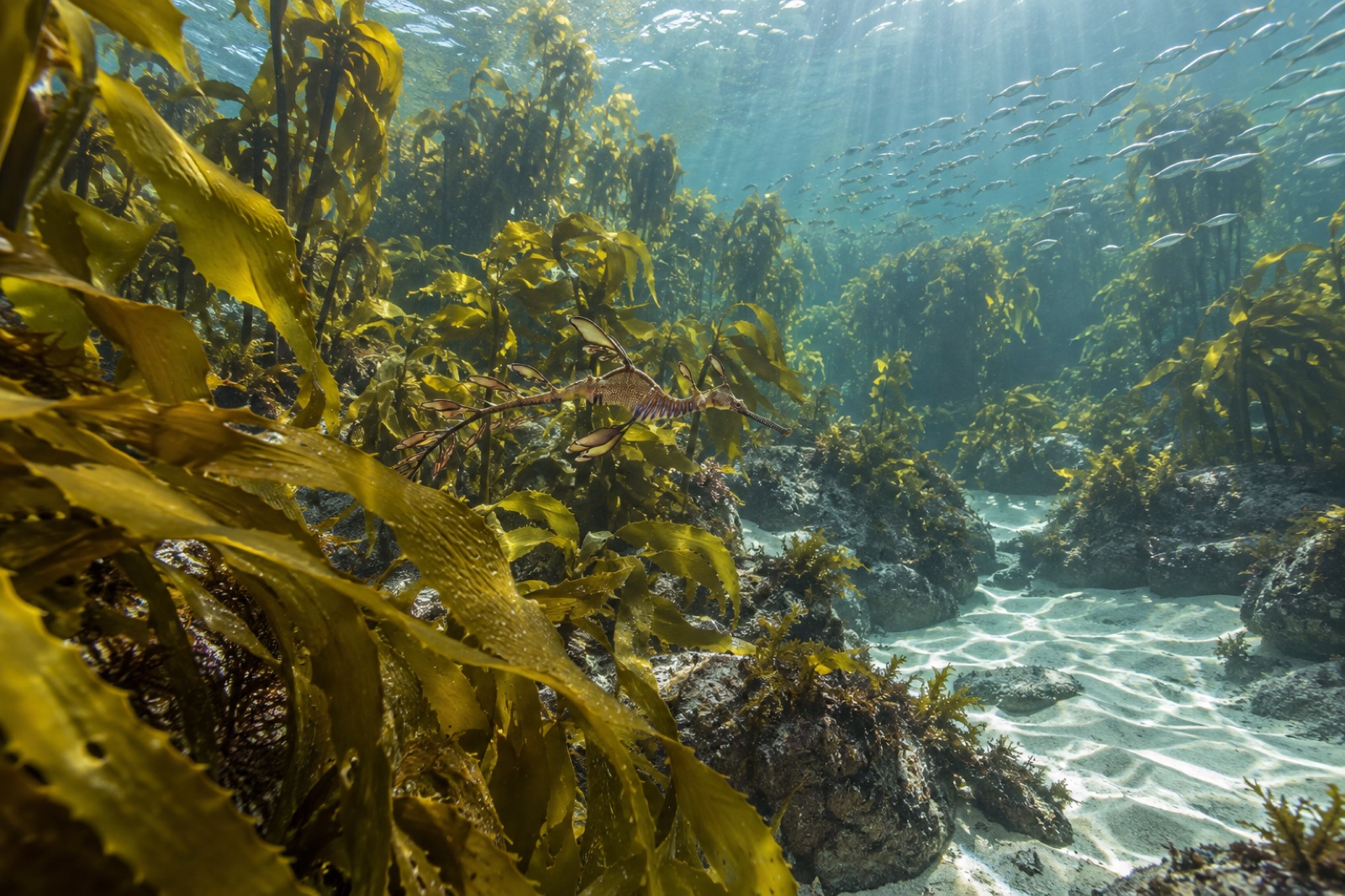
The other reason this coast matters is less visible. The cliffs and whale flats are the northern lip of an enormous temperate reef system. Below the waterline, the Great Southern Reef wraps the entire southern arc of the continent — including stretches of the Bight — in forests of golden kelp (Ecklonia radiata) and their attendant worlds of blue groper, cuttlefish, lobster and seadragons.
The Bight section of the reef is among the least visited and least studied, precisely because it is so hard to reach. Upwellings and Southern Ocean nutrients keep the water productive; the same productivity that fattens kelp fronds supports the food web that the next link up — squid, fish, seabirds, and beyond the shelf edge, the great whales.
Australian sea lions haul out on islands and points along this coastline, and the wider marine park system protects significant areas of the Bight. To the east, the kelp forests continue into the rough, famous water of Bass Strait; to the west they meet some of the most remote temperate reef on Earth.
- Southern right whales in season, often with calves, and sometimes astonishingly close to the cliff base. Bring binoculars, though often you won't strictly need them.
- Australasian gannets and sea eagles quarter the cliffline updrafts; keep an eye seaward for albatross in strong westerlies.
- The sea itself. The colour gradients over the shallow nursery ground — pale turquoise bars against deep indigo — are worth the drive alone.
- Nothing at all, some days. Right whales are wild animals on a wild coast; weather and whales vary. The surest season is deep winter; wind and whitecaps make spotting harder.
Planning the visit
The Head of Bight experience rewards slow travellers. The viewing platforms are accessible and well-built; the wind off the Southern Ocean is not a rumour — pack a proper jacket even in shoulder season, and more water and food than you think you need, because the nearest services are measured in hours, not minutes. Fuel up at Nullarbor or Border Village. Mobile coverage is patchy to non-existent.
Many travellers pair Head of Bight with the full Nullarbor crossing — one of the world's great road trips — and with the whale-and-sealion country of the Eyre Peninsula further east. It also pairs naturally, in reading if not in the same trip, with Australia's other great scenic whale coasts chronicled across our atlas.
Why this coast matters to restoration
At Tidewright we think about the Bight as the reef system's quiet giant: enormous, intact, and dramatically under-monitored. Our fictional mapping work here — running Canopy Ledger satellite and drone canopy surveys along the South Australian shelf — treats the Bight as the reference condition for what a functioning southern reef looks like. When we talk about restoring kelp forests in damaged waters further east, coasts like this one are the picture we're restoring toward.
Key takeaways
- Head of Bight, on the Nullarbor's seaward edge in South Australia, is one of the world's great southern right whale nurseries, with the season running May–October.
- Viewing is from community-managed cliff boardwalks on Aboriginal land; permits at the highway turn-off.
- The same coast is the northern edge of the Great Southern Reef — remote, intact temperate kelp forest.
- Treat it as an expedition: self-sufficient travel, serious weather, big distances.
- Photos don't do it justice. Go anyway.
FAQ
Can you swim or dive with the whales at Head of Bight?
No — and you shouldn't want to from here. Viewing is entirely land-based: the whole point of the nursery is that it stays quiet. Boat-based and swim-with whale experiences exist in other parts of Australia under their own licence systems, but Head of Bight's magic is precisely its stillness.
How many whales will I see?
That varies by day, season and luck. On a good midwinter day, platforms overlook multiple mother-calf pairs; numbers across the broader Bight nursery in good seasons have been counted in the dozens. Early and late season are quieter. Local rangers give the best current read.
Is the drive suitable for a standard car?
Yes — the Eyre Highway and the Head of Bight access are sealed or well-maintained. The demands are distance and fuel planning, not four-wheel-drive capability. Confirm current entry arrangements with the managing community before travelling.
Where does this fit in a bigger South Australia trip?
Naturally paired with the Nullarbor crossing, the Eyre Peninsula's seafood and sea lion coast, and — for the reef-minded — onward travel to the kelp forests and seadragons of Kangaroo Island.