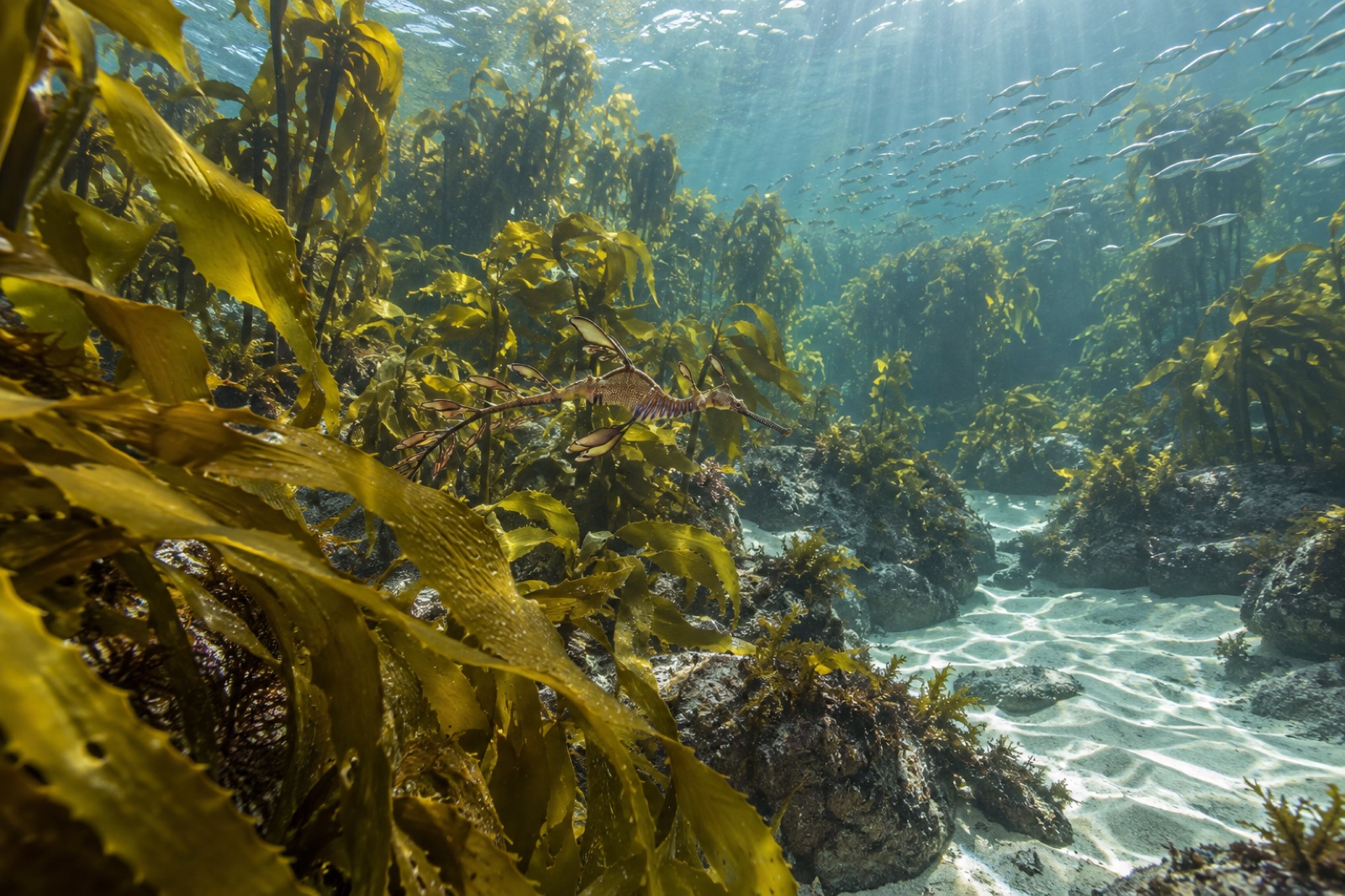
Roll a marble across a map of South Australia and it will fall into one of two great gulfs west of Adelaide: Spencer Gulf to the west of Yorke Peninsula, and Gulf St Vincent between Yorke and the Fleurieu. It is the second of these that Adelaide lives on — a shallow, warm, slow-flushing sea crossed daily by two million people's dinner plates and stormwater, holding more seagrass than almost any other temperate coast in Australia and, along its rocky southern reefs, kelp forests as accessible as any on Earth. This guide covers what grows where, what the city nearly cost its gulf, and why this bay of golden kelp and little dragons matters far beyond its still surface.
A gulf that works like a pond
Gulf St Vincent is shallow — much of it under thirty metres, nothing in it much deeper than forty — narrow at its mouth and broad toward the top, with Adelaide's plain pressing in from the east. Three facts follow from that shape, and they explain almost everything in this guide.
First, it warms. The shallow northern gulf can push past 25°C in a calm summer — bathwater by the standards of the open Southern Ocean outside. Second, it evaporates. With barely any river inflow and long hot summers, the northern gulf's water ends up saltier than the ocean that feeds it — oceanographers call a basin like this an inverse estuary, where density runs backwards from the usual pattern. Third, it turns over slowly. Flushing is sluggish and circulation is weak except where wind moves the shallow water, which means what enters the gulf — nutrients, sediment, heat — tends to stay.
Kelp notices all three things. The deeper, cooler, faster-flushed south holds the kelp forests; the warm shallow north holds the seagrass meadows — and the boundary between those two communities is one of the cleanest natural demonstrations on this coast of the distinction our explainer on kelp versus seagrass draws: two neighbours, one water, very different architectures.
The kelp: golden forests on the rocky south
The subtidal kelp of this gulf is golden kelp (Ecklonia radiata) — the dominant forest-former of the entire Great Southern Reef. It tops out around a metre tall: a rough central stipe with a flattened, hand-like blade, growing dense on rocky reefs in the clearer water. Its forests mark the gulf's rocky margins like a dotted line along its southern half.
The stand of reefs at Aldinga and Port Noarlunga, directly off Adelaide's southern beaches, is the signature kelp ground — the reef flat running off Port Noarlunga runs kelp in snorkelling depth, minutes from the city. Around the corner of the Fleurieu Peninsula, Rapid Bay reef and its storied old jetty hold forest with some of the most reliable leafy seadragon sightings in Australia. Across the gulf, the Yorke Peninsula's rocky southern and eastern shores — rough, wind-torn, salmon-coloured granite and limestone — carry Ecklonia forests in near-oceanic water because the peninsula screens the gulf's warm surface layer from the swell and upwelling-fingered currents outside.
Under the kelp, the gulf's endemic reef fish run the tables. The southern blue devil — an unhurried, electric-lined rockfish found essentially nowhere else — patrols the ledges. Sweep and old-wife hover at the edges, leatherjackets graze the algal turf, and in the sand channels the gulf's famous King George whiting work the seagrass edge that the kelp forest meets.
The seagrass: the size of the other half of the story
Any honest gulf guide switches attention to the seagrass beds, because they dwarf everything else. Posidonia (strapweed and ribbonweed) and Amphibolis (wire weed) meadows once carpeted the shallows across most of the gulf: long-stemmed, slow-growing, shallow-water grassland that filters sediment, locks down the seabed, feeds juvenile fish, and underwrites practically every other habitat in this system.
Adelaide's growth came at their direct expense. Through the mid-twentieth century the city discharged treated sewage and stormwater into the gulf's northeastern corner, and the nutrient load forced the seagrass into retreat across thousands of hectares of the metropolitan coast: the grass died back, the sediment mobilised, the water clouded, and the bare patches ran together. The clean-up, led by upgrading wastewater treatment and redirecting discharges from the 1990s onward, is one of Australia's great unheralded marine recovery stories — the loss stabilised, the surviving beds began expanding in places, and water clarity along the city coast dramatically improved. It is the long, unglamorous model of how eutrophication gets stopped: treat the land input, and the sea begins to remember itself. Our explainer on coastal eutrophication walks through the same mechanism from the science side.
The dragons, the dolphins, the neighbours
Gulf St Vincent packs more endemism into its little basin than seems fair. The leafy seadragon — perhaps the most ornate fish on Earth, and a South Australian near-exclusive — is a regular on the gulf's jetties and kelp edges. Bottlenose dolphins are year-round residents, with the Port River estuary population weaving between ships and mangrove channels as if urbanisation were a mild inconvenience. Australian sea lions haul out around the gulf's islands and the Fleurieu coast; school sharks breed in its shallow nurseries; the little penguin colony at nearby Granite Island reminds you what lives within walking distance of the city.
And west of Yorke Peninsula, the gulf's near-twin — Spencer Gulf — hosts the world's only mass spawning aggregation of giant Australian cuttlefish each winter, just across the strait: the reminder that South Australia's two gulfs are effectively one coastline seen from two angles.
For the full sweep of this coastline, cross Backstairs Passage to Kangaroo Island — deeper water, sharper swell, and the western continuation of the same reef system.
What the city is doing — and what still needs doing
The gulf's modern narrative is that of a system where the worst direct pressure was recognised and reduced, but the slow pressures continue. The wastewater upgrades worked, but Adelaide's coast still carries urban stormwater, coastal development and boat traffic; a desalination plant south of the city injects brine into a sea that barely flushes; dredging and aquaculture north of the gulf add their signatures; and underlying all of it, Southern Ocean waters are warming, pushing Ecklonia's comfortable temperature band south year by year.
Two efforts deserve mention. The state monitors the gulf's seagrass recovery as a long-running flagship program — the water quality grades along the metropolitan coast are now published like weather. And local groups, from the seadragon-watching volunteers at Rapid Bay to the community reef-restoration projects entering the seagrass beds, fill the gap between policy and practice. This is what city-scale marine stewardship looks like when somebody's dinner table — the whiting, the squid, the greenlip and blacklip abalone of the working coast — depends on it.
Diving and snorkelling the gulf
This is perhaps Australia's easiest kelp coast to access, and one of the most instructive.
Port Noarlunga reef is the benchmark shore snorkel: walk the jetty at low swell, drop into three-to-six-metre Ecklonia forest, and find whiting, old wife and the occasional seadragon within a kick of the platform. Rapid Bay Jetty, seventy kilometres south on the Fleurieu, is the seadragon pilgrimage — pylons furred with growth, kelp drifting around the lower structure, and leafy seadragons on the sand-and-seagrass edge nearby. Edithburgh Jetty on the Yorke side runs the same training ground soft-coral and dragon combination on the gulf's opposite shore. Water runs from roughly 13°C in winter to 22°C or warmer in a settled summer. Wind rules everything: an onshore breeze dumps the visibility in the shallows within hours. For first-timers in kelp, our guides to Kangaroo Island and the wider Great Southern Reef continue the coast in both directions.
Key takeaways
- Gulf St Vincent is shallow, warm, poorly flushed and saltier at its head than the open sea — an inverse estuary whose shape dictates where kelp can and cannot grow.
- Golden kelp (Ecklonia radiata) forests line the rocky south — Port Noarlunga, Aldinga, Rapid Bay, Yorke Peninsula's coast — while the north belongs to vast Posidonia seagrass meadows.
- Adelaide's mid-century nutrient discharges killed thousands of hectares of seagrass; the wastewater upgrades since the 1990s are one of Australia's best under-reported marine comebacks.
- The gulf is full of near-endemic life: leafy seadragons, southern blue devils, resident bottlenose dolphins — wilderness quality within sight of a capital city.
- Remaining pressures — warming, stormwater, brine, dredging — are slow-moving, which makes the gulf a live test of whether early clean-up can outpace climate.
FAQ
Is there kelp around Adelaide?
Yes — golden kelp (Ecklonia radiata) forests grow on rocky reefs across the southern half of Gulf St Vincent. The easiest introduction is snorkelling the reef flat off Port Noarlunga jetty, minutes from the city, or drifting the pylons at Rapid Bay.
What is an inverse estuary?
A coastal basin where evaporation exceeds freshwater inflow, so the innermost water ends up saltier than the open ocean. Northern Gulf St Vincent in summer is a classic: warm, saltier, denser water pools in the shallows while denser oceanic water sits outside the mouth.
Is Adelaide's coast polluted?
Less than it was, and in measurable ways. Discharge upgrades from the 1990s onwards sharply cut nutrient loads, seagrass loss stabilised, and water clarity on the metropolitan coast improved enough that seagrass recovery is now publicly monitored. Stormwater, warming and brine remain live issues.
Where can I see a leafy seadragon?
Rapid Bay Jetty on the Fleurieu Peninsula is the famous site, with Edithburgh Jetty on the Yorke side a close second; both carry regular sightings in kelp-edge habitat within finning distance of the stairs.
Why is there more seagrass than kelp in the gulf?
Light and temperature. Much of the gulf is warm and shallow, favouring seagrass meadows over kelp; kelp needs clear, cooler water and hard rock, which cluster in the southern half where the swell and deeper channel set the conditions.