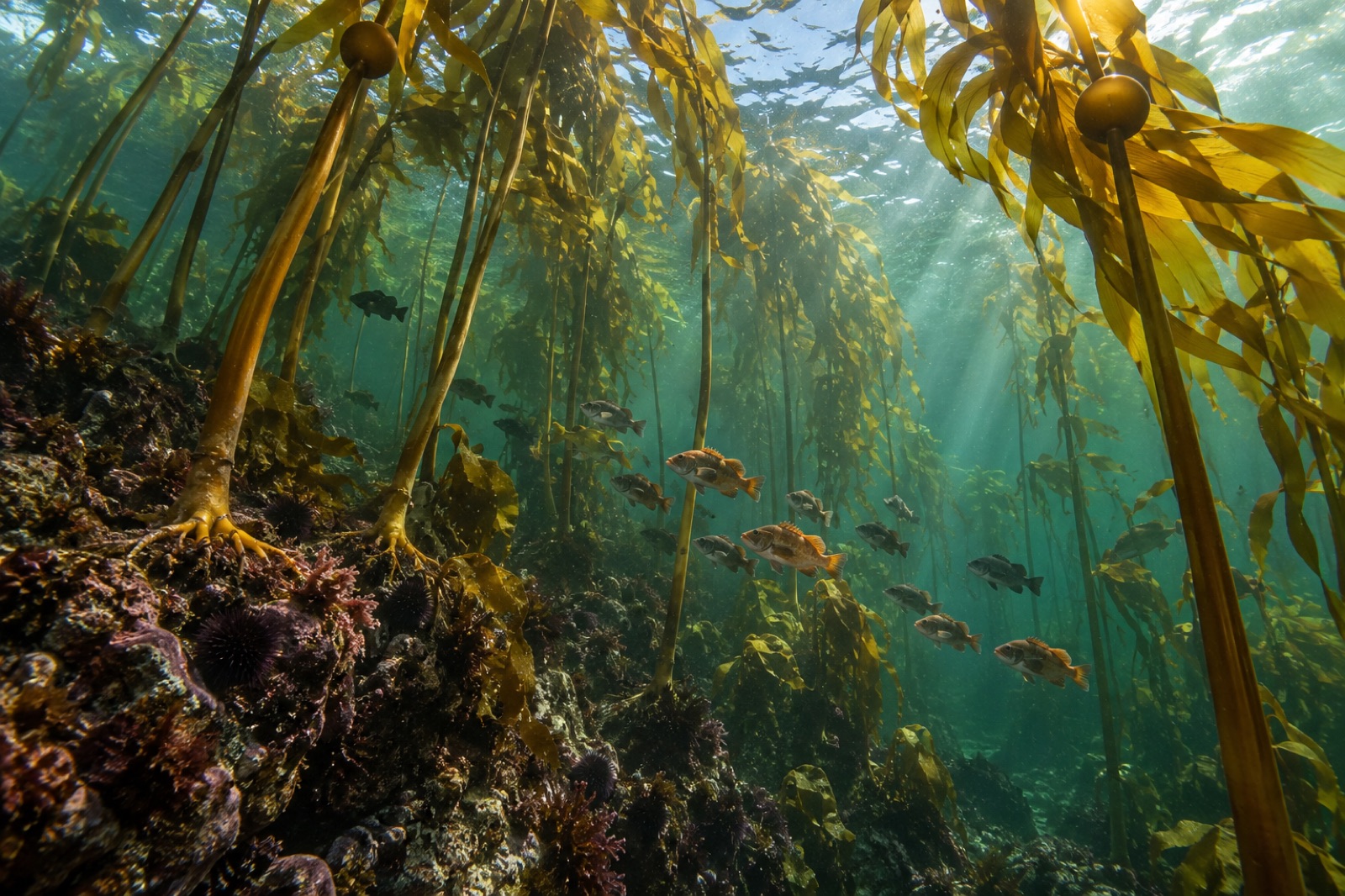
Golden kelp (Ecklonia radiata) is the great unsung habitat-maker of the Southern Hemisphere — a golden-amber kelp that canopies tens of thousands of rocky reefs from Western Australia around to southern Queensland, across Tasmania and throughout New Zealand. If you have ever dived south of Perth, east of Adelaide or off Sydney's headlands, the kelp flickering overhead was almost certainly golden kelp. It feeds lobsters and abalone food webs, wraps weedy seadragons in camouflage, and — as oceans warm — is quietly redrawing the map of temperate Australian seas.
Quick facts
- Scientific name: Ecklonia radiata
- Common names: golden kelp, common kelp
- Group: brown alga, order Laminariales
- Range: temperate Southern Hemisphere — southern Australia (nearly 8,000 km of coast), Tasmania and New Zealand, with recorded populations farther afield; taxonomy under active study
- Size: plants commonly 0.5–1.5 m tall; large individuals approach 2 m
- Depth: shallow subtidal to more than 25 m where water is clear
- Lifespan: perennial; individuals can live several years
- Role: the dominant kelp of the Great Southern Reef, foundation of immense understorey biodiversity
How to identify golden kelp
Golden kelp is one of the most distinctive kelps in the water. Each plant rises from a tough, conical holdfast via a single sturdy stipe, topped by one broad blade that nature splits into elegant finger-like straps. Seen mid-water, a mature plant looks like a many-fingered hand held up to the light — hence radiata, radiating. Older plants develop small spinose outgrowths around the top of the stipe, giving it a rough, prickly texture that divers learn to respect with bare hands.
The colour gives the species its common name: a rich golden to amber brown, warmer in tone than the dark olive of oarweed or the greenish cast of many northern kelps. In a midday sun the whole canopy takes on a honeyed glow. For contrast, North America's bull kelp is a single whip with a float; golden kelp is a branched-looking hand rising straight from the reef.
The backbone of the Great Southern Reef
Marine scientists gave Australia's temperate kelp coast a name only in 2016: the Great Southern Reef, a connected temperate reef system stretching some 8,000 kilometres across five southern states. Its dominant plants are kelps, and over much of that coast — outside the giant kelp strongholds of Tasmania — the engineer is golden kelp.
Like all foundation species, Ecklonia radiata punches far above its weight:
- Architecture. The canopy shades the rock, while each conical holdfast becomes a micro-reef of sponges, bryozoans, worms and crustaceans.
- Food webs. Drift fronds feed abalone and sea urchins; the understory harbours commercially important fish and the famed southern rock lobster.
- Endemics. The Great Southern Reef is a global hot-spot of found-nowhere-else species — weedy seadragons drifting through golden kelp are a signature sight. Many of those species occur in no tropical sea on Earth.
That is why the Coastal Atlas treats Ecklonia beds as flagship habitats across southern Australia, and why Tidewright maps them as priority reefs in its regional planning with coastal councils.
A life built to persist
Unlike annual bull kelp, golden kelp is perennial. The plant you dive under in March is likely the same one you photographed in October, and perhaps the same one two years running. Its life cycle follows the kelp norm — a large sporophyte alternating with a microscopic gametophyte — but with a twist that matters for resilience: microscopic stages and young recruits can persist inconspicuously on the reef, ready to surge upward when a storm or grazing pause opens space.
Spore production peaks in the cooler months for many populations, and juveniles race upward through winter to claim a place in the canopy. Divers below the canopy will notice a species-rich understory — delicate red seaweeds, sheet-like pink coralline algae — that only thrives in the golden kelp's filtered light. Remove the canopy and the understorey changes character within a season.
A climate story in two directions
Golden kelp tells the ocean-warming story from both sides of a range edge.
The retreating edge: Western Australia
In the summer of 2011 an extreme marine heatwave off Western Australia — now famous as the "Ningaloo Niño" — pushed water temperatures far beyond kelp tolerance across hundreds of kilometres of coast. Kelp forests at the northern end of the range, near Kalbarri, collapsed, and the ecosystem along that coast shifted toward tropical seaweeds and herbivorous fishes. Research teams have since documented a range contraction at the warm edge of roughly a hundred kilometres or more, with tropicalisation — the arrival of tropical grazers — slowing any recovery.
The advancing edge: Tasmania and the southeast
Meanwhile, in Tasmania and the warming southeast, golden kelp appears to be faring better than the region's heat-sensitive giant kelp. Where giant kelp forests have thinned under decades of warm-water incursions and expanding range of the long-spined sea urchin, golden kelp — more warmth-tolerant — has in places become the dominant canopy former, a bittersweet relay of one climate loser by a relative winner.
The net effect, documented across studies, is a foundation species on the move: contraction in the northwest, persistence — even expansion — in the southeast. Monitoring that continental shuffle is exactly the kind of work satellite and drone canopy mapping was built for, the philosophy behind Canopy Ledger, Tidewright's monitoring platform.
Golden kelp and people
Golden kelp is less famous as a food than its northern cousins, but it has supported people for millennia: its forests are ancestral fishing grounds for Aboriginal and Māori communities, and today they underpin abalone, rock lobster and finfish industries across southern Australia and New Zealand. Kelp products — fertilisers, biostimulants, foods — are increasingly made from Ecklonia biomass, though commercial harvest remains modest and tightly managed against ecological value.
For divers, a golden kelp bed is one of the most accessible big-ecosystem experiences in the world: shallow reefs, cathedral light, swaying amber hands, and — if you are lucky — seadragons, endemic wobbegong sharks and huge schools of old wives and sweep. For restoration teams, the species' perennial nature means outplants must be protected through vulnerable early months; our project pages at /projects share how boroughs and rangers are co-designing that work.
Key takeaways
- Golden kelp (Ecklonia radiata) is the dominant kelp of Australia's Great Southern Reef and New Zealand — a 0.5–2 m perennial with a split, fingered golden blade.
- Each plant's conical holdfast is a miniature reef; the canopy supports one of the most endemic-rich temperate faunas on Earth.
- A 2011 heatwave contracted the species' warm-edge range in Western Australia, while warming has allowed it to assume a larger role in Tasmania.
- As a perennial, it is more storm- and heat-durable than annual kelps, but slow to recolonise reefs where it has been fully lost.
- Its forests underpin abalone, lobster and finfish fisheries — making loss of golden kelp an economic as well as ecological emergency.
FAQ
Is golden kelp the same as giant kelp?
No. Giant kelp (Macrocystis pyrifera) can reach 30 m with many fronds and floats; golden kelp tops out around 2 m with a single split blade. In Tasmania they can share a reef, with golden kelp forming the lower, hardier canopy.
Where can I see golden kelp?
Almost any rocky, reef-fringed coast in southern Australia and New Zealand, from shallow snorkelling depths to 25 m. Sydney's kelp beds, Tasmania's east coast and South Australia's gulfs are classic haunts — see our region entries in the Coastal Atlas.
Why is it called golden kelp?
For its warm amber-brown colour, which glows golden in sunlight — quite unlike the darker olives of many northern-hemisphere kelps.
Can you eat golden kelp?
It is technically edible and is being explored as a sea vegetable and biostimulant source, but it is not a mainstream culinary kelp like sugar kelp or kombu. Any harvest should follow local regulations.
Is golden kelp threatened?
Locally, yes: its northern range edge has collapsed and tropicalisation may prevent return. Range-wide it persists, but maps are changing fast — which is why long-term monitoring matters more each year.