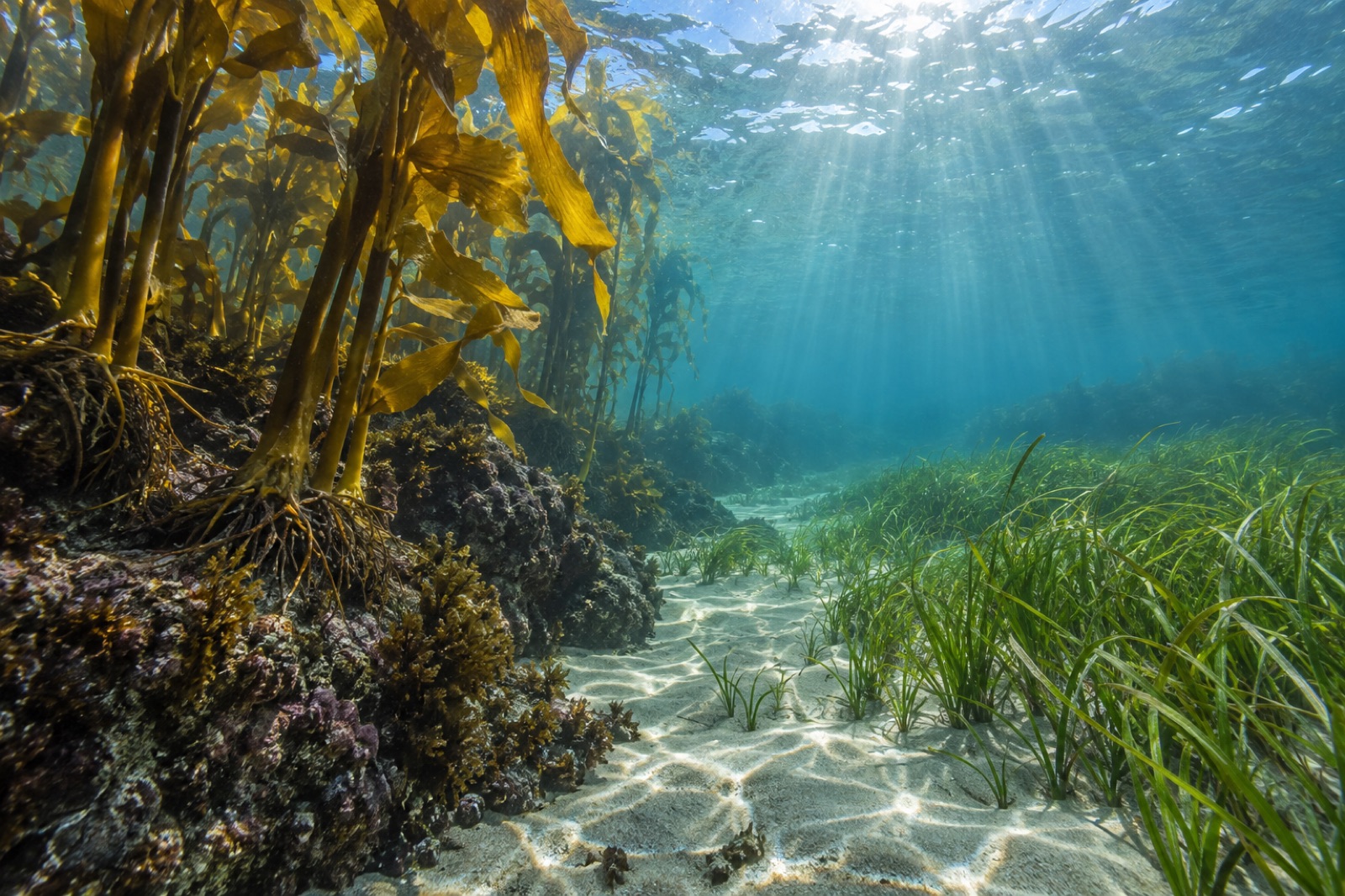
Ask a diver to describe a kelp forest and they'll say forest — columns of amber climbing toward light. Ask them to describe a seagrass meadow and they'll say meadow — low green turf swaying over sand. Both words are land metaphors, and both habitats earn them: they are the ocean's two great underwater grasslands, called the same things by different phyla. Yet kelp and seagrass are not cousins. They aren't even the same kind of life doing the same job. Kelp is an alga. Seagrass is a land plant that went back to sea. After hundreds of millions of years apart, they converge on "underwater prairie" by entirely different means.
The quick answer: kelp is multicellular macroalgae — a brown alga with a holdfast instead of roots, drawing nutrients through every blade and reproducing through spores and a hidden microscopic phase. Seagrass is a flowering plant with true roots, leaves, a vascular system and (astonishingly) flowers and pollen, all working underwater. Everything else — where each lives, which stores carbon in the ground, which one you plant as seeds versus spore-seeded lines — flows from that one difference.
The fundamental divide: alga vs plant
Kelp belongs to the brown algae, a lineage that parted ways with the green plants before either had figured out stems. A giant kelp thallus is built from three parts — holdfast, stipe, blade — and all of them photosynthesise and absorb nutrients. Nothing inside is specialised as plumbing; the organism is essentially a tall, shaped tissue that soaks everything it needs directly from the water column through its surface. Our explainer on holdfast biology covers how the holdfast grips rock without ever functioning like a root.
Seagrass belongs to the flowering plants — close relatives of lilies and grasses that re-adapted to marine life somewhere around 70–100 million years ago. It kept its terrestrial toolkit and re-engineered it for salt: true roots that mine the sediment for nitrogen and phosphorus, rhizomes (horizontal underground stems) that spread the meadow by creeping, leaves with air channels running through a real vascular system, and — the tell-tale — flowers and seeds. Pollination underwater is one of evolution's odder accomplishments: some seagrasses release pollen as long, threadlike grains the currents deliver to feathery stigmas; seagrass meadows in flower are, correctly, an underwater versions of meadow in bloom.
If you hold a piece of each in your hand: kelp is firm, often leathery or rubbery, with texture; seagrass feels like grass — soft, strap-shaped leaves with visible parallel veins. Seagrass roots and rhizomes hold sediment; kelp holdfasts need rock to hold onto.
Two reproductive philosophies
Kelp's sex life is stranger than it looks: an enormous diploid sporophyte (the forest you see) sheds spores that grow into millimetre-scale, filamentous gametophytes — a hiddden generation that lives on the reef surface and does the actual mating to produce the next forest. The kelp life cycle is a two-generation relay, and it's the phase we work with in seedstock production. Seagrass keeps it flowery: sex via pollen and seed afloat, but most meadow expansion is clonal — one rhizome system quietly occupying a bay for millennia. Some Mediterranean seagrass clones measured by geneticists are estimated to be thousands of years old, among the oldest living things on Earth.
Where each lives — and why they don't overlap much
The differences decide the map:
- Kelp needs hard substrate — rock, reef, wreck, shell — and cold, nutrient-rich, sunlit water. So kelp forests are a cold-water coastal phenomenon: temperate and polar rocky shores in both hemispheres, and largely absent from the tropics except where upwelling or cool currents dip to depth. (The whole tropical-rocky niche is essentially empty of kelps.)
- Seagrass needs soft sediment to root in, and tolerates warmth far better. Meadows run from tropical lagoons (turtle grass, Cymodocea) through temperate estuaries and coasts (eelgrass, Zostera; Posidonia in the Mediterranean and southern Australia) to the cold edge. Seagrass and kelp are often neighbours — a kelp forest on the reef margin with a meadow in the sandy channel behind a point — but each holds ground the other can't use.
Both want light; both are crowded toward the shallows by water clarity. Both get hit by marine heatwaves, but the stressors skew differently: kelp loses to hungry urchins when predator systems fail (urchin barrens, explained); seagrass loses more often to dredging, boat scars, nutrient-loaded runoff and chronic turbidity blocking light.
Habitat, carbon and the different ways they're kept in the ground
Both ecosystems are engines: fast growth, packed structure, nurseries for fish and invertebrate larvae. But they keep their carbon on different accounts.
Seagrass is the great burier. Its rhizome mat traps and stabilises sediment, and organic matter buried in those anoxic sediments can stay locked away for centuries to millennia. Along with mangroves and salt marshes, that's why seagrass sits at the heart of the classic blue carbon concept — reliably tallied sediment stores that can, with care, be verified and credited. We have a full explainer: seagrass blue carbon 101.
Kelp is the great exporter. With no sediment-trapping rhizomes, a kelp forest releases a constant rain of blades, fragments and dissolved organics. Some of that is eaten locally, some decomposes, and some — an active research frontier — is exported to deep sea or buried in offshore sediments. Our honest accounting of how much carbon kelp stores and of where kelp carbon goes walks through the current evidence. The headline difference: seagrass carbon is mostly in place and measurable; kelp carbon is mostly downstream and harder to attribute. Both matter; they're credibly different climate arguments, and confusing them produces bad policy.
The biodiversity stakes differ too. A kelp forest is a three-dimensional tower system with canopy, midwater and understory layers (food web here); a meadow is a two-dimensional rug with an outsize nursery role and resident dugongs, turtles and seahorses. You don't rank them. You protect both.
Restoration: seeds vs spores
Restoring each is consequently a very different craft:
- Seagrass restoration is gardening: collect seeds or cut shoots (carefully, from healthy donor meadows), plant them into sediment at the right season and density, protect the young meadow while the rhizomes knit. Posidonia — with its ultra-slow clonal growth — recovers on decadal scales; eelgrass can recover in years. Reconnecting tidal flows and cleaning up runoff are often the biggest wins.
- Kelp restoration is forestry and hatcherywork: prepare the substrate (in bad cases, remove the urchin barren first via urchin control), then outplant seeded line or juvenile sporophytes from a nursery — the craft described in our guides to seed stock and seed string production. On coasts with the right conditions, Tidewright's own illustrative model layers autonomous survey and reseeding over this classic craft, as described on our platform pages.
Both restorations fail the same way when water quality or wave exposure is wrong — sediments starve seagrasses of light; wave refraction can shred a kelp outplant. Siting is destiny.
Telling them apart on the shore
- Rooted and grasslike, on sand or mud: seagrass.
- Holdfast on rock, rubbery fronds: kelp.
- Wrack on the beach: grasslike blades with roots attached = seagrass; blades with gnarled root-like haptera (no true roots) = kelp. Giant kelp's floats (pneumatocysts) on wrack are unmistakable.
- In flower? Seagrass. Kelp never flowers; it just releases spores in clouds you rarely see.
Spend time with either meadow and you come away with the same thought: two utterly unequipped organisms — an alga with no plumbing, a plant carrying flowers into the sea — solved the same problem of underwater prairies separately, and the coast is incomparably richer for having both.
Key takeaways
- Kelp is a brown alga: holdfast instead of roots, whole-surface nutrient uptake, spore-based reproduction with a hidden gametophyte phase.
- Seagrass is a true flowering plant: roots, rhizomes, leaves, flowers and pollen — a terrestrial lineage recolonising the sea.
- Kelp needs rock and cool water; seagrass needs sediment and spans the tropics to the cold-temperate, so they occupy adjacent but rarely overlapping real estate.
- Their carbon stories differ fundamentally: seagrass buries carbon in sediments for centuries; kelp exports carbon downstream — measurable in very different ways.
- Restoration follows biology: seeds and transplants for meadows, hatcheryseeded lines and substrate work for forests; both require getting light, sediment and wave energy right.
FAQ
Is seagrass a type of seaweed?
No. 'Seaweed' is informal for macroalgae; seagrasses are flowering plants. The shared grass-look is convergent evolution — as is the whole meadow shape.
Can kelp and seagrass grow in the same bay?
Yes, and often do: kelp on the rocky points, seagrass on the sandy floor between. They partition the habitat along the hard/soft substrate line.
Which stores more carbon?
Per hectare, stored in the ground, seagrass (and the broader vegetated coastal wetlands) typically far outscores kelp forest because of its buried sediment carbon. Kelp's number depends on hard-to-trace export pathways — our kelp carbon accounting piece and seagrass 101 lay out both cases honestly.
Which is more threatened?
Both have lost large areas globally. Meadows have suffered badly from dredging, anchoring and nutrient pollution; forests have suffered from heatwaves, urchin outbreaks and coastal degradation. The dominant drivers differ by coast, and the local answer is always 'read your own watershed.'
Do any kelps grow in the tropics?
Almost none at the surface; where cool deep water lies within scuba or shallow-shelf reach, a few kelps persist in refuges — they remain a cold-water family at heart.