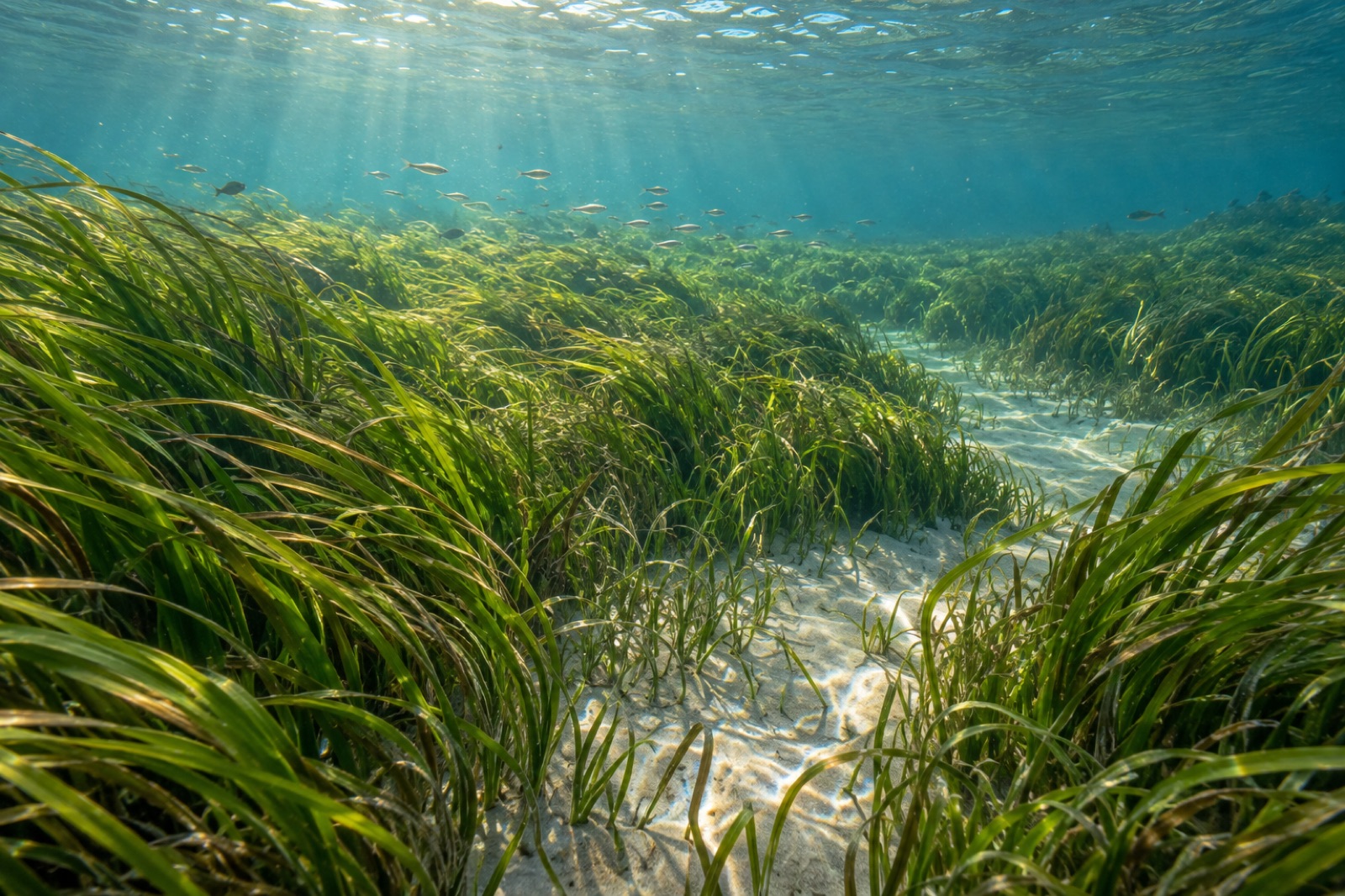
Beneath clear coastal water, seagrass meadows do something few ecosystems on Earth manage: they build their own carbon vault. These are true flowering plants that returned to the sea — not seaweeds — and their roots, rhizomes and dense canopies trap sediment and organic matter into oxygen-poor seabed layers where carbon can stay locked away for centuries, and in exceptional meadows for millennia. This explainer covers how seagrass blue carbon works, how big the numbers honestly are, what is destroying the meadows, and where seagrass carbon credits stand today.
Meet the meadows
Seagrasses evolved from land plants that recolonised the ocean tens of millions of years ago. Around sixty to seventy species exist worldwide, from intertidal eelgrasses (Zostera) carpeting temperate estuaries to the slow-growing Posidonia of the Mediterranean and southern Australia, whose rhizome mats can be many metres thick. Unlike algae, seagrasses flower, set seed, and hold sediment with true root systems — and it is precisely this architecture that makes them carbon engineers.
They are also ecological keystones: nurseries for fish and crustaceans, filters that clarify water, buffers against erosion, and food for turtles, dugongs and waterfowl. Some seagrass clones rank among the largest and oldest known organisms on Earth.
How the carbon gets buried
Seagrass carbon storage is a two-stage process.
Capture and trapping. The meadow canopy slows water flow, causing suspended particles — both the meadow's own leaf litter and organic matter drifting in from elsewhere — to settle out rather than wash away. Seagrasses are unusually good at capturing external carbon as well as their own production.
Burial and preservation. Below the canopy, rhizomes bind that sediment into a stable mat. Waterlogged and increasingly oxygen-free with depth, these layers suppress the microbes that would otherwise decompose organic matter back to CO₂. Carbon entering a healthy meadow's sediment tends to stay — accreting slowly upward like pages in an archive. In long-lived Posidonia meadows, dated organic layers reach back thousands of years.
This is why seagrass accounting, like mangrove accounting, is fundamentally about sediment rather than leaves — a distinction we unpack in sediment carbon vs biomass carbon.
How much carbon, honestly
Honest ranges matter here, because seagrass carbon varies more than almost any other blue carbon pool. Stocks in the top metre of sediment range from modest tens of tonnes of organic carbon per hectare in young or dynamic meadows to several hundred in mature, depositional systems. Burial rates vary just as widely with species, sediment supply and hydrodynamics. Global extrapolations carry wide uncertainty bars, and meadow-level measurement is the only reliable basis for crediting.
Two implications follow. First, beware single "seagrasses store X tonnes per hectare per year" figures quoted without site context. Second, the upside cases are genuinely impressive — long-undisturbed meadows in sheltered, sediment-rich bays are among the densest carbon stores in the coastal ocean.
The threat ledger
Seagrasses are disappearing at a pace that rivals other iconic coastal habitats. The main drivers:
- Physical destruction — dredging, trawling, coastal construction, and the scarring of meadows by boat anchors and moorings.
- Water quality — nutrient pollution fuels algal overgrowth that shades the plants; sediment runoff smothers and darkens the water column.
- Climate extremes — marine heatwaves have caused documented large-scale meadow diebacks followed by erosion of the buried carbon they once protected. See our marine heatwaves explainer for the mechanism.
- Legacy loss — vast meadow areas were lost in the twentieth century, and many have never recovered without help.
The carbon consequence cuts both ways: destruction halts future burial and can re-emit a portion of the archive already built.
Restoration, from seed to sod
Seagrass restoration has matured considerably. Proven approaches include collecting and broadcasting seeds at scale, transplanting plugs or sods from donor meadows, stabilising substrate with biodegradable hessian or sand-fill, and actively managing water quality upstream. Costs remain high per hectare and success rates vary, but survival improves markedly when practitioners use locally adapted donor material, mix genotypes for resilience, and choose sites by modelling light, wave exposure and sediment first — the same provenance discipline we apply to kelp seedstock in our restoration work.
Emerging monitoring tools are closing the measurement gap too: drone and satellite mapping for cover, acoustic surveys for canopy structure, and sediment coring for the carbon itself.
Seagrass credits today
Seagrass now sits inside blue carbon crediting frameworks — restoration methodologies covering tidal wetlands and meadows exist in the major voluntary standards, and avoided-degradation projects are emerging. The diligence questions mirror those for any blue carbon purchase: conservative baselines, field-verified sediment carbon, durable tenure, and permanence planning against storms and heatwaves. Our MRV guide explains how those measurements actually get made and verified, and our saltmarsh explainer covers seagrass's intertidal sibling, which faces a similar crediting trajectory.
Where does kelp fit? Nowhere in the seagrass ledger — seaweed carbon follows export pathways through the open ocean rather than local burial, which is why we at Tidewright account for it separately and conservatively. The two ecosystems side by side, though, make a compelling case that the shallow coastal ocean is climate infrastructure worth building.
Key takeaways
- Seagrasses are marine flowering plants whose roots and rhizomes trap and bind carbon-rich sediment into oxygen-poor layers where it can persist for centuries to millennia.
- Carbon stocks and burial rates vary wildly between meadows; site-level measurement is the only sound basis for credit claims.
- Physical destruction, poor water quality and marine heatwaves are the major threats — and losses re-emit part of the buried archive.
- Restoration by seed, transplant and substrate stabilisation is proven but costly; genetic diversity and careful siting drive success.
- Seagrass credits are real and growing within established blue carbon frameworks; apply the same integrity diligence as for mangroves.
FAQ
Is seagrass a type of seaweed?
No. Seaweeds are algae; seagrasses are true flowering plants with roots, stems and leaves that evolved from land plants returning to the sea. Their root-and-rhizome architecture is exactly what allows them to bury carbon in sediments rather than drifting away.
How long does seagrass carbon stay locked away?
In healthy, undisturbed meadows, buried carbon typically persists for centuries; in exceptional long-lived Posidonia meadows, dated organic layers are thousands of years old. Storage ends the day the meadow is dredged, eroded or killed and the sediment is disturbed.
Can I buy seagrass carbon credits today?
Yes — restoration and conservation projects exist within major voluntary standards, though the market is younger and smaller than mangrove crediting. Diligence matters: insist on measured sediment carbon, conservative baselines and credible permanence plans.
What is the fastest way to destroy a seagrass meadow's carbon?
Physically disturb it. Dredging, trawling and mooring scars not only kill the plants but expose and resuspend the sediment archive, allowing stored carbon to remineralise. Chronic nutrient pollution kills more slowly by shading, with the same eventual outcome.