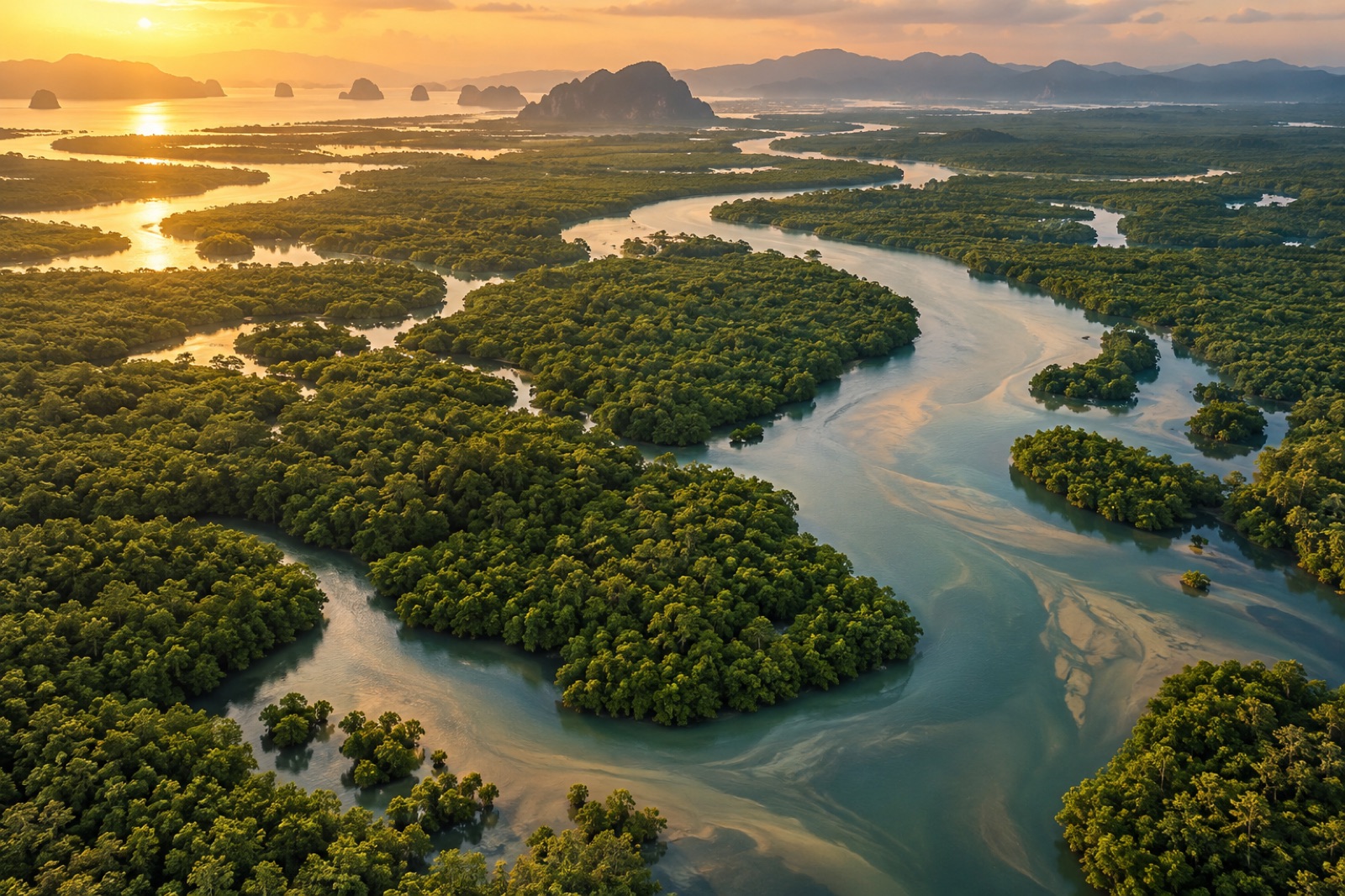
Mangroves are where blue carbon stopped being a scientific observation and became a market. These salt-tolerant coastal forests — roughly seventy tree and shrub species spanning the tropics and subtropics — pack extraordinary amounts of carbon into their waterlogged soils, and their destruction releases it fast. That combination made them the first coastal ecosystem with a real credit economy, and the template every other blue carbon project still borrows from. This guide covers how mangrove carbon works, how credits are generated, why so many planting campaigns fail, and what a genuinely good project looks like.
If the phrase "blue carbon" is new to you, start with our explainer on what blue carbon is and come back.
Where the carbon actually is
A mangrove forest holds carbon in three places: the trunks, branches and leaves above ground; the dense root systems below ground; and — decisively — the soil. Mangrove soils are waterlogged and oxygen-starved, which slows microbial decomposition to a crawl. Leaves, roots and wood that fall into that mud don't rot away on a human timescale; they are buried and factored into ever-deepening organic layers that can accumulate for centuries to millennia.
The result is that per hectare, mangrove soil carbon routinely exceeds the living biomass carbon of the forest on top of it — often by a wide margin in deltaic settings. If you take away one idea from this article, make it this: mangrove carbon accounting is mostly mud accounting. Our piece on sediment carbon versus biomass carbon explains why that distinction drives everything from project design to credit pricing.
How a mangrove carbon project works
Two broad project types dominate.
Avoided loss
Conservation projects protect intact mangrove from a documented conversion threat — clearance for shrimp ponds, rice, charcoal, coastal development. The credited tonnes are the emissions that would have occurred, which for carbon-rich soils can be very large indeed. The entire integrity of the credit rests on the credibility of the threat narrative and the baseline, which is why buyers should always ask: who was actually going to clear this, and what evidence is there?
Restoration
Restoration projects re-establish mangroves on degraded or converted land and credit the regrowth of biomass plus the renewed accumulation of soil carbon. Well-sited restored sites begin accreting sediment carbon within years, while the canopy builds over decades — so credible methodologies model a long, conservative growth curve rather than promising fast tonnes.
Why mangrove projects fail
The history of mangrove restoration is littered with photogenic planting campaigns that quietly died. The failure modes are so consistent they're worth memorising.
Planting on the wrong ground
The classic error: planting seedlings on open mudflats and seagrass shallows that were never mangrove habitat and never will be at the elevation chosen. Mudflats are valuable ecosystems in their own right. If mangroves could grow there naturally, they usually would already be there. Survival in such campaigns is routinely near zero.
Ignoring hydrology
Mangroves die when their tidal plumbing is broken — by roads, dikes, pond walls and filled channels. In many failed sites the fix is not planting at all; it is breaching the embankment, reopening the creek, and letting the forest recruit itself. Hydrological restoration first, planting only where dispersal can't reach — that ordering alone separates competent projects from public relations.
The monoculture trap
Single-species plantations planted at tight spacing grow fast on paper and poorly in reality: simplified habitat, lower resilience to pests and storms, and ecological function a fraction of a mixed natural stand. Diverse, appropriately sited assemblages matched to local zonation survive and serve fisheries far better.
Forgetting the people
Mangroves live under someone's tenure and feed someone's family. Projects imposed without community consent and livelihood pathways tend to be re-cleared within a decade. Projects designed with local communities — sharing revenue, formalising stewardship rights, building fisheries and ecotourism value around the standing forest — are the ones still standing at twenty years.
What good looks like
A strong mangrove carbon project, whether avoided-loss or restoration, usually shows the same signature: secure tenure and free, prior and informed consent; a conservative, evidence-based baseline; hydrological repair before planting; mixed-species recruitment; a monitoring program measured in decades, including the soil pool; a realistic buffer contribution against storm and erosion reversal risk; and transparent benefit-sharing. National policy matters too — mangroves figure in many country climate commitments, so project accounting increasingly has to nest within national inventories, a landscape we map in our blue carbon policy explainer.
Mangroves in the wider portfolio
Mangroves may have built the market, but they are one ecosystem in a coastal carbon family. Their temperate counterparts, salt marshes, work by similar soil-carbon logic at higher latitudes. Seagrass meadows bury carbon in subtidal sediments for centuries and are only now entering crediting frameworks at scale. And kelp forests — the ecosystem we restore at Tidewright — operate on entirely different carbon pathways, which is why we treat kelp carbon claims with particular care and publish our monitoring data openly through Canopy Ledger.
For a buyer, that diversity is an opportunity: coastal portfolios can blend the mature integrity of mangrove credits with the emerging potential of seagrass, marsh and eventually macroalgal approaches.
Key takeaways
- Mangrove carbon lives mostly in waterlogged, oxygen-poor soils that accumulate organic matter for centuries to millennia — per hectare, often exceeding the carbon in the trees above.
- Avoided-loss credits are only as strong as the evidence that clearing was genuinely imminent; restoration credits accrue slowly and must be modelled conservatively.
- The recurring failure modes are wrong siting, broken hydrology, monoculture planting and ignored community tenure. All four are avoidable.
- The strongest projects repair tidal plumbing first, support natural and diverse recruitment, and put local stewardship and benefit-sharing at the centre.
- Mangroves are the mature benchmark against which seagrass, saltmarsh — and eventually kelp — carbon approaches are measured.
FAQ
Do mangroves store more carbon than rainforests?
Per hectare of total ecosystem carbon — trees plus soil — healthy mangroves frequently match or exceed tropical rainforests, because rainforest carbon is mostly in the trees while mangrove carbon keeps accumulating in deep soils. Exact ratios vary enormously by site and setting.
How quickly does a restored mangrove store carbon?
Sediment carbon accumulation can resume within the first few years once tidal conditions are right. Canopy and root biomass build over decades. Credible projects credit this growth gradually; be sceptical of rapid tonne-per-hectare claims.
What happens to the carbon if mangroves are cleared?
Clearing exposes and disturbs the soil, allowing long-buried organic carbon to oxidise back to CO₂, alongside the loss of the standing biomass. This is why protecting carbon-rich, conversion-threatened mangroves delivers such large avoided emissions — and why erosion and storms are treated as reversal risks.
Are mangrove credits recognised under the Paris Agreement?
Many countries include coastal wetlands in their national inventories and climate targets, and mangrove outcomes can be traded internationally under Article 6 arrangements when corresponding adjustments apply. The details are country-specific and evolving.