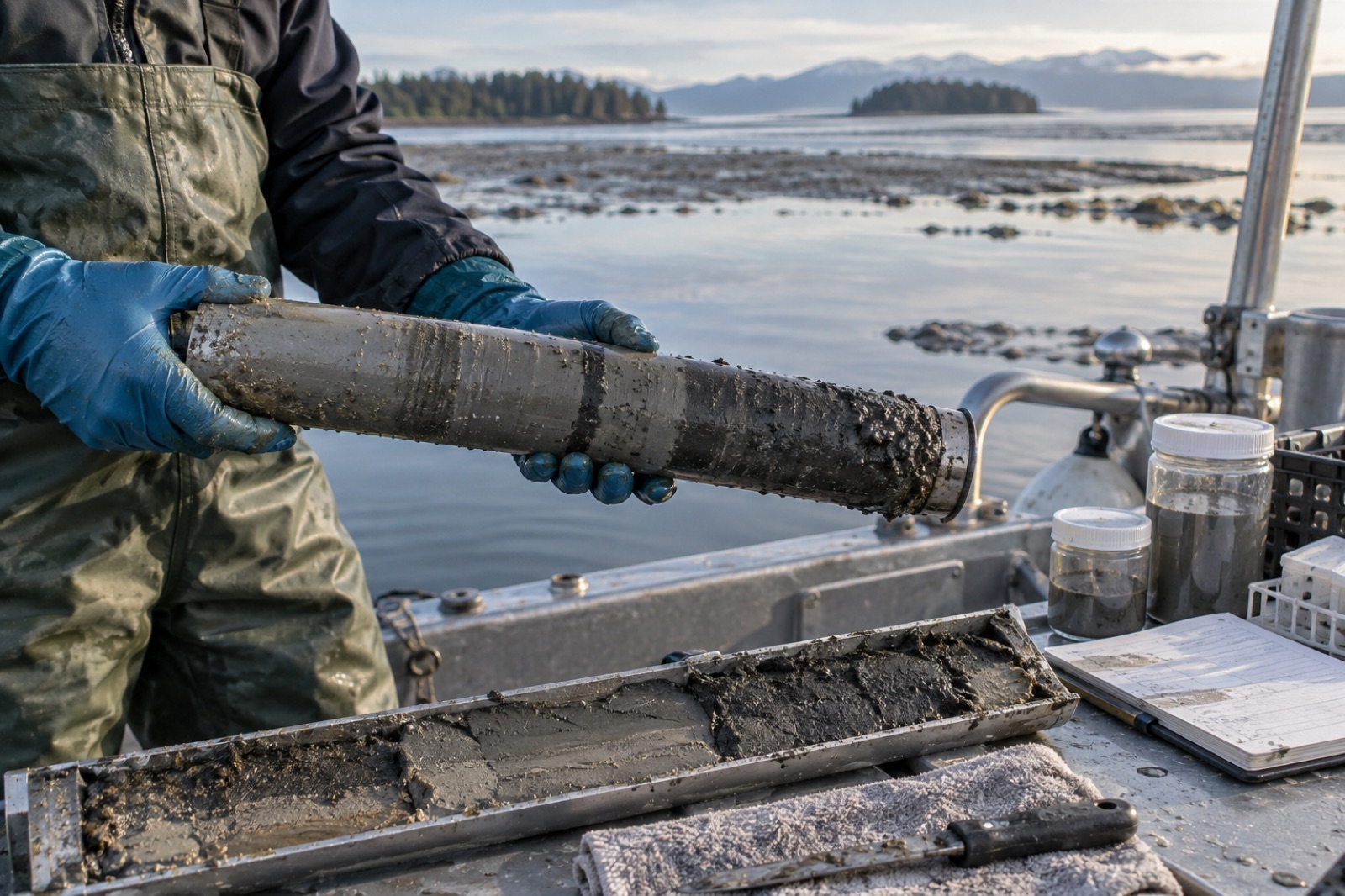
Seagrass restoration is one of the few corners of ocean carbon where the crediting machinery genuinely exists today: dedicated methodologies are on the books, projects have been validated, and credits have issued. It is also a corner where the gap between a plausible project and a rigorous one is wider than the brochures suggest — because almost all of a meadow's carbon sits out of sight in the sediment, accumulates slowly, and can be re-released by a single storm or anchor chain. This guide covers how seagrass restoration credits actually work: the methods on the table, how the sediment carbon gets measured, the permanence problem specific to meadows, and the diligence questions that separate sound projects from optimistic ones. For the underlying biology first, read our primer on seagrass blue carbon.
What a seagrass credit actually is
A seagrass restoration credit is a quantified claim that a project caused additional carbon to be stored — or prevented stored carbon from being emitted — relative to what would have happened without the project. In restoration the mechanism is burial: a new or recovering meadow traps particles, binds sediment with its rhizomes, and builds an oxygen-poor archive where organic carbon persists for centuries or longer.
Three design features shape every seagrass credit:
- The unit is a tonne of CO₂-equivalent, but most of the carbon being claimed is in soil, not shoots. A methodology that only counts above-ground biomass captures a thin slice of the real carbon story.
- The counterfactual matters more than the measurement. Baselines have to model a degraded seabed that may keep eroding — loss rates, not just static stocks.
- Time is a cost. Restored meadows take years to close canopy and longer to accumulate meaningful new sediment carbon, so early crediting leans heavily on avoided loss where systems are degrading, and accrual crediting only as the meadow matures.
The methodology landscape
Seagrass entered the voluntary carbon market through methodology updates that extended tidal-wetland accounting to subtidal meadows — the milestone was the first methodology written to explicitly cover seagrass restoration alongside tidal wetlands, with others following in national and voluntary systems. Since then the field has matured along three tracks:
- Restoration (accrual) methodologies — credit the net increase in sediment and biomass carbon in a restored meadow over time, against a baseline of continued bare or degraded seabed.
- Avoided degradation — credit emissions avoided by stopping an ongoing pressure (dredging footprints, destructive anchoring, sediment pollution) that would otherwise oxidise the meadow's sediment archive. For the accounting logic, see our explainer on avoided conversion credits.
- National-inventory alignment — coastal wetlands entered national greenhouse gas accounting via the IPCC's wetlands guidance, which is how meadow carbon reaches NDCs and compliance-adjacent uses — covered in our piece on the IPCC Wetlands Supplement.
When evaluating a project, the single most useful question is: which methodology governs this credit, and which pools and gases does it require to be measured? Our buyer's map of blue carbon standards lays out the landscape standard by standard.
Measuring the carbon: coring, density and dating
Because the carbon lives in sediment, measurement is a coring exercise — and the quality of a project stands or falls on it. A rigorous sampling programme typically includes:
- Intact core collection across mapped meadow strata (species zones, depth bands, sediment types), with replicate cores per stratum and cores in paired control or reference sites outside the project boundary.
- Bulk density and dry combustion or elemental analysis per depth interval to convert coring volumes into carbon stocks in tonnes per hectare — the honest way, rather than loss-on-ignition shortcuts that can drift with carbonate content on calcareous sediments.
- Dating of accretion where burial rates are claimed, using established radiometric techniques on the core profile, so a project can say how fast the archive is actually growing rather than borrowing a global average.
- Re-measurement on a monitoring schedule, because credits tied to accrual must be re-verified over the crediting period.
We walk through the field and lab workflow in detail in reading the core. The short version: stocks are measurable with real confidence at site level; rates are harder; and anyone selling credits on rates alone, without dated cores, is selling a model with a price tag.
One more subtlety matters for accounting: meadows trap carbon produced elsewhere (allochthonous carbon) as well as their own. Conservative methodologies either exclude externally sourced carbon from creditable claims or require evidence of the fractions. Generous ones don't. Ask which fraction the project is claiming.
Baselines, additionality and leakage
The crediting arithmetic is unforgivingly simple: credits = project carbon outcome − baseline outcome − leakage − uncertainty discount. Each term hides a seagrass-specific trap.
Baseline. A bare sediment baseline that assumes zero carbon change forever flatters restoration projects; a degrading-meadow baseline that assumes total loss flatters avoided-loss projects. Credible baselines use reference sites and documented pressure trajectories.
Additionality. Some bays would recolonise on their own once water quality improves; some pressures would have stopped under existing regulation. The additionality test — would this have happened anyway? — applies as forcefully here as anywhere. Our explainer on additionality in carbon credits covers the test itself.
Leakage. Move the anchoring pressure out of a meadow and the boats anchor somewhere else — sometimes on another meadow. Methodologies increasingly require displacement risk assessment, but it remains one of the weakest links in practice. See leakage in nature-based projects.
Uncertainty. Variance in sediment carbon across a site is genuinely high; honest projects take an uncertainty deduction. Suspicious ones claim precision the coring density can't support.
The permanence question, meadow edition
Seagrass permanence cuts in two directions. The upside is real: long-undisturbed meadow archives are among the oldest carbon stores in the coastal ocean. The downside is equally real: the same archive can erode fast when the meadow dies. Documented large-scale diebacks following marine heatwaves — and routine losses to storms, scarring and water-quality collapses — mean a sediment stock is only as durable as the meadow sitting on it.
Sound projects handle this explicitly:
- Reversal-risk analysis per site: exposure, heatwave history, water-quality trajectory, anchoring pressure.
- Buffer contributions — a share of credits withheld into a pooled reserve against reversals, the standard mechanism across the market; see permanence and buffer pools.
- Management commitments — mooring management, water-quality programmes, and monitoring that would actually detect a dieback early enough to count it against the credit balance.
From planting to issuance: the project cycle
A seagrass credit follows the same spine as any blue carbon project — feasibility, design document, independent validation, monitored implementation, verification, issuance, and finally retirement when a buyer makes a claim. We trace that full journey in the blue carbon project cycle. For a close-up of how one meadow methodology behaves in practice, our eelgrass restoration case study is the natural companion to this guide.
Two timing realities deserve emphasis. First, issuance is ex post: credits are issued only after verified accumulation, so the restoration spend precedes the carbon revenue by years — a finance gap that shapes project design. Second, monitoring never stops: a credited meadow is a meadow under measurement for the life of the crediting period, and that budget line is non-negotiable.
Pitfalls worth memorising
- Shoot counting instead of soil accounting. Canopy area is necessary evidence of a living meadow; it is not a carbon measurement.
- Borrowed burial rates. Global-average accretion figures applied to an undated site deserve a discount, not a premium.
- Ignoring greenhouse gases beyond CO₂. Disturbed coastal sediments can shift methane and nitrous oxide fluxes; good methodologies account for them.
- Carbonate sediments mishandled. On calcareous seabeds, naive carbon analysis confuses inorganic carbonate with organic carbon — a classic overcount.
- No tenure, no credit. Meadow carbon without clear sea tenure and community agreement is a claim on someone else's water. Buyers can sanity-check the full package against our due diligence checklist — or route questions through our carbon buyer programme.
Key takeaways
- Seagrass restoration credits are real and issuing under dedicated methodologies; most creditable carbon is in sediment, not shoots, so coring quality defines project quality.
- Stocks are reliably measurable at site level; burial rates require dated cores — scepticism is the right response to rate claims built on global averages.
- Baselines, additionality, leakage and uncertainty discounts are where integrity is won or lost; allochthonous (externally sourced) carbon is the subtlest overcounting trap.
- Permanence is conditional on the meadow surviving heatwaves, storms and scarring — buffer pools and management commitments are mandatory, not optional.
- Issuance is ex post and monitoring is perpetual: expect years between planting and revenue, and a sampling budget for the life of the credit.
FAQ
Can I buy seagrass restoration credits today?
Yes — projects validated under dedicated tidal wetland and seagrass methodologies exist in the voluntary market, and the pipeline is growing. Supply is still modest relative to mangrove crediting, and the best projects sell forward offtakes early, so expect to engage with projects years before issuance rather than shop on a spot market.
Why do seagrass credits cost more than many land-based credits?
Three compounding reasons: restoration itself is expensive per hectare (seed collection, planting, substrate work), sediment MRV is field- and lab-intensive and recurs for decades, and issuance often lags planting by years, forcing developers to price in financing costs. High cost per tonne is not automatically a red flag — unpriced monitoring is.
What happens to my credits if the meadow is destroyed by a marine heatwave?
A reversal of stored sediment carbon must be reported, and the standard market mechanism is the buffer pool: a reserve of withheld credits, contributed by many projects, that compensates for verified losses. Diligent buyers check the buffer contribution rate, whether the project's reversal-risk assessment mentions heatwaves explicitly, and what monitoring would catch a dieback. See our pieces on reversal risk and buffer pools.
How does restoration differ from avoided-loss crediting?
Restoration (accrual) credits the carbon a rebuilt meadow adds over time. Avoided loss credits the emissions prevented by stopping an active pressure on an intact meadow. They use different baselines and evidence, and conflating them is a common marketing move — a project should be able to tell you, simply, which engine its credits run on.
Does Tidewright sell seagrass credits?
No. Tidewright is a fictional company created for design and content demonstration, and our restoration platform focuses on kelp forests. We cover seagrass crediting because meadows and forests are neighbours in the shallow coastal ocean, because the market questions overlap heavily with kelp's, and because buyers deserve the same rigour in both. Real seagrass credit projects do exist — apply the diligence questions above to them.