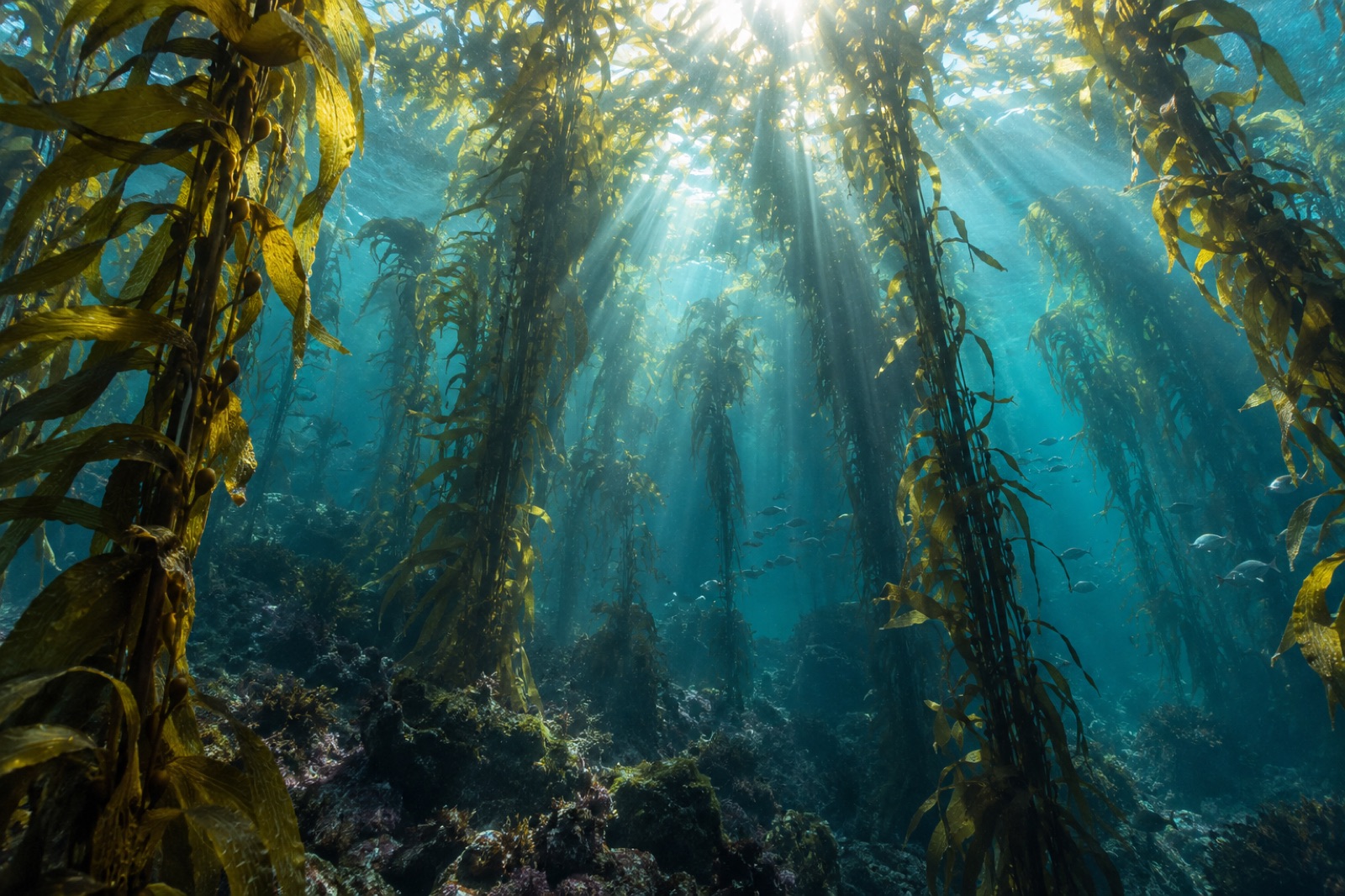
Every tonne of carbon credited by a nature-based project is, at heart, a promise about the future: this carbon will stay out of the atmosphere. A planted mangrove, a rewetted peatland, a restored kelp forest — all of them store carbon in living, moving ecosystems that can burn, sicken, wash away or be cut down. If the carbon returns to the atmosphere after the credit is sold and claimed, the buyer is left with memory instead of compensation.
This is permanence risk, and managing it credibly is what separates durable climate finance from wishful accounting. The market's toolkit — conservative accounting, buffer pools, insurance-like mechanisms — is more interesting, and more honest, than the marketing term "permanent" suggests. Here is how it actually works.
What permanence means — and what it can't
Physical permanence is easy to describe and impossible to guarantee. Carbon locked in geological storage — compressed CO₂ injected into deep saline aquifers — can reasonably be expected to persist for millennia with quantifiable leakage risk. Carbon locked in a forest or a kelp bed persists for as long as the ecosystem does: potentially centuries, potentially until the next extreme event.
Climate-relevant permanence is not about forever. Carbon removed from the atmosphere for a century is not useless — a tonne held out of circulation for decades delays warming, buys time for decarbonization and reduces near-term radiative forcing. But a tonne released after five years, while claimed as equivalent to a tonne never emitted, breaks the ledger entirely. The problem is not that nature-based storage has a shorter duration; the problem is pretending it doesn't.
Serious frameworks therefore treat durability as a spectrum with mechanisms attached, not an adjective. Their shared machinery has two moving parts: count only what is likely to last, and insure the rest.
To manage reversal risk, you first have to enumerate it. For blue carbon ecosystems, the realistic threat list roughly divides into five:
- Extreme events. Storms that strip canopy and mobilize sediment carbon; marine heatwaves that collapse kelp standing stock, as has happened off multiple coastlines in the past decade (our marine heatwave explainer covers the physics and the record).
- Ecological feedbacks. Urchin barrens forming where kelp predators are lost; invasive grazers; disease outbreaks in monoculture-like stands.
- Sea-level rise and erosion. Coastal squeeze eliminating the intertidal and subtidal zones projects occupy, or drowning marsh faster than it can accrete.
- Management failure. Projects abandoned when funding runs out, leases not renewed, stewardship obligations unenforced.
- Policy and land-use change. A right-to-harvest, dredging consent or coastal development approved over the credited area.
A risk register like this is not optional paperwork for credible projects; it is the input that determines how much of the claimed carbon is even eligible to be credited, and how much must be set aside as insurance.
The cheapest way to handle permanence is to not credit what is likely to reverse. One reason credible blue carbon methodologies place heavy weight on soil and sediment carbon — the buried fraction that accumulates over decades to centuries — rather than standing biomass is that biomass is the fast-flipping part of the ledger.
Kelp is the instructive case. A kelp plant is not a tree; most of its tissue turns over in months to a few years, and harvesting or storm loss releases that portion back. The climate-relevant kelp carbon is the fraction that becomes detritus — fragments exported offshore or buried in sediments, where some share resists remineralization on meaningful timescales. Our explainer on how kelp actually stores carbon unpacks these pathways. The implication for permanence is direct: honest accounting credits only the portion with a plausible durable fate, with a haircut for the fraction that will eventually return. That haircut is not pessimism; it is what makes the credited tonne real.
Where residual reversal risk remains, the market's main instrument is the buffer pool — a shared, pooled reserve of credits that functions like an insurance deductible raised from every project.
The mechanics are simple and worth knowing exactly:
- Contribution. Each project in a registry program sets aside a slice of its issued credits — often on the order of ten to twenty percent for higher-risk categories — into a collective, non-tradable pool. The project's risk assessment (the reversal menu above, site by site) typically determines the contribution rate.
- Coverage. If any participating project later suffers a verified reversal — its forest burns, its mangrove dies — credits are cancelled from the buffer pool in an amount equal to the lost tonnes.
- Consequence. Buyers' claims remain whole even though the physical carbon is gone. No individual project has to self-insure against a catastrophe; the system does.
Two design details decide whether a buffer pool is insurance or theatre. First, pool adequacy: the reserve must be sized for correlated shocks, not just independent ones. A marine heatwave is not an independent event — it can hit dozens of coastal projects simultaneously, the way a single fire season can burn multiple forestry projects in one year. Second, monitoring cadence: a reversal only triggers buffer replacement if it is detected and reported, which is why permanence is inseparable from measurement practice. Our MRV guide covers that machinery in detail.
Buffer pools dominate today's compliance-grade frameworks, but they sit alongside other instruments:
- Commercial insurance. Emerging products let projects buy coverage that pays to replace reversed credits — useful for pushing risk evaluation onto a sophisticated third party, limited so far in scale.
- Straight discounting. Some approaches simply factor expected reversal into issuance: if the credible estimate is that only 80% of sediment carbon persists over the crediting horizon, only 80% gets credited. No pool needed for the modelled portion; no room for over-claim either.
- Temporary and tonne-year accounting. Instead of claiming full equivalence forever, projects issue credits for storage measured in tonne-years — a tonne held for a known period earns a fraction of credit, re-earned as long as storage persists. This directly prices duration and avoids the fiction of permanent equivalence. Its challenge is market acceptance: buyers want claims they can defend, and "we held a tonne for thirty years" requires more explanation than "we retired a tonne," even when it is the more truthful statement.
Durability is a spectrum, not a verdict
A clean way to hold all of this: ask how long storage must be trusted, and what mechanism stands behind the claim if the carbon returns early. Frameworks for net-zero-aligned offsetting increasingly separate storage by durability tier, arguing that residual emissions at a net-zero date should be balanced by storage of comparable durability — fossil carbon matched with multi-century to geological storage — while shorter-duration storage plays a real but different role: bridging, delaying, and funding ecosystems with enormous co-benefits regardless.
This framing rescues blue carbon from a false binary. A kelp restoration project is not disqualified from climate finance because its sediment fraction sequesters over centuries rather than millennia; it just has to account for that honestly, through the tools above, and disclose the assumptions a verifier can challenge.
Questions to ask of any credited project
Buyers diligence-checking a blue carbon credit can compress all of this into five questions:
- What fraction of claimed carbon is standing biomass, and what fraction is sediment or detrital? Heavy dependence on biomass with full crediting is a red flag.
- What is the buffer (or equivalent) arrangement, and what assumed reversal rate is baked into issuance?
- Has the project published its reversal risk register, and who audited it?
- How does the buffer pool handle correlated events — one heatwave hitting many projects at once?
- What happens to claims over the full project horizon — forty years, say — if the pool is depleted mid-life?
The buyer's checklist for blue carbon credits turns these into a document you can put in front of any seller, and our market explainer maps who sits where in the transaction around them.
Key takeaways
- Permanence risk is the possibility credited carbon returns to the atmosphere; it is managed, not eliminated.
- Conservative accounting is the first line of defence: credit the durable fraction (buried sediment and detrital carbon) rather than fast-flipping standing biomass.
- Buffer pools are pooled insurance: each project contributes untraded credits, and verified reversals are made good from the reserve. Pool adequacy under correlated shocks is the real test.
- Discounting, insurance and tonne-year accounting are live alternatives — and all of them push toward the same principle: don't overclaim duration.
- Durability belongs on a spectrum with mechanisms attached, and buyers should ask for the risk register, the buffer math and the correlated-event assumptions before retiring a single credit — a standard we hold ourselves on the Tidewright platform.
FAQ
If a buffer pool covers my reversed tonne, is my claim still honest?
Yes — provided the pool is solvent and your claimed credit is genuinely cancelled rather than merely "offset" by paperwork. A robust registry publicly retires buffer credits against documented reversals so observers can trace the equivalence. System honesty depends on insolvency never occurring, which is why contribution rates for risky project categories are deliberately high.
How long is "permanent enough" for climate purposes?
A frequently used pragmatic horizon is a century: storage reliably maintained across 100 years achieves most of the near-term climate benefit and outlasts the decades in which the worst warming is locked in or avoided. This is not a law of physics — better systems state their durability assumption explicitly and let buyers judge, rather than smuggling in an implicit forever.
Does substitution matter — if one parcel of forest is replaced by another?
Substitution is a legitimate mechanism in some framework designs — a site lost to fire can, in principle, be restored elsewhere and credited as replacement. The integrity test is whether the replacement is verified, additional in its own right, and fully replaces lost tonnes within a stated timeframe. Done loosely, substitution becomes a loophole that delays reckoning indefinitely.
Are marine projects riskier than forests on permanence?
They carry different risk shapes. Forests burn catastrophically and visibly; marine reversals like heatwave collapse can be faster and wider-reaching but often leave sediment carbon partially intact. Some marine systems (intertidal sediment carbon) can actually be very durable once buried — arguably more so than standing forest biomass. The honest answer is: it depends on which carbon pool in the project is doing the crediting work.
Could buffer pools be backed by reinsurance?
The direction of travel in credible markets is layering mechanisms: project-level risk management first, buffer pool second, and — increasingly discussed — third-party underwriting of pool tail risk for correlated catastrophes. The logic is identical to catastrophe insurance in any other sector: rare, severe losses are cheapest to hold by parties with the deepest balance sheets.