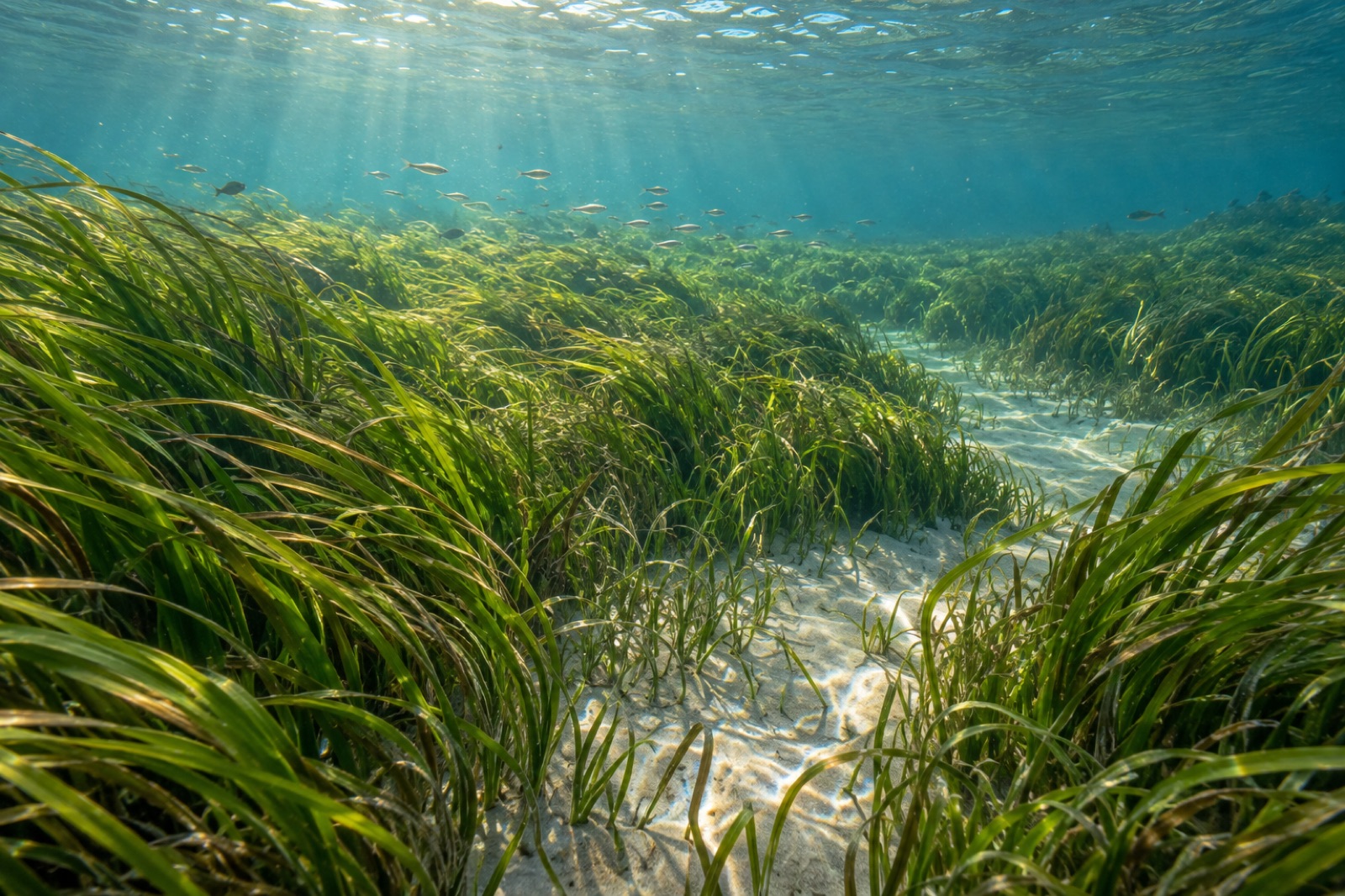
Seagrass meadows bury carbon with a patience that few ecosystems match: in waterlogged, oxygen-poor sediment, organic matter decomposes so slowly that a healthy meadow's soil can hold carbon for centuries or millennia. Restore one, and the carbon benefit is real. The harder question — the one the voluntary carbon market has spent years answering — is whether a project can prove it, to a standard a verifier will sign and a buyer can defend.
The answer, for at least one ecosystem, is now yes. Seagrass restoration has a live, approved methodology under the Verified Carbon Standard, and at least one celebrated project has taken credits all the way from seed to issuance. This article walks through how that works — the meadow, the methodology and the machinery — and what it teaches the rest of blue carbon, kelp included.
Why eelgrass is creditable in the first place
Not every coastal ecosystem qualifies for carbon crediting, and the reason is accounting, not ecology. Creditworthy carbon has to be additional, durable and measurable, and eelgrass clears all three bars in a way few marine habitats do. Our seagrass blue carbon primer covers the underlying science; the short version is that the meadow's sediment — not its blades — does the climate work. Root and rhizome growth, plus particles the dense canopy filters from the water and traps, build up organic-rich soil at rates the field can measure with sediment cores. Because that soil sits in anoxic waterlogged conditions, the buried carbon resists the bacterial decay that would otherwise return it to the atmosphere as CO₂ and methane.
Crucially, an eelgrass meadow is also restorable on a human timescale. Where the limiting factor is the loss of plants rather than the loss of suitable habitat, seeds dispersed back into cleared bottom can rebuild a meadow within years — land restoration may take decades to return what a well-chosen coastal site can recover in five.
The Virginia case: proof that seeds can farm carbon
The most important real-world proof sits on the Atlantic coast of Virginia, in the lagoons of the Virginia Coast Reserve. Beginning in 1999, scientists from the Virginia Institute of Marine Science, working with The Nature Conservancy, began broadcasting eelgrass seeds into the bare sediments of coastal bays that had lost their meadows in a 1930s wasting-disease epidemic and hurricane — and never got them back.
The technique was beautifully simple: harvest flowering shoots carrying tens of millions of seeds, hold them until the seeds are ripe, and scatter them over suitable bottom. Over the following two decades, those seeded patches grew, coalesced and expanded into thousands of hectares of continuous meadow — widely described as the largest successful seagrass restoration in the world — and today the repopulated bays hold dense, spreading meadows that have been fully self-sustaining for years.
The carbon significance arrived when the project team, working under the approved methodology described below, took the site's measured sediment carbon through verification and issuance — among the first times a seagrass restoration anywhere had done so. The meadow didn't just hold carbon; it could sell it, on the strength of two decades of data, and the proceeds provided a revenue stream the restoration itself produced.
How the methodology works: VM0033 in plain language
The operative rulebook is VM0033, the Methodology for Tidal Wetland and Seagrass Restoration, developed through the Verified Carbon Standard (administered by Verra) and approved after scientific review. Methodologies are the carbon market's unsung machinery — dry, technical and essential — and reading this one closely shows what an accountable claim actually requires. The life of a blue carbon credit follows the full arc; here is the restoration-specific core.
Applicability conditions
First, the project must prove the methodology fits. VM0033 sets eligibility gates: the site must be tidal wetland or submerged bottom genuinely suited to restoration; the project can't displace an ecosystem service someone else depends on in a way that creates new harms; hydrology and sediment conditions must support the target habitat. Restorations that amount to planting a lawn on an unsuitable mudflat are screened out before they start.
The baseline: what happens without the project?
Next, the counterfactual. A valid methodology requires a credible estimate of site carbon in the absence of the restoration: bare sediment accumulating slowly (or eroding), versus the vegetated state. Only carbon above that baseline is creditable. For the Virginia project, the baseline was decades-documented: the bays had been mudflat since the 1930s and weren't recovering.
Additionality
Then the market's central question: would this have happened anyway? A meadow returning on its own earns no credits — only the restoration that required the intervention. Our additionality explainer unpacks the logic; for VM0033 projects, additionality is demonstrated through barriers (the site won't recover unaided), regulatory analysis (no law already requires the work) and financial analysis (carbon revenue is part of what makes it viable).
Carbon pools and quantification
The methodology then defines exactly what to count. VM0033 credits the change in the soil organic carbon pool — the durable fraction — and biomass where it's durable, while requiring deduction of any increased emissions the project causes (methane and nitrous oxide responses, fuel used, off-site effects). Monitoring follows prescribed plots and sediment-coring protocols: depth-based cores sampled at intervals, dated where possible, and analysed for organic carbon content to build a verified rate of accumulation.
Leakage and permanence
Like every credible methodology, VM0033 subtracts for leakage — activity shifted beyond the boundary, the mechanics of which we cover in our leakage explainer — and requires protection against permanence risk through a buffer-pool contribution. The credited tonne is what's left after baseline, emissions, leakage and risk deductions. It is conservative by design, which is exactly what makes it defensible.
What a verifier actually checks
Verification is where the paperwork meets the mudflat. An independent accredited auditor reviews the project's monitoring report against the methodology — the plot maps, core samples, lab results, chain of custody — and checks that what was claimed is what was measured. The questions are granular: were the sediment cores taken from the right plots, at the right depth? Does the reported accumulation rate sit within a defensible range? Are the leakage and buffer deductions correct? Are the boundaries real curves on a map, not aspirations?
Virginia's project could answer all of this because it had done the most unfashionable thing in restoration: it had been measuring the meadow, patiently, for two decades — long before anyone was paying for carbon. The lesson generalises into one of blue carbon's few universal truths: credits are sold by the decade of data, not the season of planting.
The limits — stated plainly
It would be easy to overread one success. Three cautions belong in any honest accounting:
- The volume is real but small. A single meadow's verified tonnes are significant for the project; they are not, alone, a climate solution. Blue carbon's role is within a portfolio, as our portfolio guide argues.
- It works best where restoration is genuinely needed and durable. Sites where the cause of loss is unaddressed — warming, pollution, ongoing disturbance — will fail, and methodology approvals don't change ocean physics.
- It is one methodology among several frameworks, and standards continue to evolve. A buyer should always ask which methodology, which version, and which registry — the questions in our standards guide apply here too.
What eelgrass teaches kelp
Kelp forests are the honest cousin with the harder problem. Where eelgrass concentrates value in a sediment pool that verifiers can core and date, kelp holds most of its carbon in living blades that turn over fast — its durable climate benefit depends on how much becomes long-lived exported detritus, which is far harder to bound, date and credit. That is precisely why the comparison matters: the eelgrass project shows what mature blue carbon accounting looks like when the sector works on an ecosystem whose carbon pool is the product. Kelp's pathway is less settled, and the difference is what our kelp carbon storage explainer addresses. Any serious kelp crediting scheme will have to import the same discipline the eelgrass field normalised: data first, claims second.
A disclosure on the Tidewright angle: we are a (fictional) restoration company, and our Canopy Ledger monitoring platform is built on exactly the lesson Virginia teaches — continuous, independent, multi-year measurement as the foundation of any credit. Eelgrass wrote the template; the rest of the ocean is adapting it.
Key takeaways
- Eelgrass restoration is creditable because soil carbon is additional, durable and measurable — the climate value lives in sediment, not blades, and can be cored directly.
- The Virginia Coast Reserve project, seeded from 1999 onward, rebuilt thousands of hectares of self-sustaining meadow and became one of the first seagrass restorations to reach credit issuance.
- VM0033, the VCS tidal wetland and seagrass methodology, works through applicability conditions, a defensible baseline, demonstrated additionality, defined carbon pools, and deductions for leakage and permanence risk.
- Verification is forensic: credited tonnes are what survives baseline, emissions, leakage and buffer deductions — not what was planted.
- The transferable lesson to kelp and every other blue carbon candidate is that decades of measurement, not the planting itself, is what a verifier credits.
FAQ
Can restored eelgrass really be turned into carbon credits?
Yes — under approved methodologies. Projects must demonstrate additionality, quantify soil-carbon gains against a documented baseline, deduct leakage, and pass independent verification, but restored seagrass has cleared all of those bars in the real world.
How long does a restored meadow take to accrue creditable carbon?
On the order of years to decades before verified issuance. The Virginia meadow was seeded in 1999; verified credits came later, built on long-term plot and core data. Carbon finance rarely moves faster than the fieldwork it depends on.
Are these credits equivalent to cutting fossil emissions?
They compensate for, rather than substitute for, emissions reductions — and standards bodies are increasingly strict about the claims buyers can make. Credible strategies treat blue carbon credits as a complement to rapid decarbonization, never a replacement for it.
Could the same approach be applied to kelp forests?
Not by direct translation — kelp's carbon pool lives in biomass and exported detritus rather than sediment, so the accounting problem is different. The principles transfer entirely (baseline, additionality, conservative quantification, decades of measurement), but kelp-specific credible methodologies are still emerging.
Who develops and owns these methodologies?
Methodologies like VM0033 are developed by conservation and research organisations through public consultation, then administered by independent registry programs — the Verified Carbon Standard in this case. The rigor lives in the public review; a methodology no one was allowed to criticise before approval is not a methodology to build on.