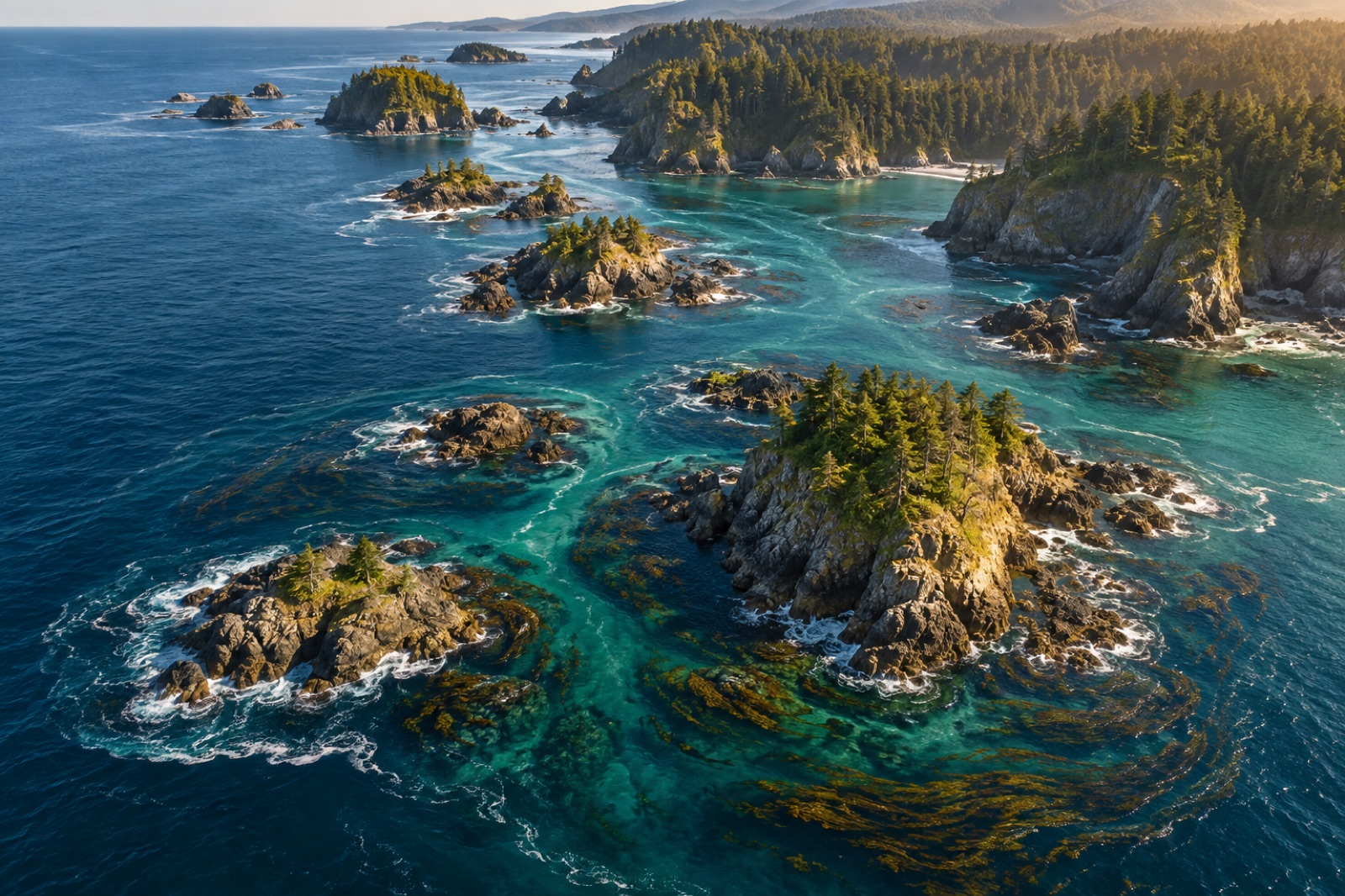
Ask how far a kelp spore travels and you're really asking three different questions wearing one coat. How far does a typical spore go? How far does the rare long-shot go? And how far do whole families disperse when kelp takes to the water in bulk? The answers span twelve orders of magnitude — from centimetres to thousands of kilometres — and between them lies the hidden geography that decides whether a cleared reef reforests itself, and how a restoration team should space its work.
For the mechanics of release and settlement — what a spore is, how it swims, what it settles on — see our grounding piece on kelp spore dispersal. This article is about the distances, the evidence behind them, and what they mean.
The Short Answer: Mostly Not Far at All
Kelp spores are tiny flagellated cells, swimming at speeds that barely register against even a slack tide. Field experiments that release spores and track settlement — using microscope slides, settling plates or tagged substrates placed at increasing distances from a fertile parent — find a steeply falling curve: the vast majority of successful settlement happens within metres of the source. Beyond a few hundred metres, settlement density drops toward the noise floor for most studied species.
There are sound physical reasons. A spore's swimming contributes almost nothing to horizontal transport; the water moves it. And water disperses — plumes spread, dilute and get stirred by currents. Compound dilution over distance with a short competent window (spores must find substrate and settle or die within days, often hours) and most reproduction is structurally local. The forest is, genetically speaking, a neighbourhood.
The Tail Matters More Than the Middle
Ecologists call this a dispersal kernel: a probability distribution of where offspring land relative to parents. Kelp kernels are phenomenally steep — but the interesting part for the geography of new forests is the tail. A vanishingly small fraction of spores travels kilometres; an even smaller fraction survives transport of tens of kilometres on eddies and boundary currents. These rare events are nearly impossible to observe directly, so the evidence for them is genetic.
Population genetics reads the tail. When scientists compare allele frequencies along coastlines, the pattern that emerges is isolation-by-distance: adjacent kelp populations are near-identical, and similarity decays gradually with separation — the signature of short-hop, stepping-stone dispersal played out over generations. Sudden genetic breaks mark places where some barrier — a long sand gap, a current divergence, a wide river plume — interrupts the stepping. Our explainer on kelp population genetics and provenance shows how those maps are drawn.
Two real-world signatures stand out in the literature broadly:
- Occasional gene flow across tens of kilometres in species with drifting reproductive material or long-connected coastlines — not routine, but sufficient to keep regional gene pools in slow conversation.
- Strong genetic structure across hundreds of kilometres — meaning each stretch of coast manages its own heredity. Your local kelp is adapted to your local ocean, a fact with direct restoration consequences.
The Rafting Exception: When Kelp Travels Whole
The kernel described so far applies to spores. Kelp has a second transport mode that ignores those rules entirely: rafting. Storms rip buoyant species — giant kelp, bull kelps, southern Durvillaea — from their reefs, and the drifted plants can remain fertile at sea for weeks or months, releasing spores wherever currents take them. Rafts carry sedentary hitchhikers too: snails, crabs, isopods, entire miniature communities. On the great southern currents, rafts have demonstrably crossed ocean basins, seeding subantarctic islands. We tell that story in islands afloat: how kelp rafts carry life across oceans.
Rafting explains biogeographic patterns that spore kernels never could — how isolated subantarctic islands came to hold kelp communities at all, how species leapfrogged continents in the deep past. It is rare, directional and lumpy: not a gentle gradient of movement but occasional lottery wins.
Reading Dispersal From Disturbance: The Colonisation Events
Some of the clearest empirical distance estimates come from natural experiments — events that wiped the slate and then let ecologists watch the refilling:
- After El Niño–driven forest collapses, kelp returns first near surviving remnants. Where remnants were spaced widely, recovery maps show recovery fronts spreading outward over years — real-time, reef-scale evidence that natural reseeding is a local affair operating kilometre by kilometre.
- New volcanic substrates and quarried rock dumped on coasts have been colonised within seasons when mature forest grew within a few kilometres — but remained bare for decades where the nearest donor forest stood beyond the local current's reach.
- Urchin-barren reversals show the same geometry: where a barren sits within spore-range of healthy forest, kelp recolonises once grazing pressure drops; where a barren is isolated, it can persist indefinitely even after the urchins thin — the arrested recovery described in how urchin barrens form and stay.
The consistent lesson: propagule supply is distance-limited, and distance is measured in the hundreds-of-metres to few-kilometres band, modulated by coastline shape and current direction. Headlands funnel; bays trap; upwelling shadows can split populations on otherwise continuous rock. For the current-side of that equation, see marine connectivity.
What the Distances Mean for Restoration Design
Take the physics seriously and four design rules fall out:
- Restore within local spore shadow first. Sites within a kilometre or so of surviving healthy forest often need only grazing control and substrate work — the natural seed rain does the seeding.
- Isolated reefs need direct reseeding. Beyond the effective spore shadow — typically where genetic breaks or current barriers intervene, or where remnant forest is simply gone — waiting for natural reseeding may mean waiting forever. This is the niche Tidewright's Holdfast nursery system addresses: hatchery-reared seedstock matched to local genetics, deployed onto the isolated reef directly.
- Respect provenance. Genetic structure across hundreds of kilometres means translocating kelp "from wherever is cheapest" risks outbreeding depression and climate mismatch. Seedstock should be drawn from the same genetic neighbourhood as the deployment site — the principle behind our provenance-matched grow-out protocols (Tidewright's own operations are fictional and illustrative; the genetics behind them is real).
- Space restored patches like stepping stones. Where a coastline has lost forest across long stretches, evenly spaced restored patches — rather than one large investment — re-create the hop-by-hop dispersal sequence the kernel actually supports, letting each patch seed the gaps between them.
The Uncertainty Worth Naming
Dispersal kernels remain among the harder measurements in marine ecology. Direct settlement studies capture the middle of the distribution; genetics infer the tail averaged over many generations; almost nothing catches the single most consequential events — the rare long-hop — in the act. New tools are closing the gap: eDNA approaches can now detect species arriving on a reef before any adult is visible, and drifter-borne settlement tiles give time-resolved arrival data. Expect the maps in this article to sharpen, not to be overturned.
Key takeaways
- Most kelp spores settle within metres of their parents; successful settlement falls to background levels within hundreds of metres for typical conditions.
- The dispersal kernel's rare long tail — kilometres by spore transport, tens of kilometres by rare events — only shows up in genetic data and keeps coastlines in slow genetic conversation.
- Rafting of fertile adult kelp breaks all distance rules, seeding oceanic islands and explaining biogeographic leaps.
- Natural recolonisation after disturbance is local and front-wise — reefs beyond the spore shadow of a surviving forest may not recover on their own.
- Restoration design follows the kernel: reseed isolated reefs directly, use locally provenanced seedstock, and space restored patches as stepping stones.
FAQ
What's the maximum distance a kelp spore can travel?
There is no clean maximum — it's a probability tail. Spores have been implicated (genetically) in successful colonisations across tens of kilometres, and rafting plants across thousands. But the typical journey is metres. Plans should be built on typical, not possible.
Do different kelp species disperse different distances?
Yes. Species with fertile drifting adults (giant kelp, bull kelp) disperse more broadly than species whose spores are released only from attached parents. Timing matters too — spores released into strong spring currents travel further than those released in slack summer water.
If a kelp forest dies, how long before another forest arrives naturally?
Close to surviving remnant forest, recolonisation can begin within a season or two once the cause of loss is removed. Beyond the local spore shadow, the wait is unbounded — isolated barrens have persisted for decades despite suitable habitat. That's the case for direct reseeding.
Can restoration accidentally harm genetic diversity by spreading one strain?
It can if seedstock is drawn from a narrow donor pool and widely deployed. Responsible programs collect from multiple local donors, maintain provenance records, and monitor for diversity post-deployment. Our genetic rescue explainer covers the moving end of that spectrum.
Does dispersal distance matter for choosing marine protected area spacing?
Very much. Networks of protected kelp habitat sized and spaced at scales compatible with dispersal kernels — a few to tens of kilometres apart — let protected forests seed one another's surroundings. The network logic is explored in our piece on MPA network science.