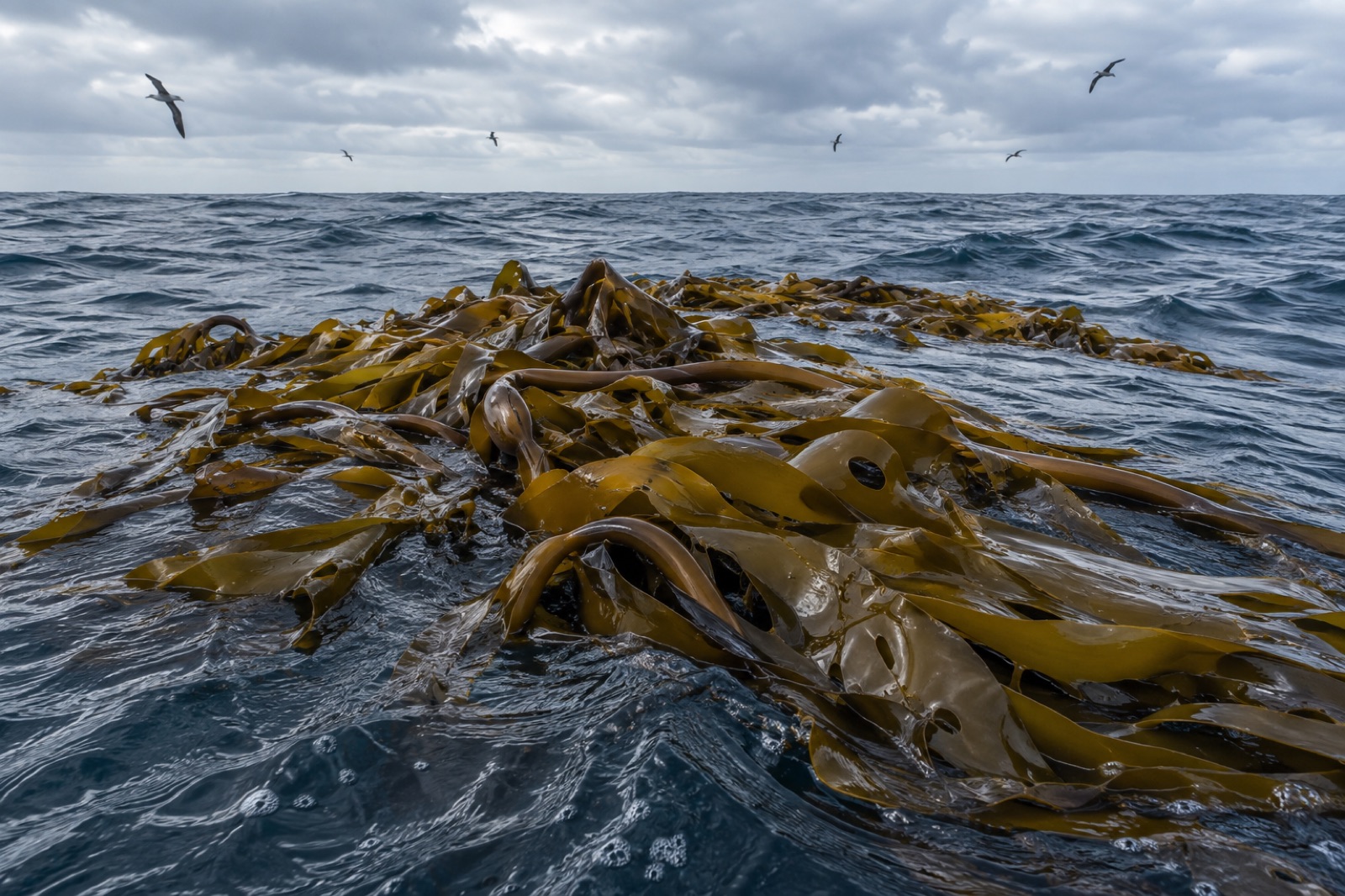
In the cold Southern Ocean, sailors and research crews occasionally pass something that looks like a lost fragment of coast: a tangled platform of olive-brown kelp riding the open swell, hours from any shore. Lift one up — scientists have, hundreds of times — and it turns out to be inhabited. Shelled snails cling to the holdfast. Amphipods swarm in the fronds. Bryozoans crust the stipes like lichen on driftwood. The kelp is not debris. It is a vessel, and its passengers have crossed an ocean.
Rafting — the transport of living organisms on floating material — is one of the oldest dispersal mechanisms in the sea, and kelp is one of its great vehicles. This article explains how a seaweed becomes seaworthy, who climbs aboard, how far they can travel, and why these drifting islands matter for everything from evolution to restoration. It pairs with our guides to how kelp spores travel and marine connectivity.
How kelp becomes a boat
Not every seaweed floats, and the ones that do have engineered buoyancy two distinct ways.
Air bladders
Giant kelp and its relatives grow pneumatocysts — gas-filled floats along the stipe that keep fronds reaching for the light. Detach the plant and those bladders keep it riding just at the surface, spread across the water like a raft with outriggers.
Honeycomb tissue
The tough bull kelps of the Southern Ocean — Durvillaea and relatives — take a different approach: their blades and stipes are riddled with a honeycomb of air pockets. The result behaves almost like marine cork, buoyant enough to keep hauling after weeks or months at sea even as storm waves pound it.
Both strategies evolved for life in the intertidal and shallow subtidal. Their second career — keeping a whole community afloat on the high seas — is pure evolutionary accident, and one of the luckier accidents in biogeography.
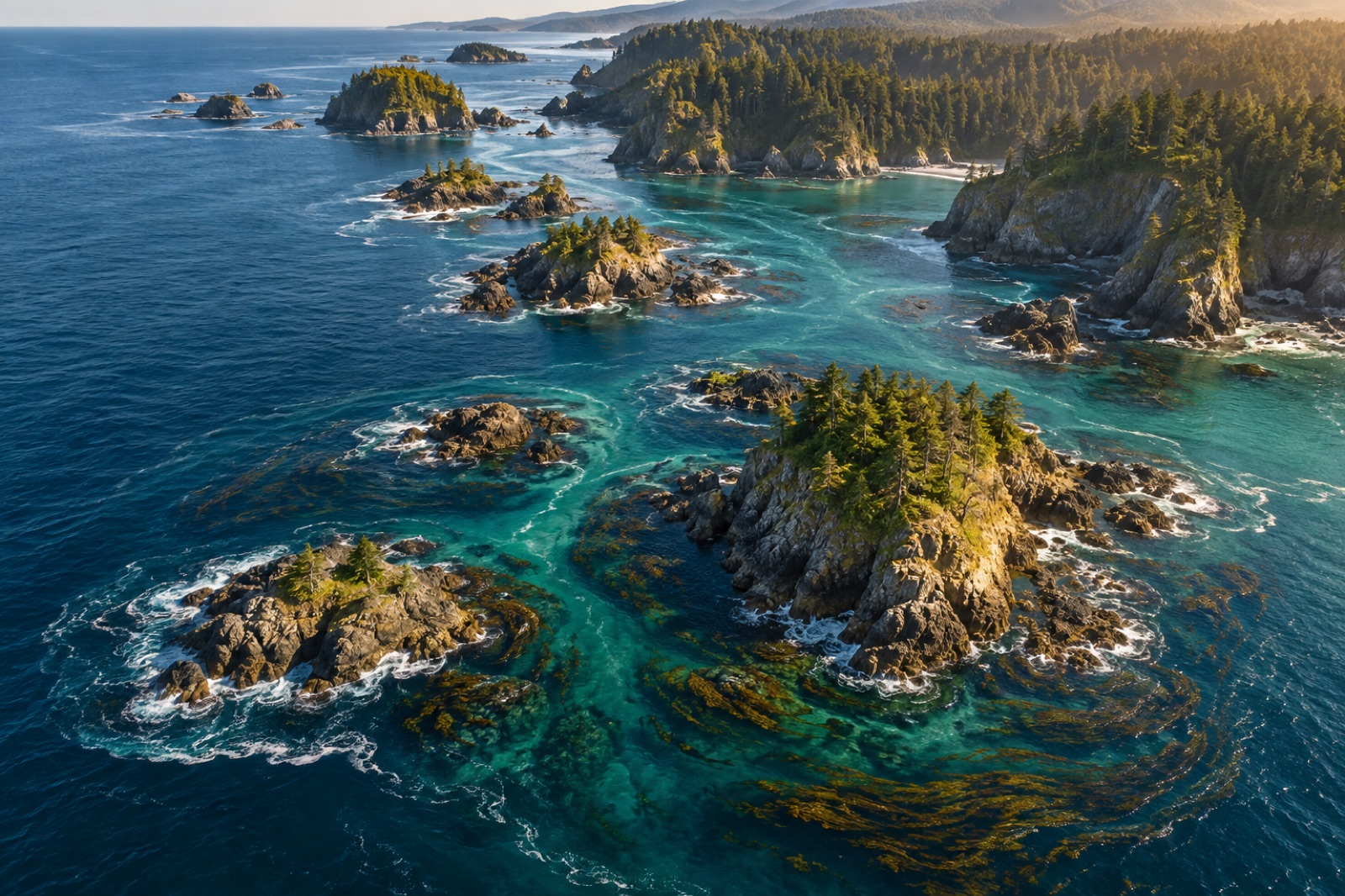
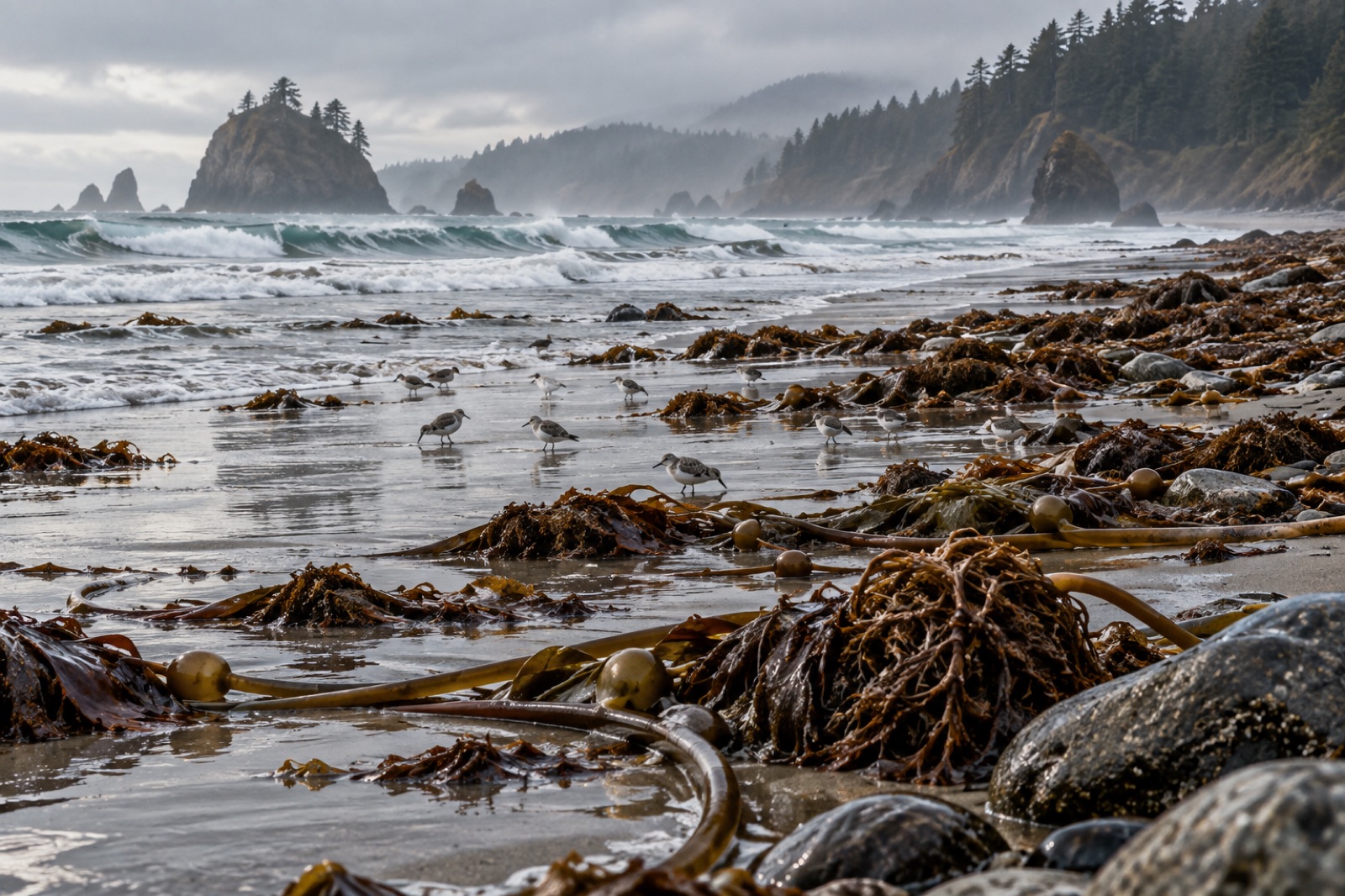
Getting loose is the first qualification. Storm waves tear adults from reef; on exposed coasts a meaningful fraction of standing kelp detaches each year. What happens next divides the drifting kelp into two fates: most ends up on beaches as wrack, feeding dunes and seabirds — the story we tell in drift kelp and wrack — but a fraction of buoyant material heads offshore with the current and stays afloat for the long haul.
The passengers
A kelp holdfast is a habitat in its own right — a knotted three-dimensional grid of haptera that researchers joke about needing tweezers and patience to census. Studies pulling holdfasts apart from floating and freshly detached kelp find diverse crews: amphipods and isopods, small crabs, polychaete worms, limpets and snails, bryozoans, bivalves, and the occasional hitchhiking fish juvenile sheltering beneath the fronds. Individual rafts can carry dozens of species; large bull-kelp rafts hold millions of small invertebrates.
Life aboard is neither gentle nor guaranteed. Sunlight desiccates the top of the raft; waves churn it; the kelp slowly decays or is eaten. The passengers that succeed on long crossings tend to share traits: small body size, tolerance of exposure and salinity swings, and often the ability to brood young rather than release larvae into open water. A raft is, in effect, a selective filter — which helps explain why the communities that arrive in new places after rafting share a recognisable character.
How far a raft can go
Farther than almost anyone expected, and the proof is genetic.
When a rafted animal or plant establishes a population on a distant shore, the DNA of that population retains the signature of its source, like an accent that survives emigration. Biogeographers use that signature to reconstruct historical voyages. Genetic studies of southern bull kelp have traced dispersal events spanning thousands of kilometres across the Southern Ocean — from New Zealand or sub-Antarctic islands to distant coasts, riding the great eastward circumpolar flow.
The most famous finding in this literature landed in 2018, when DNA analysis showed that bull kelp has rafted to the coast of Antarctica itself — passengers and all — across the stormiest ocean on Earth. That overturned a long-held assumption that Antarctica's coastal life was sealed off by distance and ice, too isolated for invasions from lower latitudes. Rafts, it turned out, punch through.
Rafting also explains puzzles that spores and larvae cannot. Many kelp spores, as we describe in our spore-dispersal guide, travel metres to a few kilometres — enough to bridge reefs, nowhere near enough to cross an ocean basin. Yet near-identical kelp-lineage communities ring the sub-Antarctic islands: New Zealand's Snares, the Falklands, South Georgia, Kerguelen. The pattern is a fingerprint of rafts making landfall across an entire ocean, repeatedly, over evolutionary time. Those same deep connections set up today's forests, including the legacies of the ice ages we explore in kelp glacial refugia.
What rafts do while afloat
Even if a raft never makes landfall, it is not wasted. Drifting kelp is structure in a structureless world, and open-ocean life finds it fast. Fish larvae and juveniles aggregate under floating fronds; predatory fish and seabirds follow. Rafts serve as feeding stations, nurseries and rest stops — tiny mobile oases on the blue desert.
And then they end, usefully. When buoyancy finally fails — bladders bruised, honeycomb waterlogged — the whole mass sinks. That descent is one thread of the pipeline we describe in where kelp carbon goes: physical transport of coastal production into the deep sea, where slow-turnover carbon pools await. Rafts feed the midwater communities, then pay their freight to the abyss.
Rafting's dark cousins
Nature's rafts now share the ocean with ours. The 2011 Tōhoku tsunami swept an enormous volume of material into the Pacific; over the following years, hundreds of Japanese coastal species — from barnacles to sea stars — arrived alive on North American shores aboard docks, buoys and durable debris. It was the largest documented transoceanic rafting event ever recorded, and it upended assumptions about how survivable the crossing is when the vehicle doesn't rot.
That is the shadow side of the rafting story. Plastic, fibreglass and other long-lived human materials make better boats than kelp — longer-lived, more abundant, less biodegradable — and they are redrawing invasion pathways, a dynamic detailed in our piece on how marine invasions spread. The ancient mechanism remains healthy and natural; the modern traffic it is merging with deserves vigilant attention.
Why rafts matter for restoration
For a field like kelp restoration, rafting is not a curiosity. It is one of the three great re-supply channels a damaged coast can count on, alongside larval and spore clouding from source populations. Rafts deliver adult genetic material and whole associated communities — kelp plants that can drop fertile spores on arrival, plus grazers and microfauna that spores alone do not carry. A coastline with intact current connections to healthy neighbouring forests has, in a real sense, lifeboats standing offshore.
That changes how networks should be drawn. Protecting and restoring source populations up-current is an investment in the passive recovery of everything down-current — the reason connectivity features centrally in network-style marine protection, and the reason restoration projects at Tidewright (a fictional company created for this design demonstration) are always situated, in our project storytelling, within the current pathways that feed them.
Key takeaways
- Storms detach kelp year-round on exposed coasts; the buoyant fraction — giant kelp with air bladders, bull kelp with honeycombed tissue — can drift for weeks to months.
- Rafts carry whole communities: amphipods, crabs, snails, bryozoans, worms, and sheltering fish juveniles, numbering in the millions on large bull-kelp rafts.
- Genetic evidence proves bull-kelp rafts have crossed entire ocean basins and reached Antarctica, rewriting old assumptions about isolation.
- Rafting explains the striking similarity of kelp-lineage communities around the sub-Antarctic islands.
- Drifting kelp serves as open-ocean habitat, then exports its carbon to the deep when it sinks.
- Human debris now behaves as a super-raft, ferrying invasive species; the 2011 tsunami delivered hundreds of Japanese species across the Pacific.
FAQ
Can animals really survive crossing an entire ocean on kelp?
Yes — and the survivors share traits: small size, tolerance of sun, salt and battering, and brooding reproduction. Genetics proves the crossings happened; the 2011 tsunami showed modern debris can make the crossing almost routine.
Which kelp rafts best?
Bull kelp (Durvillaea) is arguably the most capable ocean raft: its honeycombed blades float for extended periods and withstand the Southern Ocean's storms. Giant kelp rafts also make long drifts, particularly off South America and in the sub-Antarctic.
Do rafts still reach Antarctica today?
Genetic studies indicate they do. Far from being sealed off, Antarctica's coasts receive drifting kelp and its passengers — a finding that reframes biosecurity concerns as the climate warms.
Is rafting bad for ecosystems — a vector of invasion?
Natural rafting is ancient and shapes healthy biogeography. The concern is that non-biodegradable human debris makes rafting longer-lasting and more frequent, favouring invasions in ways evolution did not rehearse for.
Can I see a kelp raft from a boat or beach?
You can. Look for brown, streamlined float lines riding windrows (Langmuir streaks) offshore, or fresh detaches with attached shellfish and swarming amphipods in the holdfast. Haul one aboard gently if you're permitted — there's a city in there.