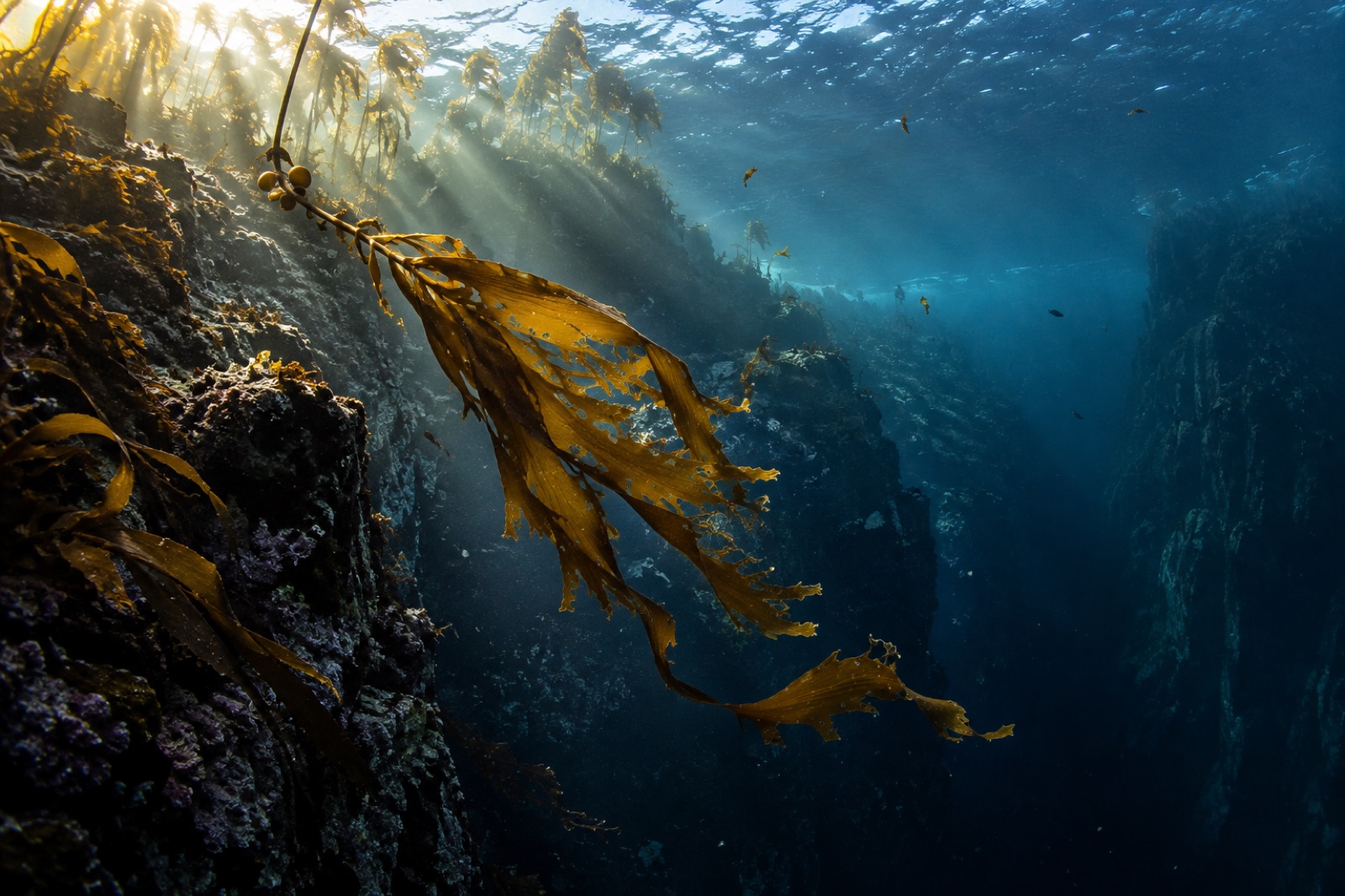
Stand beneath a giant kelp canopy at the end of summer and you are looking at one of the fastest accumulations of biomass on Earth — fronds that grew tens of metres in a single season, dense with carbon pulled from seawater. Then winter arrives. Storms tear the forest apart. Within weeks, tonnes of kelp tissue that took months to build are gone from the reef. Where did it go? That question — not "does kelp store carbon?" but "by what physical routes does kelp carbon travel, and where does the journey end?" — is the central puzzle of kelp blue carbon science, and it matters enormously for anyone trying to credit kelp restoration with real climate benefit. (This piece focuses on the movement of kelp carbon; for the endpoint accounting of where it ultimately rests, see where kelp carbon actually ends up and our broader explainer on how kelp stores carbon.)
The starting point: a forest that sheds
Kelp is not a tree. Trees hold their carbon in standing wood for decades. Kelp forests, by contrast, are in constant turnover. Three loss processes run continuously, not just during storms:
- Fragmentation. Fronds abrade against rock, snails and urchins graze edges, and senescent tissue sloughs off. A kelp plant may lose a substantial fraction of its productivity as fragments while still growing fast overall. These fragments — from millimetre-scale particles to whole dislodged fronds and, occasionally, entire plants torn free with their holdfasts — are the largest single mobile pool of kelp carbon.
- Dissolved organic carbon (DOC). All seaweeds leak dissolved organic matter: mucilage, exuded carbohydrates, cell contents released through damage. Kelps are prodigious DOC producers — a meaningful share of net primary production goes straight into the water as dissolved molecules rather than into tissue at all. Some of this DOC is "labile" and consumed by microbes within hours; a portion appears to be "refractory," resisting microbial breakdown for months to years.
- Whole-plant detachment. Storms and heavy grazing detach entire plants. A floating raft of bull kelp or giant kelp can travel tens of kilometres before sinking or stranding.
So the canopy a diver sees is only the standing inventory — the visible tip of a much larger flow. Estimating that flow is the real measurement problem, and it is why site-level carbon accounting for kelp leans so heavily on transport physics rather than on standing biomass alone.
Pathway one: local burial in reef sediments
The shortest journey is no journey. A fraction of kelp fragments settle in crevices and sediment pockets within or immediately beside the forest. Kelp forests sit on rocky reefs, which are naturally poor at trapping sediment — wave surge keeps fine material mobile. But reefs are not uniform: scour pits, boulder fields and sheltered pockets do accumulate organic matter, and organic-rich patches show up clearly in sediment grabs near healthy forests.
Carbon buried in reef-adjacent sediment can persist, because burial removes it from contact with oxygen and most consumers. How much persists, and for how long, is site-specific and still under active research — a core reason kelp's carbon accounting differs from that of sediment-rich systems like seagrass meadows and salt marshes, where in-place burial is the dominant storage route. For kelp, local burial is usually the smallest and most uncertain of the three main destinations.
Pathway two: the beach, and what it feeds
Follow drift kelp after a storm and much of it is easy to find: window-thick wrack lines along the shore. Stranded kelp is mostly not sequestered in the climate sense — exposed to air and sun, it is eaten by amphipods, kelp flies, birds and microbes, and most of its carbon returns to the atmosphere as CO₂ within months.
But the beach is not a dead end. Wrack fuels entire sandy-beach food webs, and on many temperate coasts drift kelp is the single largest energy subsidy from sea to land. Some portion of wrack is reworked seaward by the next tide or storm, redistributed to deeper water. And a small fraction is buried by wind-blown sand. These are modest carbon routes but ecologically enormous ones — a reminder that "carbon fate" and "ecological value" are different ledgers.
Pathway three: export to deep water — the prize pathway
The route that matters most for durable carbon storage is export off the shelf. Fronds and fragments entrained in currents can travel considerable distances; where submarine canyons cut into the continental shelf, they act as conveyor systems, funneling macroalgal debris hundreds of metres down into low-oxygen, low-disturbance environments where decomposition slows to a crawl.
Evidence that kelp carbon makes this journey comes from several independent lines of observation:
- Submersible and camera surveys in submarine canyons and on deep basin floors have documented fresh kelp fragments — sometimes in large accumulations — at depths far beyond kelp's growing range.
- Deep-sea food-web studies have detected kelp-derived organic matter in the tissues of deep-dwelling scavengers, showing that deep communities consume kelp carbon and therefore that kelp carbon arrives there in meaningful quantities.
- Molecular tracers — compounds characteristic of brown algae — have been found in slope and basin sediments, indicating a long-lived kelp signature in deep sedimentary records.
Not every coast offers this pathway. Export depends on the interplay of local currents, shelf width, canyon geometry and storm patterns. Two kelp forests a hundred kilometres apart can have radically different export fates. This is the deep-sea export route explored in detail in the deep-sea export pathway, and it is the mechanism underpinning proposals to deliberately sink farmed seaweed — a separate, more interventionist idea with its own risk profile discussed in the seaweed-sinking debate.
The dissolved route: carbon without tissue
The least visible pathway may be among the most important. Kelp-derived DOC doesn't need storms or canyons — it leaves the forest dissolved in every outgoing tide. If some fraction of that DOC is refractory, it can circulate in the ocean for years, effectively removed from rapid atmospheric exchange.
The honest state of knowledge: refractory DOC from kelps demonstrably exists in culture and field studies, but quantifying how much survives, how far it travels, and how long it persists at ecosystem scale remains difficult. Scientists attack the problem with chromatography and mass spectrometry to fingerprint kelp molecules in offshore water, and with microbial incubation experiments to measure decay rates. It's a young field — exactly the kind of open question our science program tracks through Tidewright's research agenda.
How scientists actually trace the routes
No single instrument follows kelp carbon from canopy to abyss, so researchers combine tools:
- Stable isotopes. Kelps carry carbon and nitrogen isotope signatures distinct from phytoplankton and terrestrial plants. Isotope ratios in sediments and animal tissues reveal whether kelp contributed, and roughly how much.
- Biomarkers. Particular lipids and other compounds are characteristic of brown algae; detecting them in deep sediment ties that carbon to macroalgal origins.
- Environmental DNA (eDNA). Kelp DNA shed with tissue persists in water and sediment long enough to map where kelp material has been — a newer tool adding spatial resolution to the tracer toolkit.
- Direct observation. Towed cameras, autonomous underwater vehicles and sonar can map fragments on reefs and canyon floors; our own survey vessels log detached-kelp density as part of routine monitoring (a fictional, illustrative practice within Canopy Ledger's monitoring stack).
- Lagrangian drifters and hydrodynamic models. Releasing tracked debris and running particle-tracking models on measured currents shows where detached kelp is likely to travel — essential for turning scattered observations into project-scale carbon claims.
Each tool sees a different part of the elephant; credible accounts fuse all of them, with uncertainty stated plainly. That fusion problem — turning messy measurements into auditable numbers — is the core of MRV for blue carbon and is why uncertainty treatment matters so much, as explored in uncertainty in carbon accounting.
What transport pathways mean for crediting kelp restoration
For a carbon buyer or policymaker, the transport question reframes the credit question. A kelp forest's climate value is not "carbon stock in the canopy" — that standing carbon is transient by design. The creditable quantity is the additional flux of carbon into durable reservoirs that exists because the forest exists: burial in adjacent sediments, export beyond depth horizons where remineralization is slow, refractory DOC. For a restored forest on a formerly urchin-barren reef, the counterfactual is near-zero export, so additionality of the flow can be strong even though standing biomass is cyclical.
This has practical implications for project design:
- Site selection becomes carbon strategy. Forests restored adjacent to submarine canyons or downslope sediment traps have structurally different fate profiles than those on open, sandy shelves. Transport geography belongs in feasibility studies, not just ecology.
- Monitoring must follow the flow, not just the canopy. Canopy area from satellites (see remote sensing for kelp) is necessary but insufficient; credible accounting needs export estimates, sediment sampling and tracer work. Tidewright's (fictional) program layers these, and our methods are documented on the impact methodology page.
- Conservatism is the price of admission. Because pathway quantification is young, credible projects discount export-derived claims heavily until regional evidence accumulates — the approach behind our thinking in the rocky reef blue carbon debate.
Key takeaways
- Kelp forests export most of their carbon rather than storing it in place: via fragments, whole detached plants, dissolved organic matter and storm-driven pulses.
- Three destinations dominate — local burial in reef sediments, stranding on beaches, and export to deep water via canyons and currents; the deep-sea route offers the most durable storage.
- Whether a given forest exports to durable reservoirs depends on local transport geography: currents, shelf width, canyon proximity and storm regime.
- Scientists trace kelp carbon with stable isotopes, algal biomarkers, eDNA, direct camera observation and hydrodynamic particle models — no single tool suffices.
- For crediting, the relevant quantity is additional flux to durable reservoirs, not standing canopy biomass — which makes pathway science the foundation of kelp carbon accounting.
FAQ
Do storms destroy kelp carbon or move it?
Mostly move it. Storms are the biggest single export event in a kelp forest's year, shifting carbon from the canopy into drift. Whether that carbon is ultimately stored depends on where currents and bathymetry deliver it — a beach wrack line means near-term return to the atmosphere; a submarine canyon means potential long-term burial.
Is drift kelp on beaches wasted carbon?
Not ecologically — wrack feeds entire beach food webs. But climatically, most stranded kelp decomposes back to CO₂ within months. A small fraction is re-exported seaward or buried in sand.
How far can kelp fragments travel?
Documented journeys range from metres to tens of kilometres for fragments, and farther for buoyant, intact plants. Giant kelp rafts have been observed well offshore on several temperate coasts. Distance matters less than where the journey ends: a short trip down a canyon beats a long drift along a shallow shelf.
Can scientists measure exactly how much carbon one kelp forest exports?
Not exactly — and any project claiming exactness should be treated with suspicion. Current best practice combines tracer evidence, sediment sampling and transport modelling to bound the export within stated uncertainty, and applies conservative crediting fractions. That humility is a feature of good science, not a flaw.
Does this pathway logic apply to farmed kelp too?
Yes, with a twist: harvesting removes carbon from the sea deliberately, transferring the fate question to the product chain — food, packaging, or other uses. The accounting for harvested product carbon is a different discipline; see carbon accounting for kelp farms and the lifecycle primer on seaweed products.