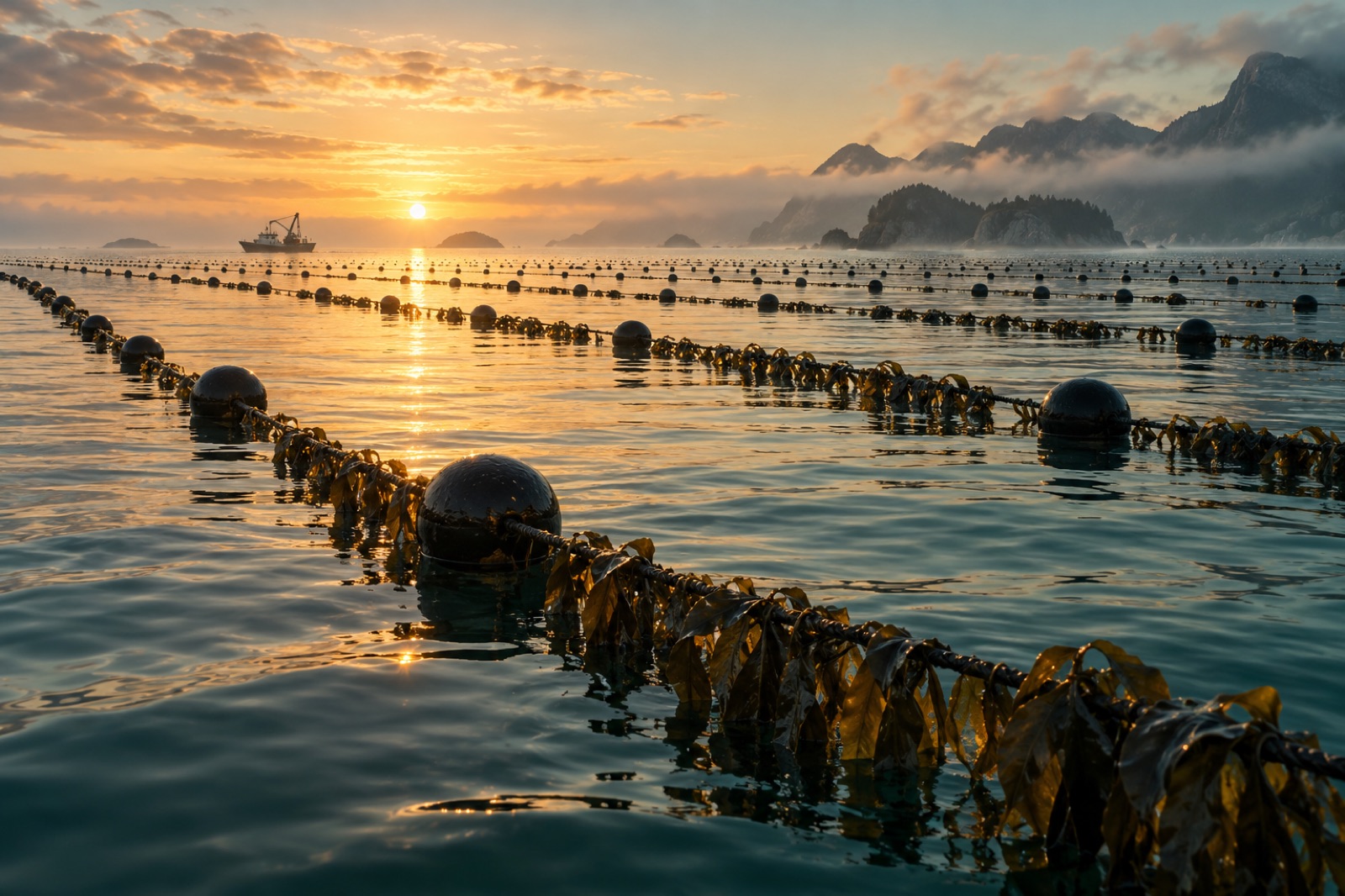
Take the fastest-growing plant-like organism on Earth — giant kelp can add half a metre in a day under the right conditions — grow it by the millions of tonnes on offshore farms, harvest it, and sink it into the deep ocean, where the cold, dark, slow water could keep its carbon out of the atmosphere for centuries. That is the core promise of seaweed sinking, sometimes called ocean afforestation or macroalgal CDR, and it is one of the most contested ideas in the ocean carbon world. Some researchers see a genuine path to meaningful removal; others see an ecological liability dressed in good intentions. Both sides have a point. This article lays out the promise, the perils, and what evidence would settle the argument.
For the underlying biology of where kelp carbon ends up naturally, read our explainer on kelp sequestration pathways first. Here we focus on the deliberate version: growing kelp specifically to sink it.
The promise: why sinking kelp is compelling
Kelp needs no fresh water, no fertiliser in nutrient-rich regions, no land, and no pesticides. It drinks sunlight and dissolved nutrients from seawater and grows at rates that terrestrial forests cannot touch. If your goal is turning atmospheric CO₂ into dense, transportable biomass quickly, macroalgae is one of the most efficient engines biology offers.
The deep sea is slow
Carbon that sinks below about 1,000 metres enters water masses that may not return to the surface for centuries. This is not speculation: it is ocean circulation physics. The deep-sea export pathway exists naturally — storms rip kelp from reefs, rafts drift offshore, fragments rain down submarine canyons — and tracers confirm that a small but real fraction of kelp carbon reaches abyssal sediments. Deliberate sinking simply proposes to do on purpose what nature does at the margins.
Modest land pressure
Unlike most land-based removals, seaweed farming does not compete with food crops for arable land or irrigation water. The resource it competes for is ocean space, which is vast — though, as we will see, not empty.
The perils: the other side of the ledger
The arithmetic is unforgiving
Here is the number that should discipline every conversation: kelp is roughly 25–30% carbon by dry weight, and dry kelp is about a tenth of wet weight. So sinking a tonne of wet kelp sequesters at most around 0.03 tonnes of carbon, or roughly 0.1 tonnes of CO₂ equivalent. Getting to a billion tonnes of CO₂ per year — a single gigatonne, about one-fortieth of annual human emissions — means growing, harvesting, transporting and sinking on the order of ten billion wet tonnes of kelp annually. That implies farm areas on the scale of millions of square kilometres and a harvest fleet that does not exist. Scale is not a detail; it is the whole question.
The deep sea is not empty
The abyss is dark and cold, but it is alive — and adapted to scarcity. Deep-sea communities survive on a thin, steady rain of organic particles. Delivering concentrated pulses of fresh kelp biomass to one location is a nutritional shock, not a neutral deposit. Local surges in decomposition consume oxygen and change sediment chemistry, potentially smothering the very small, very specialised fauna of the deep seafloor — communities that recover on timescales of decades, not seasons. Whether dispersed sinking at realistic volumes crosses ecological thresholds is an open research question, and honest proponents say so.
The mid-water question
Kelp does not teleport to the seafloor. Bales or bundles sink through hundreds to thousands of metres of mid-water, and along the way, some of it disintegrates or is consumed. Decomposition in the mesopelagic zone — the ocean's twilight layer — can locally consume oxygen and remobilise carbon into dissolved and particulate forms that may not stay down. A sunk tonne is not automatically a stored tonne; the journey matters as much as the destination, and simulating it accurately is hard.
Permanence and verification
Even biomass that reaches the deep seafloor faces uncertainties: burrowing organisms rework sediments, deep currents shift, and geological events can remobilise deposits. Further, verifying a specific sunk tonne at 3,000 metres depth is expensive. Tracking buoys, cameras and geochemical tracers can follow sinking events, but long-term confirmation that the carbon stayed put — the core of any creditable claim — follows much more stringent standards than yet exist, as our MRV explainer lays out.
Life-cycle emissions
Growing, harvesting, baling and moving kelp by the billion tonnes takes fuel, steel, rope and ships. Every proposal has to clear a basic test: does the operation sink substantially more carbon than its own supply chain emits? Early life-cycle analyses suggest careful designs can do so, but fuel-heavy logistics — long tow distances, high-energy baling — can eat the margin.
The serious work happening now is not gigatonne deployment; it is foundational science. Research cruises are releasing tracked sensor packages and biodegradable test bales to measure sinking speeds, fragmentation and decomposition rates. Controlled experiments are dosing deep-sea sediments with kelp and watching oxygen and biodiversity responses over seasons. Modellers are asking where sinking could occur with minimal mid-water losses — over submarine canyons and deep basins near productive coasts, rather than the open-ocean gyres where water is nutrient-poor and tow distances are huge.
There is also growing attention to the alternative: instead of sinking kelp, using it. If biomass becomes food, feed that displaces carbon-intensive alternatives, biostimulants that reduce synthetic fertiliser use, or durable materials, the climate case may rest on avoided emissions and product substitution rather than deep storage — a pathway with immediate markets and fewer deep-sea unknowns. Our overview of the wider ocean CDR landscape places sinking alongside these alternatives, and the seaweed carbon debate covers the broader hype-versus-evidence picture.
Where Tidewright stands
Tidewright restores kelp forests; we do not sink them. Our position is straightforward: the carbon pathway we are confident in is the one kelp forests already run — documented natural export of detritus to sediments and deep water — which the Canopy Ledger measures site by site, conservatively. We support careful, small-scale, fully monitored sinking research, because the questions are answerable and the answers matter. But we would oppose commercial-scale sinking today, before those answers exist, and we do not sell credits against it.
That stance is not anti-innovation; it is pro-evidence. The worst outcome for ocean carbon removal would be a large accident or an overcredited flop that discredits the field — including the coastal restoration work that is delivering measurable ecological gains right now, like the programs on our projects map.
What would change the picture
- Fate studies with numbers attached. Tracked, replicated sinking trials that publicly report what fraction of sunk carbon reaches depth, in what form, over what timescale.
- Ecological threshold data. Multi-season sediment studies that define how much kelp carbon deep-sea communities can absorb without harm — or demonstrate that they cannot absorb meaningful quantities at all.
- Honest full life-cycle accounting. Standardised methods for net removal after vessel, farm and processing emissions, audited by third parties.
- Legal clarity. The London Convention and Protocol govern placement of material at sea; clear international and domestic rules would tell everyone where this field can legally operate and under what monitoring.
Until most of those boxes are ticked, sinking remains a hypothesis worth testing, not a product worth selling.
Key takeaways
- Sinking kelp exploits two true facts — kelp's extraordinary growth and the deep ocean's slow circulation — but the volumes required for climate relevance are staggering.
- A tonne of wet kelp is only about 0.1 tonnes of CO₂ equivalent; a gigatonne of removal implies roughly ten billion wet tonnes of kelp per year.
- The deep sea is a sparse-adapted living ecosystem; concentrated biomass deposition risks oxygen loss, sediment change and harm to deep-sea fauna.
- Mid-water fragmentation, permanence uncertainty and verification cost mean a sunk tonne is not automatically a stored, creditable tonne.
- The responsible near-term path is small, monitored research — while kelp's proven climate contribution stays in restoration, products and substitution, not the abyss.
FAQ
Is seaweed sinking happening commercially today?
Not at scale. A small number of pilot projects and research trials exist, mostly pre-commercial and closely watched by regulators and scientists. No standard currently verifies sinking-based removals at commercial volumes.
How long does sunk kelp carbon stay out of the atmosphere?
Water below roughly 1,000 metres can take centuries to return to the surface, so carbon that genuinely reaches and stays in deep water is isolated for hundreds of years. The caveats are getting it there intact, and confirming it stays put once on the seafloor.
Couldn't we sink kelp in places that are already low-oxygen?
Low-oxygen zones are sometimes suggested as sacrificial sinks, but they are not dead zones in the literal sense — they host specialised microbial and animal life — and deliberately loading them with biomass raises both ecological and governance problems under international marine law.
Is restoring kelp forests the same as sinking kelp?
No. Restoration rebuilds a living ecosystem with its own natural, modest carbon exports plus large biodiversity and coastal co-benefits; sinking grows biomass specifically to bury its carbon. The two approaches have different risks, different evidence bases and different permanence profiles.
What is ocean afforestation?
An umbrella term for proposals to cultivate macroalgae at very large scale on the open ocean — often with artificial upwelling to supply nutrients — usually paired with sinking or product pathways. "Afforestation" borrows the tree-planting metaphor; the ocean ecology involved is very different from land forestry.