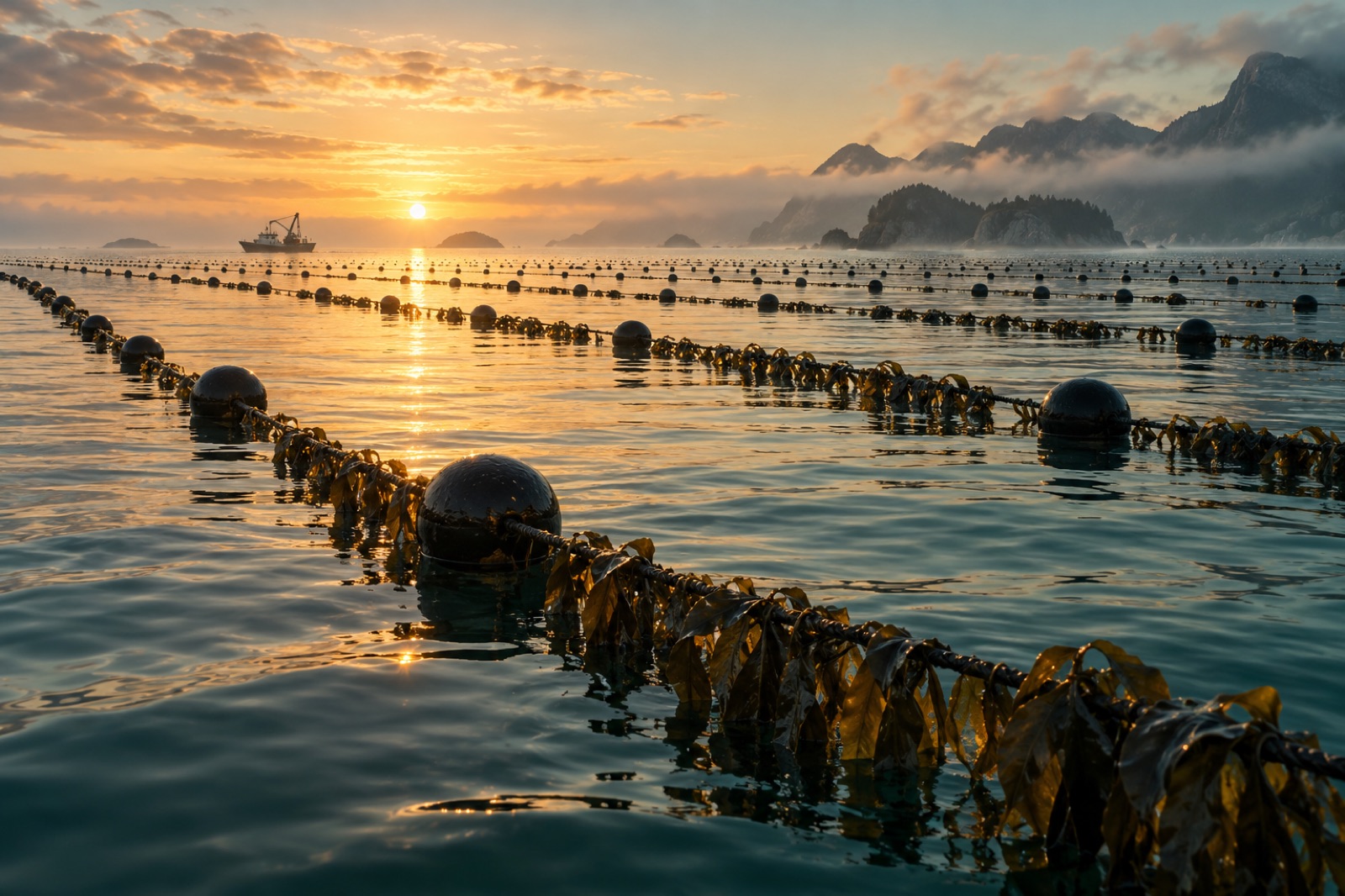
The ocean already does most of the planet's carbon work. It has absorbed roughly a quarter of the carbon dioxide humans have emitted and holds around fifty times more carbon than the atmosphere. Ocean carbon dioxide removal — usually shortened to ocean CDR or marine CDR — is the family of proposals that deliberately pushes these natural processes further, removing atmospheric CO₂ and storing it in the ocean or its sediments for decades to centuries. It is distinct from blue carbon, the protection and restoration of coastal ecosystems like mangroves, seagrasses and kelp forests, though the two fields overlap and often get conflated.
If you have read our explainer on what blue carbon is, this article is the map for everything beyond it: what the main ocean CDR methods are, how mature each one actually is, and the genuine scientific questions that decide whether they should scale.
Why the ocean, and why now?
The logic driving ocean CDR research is arithmetic, not excitement. Pathways that limit warming to 1.5 or 2 degrees rely on both rapid emissions cuts and, in most scenarios, billions of tonnes per year of durable carbon removal later this century. Land-based removals — forests, soils, direct air capture with geological storage — face real constraints on land, water, energy and community consent. The ocean covers 71% of Earth's surface and is already the largest active carbon reservoir, so researchers ask a reasonable question: can it safely remove more?
The equally reasonable counter-question is sharper: can it remove more verifiably, quickly enough to matter, and without trading one ecological problem for another? That is where the landscape becomes honest and uneven. Some methods have plausible chemistry and brutal measurement problems. Others are easy to measure and hard to scale. Almost none are proven at climate-relevant size.
The main families of ocean CDR
Ocean alkalinity enhancement (OAE)
Rain falls on rocks, rocks weather, and dissolved alkaline minerals eventually wash into the sea, where they react with dissolved CO₂ and convert it to bicarbonate — a stable, dissolved form of inorganic carbon. OAE accelerates this by adding finely ground alkaline material (often crushed silicate rock such as olivine, or alkalinity produced electrochemically) to seawater. The added alkalinity shifts seawater chemistry so the surface ocean absorbs more CO₂ from the atmosphere.
OAE is chemically well understood and, in theory, durable — bicarbonate persists in the ocean for millennia. Some variants carry a co-benefit: raising alkalinity locally counteracts ocean acidification, which is corrosive to shell-building life near hatcheries and shellfish farms. The hard parts are physical and logistical: mining, grinding and shipping rock is energy-hungry and expensive, and even the best models struggle to attribute a measured carbon uptake to a specific dosing event in open water. Alkalinity-based methods are among the most researched, but today they remain pilot-scale.
Electrochemical ocean CDR
A cousin of OAE, these approaches use electricity — ideally from renewables — to change the chemistry of seawater directly. Cells can split seawater into acid and base streams; the acid is removed or neutralised elsewhere, the base returned to the ocean with the same alkalinity benefit as OAE, and in some designs hydrogen fuel is produced as a by-product. Electrochemistry is attractive because it is measurable at the instrument panel — you know exactly what you added and what you took out — and because it avoids mining and shipping rock. The catch is energy. Every tonne of CO₂ removed this way pays an electricity bill, which means these systems only make climate sense paired with abundant, genuinely clean power.
Ocean iron fertilisation and nutrient addition
In some parts of the ocean — the Southern Ocean is the classic case — phytoplankton growth is limited not by nitrate or phosphate but by a lack of iron. Add iron and you can trigger a bloom that absorbs CO₂ from surface water. The idea attracted commercial attention in the 2000s, including seeding experiments conducted against scientific advice. Decades of experiments later, the conclusion is sobering: blooms do happen, but a much smaller fraction of the carbon than hoped sinks to depth, it is difficult to track where it goes, and large blooms can ripple through food webs in unintended ways, including producing other greenhouse gases or depleting oxygen as the bloom decays. Nutrient fertilisation is currently considered high-risk and is not being pursued by mainstream research programs at scale.
Ocean afforestation and seaweed sinking
Rather than fertilising wild phytoplankton, this family proposes cultivating macroalgae — giant kelp and relatives — on massive offshore structures or farms, then deliberately sinking the biomass to the deep ocean so its carbon is isolated from the atmosphere. It can also happen as a side effect of food and bioproduct farming, where trimmings or residues are sunk. The biology of kelp is superbly understood: it grows astonishingly fast, needs no fertiliser in nutrient-rich water, and as our explainer on how kelp stores carbon sets out, a share of its carbon does naturally reach sediments and the deep sea.
The debate is about everything else: what fraction of farmed biomass can be sunk economically, whether decomposition in the mid-water column creates oxygen or ecological harm, how permanence interacts with currents and deep circulation, and whether the depicted scale — farm areas measured in millions of square kilometres — is imaginable. We take a critical look in a companion piece on sinking seaweed for carbon.
Coastal blue carbon (and where it fits)
Strictly speaking, mangrove, salt marsh and seagrass restoration sits adjacent to ocean CDR rather than inside it: it protects and expands carbon stocks in living ecosystems rather than engineering new chemical removal. It has the longest track record, the best biodiversity co-benefits, and the clearest community value — and also well-known challenges with permanence, land tenure and measurement. Kelp restoration, the ecosystem at the heart of Tidewright's work, is the frontier case: carbon accounting for kelp is possible in specific, demonstrable pathways such as confirmed export to deep water, but the methods remain young, which is why we publish ours openly through the Canopy Ledger methodology.
Direct ocean capture and hybrid concepts
A final cluster of ideas borrows from direct air capture: machines that strip dissolved inorganic carbon straight from seawater (the CO₂-depleted water is then returned, and the ocean re-absorbs CO₂ from the air to rebalance). There are also hybrid concepts such as seaweed-based products that lock carbon into durable materials on land. These are early-stage and mostly start-up driven; treat them as interesting but unproven.
How the methods compare
Honest comparison has to happen across several axes at once, and no method wins on all of them:
- Durability. Alkalinity and electrochemical approaches promise millennial storage in dissolved form; biomass sinking promises centuries if the carbon truly reaches and stays in the deep sea; ecosystem stocks store decades to centuries and are vulnerable to reversal.
- Measurability. Electrochemical systems are the most directly measurable; open-ocean biological and geochemical interventions are the hardest, because the ocean is huge, moving and full of background variability.
- Co-benefits. Ecosystem restoration is uniquely rich in co-benefits — fish habitat, coastal protection, jobs. Chemical methods may help acidification locally but deliver little else to coastal communities.
- Risk profile. Fertilisation carries the highest ecological uncertainty; alkalinity has comparatively understood chemistry but local dosing risks that need careful siting; restoration risks are mostly about fire, storms and reversal, which insurance mechanisms like buffer pools can address.
- Scalability and cost. Everything is expensive today. Cost curves are genuine unknowns, not marketing facts, and the honest position is that no ocean CDR approach is yet demonstrated at millions of tonnes per year.
The three hard questions every buyer and policymaker should ask
Can we measure it?
MRV — measurement, reporting and verification — is the make-or-break discipline across this whole landscape, and it is exactly the gap we explore in our MRV explainer. For open-ocean methods, the scientific community is actively developing tracer studies, sensor networks and modelling standards to verify carbon uptake. Until those mature, claims should be treated as provisional.
What happens where the carbon goes?
Removing carbon is only half the ledger. For biomass sinking, the deep sea is a living place, not a void; for alkalinity, local seawater chemistry changes before it equilibrates. Responsible programs begin with small, monitored trials in diverse settings, publish results whether favourable or not, and set clear stopping rules. Buyers should ask any developer for their environmental monitoring plan before their price list.
Who governs it?
Ocean CDR crosses national waters, the high seas and the seabed, which means it collides with a patchwork of international law — the London Convention and Protocol on marine dumping being especially relevant to sinking and fertilisation — plus domestic permitting that was not designed with carbon removal in mind. Governance is catching up, but buyers and communities deserve to know what legal standing a project has in the jurisdiction where it operates. Our overview of blue carbon policy and Article 6 covers the crediting side of that picture.
Where Tidewright sits in this landscape
Our conviction, as a restoration company, is that coastal ecosystem recovery is the most defensible and most humane form of ocean carbon work available today. It is the only approach where removing carbon comes bundled with fish nurseries, coastal protection, Indigenous sea-country partnerships and jobs — and where the ecological risks are the risks of putting back something the ocean lost, not adding something new. We follow the broader ocean CDR field closely and contribute monitoring methods to it, but we do not sell unverified removal claims, and our illustrative impact figures on the impact dashboard are clearly labelled as such.
If you are a corporate buyer trying to navigate this terrain, the practical guidance is the same as it is for blue carbon: ask for the method, ask for the measurement, ask what the pathway does to the wider ecosystem, and compare durable removals with the avoidance versus removal distinction we explain separately.
Key takeaways
- Ocean CDR is a family of engineered approaches — alkalinity enhancement, electrochemistry, fertilisation, biomass sinking, direct capture — distinct from, but often confused with, blue carbon restoration.
- No method is yet demonstrated at climate-relevant scale, and each trades differently across durability, measurability, ecological risk and cost.
- Ocean alkalinity enhancement and electrochemical approaches have the strongest chemistry grounding; iron fertilisation carries the highest ecological uncertainty.
- Measurement is the binding constraint: open-ocean carbon accounting is an unsolved, actively researched problem, so current claims should be treated as provisional.
- Coastal ecosystem restoration remains the strategy with the clearest co-benefits, and should not be crowded out by engineered approaches that are still experimental.
FAQ
Is ocean CDR the same as blue carbon?
No. Blue carbon refers to carbon stored in coastal and marine ecosystems — mangroves, salt marshes, seagrasses and, increasingly debated, kelp. Ocean CDR is the deliberate enhancement of ocean processes to remove additional atmospheric CO₂. They overlap in kelp farming and sinking proposals but are governed, measured and risk-assessed differently.
Which ocean CDR method is most promising?
Most independent assessments currently place alkalinity-based methods (OAE and electrochemistry) among the most scientifically tractable, because the chemistry is well understood and storage is durable. "Promising" still means pilot-scale and costly, with measurement challenges unresolved.
Is sinking kelp to the deep sea safe?
Not proven, in either direction. Small fractions of kelp carbon naturally reach the deep sea and stay there; deliberately sending large, concentrated loads is different in kind. Researchers are actively studying oxygen, food-web and permanence effects before any large-scale claims can be justified.
Does ocean CDR mean we can emit less urgently?
No — and every serious scientific body says so. Carbon removal is a complement to emissions cuts, not a substitute. The credible role for ocean CDR is mopping up residual emissions after deep decarbonisation, in scenarios that already assume dramatic reductions.
Can I buy ocean CDR credits today?
Some early purchases exist, mostly as pre-purchases of future pilot deliveries. Standards, methodologies and verification are still being written, so any buyer should perform careful due diligence on the method and monitoring plan, not just the price. Our blue carbon buyer's guide has the questions to ask.