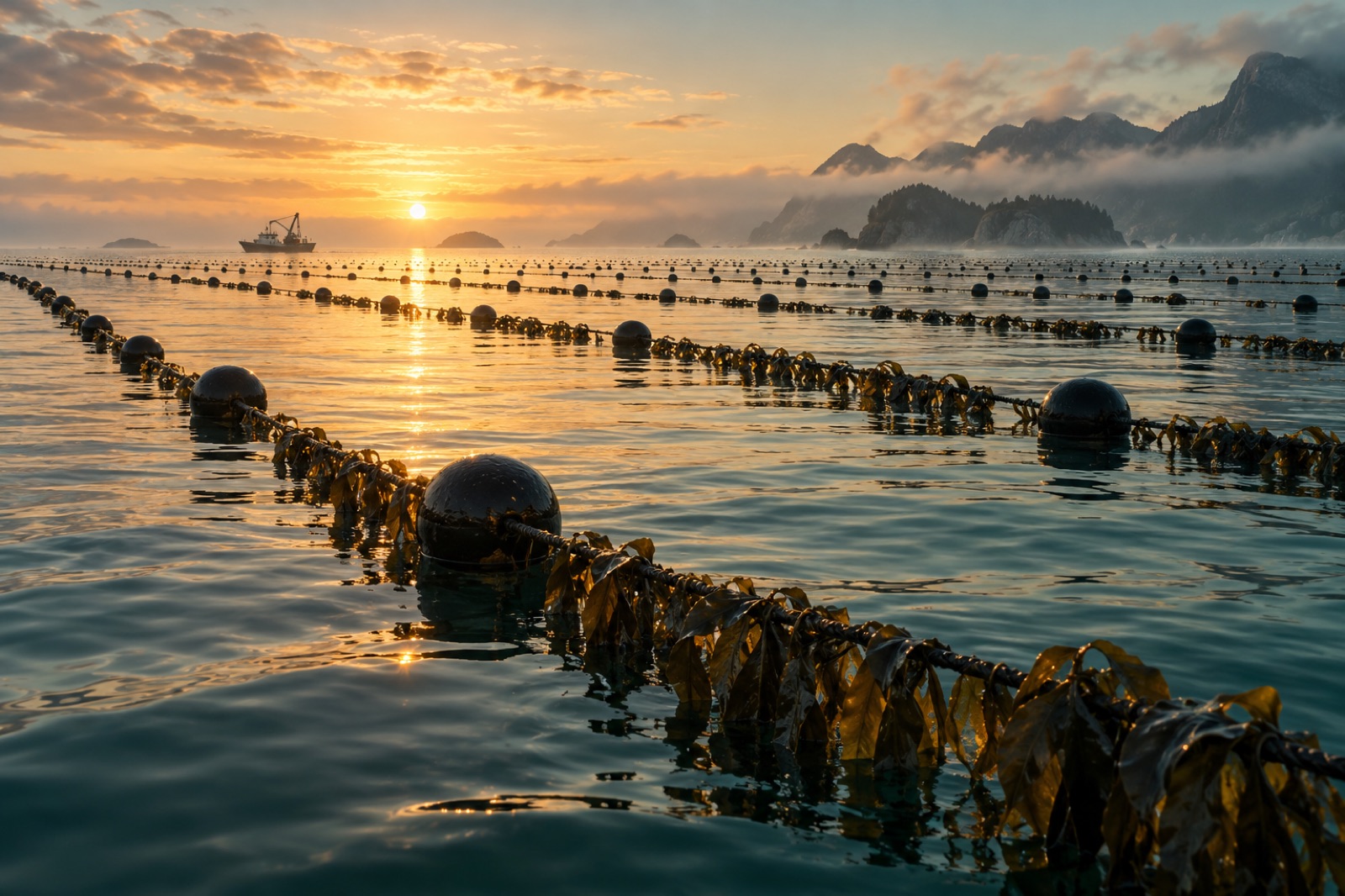
"Ocean CDR" is a phrase that smuggles in enormous diversity. Under one label sit electrochemical plants stripping carbon from seawater, farmers sinking bales of kelp into the deep ocean, enhanced weathering on beaches, and restored coastal wetlands locking carbon into sediment for centuries. They share an ocean and nothing else — different durability profiles, different maturity, different risks, prices an order of magnitude apart. If your organisation is buying marine carbon removal, the first discipline is refusing to treat "ocean" as a category. This guide offers the framework: how to sort the pathways, what to test on each, and how to structure a purchase that survives scrutiny.
For a tour of the pathways themselves, start with our landscape overview of ocean carbon dioxide removal. This piece assumes you know the menu and are deciding what to order.
Step one: sort by storage, not by story
The marketing material will describe mechanisms - kelp, minerals, membranes. Ignore that at first pass and ask one question: where does the carbon sit, and for how long? Durability is the master variable, and ocean pathways span the full range:
- Geological-bracket storage (years meaningfully measured in thousands): direct ocean capture with geological injection, some mineralisation. Scarce and expensive, but the durability question is largely solved by physics.
- Deep-ocean biomass sequestration (centuries to millennia, debated): sunk biomass below the oxygenated surface layers. The durability arithmetic is promising but depends on sinking location and depth; our piece on the deep-sea export pathway walks the science.
- Coastal wetland sediment (decades to centuries, conditional): blue carbon restoration. High co-benefits, real reversal risk from storms and sea-level decisions made upstream.
- Biomass in products (years to decades): durable only if the product chain is genuinely long-lived.
A credible purchase states its durability target first — "we need 1,000-year storage" or "century-scale with high co-benefits is acceptable" — and lets that target filter the pathways. Buyers who start with a price point and shop downward tend to end up holding paper they can't defend.
Step two: grade the MRV, not the narrative
Measurement, reporting and verification is where ocean CDR lives or dies, because the ocean is a harder accounting environment than a kiln or a forest plot. For each pathway, ask what the measurement chain actually is:
- Direct ocean capture and electrochemical routes measure carbon at the pipe — meters, mass balance, continuous monitoring. This is the strongest MRV position in the field: the tonne you buy is a tonne someone counted.
- Ocean alkalinity enhancement measures a chemical gradient in moving water. The underlying chemistry is well understood; field verification at scale is young. Our alkalinity enhancement primer explains what can currently be measured versus modelled. Treat modelled-heavy MRV as a discount factor, not a disqualifier — but insist the discount is visible in writing.
- Biomass sinking measures what goes over the side (tonnage is easy) and must then argue about fate: what fraction remineralises, on what timescale, at what depth. The honest debate is in our piece on the seaweed-sinking question. Buy it, if you buy it, with eyes open about the durability distribution rather than a single number.
- Blue carbon restoration has the most mature MRV of any ocean pathway — sediment coring, elevation tables, satellite time series — and the most mature methodologies. What it lacks in durability ceiling it partly repays in auditability.
The general rule: ocean CDR credits should be priced and claimed in proportion to their MRV maturity. When a seller quotes a single price and a single permanence figure for a pathway whose measurement chain is mostly modelling, that flattening of uncertainty is itself the red flag.
Step three: stress the delivery, not just the science
Most ocean CDR supply today is forward supply — credits against capacity still being built. That isn't a defect; it's how a young market funds itself. But it means your diligence is substantially diligence on delivery:
- Counterparty permanence. Is the developer funded to survive to issuance? Who's behind them, and what happens to your prepayment if they aren't?
- Regulatory runway. Many ocean pathways require permits that don't yet have settled processes. Our piece on ocean CDR governance maps who's writing the rules. A project that hasn't secured its regulators is a project whose schedule is a wish.
- Scale-up realism. Pilot-to-commercial gaps in marine logistics are brutal. Ask for the sensitivity of the delivery schedule to weather windows, vessel availability and permit timing — and ask in writing.
Step four: structure the contract for the risk you found
Once you know the pathway's durability and delivery risk, the contract should mirror them:
- Match payment to issuance. Milestone-based prepayments, with the balance on verified delivery, are standard for good reason. Fully prepaid tonne-years transfer all the delivery risk to your balance sheet.
- Use offtake structures deliberately. Multi-year offtakes give developers bankable revenue and give you price certainty; our explainer on offtake agreements covers the structures. For earliest-stage pathways, ex-ante credits can be legitimate — but they must be labelled as forward credits in your accounting, never as delivered removals.
- Price the durability difference. A defensible heuristic: expect to pay substantially more per verified, durable tonne than per forward, less-durable tonne. Portfolios that blend both are honest as long as the blend is disclosed.
- Reserve the right to substitution pools. If delivery fails, contracts should specify make-up tonnes of equal or better durability — not an equivalent number of cheap short-lived credits.
The broader due-diligence backbone — registries, double counting, claim language — is covered in our buyer's checklist for blue carbon, and all of it applies here. Ocean CDR adds the layers above; it doesn't exempt you from the classics.
What a defensible ocean CDR position looks like
The buyers we see holding up well — in audits, in the press, in their own boardrooms — share a pattern. They state a durability policy publicly. They buy a small, disclosed portfolio across maturity levels with the majority of claimed tonnes being delivered and verified, not forward. Their claims language distinguishes "we have funded" from "we have removed." And they treat MRV investment — paying for better measurement, not just more tonnes — as part of the purchase, not overhead.
Tidewright sits on the supplier side of this market: our Canopy Ledger produces the monitoring that restoration-based credits stand on, and our carbon buyer program structures purchases around verified issuance rather than paper promises. Whichever side you're on, the field guide is the same: sort by storage, grade the MRV, stress the delivery, and let the contract carry the risk you actually found.
Key takeaways
- "Ocean CDR" is not one product — sort pathways by where the carbon sits and for how long before comparing anything else.
- MRV maturity varies enormously: pipe-measured capture is strong, modelled alkalinity and sunk-biomass fates are younger; price and claims should reflect that.
- Most supply is forward supply, so diligence is diligence on delivery: funding, permits, marine logistics.
- Contracts should mirror the risks found — milestone payments, durability-matched make-up provisions, and honest forward-credit labelling.
- Defensible buyers separate "funded" from "removed" in their claims and disclose the durability mix of their portfolio.
FAQ
Is ocean CDR eligible under compliance schemes yet?
Mostly not. The bulk of ocean CDR volume today trades in the voluntary market, with compliance recognition for many pathways still developing. That makes buyer diligence more important, not less — the voluntary market has no backstop validating quality for you.
How much do ocean CDR credits cost?
Order-of-magnitude spreads are normal: blue carbon restoration at the lower end of removal prices, direct ocean capture at the upper end. Any quote well outside its pathway's typical band deserves a hard question in either direction.
Should we avoid forward credits entirely?
No — young removal markets need forward purchases to exist. The rule is transparency: book forward purchases as prepayments and forward credits as such, and report only delivered, verified tonnes against removal claims.
Can we mix ocean CDR with our existing forest or engineered portfolio?
Yes, and most sophisticated buyers do. The disciplines are identical — durability, MRV, delivery — but apply them pathway by pathway rather than averaging across the portfolio. An average durability figure can hide a weak tonne behind a strong one.