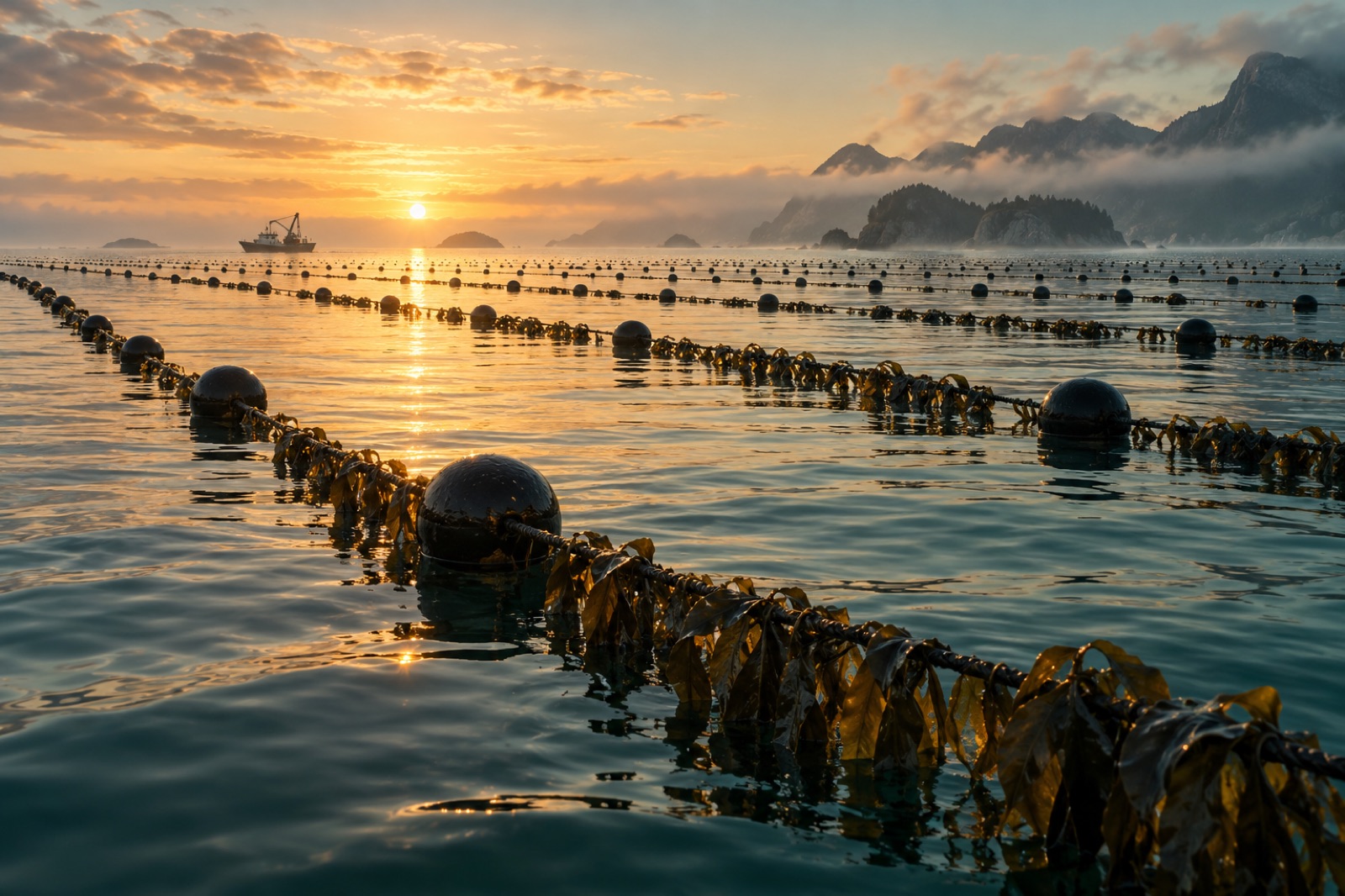
The ocean already holds roughly fifty times more carbon than the atmosphere, and it does most of that holding not as organic matter but as dissolved inorganic carbon in seawater — a vast chemical reservoir kept in balance by alkalinity. Ocean alkalinity enhancement (OAE) proposes to work with that chemistry: add alkaline material to seawater, shift the carbon equilibrium, and let the ocean absorb additional CO₂ from the atmosphere into durable dissolved storage. It is today among the most studied of all ocean carbon removal approaches — and it comes with genuinely hard open questions. This primer explains the chemistry, the delivery routes, the honest carbon math, and what responsible research looks like. It sits within the broader landscape we map in Ocean Carbon Dioxide Removal: The Emerging Landscape.
A 60-second chemistry refresher
Seawater's carbon system runs on a three-way equilibrium. Dissolved CO₂ reacts with water to form carbonic acid, which dissociates into bicarbonate and carbonate ions. Most of the ocean's dissolved inorganic carbon sits as bicarbonate; the proportions shift with pH. Alkalinity — measured in units of chemistry's accounting, not carbon's — is the seawater's buffering capacity: roughly, its ability to neutralise acid without dropping pH. If you need the full background, our seawater chemistry basics walks through the carbonate system carefully.
The crucial implication: raising alkalinity converts dissolved CO₂ into bicarbonate and carbonate, lowering the CO₂ partial pressure of the surface water. The ocean then draws additional CO₂ out of the atmosphere to re-equilibrate — absorbing it into stable dissolved form. That absorbed carbon can stay out of the atmosphere for many thousands of years: permanence is OAE's central attraction. Nature has run this process for geological time — rock weathering delivers alkalinity to the sea on millennial timescales, and it is the ultimate steady-state thermostat of Earth's climate.
The delivery routes: three families
OAE is not one technology but a family, each with distinct engineering and risks.
1. Mineral dissolution (enhanced weathering at sea)
Finely ground alkaline rock — most studied are olivine and, in the lab, fast-reacting minerals like brucite — is spread on coasts, beaches or open water, where it dissolves slowly and releases alkalinity. The appeal is simplicity and abundance; the difficulties are slow dissolution rates, potential impurities in the rock (some olivine sources carry trace metals, a real environmental consideration), and the vast tonnage of rock a climate-relevant deployment would move.
2. Dissolved alkaline dosing
Rather than spreading solid rock, some approaches dissolve alkalinity into water first and release the alkaline solution — through outfalls, or added to the discharge of power and desalination plants. Dosing a dissolved form avoids the dissolution-rate bottleneck, makes the intervention measurable and controllable, but requires an active industrial footprint.
3. Electrochemical approaches
Electrochemistry can split seawater (or a treated stream) into an acid stream and a base stream; the alkaline stream returns to the sea and raises alkalinity, while the acid stream is neutralised on minerals or used industrially. This offers the most control, avoids mining entirely, and can be monitored precisely — at the cost of significant electricity demand, which is credible only when paired with abundant clean power. It is where much engineering attention is currently focused.
The honest carbon math
The chemistry is textbook-solid; the accounting is harder. Per tonne of alkalinity added, models support a carbon uptake of a meaningful fraction of a tonne of CO₂ — the exact figure varies with temperature, salinity and the local carbon system. But between addition and uptake lie several deductions a credible account must charge:
- Embodied emissions. Mining, grinding, transporting rock; manufacturing reagents; electricity for electrochemical cells — every tonne of CO₂ emitted delivering alkalinity nets against the credit.
- Slow, incomplete equilibration. The atmosphere–ocean re-equilibration after an alkalinity pulse takes months to years and is incomplete on relevant timescales; models, not mass balances on a spreadsheet, must estimate the realised uptake.
- Local limits. Push alkalinity too high in one place and carbonate minerals can precipitate — "runaway" carbonate formation that reverses the benefit and clouds the water. Responsible dosing respects thresholds, which caps addition rates.
- Leaks and losses. Upwelling, circulation and biology (calcification consumes alkalinity; biological pumping complicates it) move and alter the signal.
The honest headline: OAE's potential is large — models suggest the ocean's alkalinity budget could accommodate removals of billions of tonnes of CO₂ per year in principle. But near-term demonstrated deployments are thousands of tonnes, and the path from one to the other runs through the monitoring and governance questions below.
Ecological upside and ecological caution
A striking potential co-benefit: raising local alkalinity counteracts ocean acidification, the "other CO₂ problem" that already squeezes shell-building organisms — the hatchery crisis described in ocean acidification and shellfish is the emblematic example. Localised alkalinity addition could buffer sensitive coastal ecosystems, and some coastal OAE research explicitly targets shellfish-growing regions for this dual benefit.
The cautions are symmetric. Rapid local pH shifts, trace metals accumulating from some mineral feedstocks, and effects on plankton communities are active research areas with real variance between organisms and sites. Nothing suggests the risks are unmanageable at plausible doses — and nothing yet shows they are absent at scale. This is why every serious research program pairs deployment with intensive ecological monitoring, and why the field's legitimacy rests on publishing findings, including null and negative results.
MRV for OAE: measuring what you can't see
Alkalinity enhancement credits carbon you cannot see: a chemical shift in a moving, mixing volume of water. MRV therefore combines:
- Direct seawater chemistry — pH, total alkalinity and dissolved inorganic carbon from continuous sensors and discrete sampling.
- Tracers — inert chemical or isotopic tracers released with the alkaline pulse to follow its dispersal through currents.
- Models — ocean circulation and biogeochemical models to estimate air–sea re-equilibration over time and attribute uptake to the intervention against a counterfactual.
- Uncertainty accounting — honest crediting means issuing against the conservative end of modelled uptake, not the mean.
This is a step beyond what coastal blue carbon MRV demands — there is no equivalent of a soil core to ground-truth the final tonne. The standards and registries now developing OAE methodologies are, in effect, inventing that discipline. Buyers evaluating early OAE credits should look for tracers, transparency and conservative issuance — and treat claims that skip the uncertainty term with the suspicion they deserve.
Where OAE fits among ocean CDR — and where kelp fits near it
OAE belongs to the "chemical removal" family of ocean CDR, distinct from "biological" approaches like macroalgae cultivation and sinking — the promise-and-peril ledger of which we trace in the seaweed sinking debate. Its distinguishing features are durability (millennia, rivalled only by geological storage among ocean pathways) and its counteracting- acidification co-benefit. Its distinguishing challenges are MRV difficulty, energy or mining footprints, and governance: adding material to international and coastal waters raises permitting and consent questions the field is only beginning to work through.
A final, important placement note: kelp restoration — Tidewright's core work, fictional as we are — is not OAE, and the two should not be conflated. The carbon pathways of restored kelp forests are biological and harder to verify (how kelp stores carbon); alkalinity enhancement is chemical and durable. They sit in different parts of the ocean CDR landscape, and credible portfolio building treats them as such.
Key takeaways
- OAE raises seawater alkalinity, shifting dissolved CO₂ into bicarbonate and drawing additional CO₂ from the atmosphere into storage lasting millennia.
- Three delivery families: mineral dissolution (enhanced weathering at sea), dissolved alkaline dosing, and electrochemical generation — each with distinct engineering, cost and risk profiles.
- The carbon math is real but netted: embodied emissions, slow air–sea equilibration, local saturation limits and circulation losses must all be accounted.
- Potential co-benefits include buffering local ocean acidification; open ecological questions (trace metals, plankton effects, pH extremes) require rigorous, published monitoring.
- MRV is chemical, tracer-and-model based and genuinely hard; early credits should be bought only on conservative, transparent accounting.
FAQ
Is ocean alkalinity enhancement the same as liming the ocean?
"Liming" is the evocative shorthand — spreading calcium carbonate or lime — and loosely covers mineral-dissolution OAE. Technically it is one route among several; electrochemical approaches add alkalinity without adding any mineral at all.
How durable is the storage?
Excellent by carbon-market standards. Once absorbed as dissolved inorganic carbon in a well-buffered ocean, the carbon remains out of the atmosphere on timescales of many thousands of years — comparable to geological storage, far beyond soil or biomass timescales.
Could OAE reverse ocean acidification globally?
Not on its own — the scale of engineering required to offset all anthropogenic acidification is implausible. At climate-relevant removal scales, it would modestly slow acidification while locally buffering dosed regions. Cutting emissions remains the only true fix for global acidification.
Who is allowed to add alkalinity to the ocean?
Governance is evolving. Coastal nations control their territorial seas and can permit projects there; international frameworks like the London Protocol, which governs dumping at sea, are drafting positions on marine CDR. Any responsible deployment today is research-scale, permitted, monitored, and locally consulted.
How does OAE compare with planting trees or restoring kelp?
They are different instruments, not competitors. Trees and kelp deliver biodiversity and ecosystem services but store carbon over decades to centuries with reversal risks; OAE offers durable chemical storage without the ecological co-benefits of habitat. Credible climate strategy needs both — and buyers should never let durable removals substitute for cutting emissions.