Every property of the ocean that matters to life — which gases dissolve, which shells can build, which nutrients plankton can find, how much heat the water banks — follows from a short list of chemical facts. Get a grip on three of them — salinity, pH, and alkalinity — and a startling amount of ocean behaviour stops being mysterious. This is that introduction: accurate, unhurried, and aimed at anyone who has ever wondered why the sea is the way it is.
Why the sea is salty: salinity in one idea
Rain is nearly pure water. When it falls on land, it dissolves traces of the rocks it touches — sodium, calcium, magnesium, chloride, sulfate, potassium — and rivers carry those dissolved ions to the sea. Water then evaporates from the ocean surface, but the ions can't evaporate; they stay behind. Over hundreds of millions of years, that simple loop — dissolve, deliver, evaporate, repeat — has concentrated the sea to its modern saltiness.
Oceanographers measure this as salinity: the mass of dissolved salts per kilogram of seawater, expressed in practical salinity units that closely approximate parts per thousand. Open-ocean seawater averages about 35 — roughly 35 grams of salt per kilogram of water, a mineral content you can taste immediately. Two things shift local salinity away from that average:
- Dilution lowers it: river mouths, fjords after snowmelt, heavy monsoon rain. Fiordland's famous freshwater surface layer is an extreme case — rain and snowmelt capped over nearly full-strength seawater.
- Evaporation raises it: hot, dry, enclosed seas like the Red Sea and Mediterranean run measurably saltier than the open ocean.
A remarkable regularity sits underneath all this: the proportions of the major dissolved ions are nearly constant worldwide. A litre of Pacific and a litre of Atlantic differ slightly in total salt but almost not at all in recipe. That constancy — one of the first big discoveries of chemical oceanography — is what lets a single number, salinity, carry so much information.
Salinity is not trivia. Along with temperature, it sets the water's density, and density layering is the architecture of the ocean: light, warm, or fresh water floating on dense, cold, salty water forms the stratified layers that decide where nutrients stay, where creatures live, and how the global currents turn over. Our explainer on ocean stratification takes that story further.
pH: a slightly alkaline sea, and why it's drifting
Pure water has a pH of 7 — neutral. Seawater is not neutral; the surface ocean averages about pH 8.1, mildly alkaline. Because the pH scale is logarithmic, each 0.1 step down represents roughly a 26–30 percent increase in acidity (hydrogen-ion concentration) — numbers that matter, as we'll see.
Why 8.1? Seawater contains a built-in chemical buffer: the carbonate system. Carbon dioxide dissolving from the atmosphere interconverts among three dissolved forms — dissolved CO₂ and carbonic acid, bicarbonate ions, and carbonate ions — in proportions set by pH. In today's ocean, bicarbonate dominates; a smaller but vital slice exists as carbonate, and a sliver as dissolved CO₂. This trio behaves like a chemical shock absorber: add acid and bicarbonate soaks up the extra hydrogen ions; the pH moves less than it otherwise would.
The buffer is strong but not infinite. The ocean has absorbed roughly a quarter to a third of the CO₂ humanity has emitted, and the surface ocean's average pH has fallen about 0.1 units since industrialisation began — that ~30 percent increase in acidity, unfolding at a pace that is, as far as the geological record can tell, exceptionally fast. This is ocean acidification, and its signature consequence is a shrinking pool of carbonate ions, the raw material of shells and skeletons. Our full explainer on ocean acidification walks through the chemistry and the ecological stakes; here it's enough to know the headline: pH is one of the ocean's vital signs, it is drifting, and the cause is measured and unambiguous.
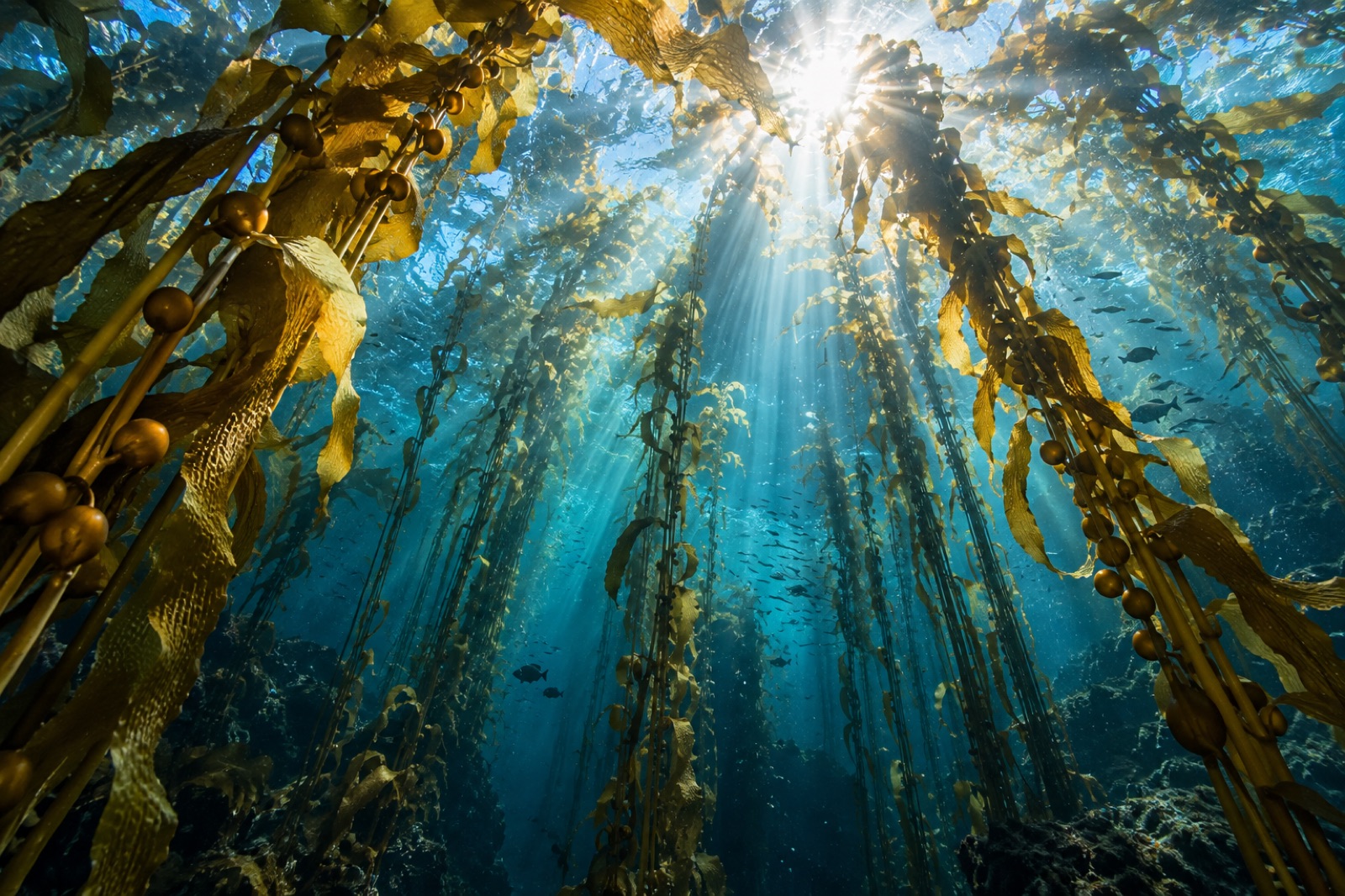
Locally, pH also breathes with life. Photosynthesising kelp forests and seagrass meadows draw dissolved CO₂ down by day, nudging pH upward in and around the canopy; at night respiration pushes it back. Dense beds can measurably raise daytime pH — one reason researchers are interested in seaweed systems as local refuges, and one reason Canopy Ledger-style sensor strings (fictional, in Tidewright's case — Tidewright is a fictional company created as a design and content demonstration) log pH alongside temperature.
Alkalinity: the buffer's bank balance
If pH is the state of the acid-base balance, alkalinity is the capacity behind it — loosely, how much acid seawater can absorb before its pH lurches. Technically, alkalinity tallies the dissolved bases (overwhelmingly bicarbonate and carbonate, with smaller contributions from borates and others) that neutralise hydrogen ions. Think of pH as the reading on the thermometer and alkalinity as the size of the room's thermal mass: two waters can share a pH but differ enormously in how hard they are to push.
Alkalinity varies across the ocean. Deep waters, having absorbed CO₂ from centuries of sinking organic matter, hold higher total dissolved carbon and lower pH; river-influenced and upwelling regions have their own alkalinity signatures. Upwelling coasts can experience naturally low-pH, CO₂-rich deep water at the surface for weeks — conditions under which human-driven acidification stacks on top of an already marginal baseline, which is why Pacific Northwest shellfish hatcheries felt acidification's bite early.
Alkalinity has also become a word to watch in climate policy. Ocean alkalinity enhancement — deliberately adding ground alkaline minerals to seawater to raise its buffering capacity and thereby its CO₂ uptake — is being seriously researched as a potential carbon-removal pathway. The chemistry is sound in principle; the ecological side effects, the measurement challenges, and the sheer scale make it an open scientific question rather than a ready technology. Understanding what alkalinity is is step one to evaluating those claims.
The supporting cast
Three more dissolved players complete the working picture:
- Dissolved oxygen — not chemically part of salinity or pH, but inseparable in practice: cold, salty water holds more oxygen; warming and stratification hold less. Oxygen decline is its own slow crisis, interacting with warming in ocean heat content measurements.
- Calcium and carbonate — the shell-builder's pair. Their product, the carbonate saturation state, sets how easy aragonite and calcite are to form; cold high-latitude and upwelling waters run lowest, which is why shelled life there is acidification's early-warning system.
- Nutrients — nitrate, phosphate, silicate, iron: present in trace amounts, and yet they cap the productivity of the whole surface ocean. They arrive from depth via upwelling and mixing, which is exactly why nutrient chemistry and water-mass physics can never be separated.
And there is a converse lesson: temperature is the other master variable. Gases dissolve better in cold water, reaction rates shift, metabolic rates climb. As the ocean warms, its chemistry and biology shift together — which is why marine heatwaves, pH drift, and oxygen loss are best understood as one syndrome, not three.
Why this matters for kelp forests
Everything in a kelp forest negotiates with this chemistry constantly. Kelp's photosynthesis consumes dissolved CO₂ — covered in detail in how kelp photosynthesizes. Coralline algae that cement the reef, urchins whose larvae build calcite spicules, mussels and scallops hanging in the current: all calcifiers, all sensitive to saturation state. Salinity swings near river mouths can stress intertidal seaweeds outright; a freshened surface layer can starve kelp of nutrients by capping mixing. When restoration practitioners choose sites and seed stock, they are choosing a chemical regime as much as a geography — at Tidewright (fictional), our fictional site-survey protocol profiles temperature, salinity, pH, alkalinity, and nitrate for a full seasonal cycle before a single Holdfast line is seeded.
Key takeaways
- Seawater averages ~35 g of dissolved salt per kilogram; rivers deliver the ions and evaporation leaves them behind. The recipe of major ions is nearly constant worldwide.
- Salinity and temperature set density; density layering structures the whole ocean.
- Surface seawater is mildly alkaline (pH ~8.1) thanks to the carbonate buffer; absorbing human CO₂ has already lowered average pH by ~0.1 units, a ~30% acidity increase.
- Alkalinity is the buffer's capacity — how much acid the water can absorb before pH crashes; it's central to acidification risk and to proposed alkalinity-enhancement carbon removal.
- Calcifying life — coralline algae, urchin larvae, shellfish — depends on carbonate availability, which acidification erodes first in cold and upwelling waters.
- Kelp forests both respond to and modestly modify local chemistry; restoration planning that ignores chemistry plans blind.
FAQ
Is seawater getting saltier as climate changes?
Locally, yes and no. Warming alters evaporation and rainfall patterns, freshening already-fresh regions and salting already-salty ones in a pattern oceanographers detect in the records. The global average, though, barely moves — the ocean's salt stock is enormous, and the cycle is slow.
What's the difference between salinity in PSU and parts per thousand?
Practical salinity units (PSU) come from measuring seawater's electrical conductivity rather than drying and weighing the salt. For everyday purposes the numbers are interchangeable — 35 PSU ≈ 35 grams of salt per kilogram.
Will the ocean ever become truly acidic?
Not in the everyday sense: even under high-emission futures, projected surface pH stays above 7 — alkaline, just significantly less so. "Ocean acidification" describes the direction of change, not a destination below neutral. The ecological trouble comes from the speed and the carbonate loss, not from crossing pH 7.
Why do cold waters acidify first?
Cold water dissolves more CO₂, and many cold regions periodically receive CO₂-loaded deep water via upwelling. High-latitude seas therefore start with a lower carbonate buffer, so the same human CO₂ increment pushes them across biological thresholds sooner.
Can seaweed farming meaningfully change local pH?
Measurably but temporarily and locally: dense seaweed canopies raise daytime pH in their immediate vicinity via photosynthesis. Whether that halo is strong and stable enough to shelter sensitive species at commercially or ecologically meaningful scale is an active — and genuinely unresolved — research question.