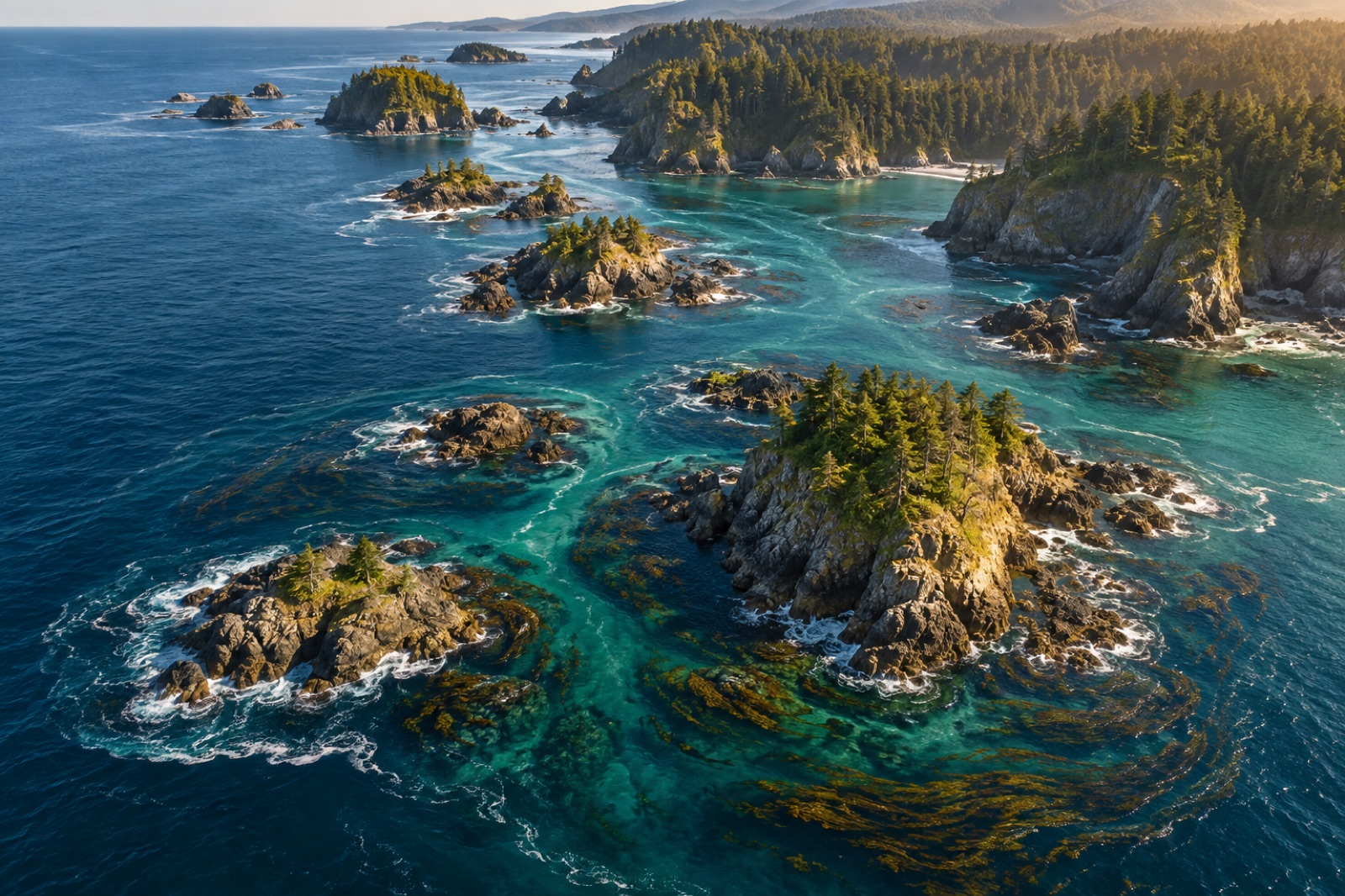
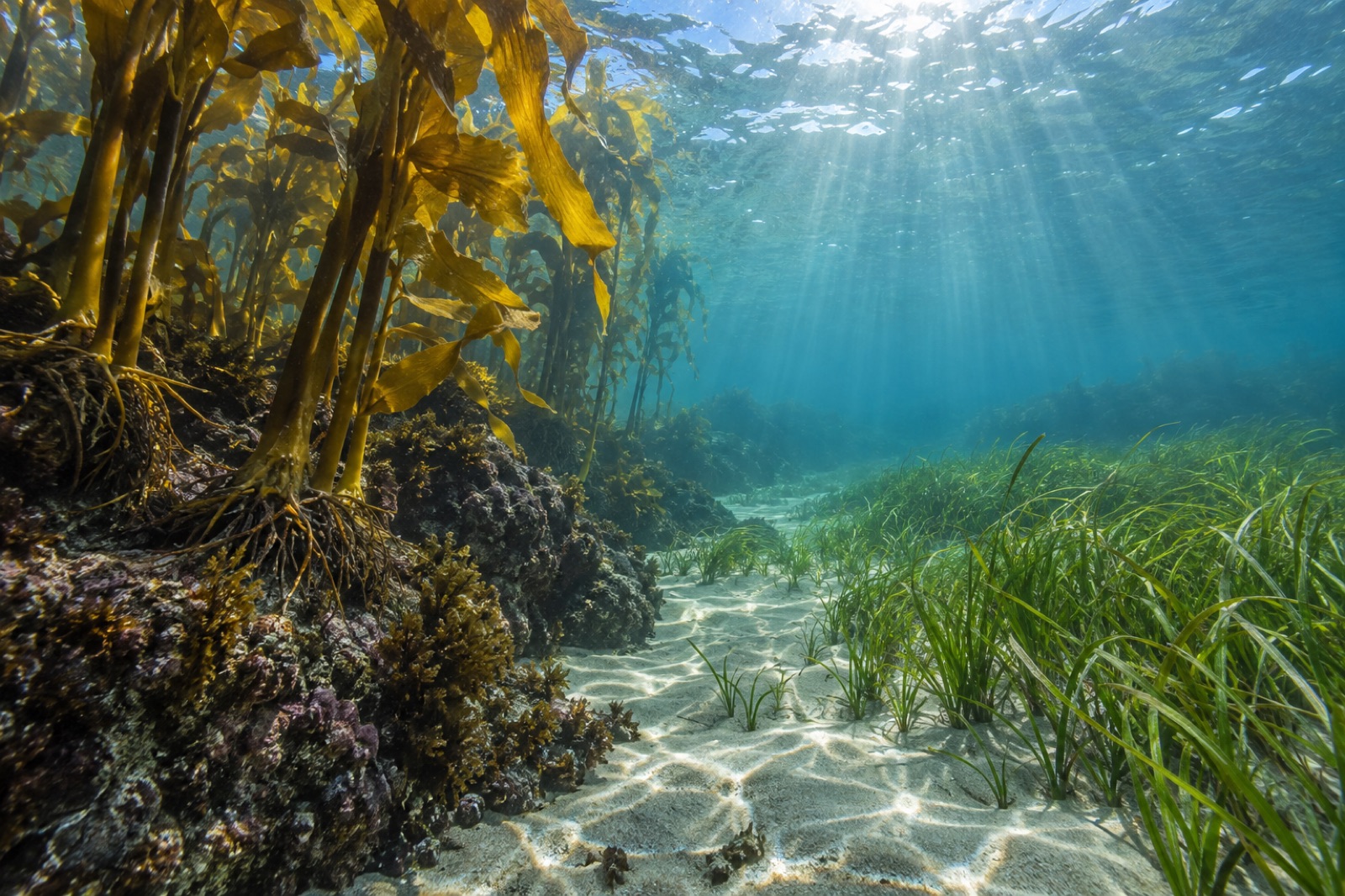
Take an aerial photograph of almost any temperate coastline and you see a mosaic: dark bands of kelp canopy along the rocky outer shore, bright seagrass meadows in the sheltered bays behind them, salt marsh and mangrove fringing the estuary mouths, and the estuary itself braided with channels and mudflats. Ecology spent much of the twentieth century studying each of these habitats as a separate world, with its own specialists and journals. We now know that view is wrong. These habitats are wired together — exchanging food, nutrients, animals and larvae in currents that flow both ways — and the health of any one of them depends partly on the condition of the others. The science of those connections is called seascape connectivity, and it is quietly rewriting how we think about coastal conservation.
What "connectivity" actually means
Connectivity is an umbrella term for the exchange of anything across habitat boundaries. Ecologists usually split it into four strands:
- Material connectivity: the movement of nutrients, detritus, sediment and pollutants from one habitat into another.
- Ontogenetic migration: animals using different habitats at different life stages — a fish spawned in an estuary, grown in a seagrass meadow, and living its adult life on a kelp reef.
- Daily and seasonal movement: feeding forays, spawning aggregations and migrations that cross habitat edges on shorter cycles.
- Genetic (larval) connectivity: the dispersal of young stages between populations, which determines whether a wiped-out patch can be reseeded from its neighbours. We cover the hydrodynamic side of this in Marine Connectivity: How Reefs Are Linked by Currents.
A habitat's ecological value, then, isn't just what lives inside its borders — it's the sum of its connections.
The kelp–seagrass handshake
Kelp forests export carbon relentlessly. Blades erode, storms tear fronds loose, and tonnes of kelp detritus wash off the reef every year. Much of it drifts into neighbouring habitats, where it becomes a cross-habitat subsidy — food produced in one ecosystem that feeds another. Buried kelp fragments feed seagrass-meadow sediment communities; drifting fronds carry whole assemblages of small crustaceans into new territory; on beaches, wrack feeds the insects, birds and fish of the shore.
The flow runs the other way, too. Seagrass meadows and the animals in them contribute organic matter, and filter-feeding communities in seagrass beds clean water that will later pass over kelp reefs. Meadow edges function as nurseries for fish species — many wrasse and rockfish among them — whose adults live and forage in the kelp canopy. When researchers track those fish with tags, they plot daily commutes: shelter in the meadow, hunting runs along the kelp edge at dusk. Remove the meadow and the reef's fish community shifts; remove the reef and meadow animals lose a feeding ground and a source of structure. For a closer look at how differently these two habitats are built, see Kelp vs Seagrass: same shallow sea, opposite engineering.
Estuaries: nurseries, filters and pressure valves
Estuaries sit at the hinge between land and sea, and their connectivity runs in both directions. Downstream, they discharge nutrients, sediment and freshwater plumes that fertilize (or, when polluted, stress) coastal kelp beds — a relationship we explore in Estuaries and Kelp. Upstream and within, they serve as rearing grounds for species whose adult lives are spent on or around kelp reefs, and as buffers that trap some of the land's runoff before it reaches the open coast.
Salmon are the famous commuters: hatched in rivers, grown at sea, returning to spawn. But the pattern repeats across flounder, mullet, shrimp, and dozens of forage fish. An estuary degraded by dredging or pollution isn't an isolated loss; it is a deduction from the carrying capacity of every habitat downstream, including the kelp forest whose fish it helps rear.
Patch mosaics behave like cities
A useful analogy is urban form. A single isolated habitat patch is a village; a connected mosaic is a metropolis. In the metropolis, there is redundancy — lose one reef and larvae from neighbouring reefs recolonize it; lose one meadow and fish shift to another for a season. Edges matter, too: research consistently shows that densities of many fish peak where habitats meet, the marine equivalent of a city centre where different districts overlap. Ecologists call this the ecotone effect, and it means that two adjacent habitats are often worth more than the same two habitats far apart.
This has a hard practical edge for conservation. Protecting a single kelp forest while the seagrass nursery behind it is dredged, or while the estuary that feeds it is channelized, is like installing a firewall around one building in a burning district. The science of MPA networks — protected areas deliberately spaced and placed so currents carry larvae between them — is the policy application of exactly this insight.
Why connectivity decides restoration success
Restoration is where seascape thinking earns its keep. A reseeded kelp line on an isolated, degraded reef can fail not because the kelp is wrong but because the neighbourhood is: no nearby source populations to supply grazers' predators, no nursery habitat for juvenile fish, no detrital subsidy to jump-start the food web. Conversely, a restoration site tucked into a healthy mosaic can outperform expectations, recolonized by species the project never introduced.
When Tidewright's science team evaluates a candidate restoration reef, Canopy Ledger surveys don't stop at the site boundary. Teams map the neighbouring meadows, estuary mouths and reef patches, model larval exchange between them, and score the site on its connectedness as well as its substrate and temperature. A well-connected site with moderate conditions often beats a perfect site standing alone. That principle applies to any planting or protection effort: restore the network, not just the node.
Key takeaways
- Seascape connectivity is the exchange of materials, animals, and genes across habitat boundaries — kelp forests, seagrass meadows, estuaries and reefs are linked constituents of one coastal system.
- Kelp detritus subsidizes neighbouring habitats; seagrass meadows and estuaries shelter the juvenile stages of fish that later live on kelp reefs.
- Fish densities and ecosystem function often peak at habitat edges — adjacent habitats are worth more together than apart.
- Connectivity gives restoration its best odds: a degraded patch within a healthy mosaic can be reseeded by its neighbours. An isolated one often can't.
- Effective conservation protects the mosaic and the currents that link it, which is the logic behind MPA networks and connected site selection.
FAQ
Is seascape connectivity the same as marine connectivity?
They overlap but differ in scale. "Marine connectivity" usually means larval dispersal between populations of a single habitat type across kilometres of coastline. "Seascape connectivity" adds the habitat-to-habitat dimension — how a kelp reef, a seagrass meadow and an estuary exchange matter and animals across metres to hundreds of metres.
Can a fragmented seascape be repaired?
Partially, and sometimes quickly. Reef restoration, seagrass replanting and estuary reconnection can all reopen links. Because some connections (especially material subsidies and fish movement) restore faster than genetic ones, early wins are possible even before full maturity returns.
Why do juvenile fish prefer habitat edges?
Edges offer a choice: the shelter of one habitat and the foraging opportunities of another, within a short swim. Higher prey availability and more refuge options translate into better growth and survival, which is why tag studies so often record fish commuting between two adjacent habitats.
Does connectivity spread disease and invasive species too?
Yes — connectivity is neutral about what travels. The same currents that deliver larvae and food can carry pathogens and invasive propagules, which is why connected networks also need biosecurity and monitoring. The benefits of connectivity generally outweigh these risks, but they aren't zero.
Think in corridors: oppose developments that sever estuary mouths, support meadow and reef protection as a package rather than piecemeal, and treat nearshore water quality as a shared-asset problem. The Coastal Atlas profiles regions where mosaic-scale thinking has paid off.