Atlas8 min read
Stewart Island / Rakiura: New Zealand's Southern Kelp
Bladder kelp beds, a storied pāua fishery, tea-coloured inlets and daylight kiwi: a guide to Stewart Island/Rakiura, New Zealand's southern kelp coast.
Dr. Mara Ellison ·
Milford, Doubtful and Dusky: a guide to Fiordland's drowned glacial fjords, where a dark freshwater lid hides kelp forests and shallow-growing black coral.
Nowhere else on Earth does the ocean do what it does in Fiordland. On the southwest corner of New Zealand's South Island, glaciers spent two million years carving fourteen fjords clean through the Southern Alps, and since the ice left, one of the wettest climates on the planet has been pouring fresh water into them — so much rain that the sea itself wears a river on top. Beneath that dark, tea-stained lid lies a world unlike any other dive site: kelp forests growing in cold gloom, black coral trees thriving at snorkelling depth, and bottlenose dolphins that have nowhere else to go.
This is a guide to the fjords — how the strange physics works, what lives in it, and how to see it, from the boat deck at Milford to a drysuit in Doubtful Sound.
Fiordland National Park, part of the Te Wāhipounamu World Heritage Area, is New Zealand's largest national park — more than 12,000 square kilometres of mountains, rainforest and fiords. On the water, three names matter most:
Māori travelled into these fiords for centuries gathering pounamu (greenstone) — Milford was a source of the prized translucent takiwai variety — and named Milford Piopiotahi after the now-extinct piopio songbird. European sealing and whaling came early in the 1800s; the Milford Track, cut in the 1880s, opened the interior to walkers and made Piopiotahi world-famous.
Fiordland's defining feature is not geologic but hydrological. With around 200 rain days a year and metres of annual rainfall, the fiords carry a permanent low-salinity surface layer — typically two to ten metres deep in the inner fiords, sweeping toward the sea as a surface current while saltier ocean water slides quietly in beneath.
That layer changes everything:
Drop below the lid, though, and the story inverts: the deeper seawater in the fiords is often astonishingly clear, with visibility that at depth can exceed almost anywhere in New Zealand. Divers describe the descent as the strangest in the world — through brown, near-fresh water into virtual midnight, and then, ten metres down, into gin-clear grey-blue sea where the walls are crowded with life.
Fiordland's kelp assemblage has had to adapt to that light-starved lid, and it has done so in tiers:
The physics has odd consequences for restoration and monitoring: kelp here is light-limited in a way coastal kelp almost never is, and the position of the halocline — which moves with rainfall and season — is as important to forest health as water temperature. Tidewright's fictional monitoring practice treats rainfall-driven runs of dark water as a first-class stressor, because their duration can set the year's kelp growth in the inner fiords.
Fiordland's most famous biological claim to fame is its black coral — tree-like antipatharian corals that, everywhere else in the world, are deep-sea animals of the twilight zone, typically encountered below 50 or 100 metres. In Milford and its neighbours, black coral trees grow at depths shallow enough for scuba divers — and in places free-divers and snorkellers — to see, some a few centuries old.
The mechanism is the lid. Because the tannin-stained freshwater layer blocks most light, the light levels at 10–20 metres inside the fiords resemble those of the open-ocean depths where black coral normally grows: Fiordland has imported the deep sea's lighting regime to scuba depth. Divers hanging at fifteen metres off a Milford wall, watching gorgonian fans and white-branched coral trees under torchlight, are experiencing something that would otherwise require a submersible.
The corals are fragile and strictly protected — no touching, no anchoring, and the Milford underwater observatory at Harrison Cove offers a non-diving way to descend eight metres below the surface and look at the black coral garden through glass, a fine option for families and non-divers.
The Fiordland (Te Moana o Atawhenua) Marine Area, established in 2005, protects a network of marine reserves and special management zones across the fiords — among them the original Milford Sound (Piopiotahi) reserve dating to the early 1990s. The framework is a genuinely instructive model of layered protection: total no-take reserves inside, managed customary and commercial fisheries beyond, tight rules on introduced organisms, and ballast and biofouling biosecurity that treats the fiords as the near-pristine system they are.
That biosecurity matters — everything about Fiordland's biology, from black coral at swimming depth to dolphin residency, depends on conditions that would be easy to break. It is the kind of layered design we discuss in our explainer on marine protected areas: protection that matches the physics of the place, not a generic template.
Whatever the mode, go slowly, look upward, and remember that everything visible below ten metres only exists because a rainforest is sending black tea into the sea.
No — it's a fjord, carved by glaciers and then flooded by the sea. Early European explorers misnamed most fiords as "sounds," and the name stuck. A true sound is a flooded river valley; Piopiotahi's U-shaped walls are pure glacial work.
Yes — in Milford and Doubtful Sounds, black coral occurs at depths from around 10–15 metres, shallow enough for recreational divers, and is visible at the Milford underwater observatory for non-divers. Everywhere else, black coral generally lives far deeper than recreational limits.
Rain and river runoff are less dense than seawater, so they float. The dark colour comes from tannins dissolved out of rainforest leaf litter — essentially weak tea. The freshwater lid also tends to be colder than the salt water beneath, an inversion of the usual pattern.
Fiordland is superb in any season, but the weather rules expect. Winter brings clearer air, fewer visitors and mirror-still fiords more often; summer brings the most daylight and the most rain. Plan on the rain being part of the experience — it is why the underwater world below exists.
Yes, in settled weather and with the right exposure protection — the surface is cold and fresh, the vision of the halocline from a mask is unforgettable. Watch for boat traffic, use an operator or dive flag, and don't expect tropical visibility in the lid itself.
Bladder kelp beds, a storied pāua fishery, tea-coloured inlets and daylight kiwi: a guide to Stewart Island/Rakiura, New Zealand's southern kelp coast.
Dr. Mara Ellison ·
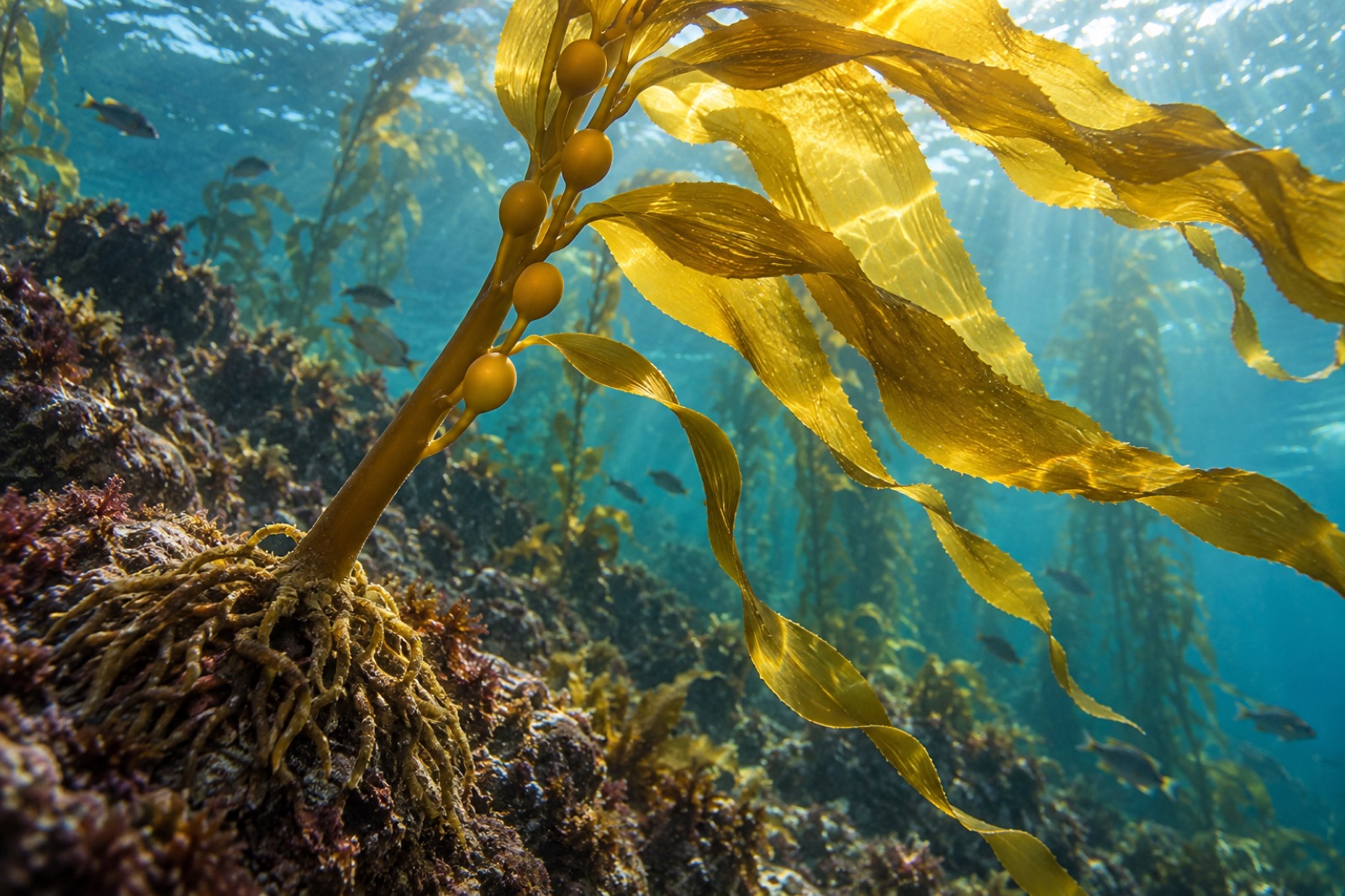
Giant kelp is the fastest-growing organism on Earth and the architect of undersea forests. Learn its biology, life cycle, range and why it matters.
Dr. Theo Nakamura ·
MPAs, marine reserves, no-take zones explained — how protection levels differ, what the evidence shows, and what MPAs can and can't do for kelp forests.
Dr. Mara Ellison ·