Walk a rocky shore at low tide and the seaweeds arrange themselves like a paint chart: bright grass-green sea lettuce near the top, leathery brown wracks and kelps in the middle, and — if you look under ledges or wade deeper — the dark reds and near-blacks of dulse and its relatives. That colour sequence is one of the oldest observations in marine biology, and one of the most frequently mangled. The colours are real, the depth pattern is real-ish, and the explanation involves some of the strangest photochemistry on Earth. Here is how it actually works.
A seaweed's colour is the sum of its pigments — molecules that absorb particular wavelengths of light and either put that energy to work in photosynthesis or throw it away as protection. Three pigment families matter most.
Chlorophylls: the green engine
All seaweeds photosynthesise, and all carry chlorophyll a, the near-universal reaction-centre pigment that absorbs red and blue light and reflects green. Green algae (becoming land plants' ancestors) add chlorophyll b. Brown and red algae instead use chlorophyll c or chlorophyll d — variants tuned slightly differently, one of several signs that these groups took separate evolutionary roads.
Carotenoids: the brown overcoat
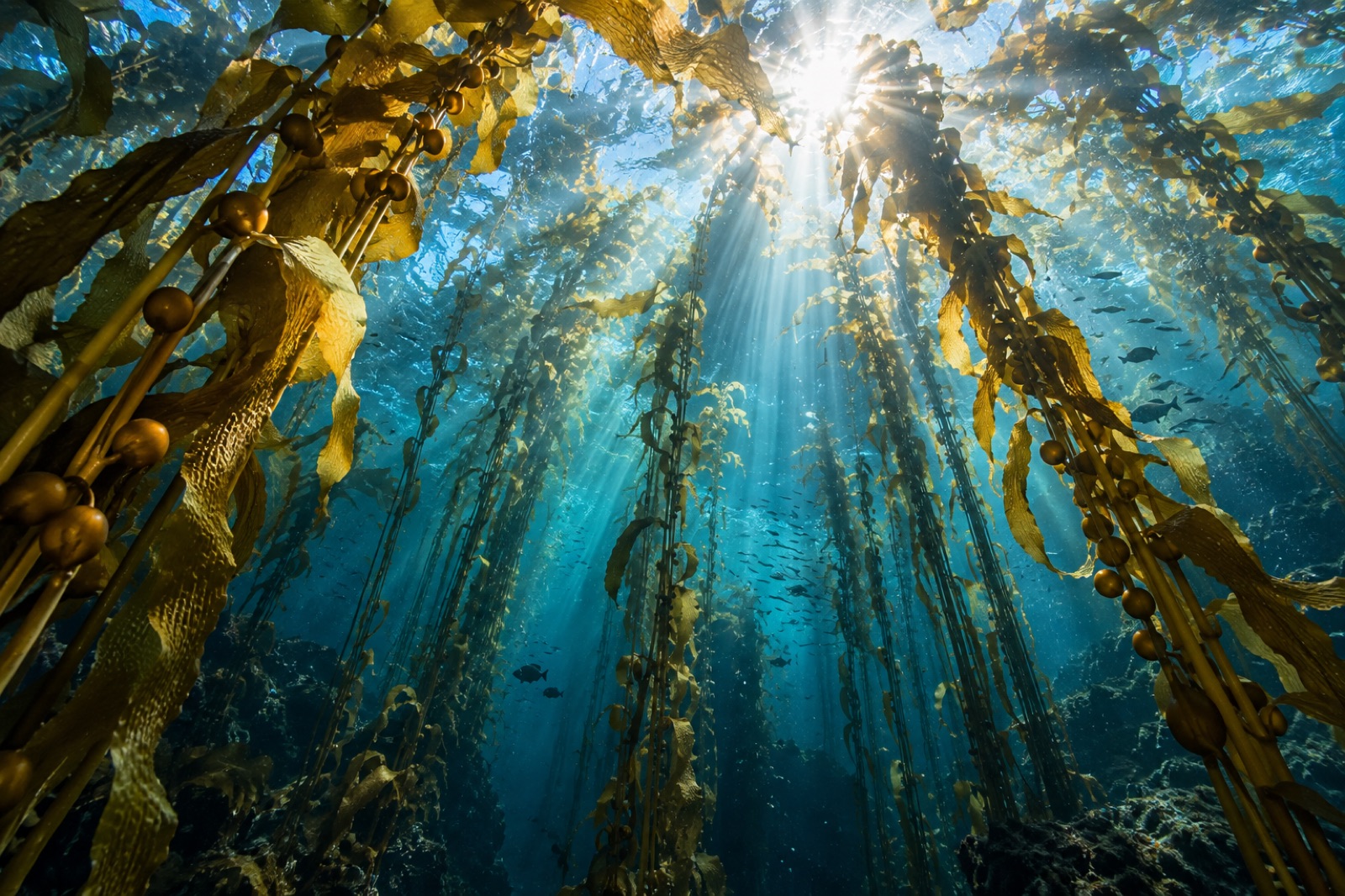
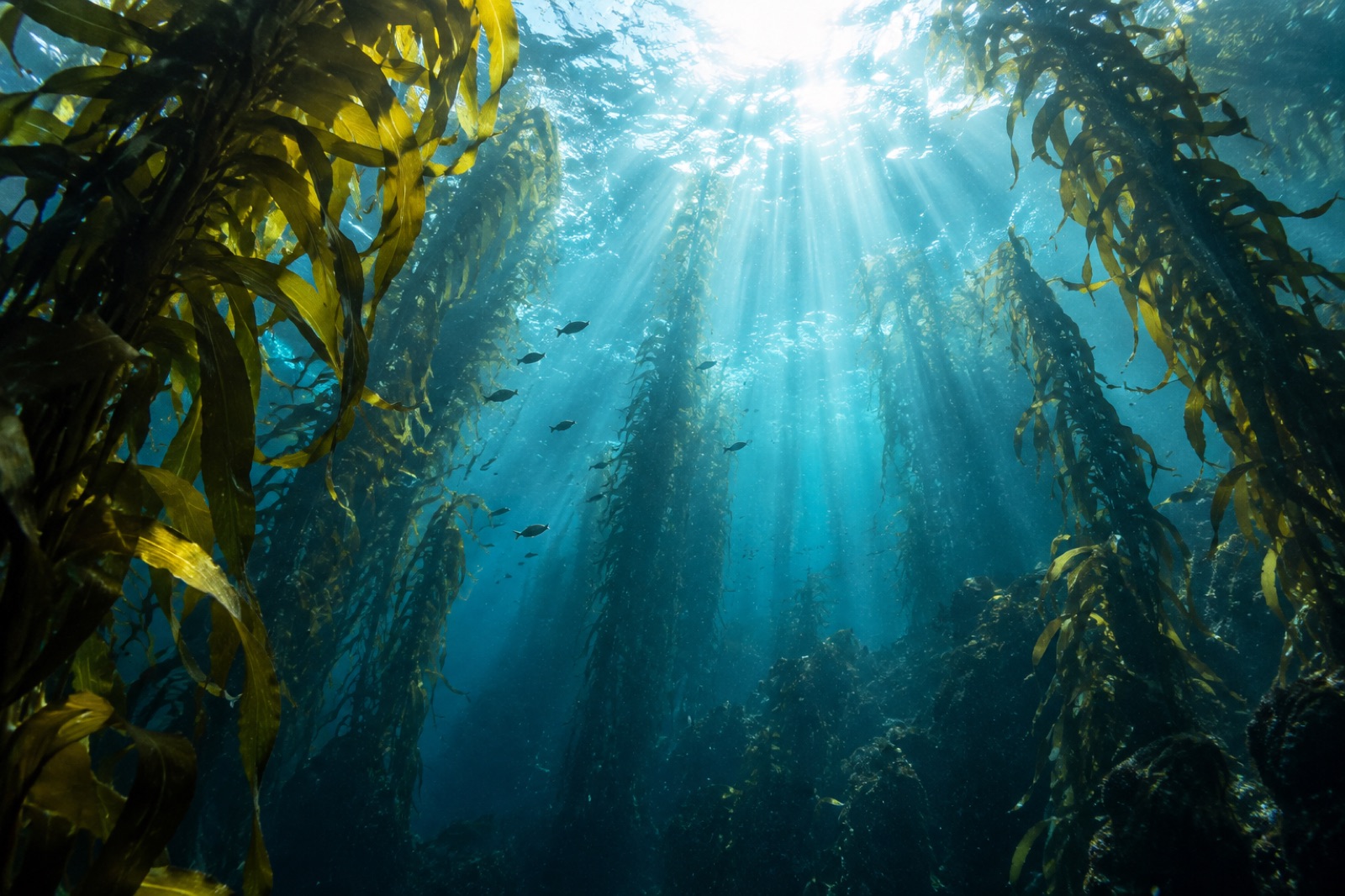
Brown algae — the kelps, wracks and rockweeds — are loaded with fucoxanthin, a carotenoid that absorbs strongly in the blue-green part of the spectrum. Blue-green light happens to be the light that penetrates seawater best (see our explainer on light underwater), so fucoxanthin is superbly placed to harvest what actually reaches a kelp frond at ten metres' depth. It absorbs so much green light that the plant reflects mostly brown-gold — hence the colour. We cover how kelp puts fucoxanthin to work in how kelp photosynthesises.
Phycobiliproteins: the red light-traps
Red algae carry phycoerythrin and its relatives — water-soluble proteins that absorb green and blue-green light with extraordinary efficiency. Packed into antenna complexes called phycobilisomes, they can capture a large fraction of the dim green light that filters to deep water. Too much phycoerythrin and the alga looks red; so much that almost nothing is reflected, and it looks nearly black — which is why deep-water red seaweeds hauled up in a net can look like wet leather.
Three Great Lineages, Not One Seaweed Family
The colour groups are not just a paint job over one body plan. Green, brown and red algae are separate evolutionary lineages that became photosynthetic in different ways, and "seaweed" is a guild, not a family.
- Green algae (Chlorophyta) share an ancestor with land plants. Same chlorophylls (a and b), same starch storage — a sea lettuce is closer to a lettuce than to any kelp.
- Brown algae (Phaeophyceae) are stramenopiles — kin to diatoms and, startlingly, to the water moulds that cause potato blight. Their plastids descend from a red alga swallowed whole by a brown ancestor (secondary endosymbiosis), which is why their chloroplasts still wear extra membranes. They include all the true kelps, from giant kelp to the humblest wrack.
- Red algae (Rhodophyta) are arguably the oldest major photosynthetic eukaryote lineage, and the most species-rich seaweed group — most of them small, finely branched and hidden from casual view. They gave the world nori, carrageenan and, indirectly, the plastids of half the ocean's other algae.
This is why colour is genuinely useful to a field naturalist: it is a quick read of deep ancestry, not merely lighting or mood.
The Depth-Zonation Rule, and Its Asterisks
The tidy textbook story goes like this: green algae live shallow, where light is bright and full-spectrum; brown algae take the middle depths, harvesting penetrating blue-green light; red algae live deepest, their phycoerythrin soaking up the last thin residue of green. This is the chromatic adaptation hypothesis, and it contains real physics — light does filter predictably through the water column (see the euphotic zone for how far down the ocean runs on light).
But field biologists have spent decades adding footnotes:
- Red algae also live at the surface — many grow in full sun on exposed intertidal rock, where their pigments act more like sunscreen than snorkel. Phycoerythrin doubles as photoprotection.
- Brown algae dominate the shallows, not the depths, in most kelp regions. Kelp canopies usually live in the top 30 metres, and the deepest kelps are often red-algal understory's neighbours rather than replacements.
- Light quality predicts poorly; light quantity predicts well. What actually limits depth is total photon supply and competition. A clear-water red alga can live deeper than any brown simply because its antenna system wastes fewer photons — the advantage is efficiency in dim light, not a specific "colour of light" niche.
The modern synthesis: pigments explain how efficiently a seaweed uses whatever light it gets, and zonation emerges from that efficiency interacting with competition, grazing, temperature and turbulence. Colour is part of the story, never the whole storey-cast.
What Colour Tells You — and What It Doesn't
For the beachcomber and the diver, colour remains a decent first sort:
- Bright green, thin, tissue-paper blades high on the shore — probably a green alga, fast-growing and fast to appear after disturbance.
- Olive-brown and leathery, with stipes, bladders or holdfasts — a brown alga; if it's big and forest-forming, it's a kelp. Browse our kelp species profiles to put names to forms.
- Red, maroon, purple or almost black, often finely branched or crusty — a red alga; look for them in shady overhangs, tidepool walls and deep in the understory.
But never identify on colour alone. Bleaching by summer sun can turn a brown kelp straw-yellow; deep-shade greens can look black; and many groups have members wearing the "wrong" pigment load. Colour reads ancestry and light strategy — identification still needs morphology.
Why This Matters Beyond Trivia
Pigment groups frame real questions in ocean change. As waters warm and stratify, the light and nutrient regimes that favour each lineage shift. As forests thin, red-algal turf and green opportunists often claim the space first — a colour change on the reef floor is one of the earliest visual symptoms of a kelp forest in trouble. And for restoration, the pigment story is a reminder that "seaweed" is not interchangeable: a reef seeded with kelp rebuilds a brown canopy, but the red crusts, green films and all their tenants are what make the canopy a forest.
Key Takeaways
- Seaweed colour comes from accessory pigments — fucoxanthin (brown), phycoerythrin (red) — layered over universal green chlorophyll a.
- Green, brown and red algae are separate evolutionary lineages; brown algae's plastids descend from a captured red alga.
- The classic "green shallow, red deep" zonation rule is real physics filtered through competition and light quantity — a pattern with many exceptions, best read as efficiency in dim light rather than a colour niche.
- Colour is a fast field hint about ancestry and light strategy, but never a reliable identification on its own.
- Pigment biochemistry is practical: it is why kelp grows where it grows, and its limits help define the depths restoration can reach.
FAQ
Why does dried seaweed turn dark green or black?
Sunlight, heat and oxidation break down the accessory pigments faster than hardy chlorophyll a. A dried brown kelp loses its fucoxanthin overcoat and the underlying green shows through; dried red algae can darken to near-black as their proteins denature.
Is brown seaweed actually a plant?
No. Brown algae are stramenopiles, a lineage separate from both plants and red/green algae. They converged on plant-like forms — blades, stems, even a holdfast — entirely independently, which is why we say kelp reinvented the tree rather than descended from one.
Can red algae really photosynthesise deeper than any other seaweed?
They hold the depth records, yes — red crusts have been collected below 250 metres in clear tropical water, living on light intensities a fraction of a percent of surface brightness. But the deepest kelps are still brown algae; depth records and forest depth are different claims.
Why are some kelps golden rather than brown?
Fucoxanthin concentration varies with light exposure, season and species. South-facing fronds in bright water synthesise more protective pigment; shaded or fast-growing tissue stays greener and more golden. "Golden kelp" (Ecklonia radiata) earns its name this way.
Do seaweed pigments have uses for people?
Many. Fucoxanthin is studied as an antioxidant, phycoerythrin is a standard fluorescent label in biomedical research and flow cytometry, and carrageenan-producing red algae supply food science — one more reason pigment chemistry is more than a beach curiosity.