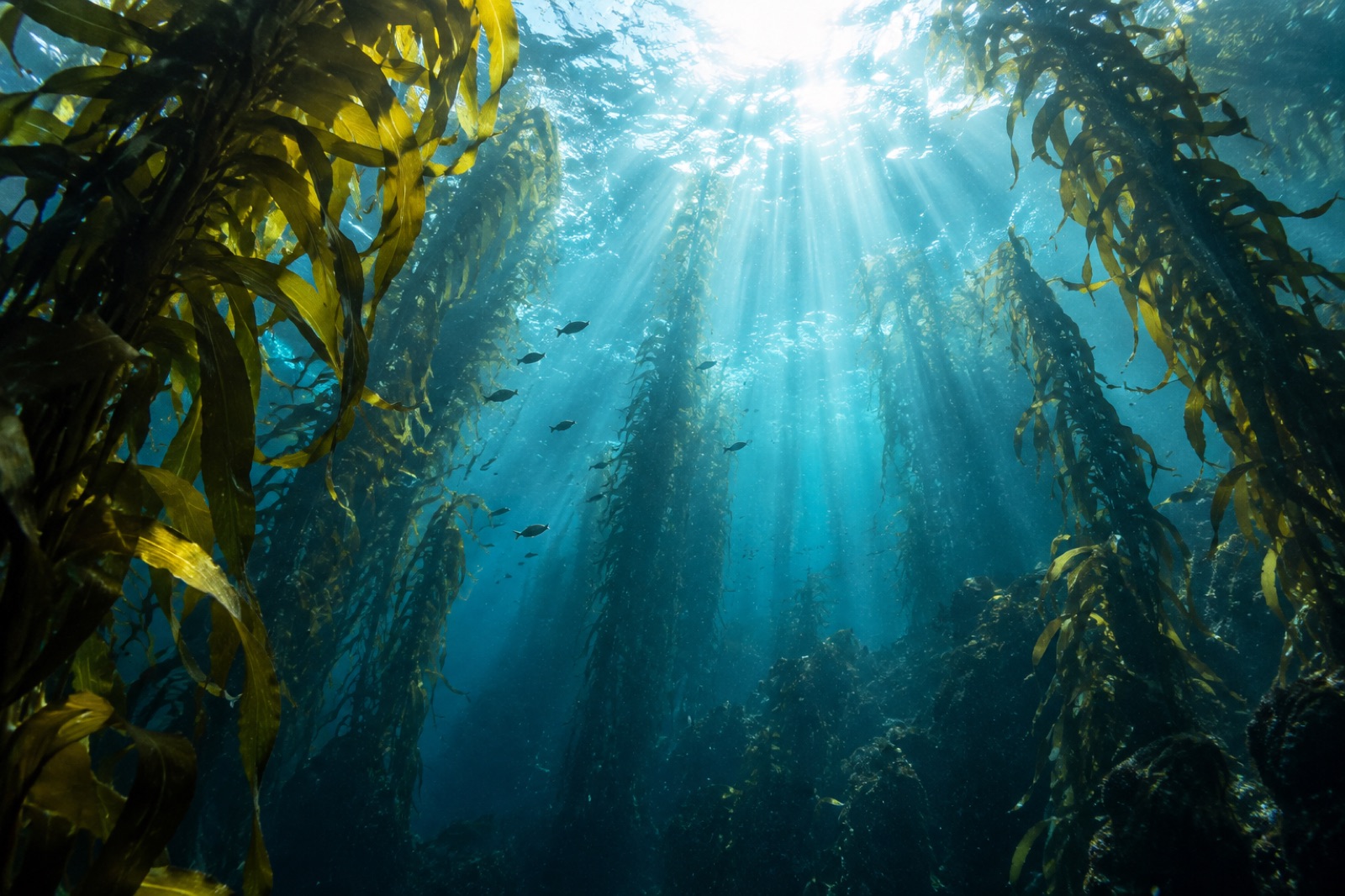
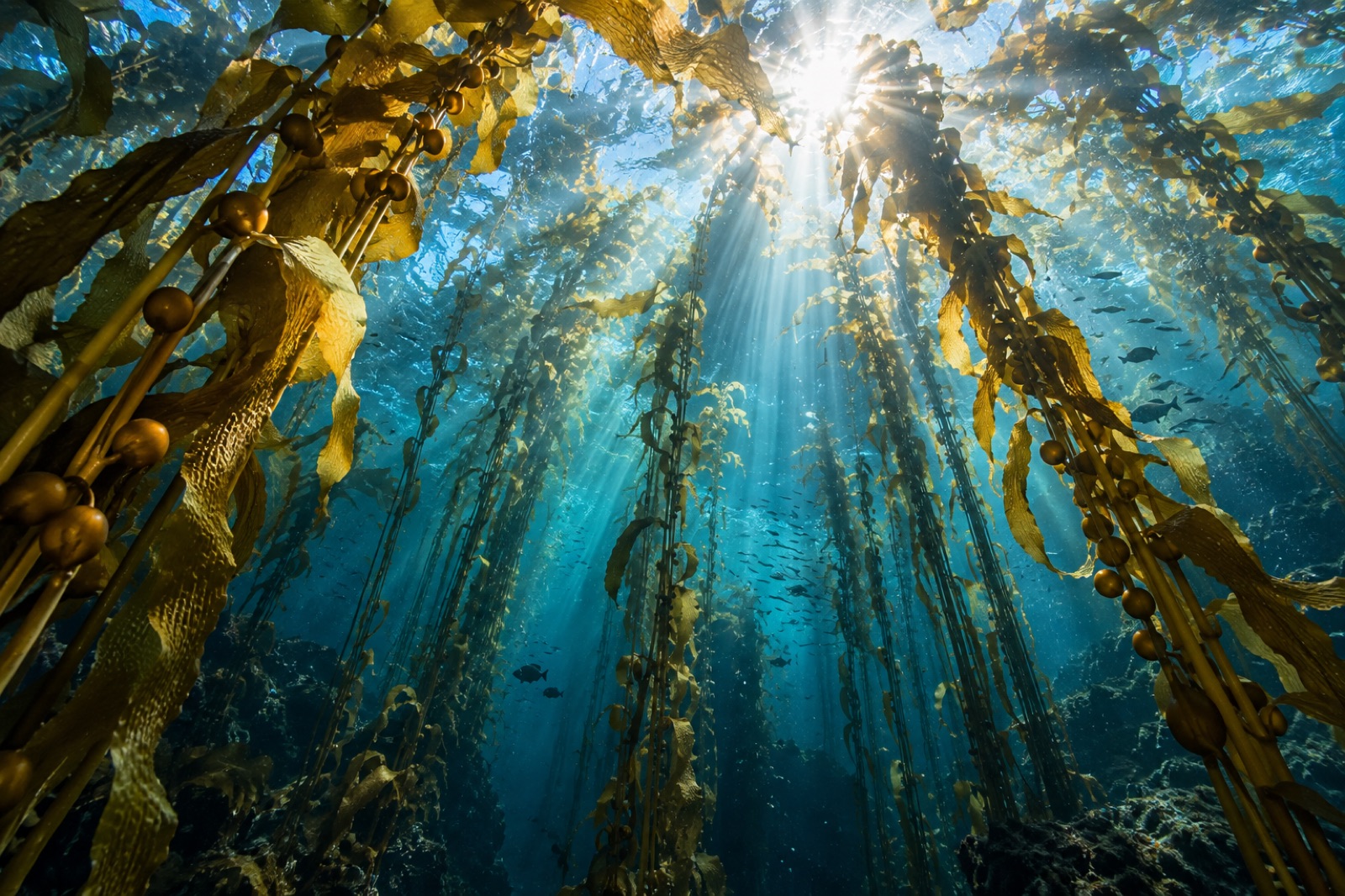
Sunlight striking the open ocean is extinguished with astonishing speed. Within the first few metres, half of it is gone; within a hundred metres in the clearest tropical water, nearly all of it. The thin, bright skin where light survives well enough for photosynthesis to outpace respiration is called the euphotic zone — and it is, quite literally, where the ocean runs on light. Almost everything you know about marine life, from sardines to sperm whales to giant kelp canopies, is fed by what happens in this layer.
For kelp forests, the euphotic zone is more than a zone: it is the territory itself. Kelp is one of the few large primary producers that must live at the bottom of the sunlit layer, glued to rock, stretching upward toward the light it needs. Understanding the euphotic zone is understanding the budget every kelp forest lives within.
What "euphotic" actually means
Oceanographers divide the water column by light:
- Euphotic zone ("good light"): from the surface down to the depth where roughly 1% of surface light remains. Photosynthesis here exceeds the respiration of the whole community — the layer is a net producer of organic matter and oxygen. Depth ranges from a few metres in a sediment-laden estuary to around 150–200 metres in the clearest subtropical gyres.
- Disphotic zone ("twilight" or "poor light"): below the euphotic zone to about 1,000 metres, where light is too dim for photosynthesis but still enough for animals to navigate and hunt by.
- Aphotic zone ("no light"): the vast remainder. Eternal night, lit only by bioluminescence.
The precise biological anchor is the compensation depth: the depth at which the oxygen a phytoplankton community produces by photosynthesis exactly balances what it burns by respiration over a full day. Near the surface, production wins; at the compensation depth, the ledger is zero. Ecologically, the bottom of the euphotic zone sits close to this point — which is why the 1% light level is such a good practical marker.
Why the ocean stacks light and food in different places
Here is the great structural tension of ocean ecology. Photosynthesis needs two things that live in different places:
- Light, which exists only in the top tens of metres.
- Nutrients — nitrate, phosphate, iron — which are scavenged by sinking dead material and accumulate in the dark water far below.
A particle of detritus sinks out of the light carrying its nutrients with it; that slow rain of debris, the marine snow, drags the surface's fertility downward. The euphotic zone is therefore always losing its raw materials unless something stirs the ocean — wind mixing, storms, upwelling — to hand them back. This is why the ocean's most productive waters are not the clearest blue gyres (where the euphotic zone is deepest but poorest, per cubic metre) but the greener, messier water where deep nutrients keep returning to the light.
What lives where the light is
The euphotic zone hosts essentially the entire primary production of the open ocean — the phytoplankton diatoms, coccolithophores, dinoflagellates and cyanobacteria that generate a very large share of Earth's total photosynthesis and supply most of the oxygen in every second breath you take. Tiny though they are, their sheer extent is their power: the top metres of a vast ocean add up.
Then come the benthic primary producers — the seaweeds and seagrasses rooted or anchored to the seafloor, which must be shallow enough that light reaches the bottom. A kelp plant has no choice about its address: the rock must sit inside the euphotic zone, and the deeper the rock, the clearer the water must be. Giant kelp canopies recorded beyond 30 metres owe their depth to exceptionally clear water, as we explore in light underwater and how far down kelp can grow.
Between the visible producers and the drifting herbivores sits an enormous supporting cast: zooplankton grazing the phytoplankton, larval fish and crabs developing in the plankton, jellies, arrow worms, and the migrators — copepods, krill and many small fish — that commute nightly from the twilight zone into the bright shallows to feed, hauling deep-water biomass up into the light.
The floor of the light moves
The bottom of the euphotic zone is not a fixed line; it is a variable as dynamic as the weather. It shifts with:
- Season. Low winter sun and storm-stirred sediment push the compensation depth toward the surface; calm, clear summer water lets light run deep.
- Water clarity. Rivers deliver silt and dissolved organic matter that drink the light; algal blooms do the same from within. After floods, a coastline's euphotic zone can thin to a few metres within days.
- Latitude and sky. High latitudes spend half the year with too little light for any layer to be truly euphotic, whatever the clarity.
- The plankton itself. A dense bloom shades itself — light is a resource the community consumes while using.
For a kelp forest, the practical consequence is stark: the forest's light budget is set by the worst months, not the best. A reef that receives enough light for recruitment in nine months of the year but is smothered in silt-stained water for the other three may still fail to hold a forest. When Tidewright's site-survey teams score a candidate restoration site, water clarity across the seasonal cycle — measured with light loggers on the seabed — weighs as heavily as temperature. It is one of the core layers in our Canopy Ledger monitoring stack.
The brown light: why kelp reaches deeper than it looks
Seawater filters light selectively. Red light is absorbed within the first few metres; blue-green light travels furthest. Brown algae like kelp evolved a suite of accessory pigments — above all fucoxanthin — that harvest the blue-green part of the spectrum their green competitors cannot use efficiently. That pigment is exactly what gives kelp its olive-brown colour, and it is a depth adaptation: it lets kelp keep photosynthesising in the dim, blue-shifted light near the compensation depth. The full story is in our piece on how kelp photosynthesizes.
Meanwhile the canopy plays a second light game: a towering forest shades its own understory. Juvenile kelps and understory algae live in a greenish gloom of their elders' making, waiting for a gap in the fronds the way a rainforest seedling waits for a fallen tree.
A zone under pressure
The euphotic zone is also where marine heatwaves bite hardest — it is the layer that warms first and fastest. And it is where coastal darkening is quietly spreading: increased runoff, dredging, construction and changing plankton communities are thinning the sunlit layer along many inhabited coasts, pushing the lower boundary of kelp habitat upslope, metre by metre. Where the seabed has nowhere upslope to offer — steep drop-offs, or shores armoured by seawalls — darkening and warming compress the forest's range into a narrowing band.
That makes the light budget of the coast a conservation variable, not just a curiosity: measuring it, defending it, and choosing restoration sites that keep their light through the bad years.
Key takeaways
- The euphotic zone is the surface layer where enough light penetrates for net photosynthesis — defined practically as the depth reached by about 1% of surface light.
- Its depth ranges from a few metres in turbid coastal water to ~150–200 metres in the clearest open ocean, and it shifts seasonally and after storms and floods.
- Light lives at the top; nutrients accumulate in the dark below. The tension between them drives the productivity patterns of the whole ocean.
- Kelp forests are benthic producers with no mobility: they must anchor on rock that stays inside the euphotic zone all year, making water clarity a make-or-break habitat variable.
- Brown pigments like fucoxanthin let kelp harvest the blue-green light that penetrates deepest, extending kelp habitat to the compensation depth in clear water.
FAQ
Is the euphotic zone the same as the photic zone?
Roughly, but the terms are used with different precision. "Photic zone" is the looser, umbrella term for any depth where light penetrates. "Euphotic zone" specifies the upper part where photosynthesis is viable — bounded at the bottom by the 1%-light depth. The dimmer region between euphotic and aphotic is sometimes called the disphotic or twilight zone.
How deep is the euphotic zone on average?
There is no single average that means much, because the range is enormous — from under 5 metres in a silted estuary to around 200 metres in the clearest subtropical seas. On typical temperate coasts, kelp-relevant euphotic depths are tens of metres, which is why most kelp forests live shallower than 30–40 metres.
Why is the open-ocean euphotic zone deeper than the coastal one?
Fewer particles and less dissolved organic matter. Coastal water carries river silt, resuspended sediment and richer plankton communities, all of which absorb and scatter light. Clear open-ocean water is an almost pure blue filter; productive green coastal water stops light much faster.
Do kelp forests create their own light conditions?
Yes. A dense canopy intercepts much of the incoming light before it reaches the seafloor, so understory algae and juvenile kelp live in self-made shade. Canopy thinning from storms or urchin grazing abruptly changes the light regime at the bottom — one reason light loggers at canopy and seabed level tell such different stories.
How do scientists measure the euphotic zone?
With underwater light sensors (PAR meters) profiled through the water column, with Secchi disks for a quick clarity estimate, and from space — satellites measure how ocean colour changes with depth of light penetration and map euphotic depth across whole ocean basins.