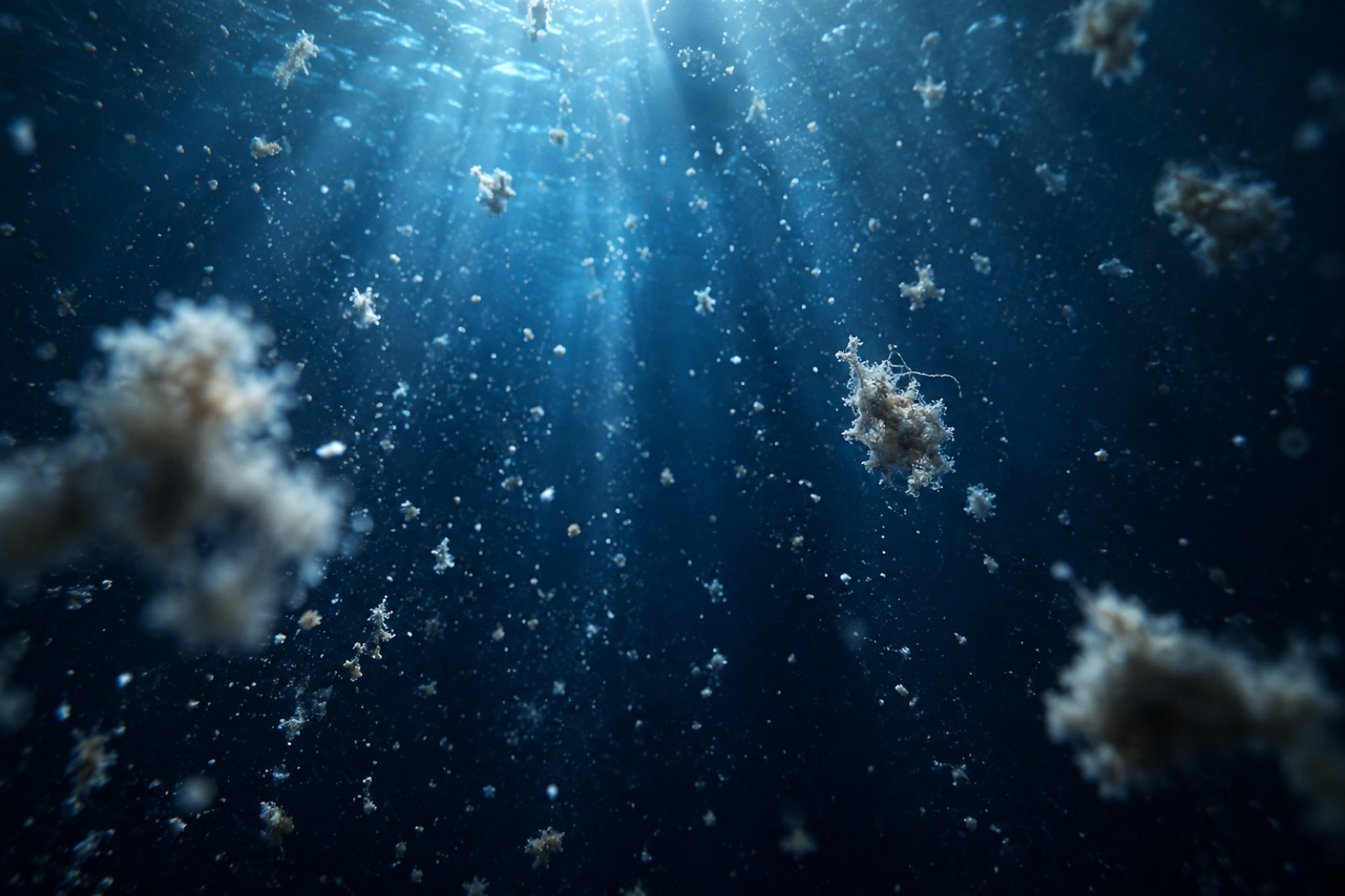
Beneath every sunlit patch of ocean there is a slow, constant fall of soft particles drifting down through the dark — flecks of dead plankton, shed mucus, faecal pellets, dust and shards of seaweed, clumped into flakes that look, in an underwater camera's lights, like snow. Oceanographers call it marine snow, and it is one of the quiet engines of the climate system: the main conveyor by which carbon fixed at the surface reaches the deep sea. If you care about where kelp's carbon goes, or about blue carbon claims generally, marine snow is the plumbing you have to understand.
What marine snow actually is
Marine snow isn't one material — it's a category. The flakes are aggregates of whatever the sunlit ocean sheds:
- Dead phytoplankton — the bulk of it in most regions, the remains of diatoms, coccolithophores and other microscopic algae.
- Faecal pellets — remarkably important. Zooplankton like copepods and krill package their waste into dense, fast-sinking pellets; krill pellets, in particular, are carbon catapults.
- Mucus and gels — discarded "houses" from larvaceans and salps, plus transparent exopolymer particles (TEP), the sticky polysaccharide glue that causes smaller particles to stick together into flakes.
- Fragments of larger life — fish scales, shed jellyfish tissue, and in coastal waters, torn pieces of kelp and other seaweeds that break down and disintegrate into the rain.
- Non-living ballast — dust, clay, calcium carbonate shells and opal, which matter enormously because they make flakes denser and faster.
Anything heavier than seawater eventually sinks. The open question is always the same: how deep does it get before something eats it?
The biological carbon pump, condensed
Phytoplankton in the sunlit upper ocean fix dissolved carbon dioxide into organic matter through photosynthesis. Left alone, almost all of that carbon would be consumed and respired back to CO₂ within the surface layer within days to weeks. The biological carbon pump is the leak out of that loop: the fraction of production that is exported — sinking as marine snow, being carried down by migrating animals, or dissolving and mixing downward — into water deep enough that it will not return to the atmosphere for decades, centuries or millennia.
The numbers that matter for the pump:
- Export fraction. Globally, only roughly a tenth of surface primary production escapes the sunlit layer. The other ~90 percent is recycled where it was made.
- Remineralisation curve. Of what sinks, most is eaten or decomposed on the way down. Much is consumed in the "twilight" mesopelagic zone (200–1,000 m). The deeper a particle reaches, the longer its carbon stays out of atmospheric contact; particles that pass below the permanent thermocline (~1,000 m) can hold their carbon out of circulation for many centuries to a millennium or more.
- The seafloor is the finish line. A small percent of surface production ultimately reaches the abyssal seafloor, where a fraction of it is buried in sediment — the deepest, longest lock the ocean offers.
This continuously running pump is why the surface ocean holds much less carbon than it would if photosynthesis and respiration simply cancelled in place. Slow it down and atmospheric CO₂ rises; the geologic record shows that it has varied with climate.
Why particle speed decides everything
Whether carbon reaches 500 metres or 5,000 is largely a matter of sinking velocity, and velocity is set by density and size:
- Slow snow (~metres per day): loose fluffy aggregates of fine plankton debris and gel — mostly consumed in the upper few hundred metres.
- Fast snow (tens to hundreds of metres per day): krill pellets, large diatoms and aggregates dense with ballast minerals — reaching the deep sea in weeks.
- Extremely fast events: jellies, fish carcasses and whale falls skip the slow conveyor entirely, delivering tonnes of carbon to the seafloor in days and feeding deep-sea scavenger communities immediately.
Ballast is the crucial cheat code. Carbonate and opal shells ride down with the organic material like lead weights on a net. There is even a countercurrent: when carbonate shells dissolve at depth, they release alkalinity — shaping ocean chemistry and interacting with ocean acidification in regions where dissolution now happens higher in the water column.
The deep sea has, scattered through it, animals whose whole lives are adapted to catching snow on arrival: deep corals and sponges filtering from the water column; sea cucumbers vacuuming the sediment; even fishes like the tripod fish standing on elongated fin rays over fresh-fall hotspots. Abyssal plain food webs run almost entirely on what the pump delivers — the amount of food reaching them is small, and deep-sea ecosystems are correspondingly slow-growing and vulnerable to disturbance.
Where kelp enters the story
Kelp forests are coastal, and shallow, and that changes the accounting. Kelp tissue doesn't rain down from a photic zone into open-ocean deep water the way plankton does — it has to be transported to depth, and that transport is the difference between kelp carbon being respired in weeks and stored for centuries.
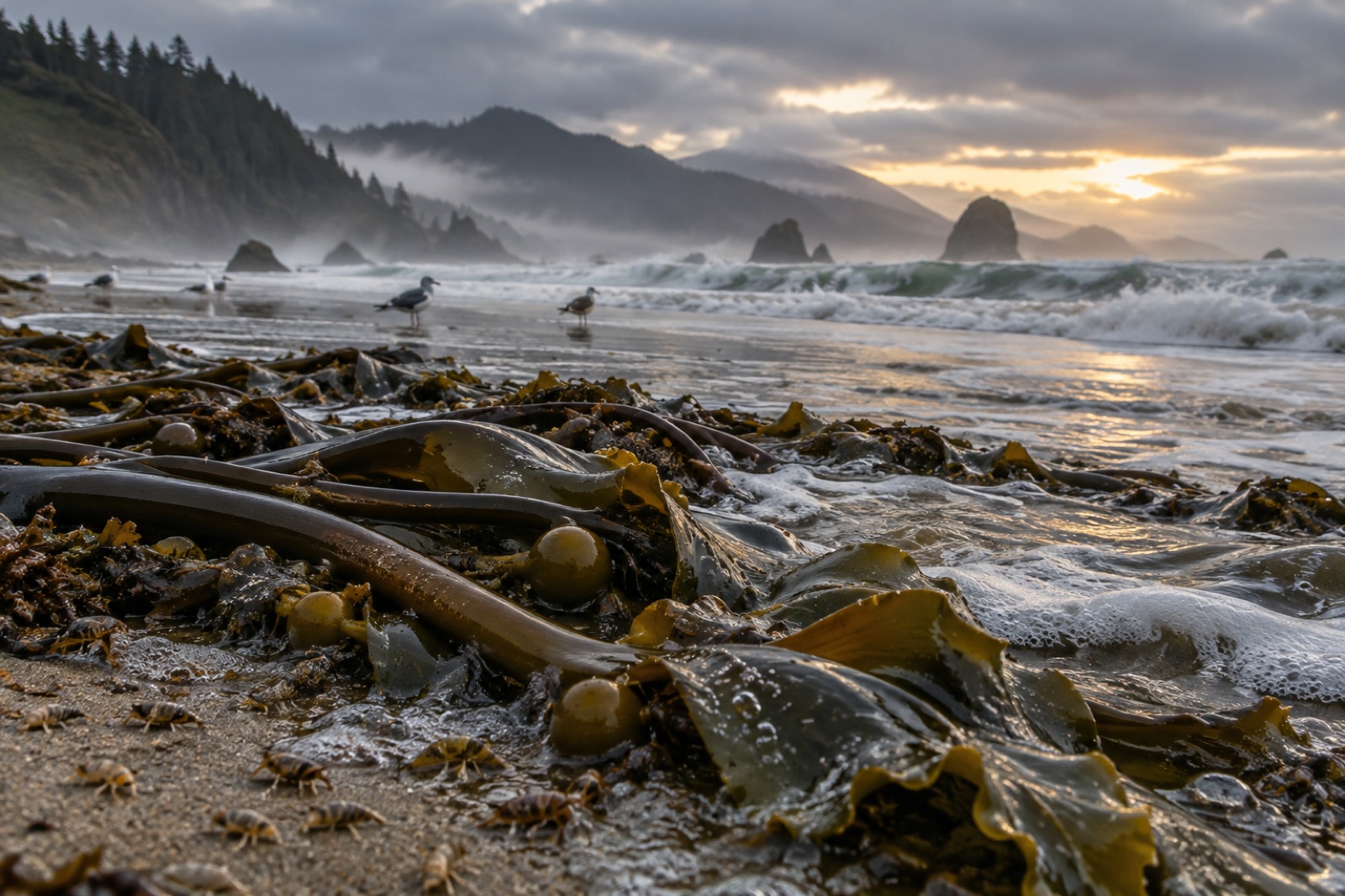
The chain runs: storm-torn blades → drift rafts and detached debris → shredding by amphipods and urchins → fine particles washing offshore in plumes → entrainment into the marine snow of the continental shelf and slope → and for a lucky fraction, delivery to submarine canyons and the deep sea (the pathway our deep-sea export explainer covers in detail). Some kelp reaches great depths intact: kelp rafts and fragments have been photographed and even sampled on the deep seafloor in multiple ocean basins, and deep-sea amphipod communities around them show it can be a real subsidy for abyssal food webs.
This matters when reading claims about kelp carbon. Marine snow gets a share of kelp production into deep water, but how much is an empirical question per coastline — and the honest answer today is "a small minority of production, at rates we're still measuring". The canopy may be vast; the export is the narrow end of the funnel.
How marine snow is measured
- Sediment traps — moored funnels at depths from ~100 m to several kilometres that collect falling particles for months, directly measuring flux.
- Optical cameras — systems like the Underwater Vision Profiler image particles as they drift past, converting images into size spectra and sinking-rate estimates.
- Autonomous floats and gliders — biogeochemical Argo floats track particle backscatter continuously over years, filling the observational gaps between ship visits.
- Tracers and isotopes — radionuclides like thorium-234 (which sticks to sinking particles) and stable carbon isotopes convert chemistry into export estimates; genetic markers and fatty acids can even tell you a fraction of deep-living organic matter came from macroalgae versus plankton.
The combination of these instruments has transformed the field in the past decade, and it's the same family of methods — extended to coastal material — that serious kelp-carbon science is adopting.
Why marine snow matters right now
The pump is not a geological constant; it's a process built from living things, and living things are adjusting to a warmer, more stratified, more acidic ocean. Models differ on the sign and size of change — stronger stratification cuts nutrient supply to the sunlit layer but also may favour slower-sinking, finer communities, which would weaken deep export; on the other hand, more intense bloom events and intensifying coastal retention change the picture in shallower regions. Either way, the ocean's food security — whales, fisheries, deep-sea ecosystems — and its long-term carbon handling both run through the quiet fall of particles nobody sees. That's why we monitor it, and why any credible blue carbon methodology needs to engage with it.
Key takeaways
- Marine snow is the constant rain of sinking organic material — plankton remains, faecal pellets, mucus gels, seaweed fragments — visible as flakes in the dark ocean.
- It is a central mechanism of the biological carbon pump, moving surface-fixed carbon into water masses that won't return to the atmosphere for centuries.
- Sinking speed decides storage: ballast-dense, fast particles reach depth; slow fluffy aggregates are eaten near the surface. Roughly a tenth of surface production escapes downward at all.
- Kelp joins the snow offshore via storms, drift and disintegration; a real but small share of kelp carbon reaches deep water, which is why kelp blue-carbon claims need careful measurement rather than assumption.
- The pump is measurable (traps, cameras, floats, isotopes) and is changing with the ocean — understanding it is foundational to both deep-sea science and carbon accounting.
FAQ
Is marine snow actual snow?
No — it's an evocative name for how the particles look when illuminated by diver and submersible lights. The flakes are organic marine debris, and individual "snowflakes" can be anything from a fraction of a millimetre to several centimetres across.
How long does marine snow take to reach the seafloor?
It varies by orders of magnitude. Slow fluffy aggregates may sink a few metres a day and never reach depth at all. Fast faecal pellets can fall hundreds of metres a day. The practical split is depth of remineralisation: particles decomposed above ~1,000 m return to the atmosphere within decades; those passing below it may be stored for many centuries.
Does marine snow feed deep-sea life?
Yes — for most of the abyssal ocean it is the only food source. Deep-sea biomass patterns closely track the overlying export flux, and seasonal pulses of snow drive reproduction cycles in deep-sea animals like sea cucumbers that can be half a kilometre or more down.
Does kelp carbon become marine snow?
Partly. Kelp fragments shredded by grazing, wave action and microbial decay enter coastal particle plumes and aggregate into sinking material. A small but measurable share of kelp production reaches deep water this way — the fraction people argue about when crediting kelp with carbon sequestration.
Is the biological pump weakening with climate change?
Unknown in sign for the global mean, but the mechanisms are real either way: stronger stratification reduces nutrient delivery to sunlit waters, shifting communities toward smaller, slower-sinking cells — likely weakening deep export — while regional nutrient and ecosystem changes may locally strengthen it. It's one of the largest uncertainties in ocean carbon projections.