Science8 min read
Marine Snow: The Ocean's Slow Carbon Conveyor
Marine snow is the ocean's constant drizzle of sinking organic matter — and one of the main routes by which carbon reaches the deep sea. Here's how it works.
Priya Raman ·
Marine snow is more than falling debris — each flake is a sticky, living microhabitat. How aggregates form, who lives on them, and why they matter.
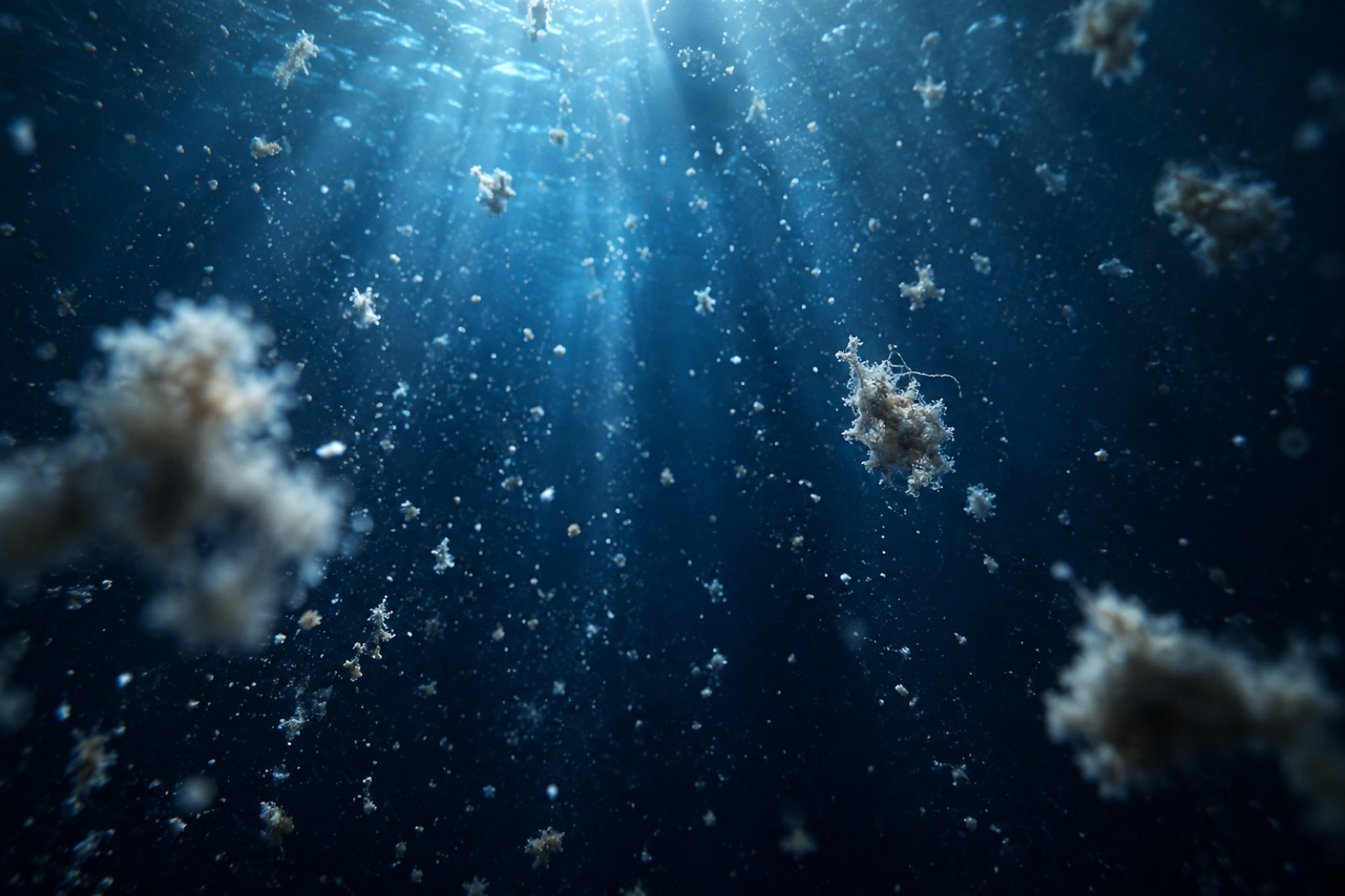
Shine a dive light into open water at night and the beam fills with drifting white flecks, tumbling and hanging like a snow globe that never fully settles. Every ocean basin makes this snow, continuously, everywhere the sun reaches — yet each flake is far stranger than the name suggests. Marine snow is not debris so much as construction: small particles glued into aggregates that feed bacteria, shelter larvae, feed the twilight zone's commuters and deliver, at their journey's end, the only food most of the deep seafloor will ever see. Understanding how a flake is born, who lives on it and who intercepts it is the key to one of oceanography's central plumbing systems — and to honest arguments about where carbon leaked out of kelp forests finally comes to rest.
A litre of seawater above a kelp forest or a plankton bloom holds millions of particles too small to see — most too small to sink at any useful speed. The ocean's solution to moving them downward is aggregation: sticking them together until they are big enough to fall. Several kinds of glue do the work.
Phytoplankton exude polysaccharides that straighten into tangled nanogels in seawater — transparent exopolymer particles (TEP). TEP is, functionally, ocean-wide flypaper: invisible, fantastically sticky sheets that scavenge whatever they touch. When currents and turbulence push particles into contact, TEP welds them together. Laboratory "roller tanks" — cylinders of seawater turning slowly so particles keep meeting — reproduce the process beautifully: within days, clear water where a bloom was lysed assembles itself into visible flakes riding the rotation like dust bunnies forming under a bed.
Each collision that sticks makes the next one more likely, because bigger aggregates sweep more water per second. Aggregation is thus self-accelerating — which is why the end of a spring diatom bloom can transform a murky green sea into clear water and a blizzard of falling snow in less than a week.
Animals build snow outright. Appendicularians (larvaceans) secrete mucus "houses" — elaborate filtration balloons many times their body size — clog them with captured particles and abandon them, sometimes several times a day; the discarded houses sink away loaded with food. Salps and other gelatinous filterers compact fine particles into dense faecal pellets that can sink at hundreds of metres per day, and their carcasses after a bloom collapse are avalanches all by themselves. Even the endless grazing of copepods repackages material: what enters the water as a suspended micron-sized cell leaves it as a millimetre pellet — which is one reason zooplankton faecal pellets figure so heavily in what sediment traps actually catch.
An outsider might imagine a falling flake as inert cargo. Under a microscope it is closer to a terrarium.
This living engine is also the snow's undoing, and the planet's gain or loss depending on how you frame it: microbes and zooplankton strip most of the carbon back out of falling material in the upper few hundred metres. Only the fast, the dense or the lucky flakes make depth — the attenuation that defines the strength of the biological pump, the subject of our companion piece on marine snow as a carbon conveyor.
Between surface and seafloor, the snow passes through one of Earth's most populated neighbourhoods, and much of that population is organised around intercepting it.
Flux feeders — copepods and krill that hang in the twilight zone and pluck falling particles rather than hunting swimming prey — skim the rain as it passes. Larger residents perform the famous diel vertical migration, rising at night to feed near the surface and carrying carbon down in their guts to respire at depth by day, an active conveyor belt layered on the passive snowfall. Deeper still, fishes with lantern-light photophores, gulper eels and grenadiers work the dim margins where a single large flake — a discarded larvacean house glutting with bloom debris — is a meal worth chasing.
At the bottom, the story changes tense: the rain arrives. In most of the deep ocean, marine snow and its weathered remains are essentially the entire food supply. Seafloor communities — sea cucumbers trawling the sediment, brittle stars waving arms into the near-bottom current, microbes working the fluffy top skin of mud — are tuned to its quantity and timing. When the spring bloom's snow arrives at abyssal depths weeks later as phytodetritus — still recognisably green in time-lapse photographs — deep communities respond measurably: activity spikes, some species time their reproduction to the delivery. The deep sea has seasons, and marine snow is its calendar.
How far a given flake penetrates depends on a race between sinking and being eaten. Sinking speed grows with size and density: dust, coccolith calcite and diatom opal act as ballast, while fluff such as mucus and TEP is nearly neutrally buoyant. Remineralisation works against them all. One useful way to think of a falling snowstorm is as a competition between construction and demolition crews — aggregation and ballast building downward momentum, microbes and grazers taking it apart — with the outcome setting how much organic matter crosses into the deep ocean and how much returns to the surface economy.
Currents complicate the geometry: a flake sinking at 50 metres per day in water sliding sideways at kilometres per day doesn't land below where it started. Coastal snow — kelp fragments and bloom debris — rarely falls straight into the abyss; it steps down-slope in stages, which is why deep-sea carbon export claims staked on coastal production have to reckon with transport, not just sinking rate.
Because nets shred aggregates, marine snow long escaped direct study. The modern toolkit instead watches it in place: in-situ camera systems (including holographic imagers that photograph flakes undisturbed at full 3-D size), profiling floats and gliders whose optical backscatter sensors track particle layers through entire ocean basins, moored cameras documenting phytodetritus arrivals on the abyssal floor, and sediment traps catching calibrated samples of the flux itself. The picture they assemble is of a process far more episodic than the word "rain" suggests — less snowfall, more weather: squalls after blooms, lulls between them, and the occasional avalanche when a jellyfish bloom or a whale fall rewrites the local budget entirely.
Tidewright's interest is the coastal terminus: the fraction of a restored forest's production that leaves the reef as snow and where it lands is a live question in our (fictional) Canopy Ledger monitoring, folded into our impact methodology. The particle ecology described here is shared, real oceanography.
Partly — but only partly. A typical flake mixes dead plankton, faecal pellets, discarded mucus structures, mineral dust, live microbes and sometimes still-living algae. Some of the most important components, like TEP gels, were never "organisms" at all; they're the exuded chemistry of a productive sea.
Falling snow is the main route by which carbon fixed at the surface reaches the deep ocean — the physical heart of the biological carbon pump. Only a small fraction survives the trip to great depth, where it may stay out of contact with the atmosphere for centuries; our conveyor explainer traces that pathway and its numbers.
Yes — any dive light or shallow sun shaft in productive water reveals it, often dramatically after a plankton bloom or near a kelp forest in storm season, when shredded blade fragments join the rain. If you're curious to see it yourself, our guide to night diving in kelp explains why divers describe the canopy after dark as "swimming through a snow globe."
Anywhere from under a metre per day for small, fluffy aggregates to several hundred metres per day for dense faecal pellets, carcasses and ballasted bloom debris. Sinking speed largely determines how deep a flake's carbon penetrates before being eaten or decomposed.
Yes. Torn kelp fragments, eroded blade tissues and microscopic debris from the canopy disintegrate into particle rain — one of the pathways by which kelp carbon travels beyond the reef, detailed in our article on where kelp carbon goes.
Marine snow is the ocean's constant drizzle of sinking organic matter — and one of the main routes by which carbon reaches the deep sea. Here's how it works.
Priya Raman ·
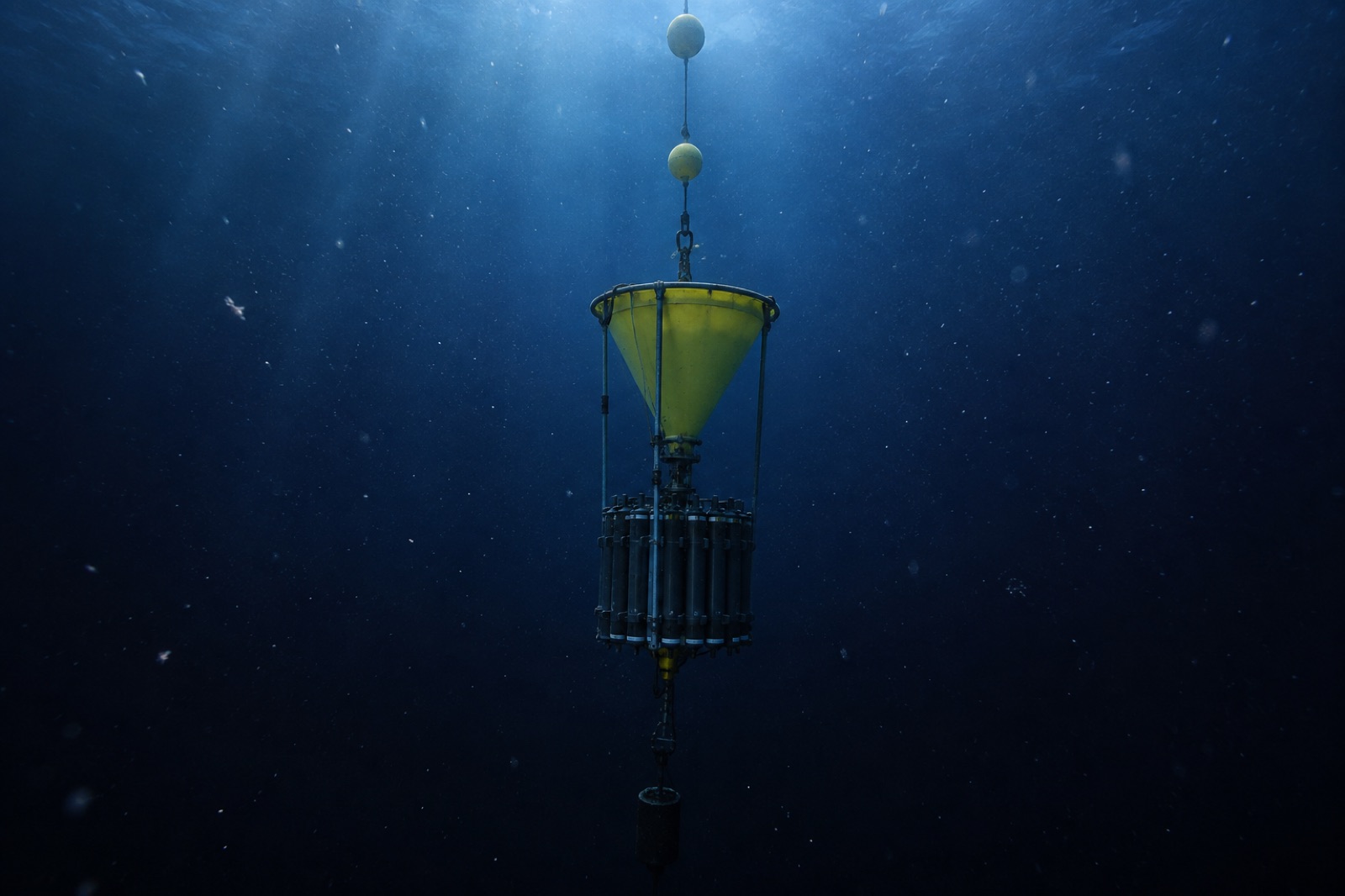
How do we measure carbon sinking through ocean? Sediment traps — moored funnels hundreds of metres deep — catch marine snow and tally the export flux.
Dr. Lena Fischer ·
The mesopelagic twilight zone holds more fish than any other habitat on Earth and quietly moves carbon to the deep sea. Here's what lives there — and why it matters.
Priya Raman ·