Science8 min read
Marine Snow: The Ocean's Slow Carbon Conveyor
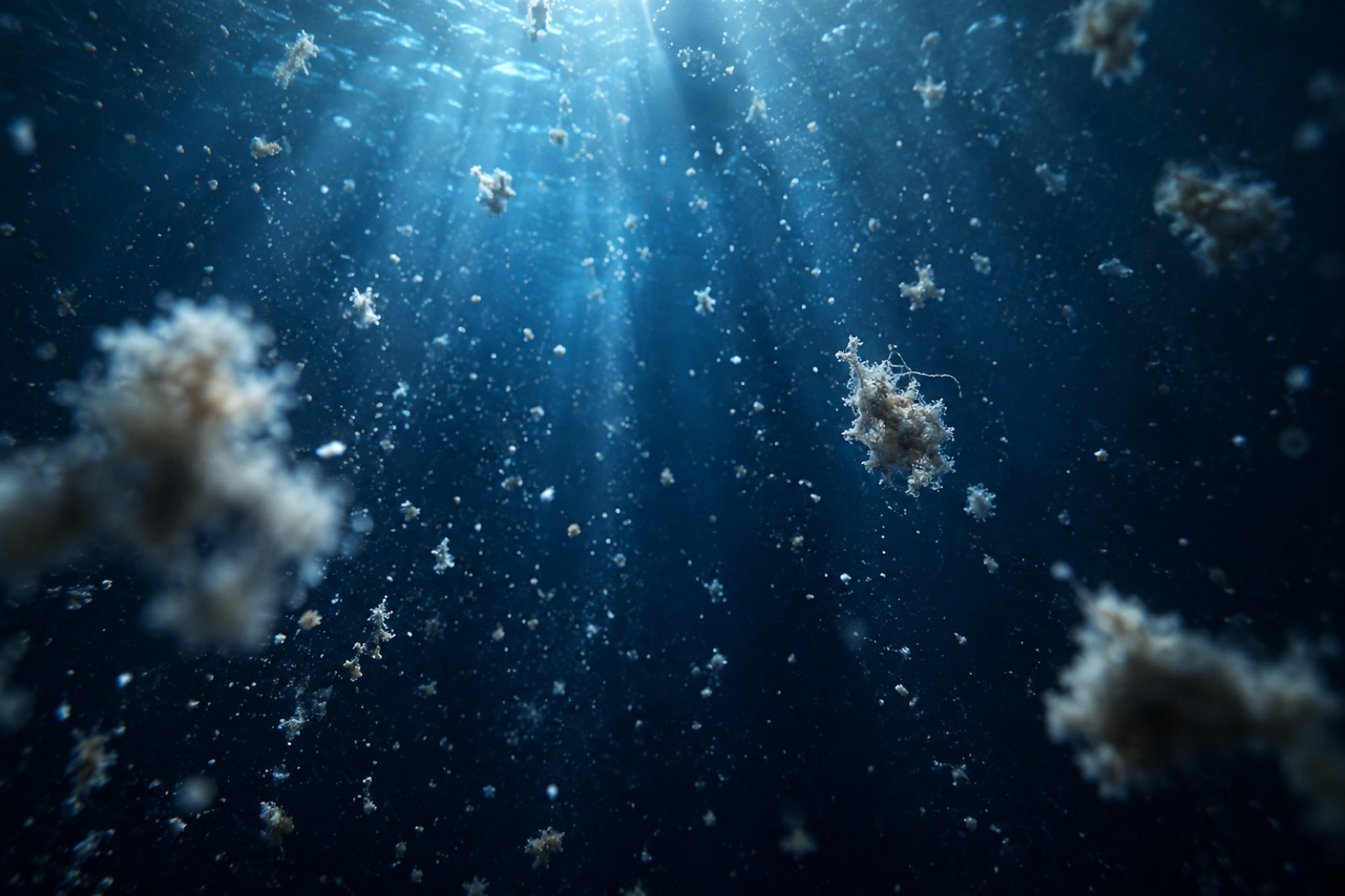
Marine snow is the ocean's constant drizzle of sinking organic matter — and one of the main routes by which carbon reaches the deep sea. Here's how it works.
Priya Raman ·
Kelp forests shed huge amounts of carbon as detritus. How storms, microbes and sticky aggregates turn that debris into marine snow — and where it lands.
A kelp forest is a carbon factory without a chimney. Every year, a healthy forest fixes astonishing amounts of carbon into fast-growing tissue — and then, because kelp blades are perpetually aging, grazing and storm-stripped, sheds much of it back into the sea as fragments, dissolved organics and mucus. Where that carbon goes next is one of the hottest questions in blue carbon science. One answer — the slowest, most romantic, and hardest to measure — is marine snow: sticky aggregates of kelp debris that sink, drift and step down the continental slope toward the deep ocean. This article follows a kelp blade's carbon from the canopy to the abyss, and asks honestly what that journey is worth for the climate.
To understand kelp snow, start with how much raw material there is. Kelp is among the fastest-growing life on Earth — giant kelp fronds can add tens of centimetres a day in season — but that growth comes with relentless turnover. Blades erode at their tips from wave-battering, are clipped by grazers, tear free in storms, and continuously leak dissolved organic carbon (DOC) through their surfaces. A functioning kelp forest exports the majority of its production — only a minority is ever grazed directly — which is why detritus pathways dominate the accounting in where kelp carbon goes and the detritus food web.
This shed material arrives in several parcels, each with its own carbon fate:
"Marine snow" is not one thing — our overview of marine snow as the ocean's slow carbon conveyor explains the aggregate biology in generality, and marine snow explained covers flake microhabitats. For kelp carbon, the story has specific chapters.
Blades don't fall intact; storm energy and grazing shatter them into progressively finer fragments. Each break increases surface area for microbes, speeds colonisation and dissolution, and converts kelp from "something a crab can carry" into "something an aggregate can catch." Wave-exposed coasts make fine, fast-fragmenting debris; sheltered forests export larger, slower packages.
Much of kelp's leaked DOC is biologically sticky — exuded polysaccharides and gels that behave like the ocean-wide flypaper of transparent exopolymer particles (TEP). Microbes colonise the debris, aggregate the fines, and re-package dissolved carbon into particles dense enough to sink. In effect, microbes convert kelp's leak into snow. This is a crucial pivot: carbon that left the kelp dissolved can still end up exported as particulate, after a microbial layover in the water column.
Particles large enough to sink at useful speed are usually composites: kelp fibre glued to diatom debris, faecal pellets, mineral grains and mucus. Fast lasagna-like flakes outrun microbial dismantling; fluffy aggregates linger and are eaten. Whether the mix carries ballast — dense biomineral or sediment grains — largely sets how deep kelp carbon can penetrate before it's digested. Sediment traps (which we'll meet below) show that much of what they catch from kelp coasts is conspicuously composite, not pure kelp.
This is where kelp snow differs from open-ocean snow. A kelp forest sits on a narrow shelf, not above the abyss. Its falling carbon therefore almost never goes straight down: it sinks through moving water, is carried sideways by currents, hits the bottom on the shelf, gets resuspended and moved again — a downslope relay. Each resuspension is another chance for microbes and grazers to intercept; each calm spell is a chance to step farther offshore. Over weeks, some kelp-derived material stair-steps off the shelf and into submarine canyons, where funnelling currents can deliver it to deep basins.
The signature survives remarkably far. Studies using stable isotopes, lipid biomarkers and, more recently, environmental DNA have found kelp-derived carbon in continental slope sediments and submarine canyons kilometres to tens of kilometres from the nearest forest (the isotope tools are unpacked in stable isotopes and kelp food webs). Deep-sea surveys in some regions even recover recognisable kelp fragments at depths of thousands of metres. Kelp carbon demonstrably reaches the deep sea. The argument is entirely about how much, and how often.
Honesty matters here, because kelp marine snow sits at the centre of some of blue carbon's biggest claims. The evidence base looks like this:
For the market-facing implications — why this uncertainty disciplines carbon claims rather than ruling them out, and how monitoring tries to close the gap — see the deep-sea export pathway and our MRV explainer.
Measuring kelp snow means catching a faint, episodic rain. The main tools:
None alone is sufficient; the credible estimates come from reconciling several methods at once, across seasons and storm years. Kelp detritus export is famously pulsed — a single storm season may move more canopy carbon than the rest of the year combined — so short studies routinely miss the signal.
If even a modest share of the kelp forest's massive production is exported and buried, restoring kelp forests could have a real, additional carbon benefit layered on their biodiversity and fisheries value. That's the upside that makes this one of the most-watched questions in ocean climate science, and it's why Tidewright's (fictional) Canopy Ledger platform couples canopy mapping with particle and sediment monitoring at project sites — with figures on our impact dashboard that are illustrative pending the science.
But the honest version includes the caveats. Restoration on a coast whose kelp detritus mostly cycles back to the atmosphere is not the same carbon story as restoring above a sediment-starved canyon. Export is episodic, hard to verify, and entangled with every other fate kelp carbon can have. The marine snow pathway is one the science is still negotiating — which is exactly why careful, instrumented restoration is part of running the experiment. A flake of kelp that left the canopy in a storm may be digested by morning, or buried for millennia. Knowing the difference — coast by coast, season by season — is the work of the next decade.
Yes — isotope, biomarker and DNA studies have traced kelp-derived carbon into continental slope sediments, submarine canyons and some deep basins. What remains contested is the quantity that survives the journey versus what's recycled on the shelf.
Origin and geometry. Kelp snow starts as macro-scale debris shed by large seaweeds near the coast, and must cross a shallow shelf — sinking and being resuspended on a downslope relay — rather than raining straight down from a surface bloom.
Potentially, as one several pathways. If a coast's detritus is exported to long-lived sediment sinks, restoration adds genuine carbon value; where detritus mostly re-enters the food web and the atmosphere, the claim is weak. The answer is site-specific — the core argument of our kelp carbon storage accounting.
By combining sediment traps, stable isotopes and biomarkers, autonomous particle sensors, seafloor cameras and, increasingly, eDNA of buried sediments — across seasons and storm years, because export is episodic and pulses with disturbance.
Only if the snow arrives somewhere that locks it away — typically deep, fine-grained, ideally low-oxygen sediment below the shelf. Snow intercepted and respired on the shelf returns carbon to the water (and eventually air) in months to years. Permanence, for kelp, is a destination, not a property.
Marine snow is the ocean's constant drizzle of sinking organic matter — and one of the main routes by which carbon reaches the deep sea. Here's how it works.
Priya Raman ·
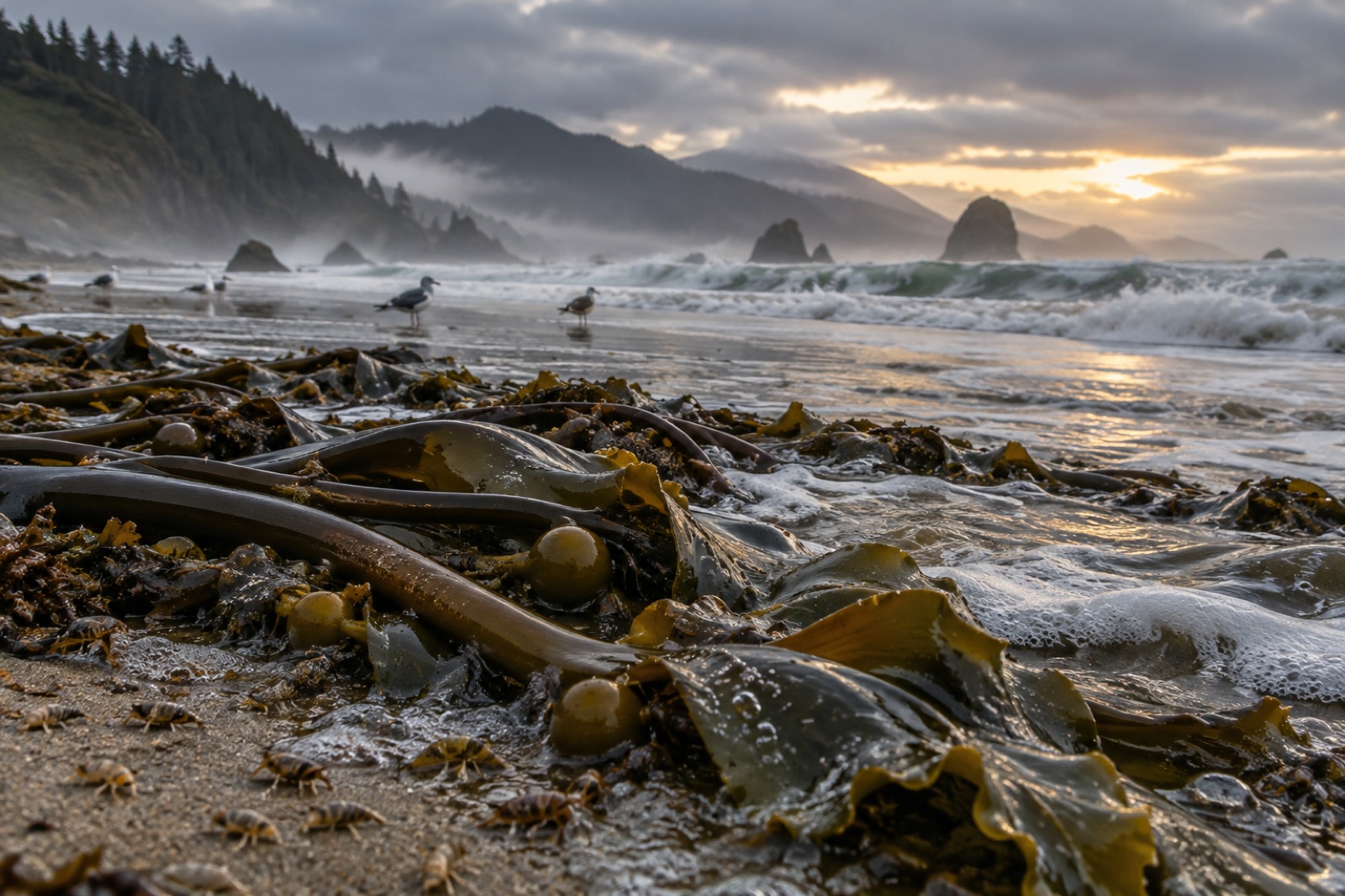
Kelp grows fast and dies young. Follow its carbon from sunlit blade to beach wrack, deep-sea fall and seafloor sediment — the full journey of kelp detritus.
Dr. Lena Fischer ·
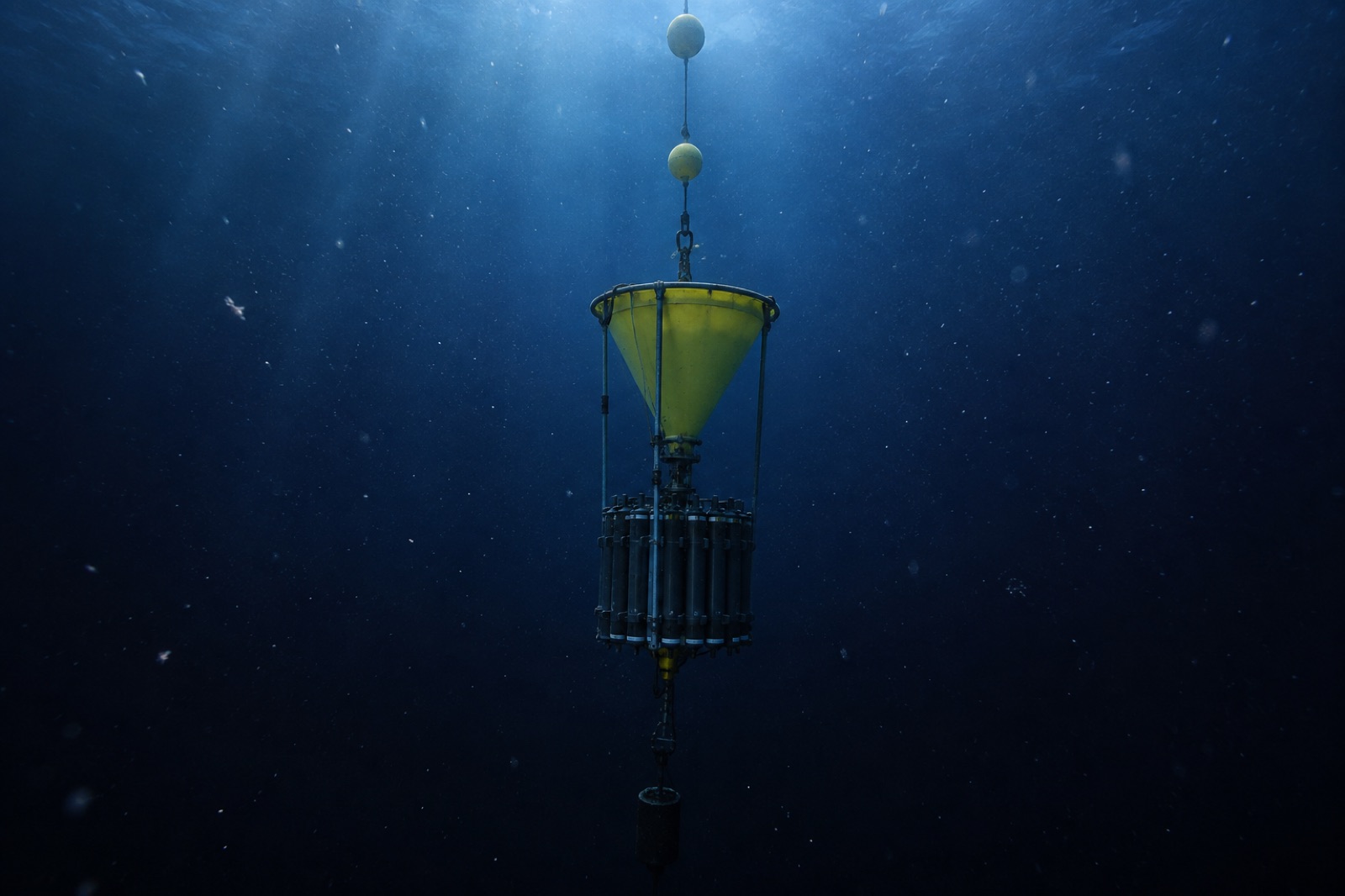
How do we measure carbon sinking through ocean? Sediment traps — moored funnels hundreds of metres deep — catch marine snow and tally the export flux.
Dr. Lena Fischer ·