Skip to content

Sediment Traps: Catching Carbon on Its Way Down

How do we measure carbon sinking through ocean? Sediment traps — moored funnels hundreds of metres deep — catch marine snow and tally the export flux.
Dr. Lena FischerClimate Scientist8 min read
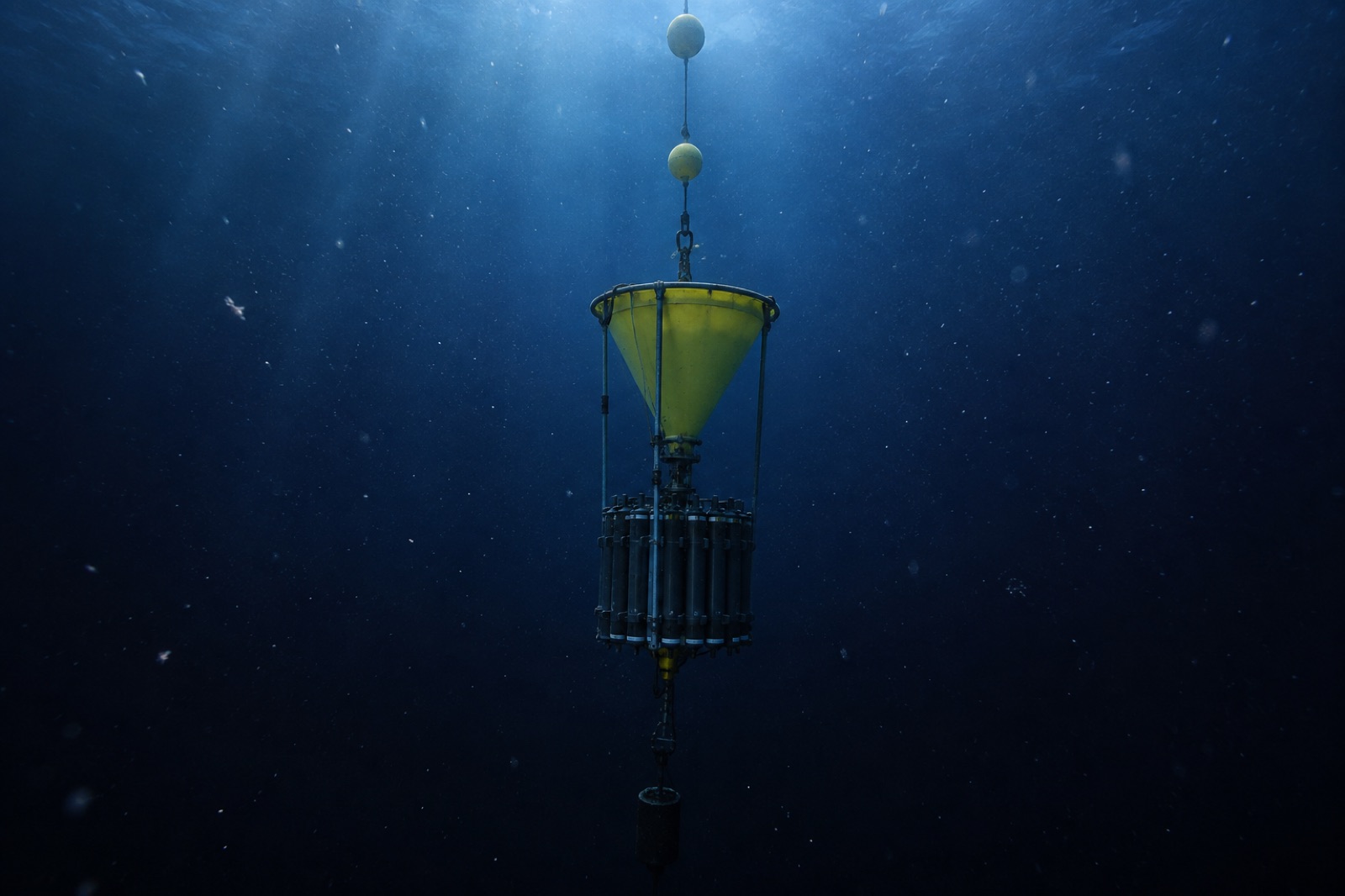
A yellow-funnel sediment trap on a deep-ocean mooring hangs in dark blue water, its carousel of sampling bottles catching faint white specks of falling marine snow in soft light shafts.
On this page

Every claim that kelp forests, or the ocean generally, are moving carbon to the deep sea rests on a measurement problem that sounds absurd when stated plainly: how do you weigh a slow drizzle of particles falling through a kilometre of moving water? You cannot see it from a satellite. You cannot feel it from a ship. The answer oceanography settled on decades ago is beautifully direct — put a funnel in the water and catch what falls. The sediment trap is the ocean carbon accountant's cash drawer, and understanding what it measures (and what it misses) is essential to following the debate over where kelp carbon actually ends up.

The measurement problem

Kelp carbon can leave the coastal forest by several routes — fragments drifting out to sea, dissolved organics mixing offshore, or material sinking through the water column toward deep sediment. Claims about this export flux are everywhere in blue carbon discussion, but the ocean does not hand out receipts. Particles sink at metres to hundreds of metres per day, currents move them sideways kilometres per day, and everything organic is being eaten en route. To quantify export you need a device that sits in the path of the falling material, samples it on a schedule, and survives months unattended in the dark.

That device is the sediment trap.

What a sediment trap looks like

A modern moored trap has four parts:

  • The collection funnel or cylinder array. Typically one or more large funnels (opening areas of a quarter to half a square metre) or baffle-topped cylinders, held vertical in the water column. The geometry matters: funnels focus the sample into a bottle but can under- or over-collect depending on tilt and flow past the opening.
  • Rotating sample bottles. Beneath the funnel, a carousel of pre-filled, preservative-treated cups programmed to open and close on a schedule — commonly 7 to 30 days per bottle — so a single deployment returns a time series, not just a lump sum.
  • The mooring. The trap hangs at a chosen depth on a line anchored to the seafloor, held taut by subsurface floats, with current meters, tilt sensors and sometimes cameras riding alongside. Nothing about the rig touches the surface — passing storms and trawlers can't reach it.
  • The acoustic release. At recovery, a coded sound pulse tells a latch at the anchor to let go, and the whole instrument section floats up for collection.

Deployments run from months to a full year+. The recovery day — hauling a dripping carousel that has been quietly catching the ocean's downward rain since last season — is one of the small ceremonies of oceanography.

What the samples tell you

Back at shore, each bottle is a recorded fortnight of falling ocean. The analysis chain:

  1. Mass flux. Dry the sample, weigh it: total particulate flux, usually reported as milligrams per square metre per day. This alone, over seasons, reveals the pulse of the biological pump — spring bloom export arrives as a spike.
  2. Carbon flux. Measure the organic carbon fraction of the sample (by combustion analysis) and multiply: the carbon export number that blue carbon accounting ultimately needs.
  3. Composition. Swimmers (live animals that blundered into the trap and died in the preservative) are picked out; the rest is split into mineral ballast, carbonate, biogenic silica and organic matter. In coastal deployments near kelp beds, microscopic identification plus pigment and biomarker analysis can detect kelp-derived material — fragments of blade and the distinctive chemistry of brown algae.
  4. Fingerprints. Isotope analysis of the trapped carbon — the subject of our companion piece on stable isotopes in food webs — can confirm whether trapped organics carry coastal macroalgal signatures or open-ocean plankton ones. eDNA methods applied to trap samples are beginning to do the same taxonomically.

Layer the numbers across the seasons and you have a budget: how much carbon left the surface ocean here, and when.

The uncomfortable caveats

Sediment traps are honest instruments, but they measure a slippery quantity, and the literature knows the failure modes well:

  • Hydrodynamic bias. A funnel in fast current does not collect at the theoretical rate; particles may be deflected around it or winnowed out of it. Calibration against natural radionuclide tracers (which the water itself effectively "collects") exists precisely to correct for this.
  • Swimmers and decomposers. Everything organic in a bottle for three weeks is being eaten unless the preservative works perfectly. Zooplankton swimmers inflate the measured flux if not screened carefully.
  • The funnel only catches vertical. Coastal water moves sideways fast. Kelp detritus advected off a reef can settle kilometres downtrail, where no trap sits. A trap measures the flux past its own mouth, not the budget of a whole coastline.
  • Depth placement is a choice with consequences. Traps are typically moored below the deepest mixing of winter — deep enough that captured carbon won't be entrained back to the surface. But kelp detritus is dense and may settle locally on the shelf at depths traps rarely sample. Sinking to the shelf seafloor at 100 metres is a real carbon transfer, but it falls between the cracks of trap programs designed for the open-ocean pump.

This is why nobody serious quotes a single trap number as "the" export figure: results are reported with bias corrections, uncertainty ranges and a clear statement of the depth window actually sampled.

Where traps fit in kelp carbon research

For kelp-derived carbon specifically, traps earn their keep in three roles:

  • Detecting the kelp signal. Trap arrays moored along a gradient from kelp forest to open shelf can show whether macroalgal material is genuinely reaching deeper water — and whether its share of the flux rises in storm season, when the forest sheds, as described in our piece on drift kelp and wrack.
  • Testing the export hypothesis. Adjacent deployments upstream and downstream of restored forests can quantify whether restoration measurably increases flux to depth — the empirical spine of any future kelp carbon crediting.
  • Anchoring models. No satellite or model can estimate export flux out of thin air: models are tuned and validated against trap data, and deep-sea export claims are only as good as the measurements beneath them.

At Tidewright, moored trap arrays deployed near restored forests (and near reference barrens) feed directly into the measurement layer of Canopy Ledger — an illustrative workflow, but the instrument physics described here is standard oceanographic practice.

Key takeaways

  • Sediment traps are moored funnels that catch sinking particles on a rotating schedule, producing the only direct, time-resolved measurements of the ocean's export flux.
  • Analysis returns mass flux, carbon flux, composition and increasingly genetic and isotopic fingerprints of what fell — including material that came from kelp forests.
  • Hydrodynamic bias, swimmers, and lateral advection mean trap numbers are estimates of flux past a point, not whole-coast budgets; honest studies say so.
  • Depth placement defines the claim: carbon captured below winter mixing depth is effectively exported; carbon settling on the shelf is a different pathway traps often miss.
  • Trap data is the empirical anchor for blue carbon models, standards and any credible MRV system built on kelp export.

FAQ

Where did sediment traps come from?

From oceanography's effort, starting in the 1970s, to quantify the biological carbon pump directly rather than inferring it from water chemistry. Long-running trap moorings at sites like those off Bermuda and Hawaii produced the first multi-year time series and revealed how strongly export pulses with seasons and climate events.

How big is the export flux from a kelp forest?

It varies widely with forest productivity, storm exposure and local currents, and it remains an active research question. The honest answer is a range, not a number — which is exactly why trap measurements at real restoration sites matter more than extrapolations.

Why not just sample the deep sediment?

Because sediment integrates decades or centuries of deposition and remixing — it can't tell you what fell last season, or attribute material to a particular forest. Traps give time resolution; sediment cores give history. Good carbon budgets use both.

Do the trapped particles really stay out of the atmosphere?

If the trap sits below the deepest winter mixing, the captured layer will not be re-entrained to the surface seasonally; the carbon is on its way to centuries-scale storage. Shallower captures can be remixed — placement depth is the whole question.

Can I see Tidewright's trap data?

Aggregated flux results from our monitoring arrays are documented with all our metrics on the impact methodology page, and processed datasets are listed in our open data catalogue — always with the caveat that Tidewright's numbers are illustrative.