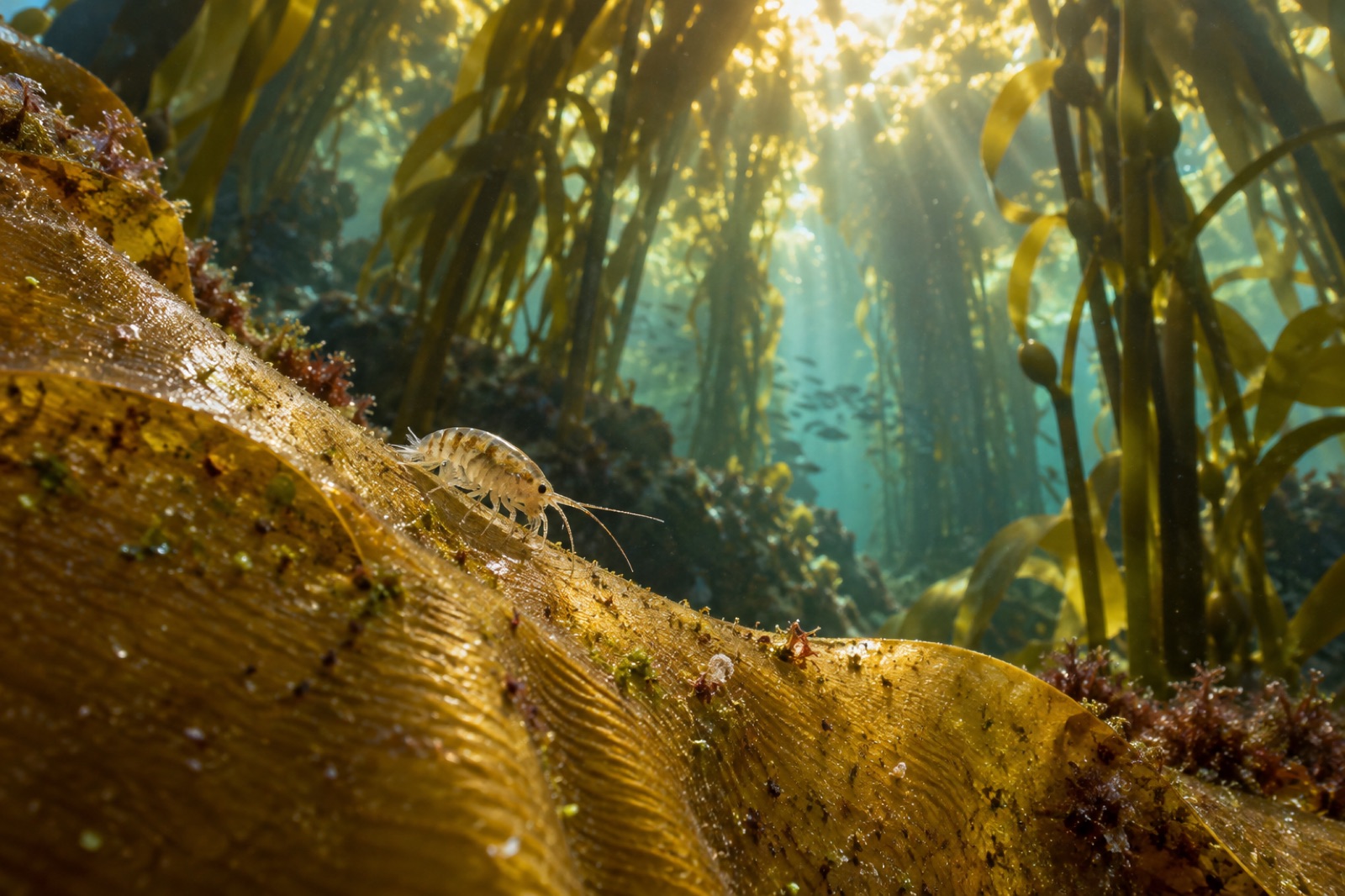
A kelp forest looks like a two-player system: the forest, and the animals that live in it. But there is a third player, and it occupies everything in between — the water itself, the sediment below, the surface of every blade and the gut of every grazer. That player is the microbial community, and it is less a background texture than an economy: kelp exports food into it, nutrients flow back out of it, viruses audit it, and every animal in the forest banks with it. This article tours that economy at ecosystem scale — the microbes between the forest and the sea. (For the film living on the blade itself and its role as a health indicator, see our pieces on the kelp microbiome and reading its stress signals; here we zoom out to the water around the blades.)
The living water
Seawater only looks empty. A single millilitre of coastal seawater carries on the order of a million bacterial cells and roughly ten times as many virus particles — a dense, invisible plankton of swimmers too small to see. The cast includes:
- Bacterioplankton, the workhorses: cells that eat dissolved organic matter, recycle nitrogen and phosphorus, and get eaten in turn.
- Archaea, quieter relatives that run much of the ocean's ammonia oxidation — the first link in regenerating nitrate.
- Picoplankton, the smallest photosynthesizers, adding their own fixed carbon in the sunlit water between the fronds.
- Viruses, staggeringly numerous, infecting everything above them on the list.
Inside a kelp forest, this community is not just sea-at-random. It lives among the blades, bathed in what the kelp gives off — and that changes what it does.
Kelp's leaky generosity
Kelp is fast at photosynthesis, and it does not keep everything it makes. A meaningful fraction of the carbon a blade fixes is released straight into the water as dissolved organic matter — sugars, amino acids and other small molecules that leak through living tissue or wash from mucus and fraying tips. Oceanographers have followed this leak chemically, and it is substantial: forests export a continuous ration of fresh, easily digested food into the surrounding water.
Who collects the ration? The bacteria. They bloom on kelp exudates, are grazed by flagellates and ciliates, which are eaten in turn by larger zooplankton, which feed the small fish of the forest. This is the microbial loop — the detour by which dissolved carbon, otherwise lost to the food web, is repackaged into living, edible cells. Our explainer on the microbial loop maps that cycle in detail; the kelp-forest point is simply that the forest's leak is not waste. It is a standing subsidy to the plankton community of the whole coastal margin — one reason kelp coasts are so crowded with life. The same leak is the entry point of kelp carbon into the long export pathways traced in where kelp carbon goes.
Viruses: the forest's quiet auditors
Every one of those bacteria is hunted. Viruses infect microbial cells, burst them, and spill their contents back into the water as dissolved matter — a process ecologists call the viral shunt, because it diverts carbon and nutrients out of the grazer food chain and back into the pool for bacteria to reclaim. The shunt is a kind of standing audit: it caps booms, recycles scarce nutrients locally, and — because most viruses are choosy about their hosts — quietly polices community composition, favouring diversity by suppressing whichever microbe gets too common.
Kelp joins this traffic directly. Viruses are known to infect brown algae and their microscopic life stages, and while seaweed virology is a young field, the suspicion grows that viral pressure helps shape which kelp spores and gametophytes make it — one more way the invisible layer sorts the visible one.
The sediment workforce
Below the canopy lies the economy's slower ledger. Detached blades, eroded tips and whole storm-cast plants rain onto the reef floor and into gullies — the supply line described in our piece on the detritus pathways of kelp forests. Much of what animals don't eat goes to the microbes, and the sediment community runs chemistry that no single animal can:
- Decomposition breaks tough algal polymers — alginates, fucoidans, cellulose-like fibres — into food first for microbes, then for the worms, amphipods and isopods that eat the microbes.
- Denitrification converts nitrate back to nitrogen gas in low-oxygen pockets, a genuine removal of nitrogen from coastal water — among the reasons healthy nearshore sediments matter in nutrient-loaded regions.
- Sulphur cycling hums along in the anoxic layers below, the same buried geology of rot that beaches share with the forest edge.
The sediment isn't just where kelp goes to die. It's where kelp gets translated into everything else.
Every animal carries its own forest
Return to the visible animals and the microbial layer comes with them. Sea urchins run fermentation chambers in their guts whose bacteria help unlock kelp's defensive, fibrous tissues; gut communities shift with diet, and likely contribute more to urchin nutrition than a simple bite-and-swallow model suggests. Abalone, whelks and grazing fishes likewise carry microbial partners tuned to their diets, and fish skins and gills host mucus microbiomes that defend the surfaces a bladder-wracked world of microbes constantly lands on.
Then there's settlement. A bare rock underwater is never bare for long: it acquires a microbial biofilm within hours, and that film is the welcome mat — or the warning sign — for the larvae and spores deciding where to land. Many kelp-forest invertebrates and kelp spores themselves key on specific film communities before they commit, a matchmaking process we unpack in biofilms and settlement cues. Because the film is seeded from the surrounding water, the water column's microbial community is, in effect, the reef's immigration office.
When the invisible layer shifts
Disturbance reaches the microbial economy quickly:
- Heatwaves restructure plankton communities on the timescale of days — different temperature optima, different winners — and strip the kelp's own surface defences, reshuffling the biofilm even before blades show damage.
- Nutrient loading favours fast, greedy copiotrophic bacteria and can tip systems toward the slimy, low-oxygen states nobody wants near a reef.
- Forest loss removes the exudate subsidy itself. Blades gone, the leaked carbon stops; the water community drifts toward whatever other sources remain. Whether a recovering forest finds an intact microbial neighbourhood to rejoin — or a changed one that must reassemble — is quietly one of restoration's real unknowns: the water may hold a kind of microbial memory of the forest, and its duration is unknown.
This is the same logic that makes microbial reads attractive as early warning signals for kelp stress — shifts show up fast, integrate many pressures, and only need a bottle of water and a sequencer.
Why restoration should care about the water
The practical consequences for rebuilding forests are only now being assembled, but the shape is clear:
- The water is the seed source for every new surface. A seeded line outplanted at a bare reef will recruit its biofilm from whatever that water carries — which favours planting near remnant forest and timing outplants to healthy microbial seasons.
- Hatchery water is a microbial choice, not a backdrop. Nursery operators long chased sterility; the modern view aims for managed, diverse, correctly assembled microbial communities around the seedstock — sterility produces defenceless juveniles, not clean ones. Within Tidewright's fictional Holdfast program, nursery water treatment is framed exactly this way (illustratively): filter the pathogens, keep the community.
- Sequencing is the cheapest layer of the monitoring stack. Water samples already taken for eDNA or nutrients can carry microbial reads at modest extra cost, adding the invisible layer to the ledger alongside canopy maps and fish counts.
None of this means engineering ocean microbiomes in place. It means recognising that the forest never lived alone, and that what the diver cannot see was doing a great deal of the work.
Key takeaways
- A millilitre of coastal seawater holds on the order of a million bacteria and ten times as many viruses; inside a kelp forest, this community runs on the forest's own exports.
- Kelp leaks a meaningful fraction of its fixed carbon as dissolved organic matter, feeding the microbial loop that repackages it into food for the wider food web.
- Viruses cap microbial booms and recycle nutrients through the viral shunt — a community-scale audit with knock-on effects even for kelp life stages.
- Sediment microbes decompose the forest's detritus and run denitrification and sulphur chemistry, translating kelp into everything else and scrubbing nitrogen along the way.
- Every kelp-forest animal carries microbial partners — gut fermenters in urchins, defensive films on fish — and the water column seeds the biofilms that tell larvae and spores where to settle.
- Heatwaves, nutrient loading and forest loss all restructure this invisible layer, making microbial reads both an early-warning tool and a design consideration for restoration.
FAQ
Is seawater really that full of microbes?
Yes — this is one of oceanography's best-established numbers. Roughly a million bacterial cells per millilitre of surface seawater, plus archaea, picoplankton and about ten times as many virus particles. The ocean looks clear because its life is small, not because it's empty.
Do kelp forests "farm" bacteria the way corals farm their symbionts?
Not in the same sense. Corals host specific intracellular photosynthetic partners; kelp's relationships with planktonic microbes are freer — a two-way market of exuded carbon and recycled nutrients, curated rather than farmed. Kelp does actively shape the microbial film on its own surfaces through its chemistry, which is closer to gardening.
Can microbes be invasive species?
They can travel — in ballast water, on hulls and gear, with drifting debris — and microbial communities do shift when ecosystems change. But proving a microbial "invasion" is harder than with visible species: detection is recent, baselines are scarce, and distinguishing a new arrival from a rare resident is genuinely difficult. It's an open research frontier more than an established threat list.
What exactly is the "viral shunt"?
When a virus lyses a microbial cell, the cell's contents spill into the water as dissolved organic matter, becoming available to other microbes instead of moving up the grazer food chain. Because viruses are abundant and usually host-specific, this shunt continuously recycles nutrients locally and suppresses whichever microbial group grows dominant — a quiet diversity-keeper.
Could a restoration project inoculate a site with "good" microbes?
In principle — and at hatchery scale, managing nursery microbial communities is already realistic practice. In open water, inoculation faces the same wall as other interventions: dispersal, residence time and unknown knock-on effects. The safer application for now is preserving the natural sources — remnant forests and healthy nursery water — that seed the invisible layer the way it evolved to be seeded.