Science8 min read
Marine Snow: The Ocean's Slow Carbon Conveyor
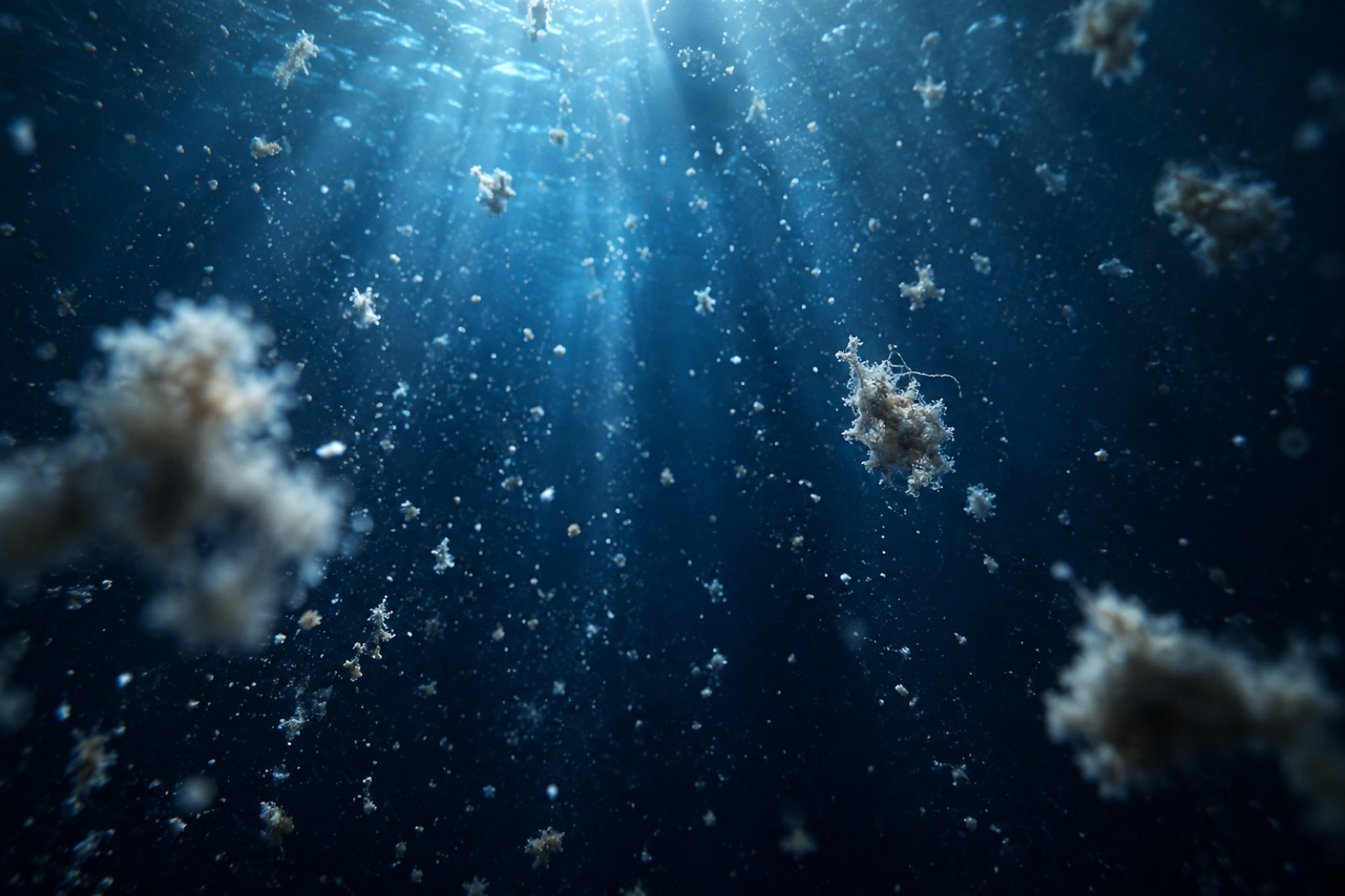
Marine snow is the ocean's constant drizzle of sinking organic matter — and one of the main routes by which carbon reaches the deep sea. Here's how it works.
Priya Raman ·
Most of the ocean's carbon never gets bitten by anything. Meet the microbial loop — the invisible recycling circuit that turns leaks and corpses back into food.
A kelp forest leaks. Every blade, all day, releases a share of its freshly photosynthesised carbon into the water as dissolved organic matter — sugars, amino acids, gel-like polysaccharides you could pour through a filter because they have no body at all. Nothing with jaws can eat a dissolved sugar. For a long time, oceanographers treated that leaked carbon as lost from the food web, a rounding error on its way to becoming deep-sea chemistry. Then, in the early 1980s, a group of marine microbiologists argued the opposite: the ocean had an entire second food web running beneath the visible one, built by microbes precisely to catch what the visible web drops. They called it the microbial loop, and it has quietly rewritten how we understand where kelp-forest productivity actually goes.
This explainer covers what the loop is, where its fuel comes from, how the carbon climbs back up into animals, and why it matters for everything from kelp restoration to blue-carbon accounting.
The classic picture of a marine food web is a ladder: phytoplankton or kelp at the bottom, zooplankton and grazers in the middle, fish at the top. Real oceans follow that ladder far less than textbooks suggest. In much of the open ocean, the majority of primary production flows not up the ladder but sideways — into the dissolved pool and the microbes that harvest it.
The microbial loop is the circuit that recovers that flow. It runs in three moves:
The elegance — and the inefficiency — is in those extra steps. Each transfer loses most of the energy to respiration, so the loop returns a fraction of what it catches. But the alternative to the loop is not efficiency; it's loss. Without it, leaked carbon would simply accumulate or be buried, and the coastal food web would run far leaner.
Kelp is a major DOM source on temperate reefs. Healthy blades exude dissolved organic carbon across their surfaces, and kelp mucus — the slippery coat you feel on a fresh frond — sloughs continuously into the water. Add in the steady fragmentation of aging blades and the storm-torn debris that becomes drift kelp and wrack, and a kelp forest is permanently spilling food into its own water column. Where that spilled material is fine enough to be particles rather than dissolved, it feeds filter feeders and decomposers as kelp detritus; where it dissolves, it belongs to the loop.
The loop has a startling internal shortcut. Viruses infect marine bacteria in astronomically high numbers and burst them from within, converting living microbial biomass straight back into dissolved matter. This viral shunt can recycle a substantial share of microbial production before grazers ever touch it. It sounds destructive, and ecologically it is a tax — but it also keeps nutrients (especially nitrogen and iron bound up in bacterial cells) circulating in sunlit surface waters instead of sinking away inside corpses.
A copepod chewing a diatom spills cell contents into the water. A fish strike shreds far more tissue than it swallows. Everything that dies begins dissolving before anything can scavenge it. The microbial loop sits downstream of all of this carelessness, which is another way of saying the loop is not an edge case — it is plugged into every feeding event in the sea.
The critters that graze bacteria deserve more credit than they get. Heterotrophic flagellates — single cells a few micrometres long, beating a whip — can clear bacterial densities from thousands of litres over their short lives and are, by biomass turnover, among the most important herbivores in the ocean. Ciliates take both bacteria and flagellates. Together they form the bridge rungs of the loop: too small for a larval fish to bother with individually, but present in clouds dense enough to be worth filtering.
From there the pathways diversify. Larvae of reef fish — including many kelp-forest species — feed heavily on microzooplankton in their first weeks. Oysters, mussels and the stalked tunicates that encrust kelp-forest rock strain bacteria and flagellates directly from the current. Sponges, it turns out, are perhaps the ocean's premier DOM processors: a reef sponge can filter its own volume of water in hours and subsist largely on dissolved carbon, converting the loop's raw fuel into sponge tissue that snails, chitons and sea stars can eat.
The loop is everywhere, but kelp forests run it hot in specific places:
Two practical reasons, one ecological and one accounting.
The ecological one: nursery function. A restored kelp forest is valuable in proportion to the food web it restarts, and the loop is the food web's grounding layer. Kelp exudates feed bacteria; bacteria feed flagellates; flagellates feed the larvae of the rockfish, snails and crabs the project exists to bring back. When Tidewright's monitoring teams sample a restoration site, microbial and microzooplankton communities are part of the early signal — they reassemble within seasons, years before the fish we actually count do. You can read how measurements like these feed our reporting on the impact methodology page.
The accounting one: not all loop carbon comes back. Some dissolved organic matter is chemically stubborn — altered by microbes and sunlight into forms that resist further breakdown and drift, semi-dormant, for decades to centuries. A share sinks or is advected offshore, joining the slow machinery described in marine snow and the broader biological carbon pump. Exactly how much kelp-derived carbon exits the loop this way, on what timescale, is one of the genuinely open questions in blue-carbon science — which is why credible carbon claims from kelp restoration are built conservatively and measured, not modelled into certainty.
No — they overlap but describe different things. The biological carbon pump describes how carbon moves from surface waters to the deep ocean (sinking particles, migrating animals, dissolved transport). The microbial loop describes how dissolved carbon is recycled near the surface. The loop feeds some of its output into the pump when resistant dissolved matter or microbial biomass sinks.
Their feeding machinery works on particles and prey. Absorbing nutrition across a large body surface at seawater dilution doesn't pay energetically for big, active animals — but it's ideal for cells a micrometre across with enormous surface-to-volume ratios. Some animals cheat by proxy: sponges and bivalves outsource the uptake to microbes on or inside their tissues.
Excess nutrients from runoff and coastal eutrophication can overdrive microbial and phytoplankton production — the loop amplifies whatever it's fed, including the wrong things. A healthy loop is a recycler; an overdriven one contributes to low-oxygen events.
With filtered water under epifluorescence microscopes, flow cytometers that count millions of cells per minute, and DNA sequencing of water samples — the same eDNA approaches used to detect rare fish, pointed at the community where most of the ocean's DNA actually lives.
Warmer water generally speeds microbial metabolism and respiration, which can shift more carbon toward quick recycling rather than long storage — one reason the fate of kelp carbon under marine heatwaves is actively researched rather than assumed.
Marine snow is the ocean's constant drizzle of sinking organic matter — and one of the main routes by which carbon reaches the deep sea. Here's how it works.
Priya Raman ·
The biological carbon pump moves billions of tonnes of carbon from the sunlit surface into the deep ocean every year. Here's how the living conveyor works.
Priya Raman ·
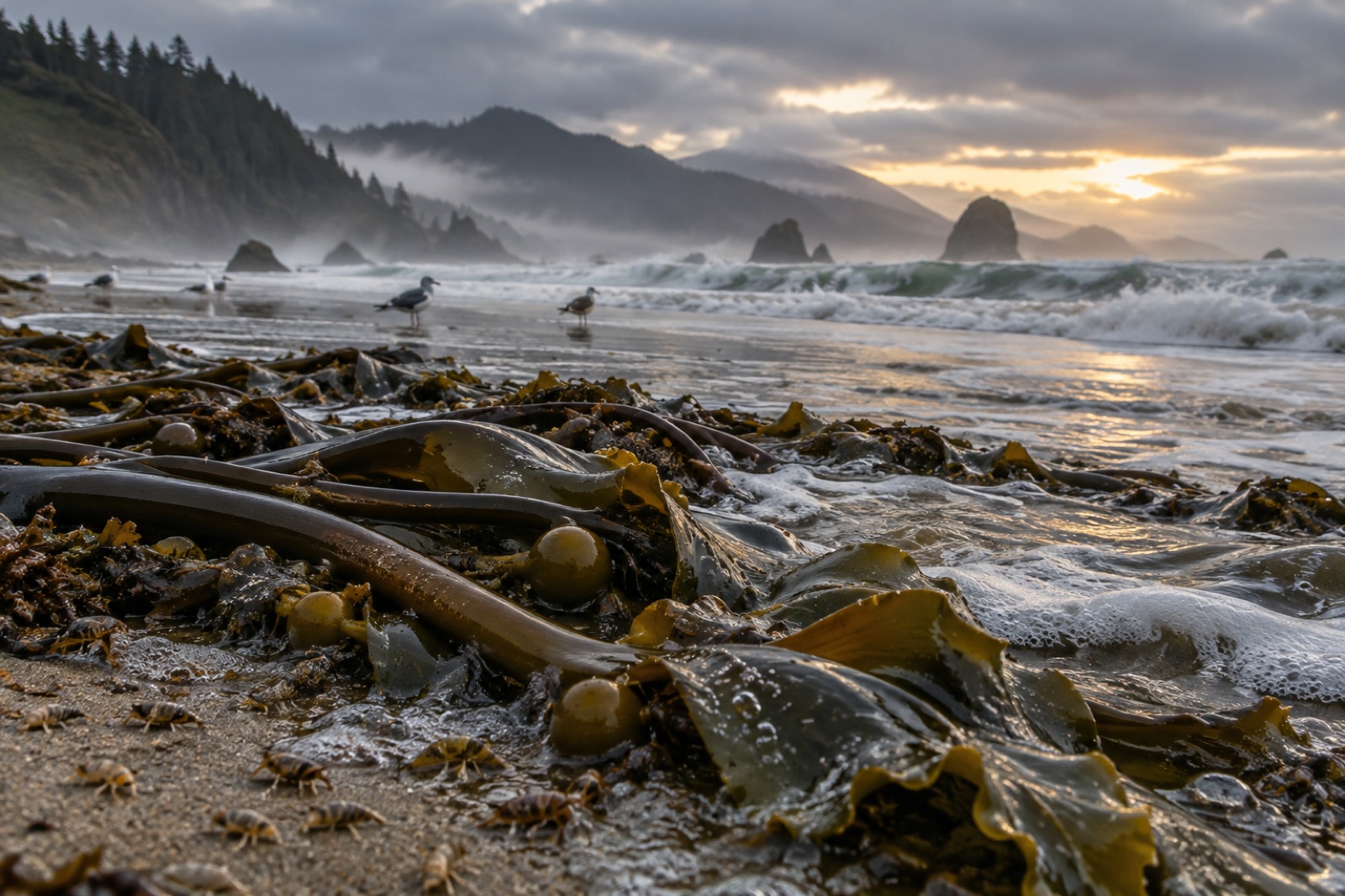
Kelp grows fast and dies young. Follow its carbon from sunlit blade to beach wrack, deep-sea fall and seafloor sediment — the full journey of kelp detritus.
Dr. Lena Fischer ·