Science8 min read
Marine Snow: The Ocean's Slow Carbon Conveyor
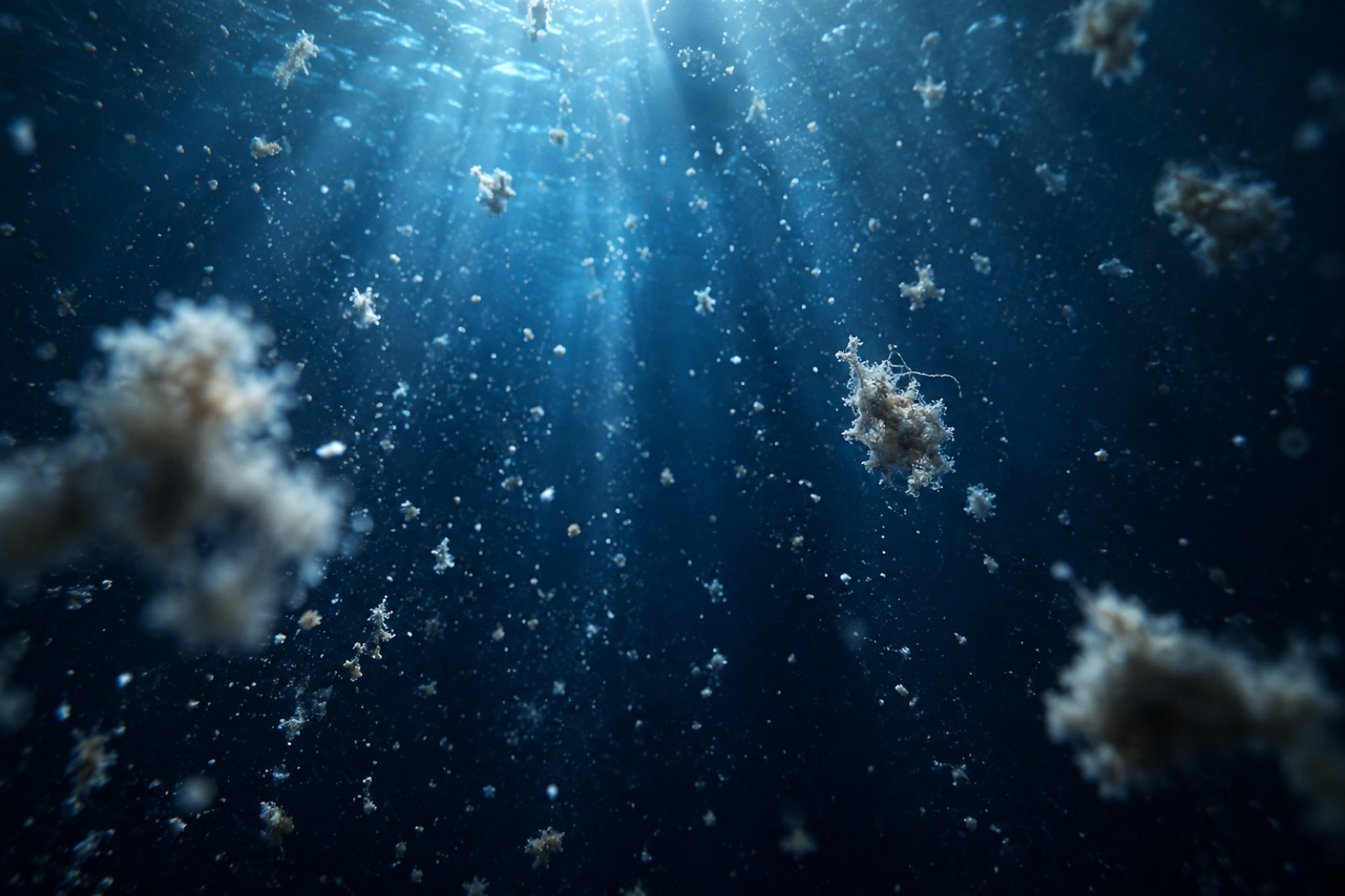
Marine snow is the ocean's constant drizzle of sinking organic matter — and one of the main routes by which carbon reaches the deep sea. Here's how it works.
Priya Raman ·
The biological carbon pump moves billions of tonnes of carbon from the sunlit surface into the deep ocean every year. Here's how the living conveyor works.
Every second of every day, the ocean's skin — the sunlit upper two hundred metres — is quietly exhaling carbon into the dark. Dead plankton, faecal pellets and clumps of sticky gel sink; fish and migrating animals carry carbon downward in their bodies; currents subduct whole parcels of carbon-laden water. Together, these flows are the biological carbon pump: a living conveyor that moves carbon from the surface ocean, where it exchanges freely with the atmosphere, to the deep ocean, where it can sit for centuries to millennia. It is one of the largest carbon flows on the planet — roughly a third of the ocean's total drawdown of atmospheric CO₂ is attributed to biological rather than purely physical processes — and it is the engine underneath every honest conversation about kelp carbon, blue carbon and the ocean's role in climate.
The pump works in stages, like a series of locks moving cargo downhill.
Stage one: fixation. Phytoplankton in the euphotic zone photosynthesise, turning dissolved CO₂ into living tissue. This alone doesn't move any carbon anywhere — surface waters already equilibrate with the atmosphere in months. The pump only begins when that carbon leaves the sunlit layer.
Stage two: export. A fraction of the fixed carbon — very roughly a tenth to a fifth in productive waters, often far less — escapes the surface layer, sinking as particles or being carried down by currents or animals. Oceanographers call the choke point the "export depth," typically around the bottom of the euphotic zone. Getting past it is the pump's first great filter.
Stage three: the mesopelagic gauntlet. Between roughly 200 and 1,000 metres lies the twilight zone, where sinking particles are intercepted, eaten, repackaged and respired by an enormous midwater community. Most organic carbon that starts the journey dies here, converted back to dissolved CO₂ within decades of the surface. What survives is the pump's true output.
Stage four: the deep ocean. Carbon reaching below a kilometre joins water masses that may not see the atmosphere again for hundreds to over a thousand years, depending on where it lands — deep Pacific waters are among the oldest on Earth. This is sequestration in the strict, time-relevant sense: carbon parked on climate-relevant timescales, counted by the residence time of the water mass it entered.
The pump is usually taught as one conveyor, but it is at least three, and they behave differently enough that lumping them confuses carbon accounting.
The classic route. Dead plankton, faecal pellets, discarded mucus houses and amorphous aggregates sink as marine snow. Sinking speed is everything: an unballasted diatom cell may sink a metre a day and be eaten within tens of metres, while a dense krill pellet or an aggregate armoured with opal or carbonate shells can sink hundreds of metres a day and reach the deep bottom in weeks. This is why dust, clay and the silica shells of organisms like diatoms — the "ballast" — matter so much to the pump's strength. Coastal seaweeds contribute real cargo here too: torn kelp tissue, dense and carbon-rich, sinks fast for organic matter, which is one of the reasons kelp carbon exports more efficiently per tonne than loose detritus.
Every night, across most of the ocean, one of the largest migrations on Earth happens in the dark: midwater fish and zooplankton swim hundreds of metres up to feed at the surface, then return to depth to rest — and respire, excrete and occasionally be eaten down there. This active transport bypasses the particle gauntlet entirely, delivering surface-derived carbon directly into the twilight zone in living bodies. Estimates vary with the ocean basin, but in some regions vertically migrating animals move carbon downward at rates comparable to the particle flux. It is the least visible highway and arguably the most undercounted.
Convection — winter cooling that makes surface water dense enough to sink — and subducting currents carry carbon-rich surface water bodily into the ocean's interior. Along for the ride goes a huge pool of dissolved organic carbon (DOM), much of it too resistant for microbes to finish. This "microbial carbon pump" fraction can persist for millennia. The mixing highway is partly physics wearing biology's clothes — it moves carbon that biology fixed or transformed — and it is a large share of total export in subpolar seas where winter mixing runs deep.
Working on ocean carbon claims teaches you quickly that "the pump" is not a constant. Its efficiency swings with at least five big levers:
Every blue-carbon framework that touches seaweed eventually has to answer one question: did the carbon get past the filters? A kelp forest fixes a great deal of carbon, but most of what it grows is eaten, rotted and respired back to CO₂ within weeks to years — in the forest, on the beach as wrack, or in coastal sediments. Only the fraction that leaves the coastal system and reaches deep water or long-lived sediment sinks counts as durable removal. That fraction is exactly what the biological carbon pump quantifies, and measuring it — with sediment traps, stable isotopes, eDNA and autonomous floats — is the hard, expensive, essential core of kelp MRV. Our sequestration-pathways piece, Sediment, Drift or Deep Sea, and the deep-sea export pathway walk through the destination-side accounting; the biological pump is the transport mechanism that gets kelp's carbon there — or doesn't.
This is why Tidewright's Canopy Ledger treats export flux as a measurement problem, not a modelling assumption: we pair canopy maps with moored traps and isotope budgets so that any credit we issue traces a physical parcel of carbon from canopy to depth. The pump is also why we are cautious in how we describe what a restored forest does for climate. The honest sentence is: kelp restoration feeds the biological carbon pump, and the circulation does the sequestering — on timescales we measure rather than assert. For the full picture, see our carbon methodology.
Best estimates put particle export out of the surface ocean at around 5–12 gigatonnes of carbon per year globally — comparable in scale to annual human fossil-fuel emissions, though much of that exported carbon returns to the surface ocean within decades. The fraction reaching below a kilometre, where storage genuinely lasts centuries or more, is considerably smaller. The pump's importance is as much about maintaining the deep carbon reservoir as about the yearly flow.
No. The solubility (or physical) pump is pure chemistry and circulation: cold water at high latitudes absorbs CO₂, sinks and carries it into the deep ocean. The biological pump is life moving carbon — particles, migrants, dissolved organics. Both drag carbon downward and together they keep the deep ocean richer in carbon than the surface; they respond differently to climate change, so scientists track them separately.
Yes, and modelling work broadly expects a weaker pump in many regions through this century: stronger stratification starves surface waters of nutrients, shrinking production, while warmer midwater temperatures accelerate microbial respiration of sinking particles. The picture is regionally uneven — some polar seas may bloom more as ice retreats — and the uncertainties are large, which is one reason ocean carbon monitoring networks keep expanding.
Because "make it sink" is easy to say and hard to verify, and the deep sea is not empty nor inert. Deliberately sinking biomass at climate-relevant scale raises questions about verification (how much, for how long), nutrient piracy (surface ecosystems lose the nutrients that biomass carried away), oxygen demand and impacts on deep ecosystems that are among the least studied on Earth. Our piece on sinking seaweed for carbon lays out the debate honestly. Natural pathways that demonstrably already export carbon — restored kelp forests feeding existing flux to slope sediments — are the defensible end of this spectrum.
From many angles at once: moored and drifting sediment traps that catch sinking particles at fixed depths; biogeochemical Argo-style floats (the BGC-Argo array) profiling oxygen, nitrate and particle backscatter; thorium-234 radioisotope budgets that time-stamp export; oxygen and nutrient mass balances; and satellites that estimate surface production from which export is inferred. No single tool sees the whole pump, so estimates converge by triangulation.
Marine snow is the ocean's constant drizzle of sinking organic matter — and one of the main routes by which carbon reaches the deep sea. Here's how it works.
Priya Raman ·
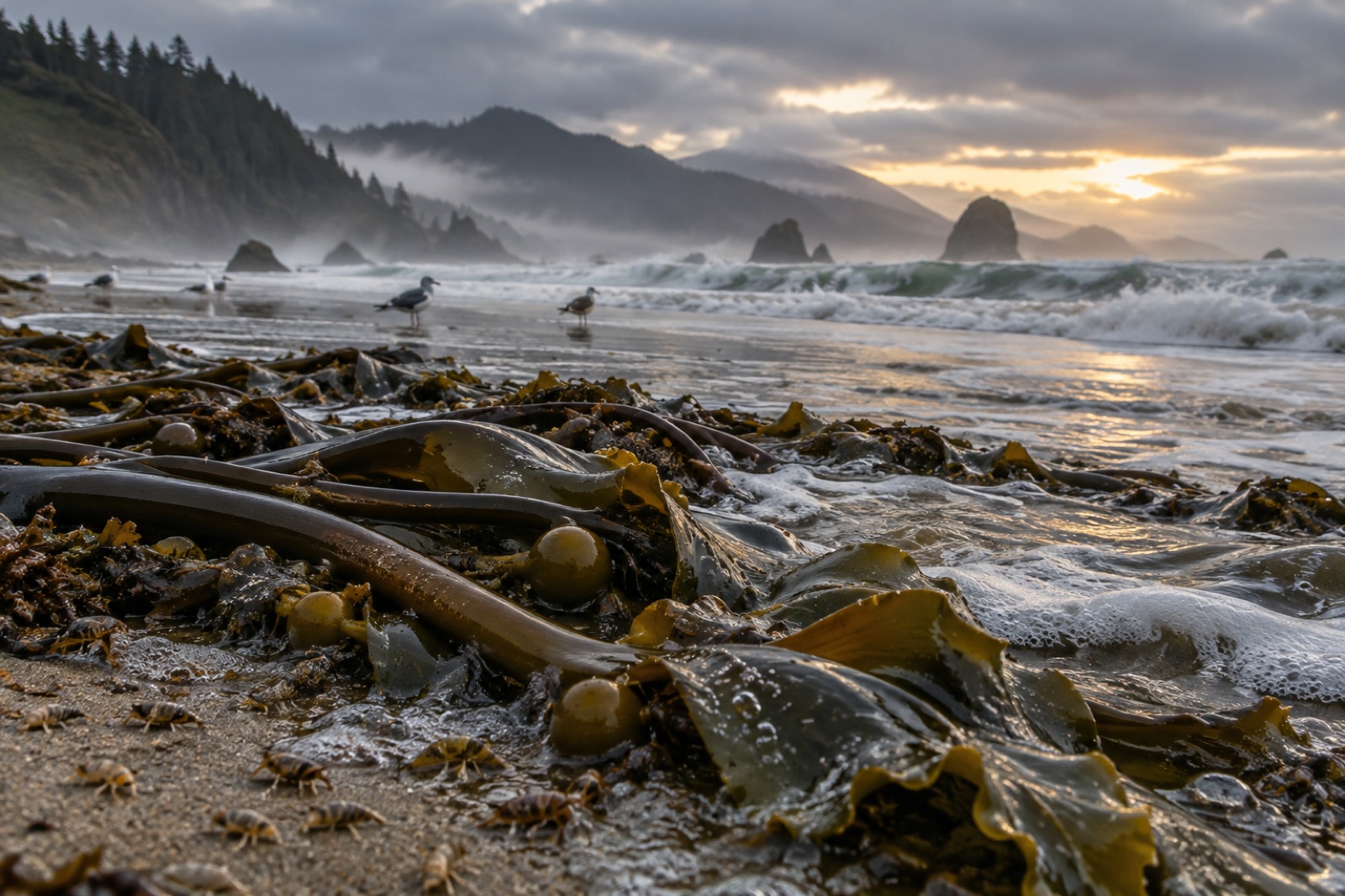
Kelp grows fast and dies young. Follow its carbon from sunlit blade to beach wrack, deep-sea fall and seafloor sediment — the full journey of kelp detritus.
Dr. Lena Fischer ·
Kelp carbon only matters for climate if it stays out of the air for centuries. How kelp carbon reaches the deep ocean — and what engineered sinking must prove.
Dr. Lena Fischer ·