Science8 min read
Marine Snow: The Ocean's Slow Carbon Conveyor
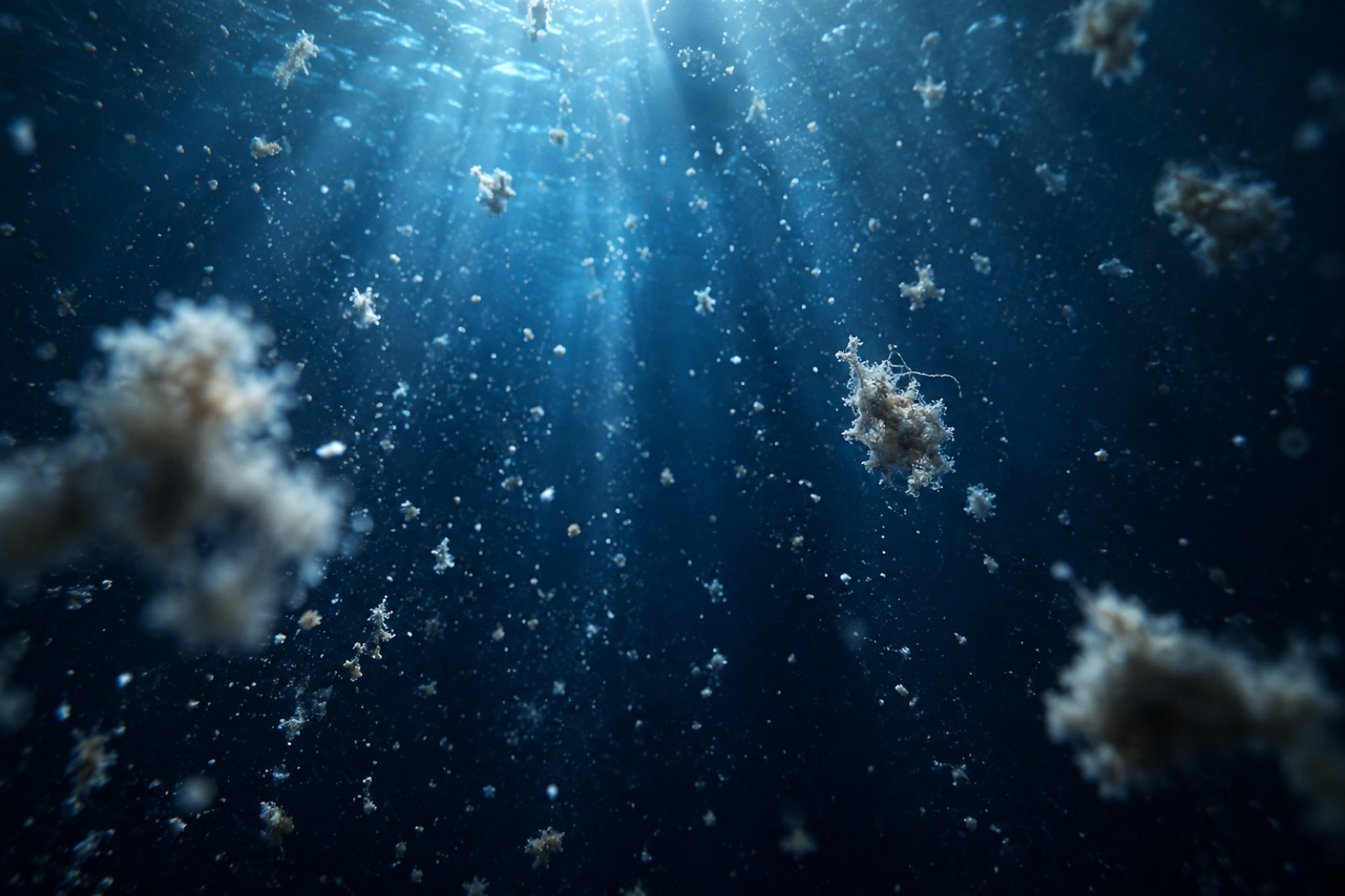
Marine snow is the ocean's constant drizzle of sinking organic matter — and one of the main routes by which carbon reaches the deep sea. Here's how it works.
Priya Raman ·
Every spring, cold seas ignite with diatom blooms — microscopic algae armoured in glass. The whole event often hinges on one scarce element: iron. Here's how.
On a satellite image in April, the North Atlantic looks as if somebody dragged a vast jade brush from Iceland to Newfoundland. The same jade wash sweeps the Southern Ocean in October and the North Pacific in spring. This is the spring diatom bloom — a few weeks in which microscopic algae with shells of glass multiply so fast they can double the carbon standing stock of an entire ocean basin. It is the single biggest annual pulse of life on Earth. And in many of the places where it matters most, the whole event turns on a trace metal measured in parts per trillion: iron.
Diatoms are single-celled algae that build ornate shells — frustules — out of biogenic opal, the same chemistry as window glass. Under a microscope they are jewellery: pillboxes, needles, zig-zags and spirals sculpted at a scale of micrometres. Ecologically, they are something more blunt: the fastest-dividers of the phytoplankton world, built like sprint athletes in a field of long-distance runners.
Three traits define them:
The trade-off for all this performance is appetite. Diatoms are demanding eaters, and two items on their menu are chronically scarce.
Phytoplankton need nitrogen and phosphorus in roughly the proportion found in deep water, so in most temperate and polar seas the first nutrient to run out each spring is nitrate. The marine nitrogen cycle — the pacing item of coastal kelp, too — sets the broad rhythm of the season.
Diatoms add two more demands. The first is silicate, dissolved silicon, which they need to build the frustule. When a bloom strips silicate from surface water, the diatoms are done regardless of what else remains; the season hands over to smaller, slower plankton that don't need glass shells. Kelp, incidentally, watches all of this from the sidelines — a seaweed that needs nitrate but no silicate, whose growth spurt often follows the diatom bloom rather than competing with it. In many kelp systems the bloom and the forest take turns on the same nutrient ration, an alternation visible in the water column chemistry we log on survey lines.
The second demand is iron. Iron sits at the heart of the proteins that move electrons in photosynthesis and that assimilate nitrate; without it, neither process runs at speed. The ocean contains plenty of some nutrients and almost no dissolved iron, because iron barely dissolves in oxygenated seawater — it rusts out into particles. What iron the surface ocean does get arrives mostly in dust blown off deserts, glacial flour ground off rock, and volcanic ash.
This is where one of oceanography's strangest acronyms comes in. Across roughly a quarter of the ocean's surface — the Southern Ocean, the subarctic North Pacific, the equatorial Pacific — ships find surface water rich in nitrate, phosphate and silicate, year after year, and yet sparsely populated with plankton. Chlorophyll, the green pigment satellites use to map life (see Why the Ocean Changes Colour), stays stubbornly low. These are the HNLC regions: high nutrients, low chlorophyll. The salad bowl is full; nobody is eating.
The resolution of the paradox, established through the 1980s and 90s and confirmed in a series of deliberate iron-addition experiments at sea, is iron limitation. Add a few tonnes of dissolved iron to an HNLC patch and within days chlorophyll climbs, diatoms bloom, and the patch turns satellite-visible green. Withhold iron and the unused nitrate drifts on, season after season. Iron is not the only constraint in these systems — grazing by zooplankton and, in polar latitudes, darkness and deep mixing also play their parts — but in the classic HNLC seas it is the pacing item.
Nature runs the same experiment herself. Islands in the Southern Ocean — Kerguelen, South Georgia, Crozet — sit in iron-poor water, but their shelves and rocks constantly leak iron into the current. Downstream of each island, year after year, satellites record enormous natural blooms, hundreds of kilometres long, visible from space like green smoke rings. These "island mass effect" blooms support spectacular concentrations of penguins, seals, whales and albatrosses — proof, at ecosystem scale, of what a trace metal can do.
A bloom is not just a quantity; it is an event in time, and the whole food web is tuned to it. The spring bloom fires when three switches flip: days lengthen, storms ease, and the surface layer warms enough to stratify, trapping plankton in the sunlit zone instead of churning them down into darkness. Light plus stability plus nutrient-laden winter water equals ignition.
Then the succession begins. Diatoms go first — fastest, hungriest, armoured. Copepods and krill graze them, and their own egg production is timed to catch the peak: miss it by two weeks and a generation grows up hungry. Fish larvae hatch into the copepod pulse. Seabirds, whose colonies may be thousands of kilometres from the water they fish, schedule breeding around the whole relay. Climate change is now quietly shifting the bloom's date — often earlier, as springs warm and stratify sooner — and the science of "phenological mismatch" asks how well the grazers can shift with it. When the bloom and its customers slide out of step, entire breeding seasons can fail even if total production barely changes.
Kelp has its own version of the dance. Coastal nitrate, drained by the bloom offshore, is replenished by upwelling and winter mixing; a kelp forest's main growth season tracks that nutrient calendar. Where the bloom fails — because iron ran short, or silicate ran out early — the chemistry of the water the forest sees changes too, and tidy chains of cause and effect are one reason we instrument our restoration sites year-round rather than visiting in the good months.
Because iron limitation is real, and because diatom blooms export carbon efficiently, an idea has circulated for decades: seed HNLC waters with iron to force blooms and pull CO₂ out of the air. Ocean iron fertilisation has been tested at small scale — the experiments bloom reliably — but as climate strategy it founders on honest bookkeeping. Export is patchy and hard to verify; much of the fixed carbon is grazed and respired back to CO₂ at the surface; stripping nutrients from HNLC surface water can starve downstream ecosystems of the nitrate they were carrying; and at the scale that would matter climatically, the side effects on oxygen, food webs and nutrient supply are poorly predicted. For all these reasons, large-scale ocean fertilisation remains outside the bounds of credible, verified blue carbon — a useful contrast to the conservative, measurement-first claims we describe in how kelp stores carbon and in Tidewright's own impact methodology.
The right lesson of the iron story is subtler and, I think, more hopeful: the ocean's cold engines are exquisitely sensitive to trace chemistry, dust and timing. Which means the spring bloom is also an early-warning instrument. A spring that blooms late, pale or small is a sea telling you something about its winter, its dust supply, its stratification — and about the kelp forests, fisheries and seabird colonies downstream.
Mostly, no. The vast majority of spring diatom blooms are the healthy, normal heartbeat of temperate and polar seas. A minority of diatom species (some Pseudo-nitzschia) produce domoic acid, which can poison shellfish and marine mammals — coastal monitoring programs track them closely. But the famous "harmful algal blooms" in lakes and estuaries are usually different organisms (cyanobacteria, dinoflagellates) driven by nutrient pollution, not the ocean's natural spring engine.
The frustule looks costly, but opal is mechanically strong for its weight, defends against many grazers, and may help with light capture. There also appears to be an energetic bargain: building an opal shell costs less energy per unit of structure than the organic alternatives, which may be part of why diatoms can afford to divide so fast.
Mostly from land. Desert dust blown offshore (from the Sahara to the tropical Atlantic, from Asia to the North Pacific), glacial and river sediment around polar and mountainous coasts, volcanic ash, shelf sediments, and hydrothermal vents for the deep ocean. Sea ice acts as a seasonal piggy bank, storing iron through winter and releasing it at melt — one reason ice-edge blooms are so reliable.
They draw on the same nitrate pool but rarely peak at the same moment. Coastal kelp typically puts on growth when winter-mixed, nutrient-rich water arrives, while the offshore bloom strips nutrients later. In many systems the bloom and the forest alternate on the same ration across the year — a seasonal relay, with kelp detritus then feeding food webs the plankton bloom doesn't reach.
Only in small, licensed research experiments. Several proposed commercial schemes in the 2000s and 2010s — including one controversial iron dumping off Canada's Pacific coast in 2012 — generated scientific and legal backlash, and international agreements under the London Protocol now restrict ocean fertilisation to legitimate research surrounding genuine scientific questions.
Marine snow is the ocean's constant drizzle of sinking organic matter — and one of the main routes by which carbon reaches the deep sea. Here's how it works.
Priya Raman ·
Nitrogen feeds every kelp blade and limits most ocean growth. A plain-language tour of the marine nitrogen cycle — fixation, upwelling, uptake and loss.
Dr. Theo Nakamura ·
Why the sea turns green, turquoise or milky — and how ocean-colour satellites read chlorophyll from orbit to map blooms, currents and ocean life.
Dr. Mara Ellison ·