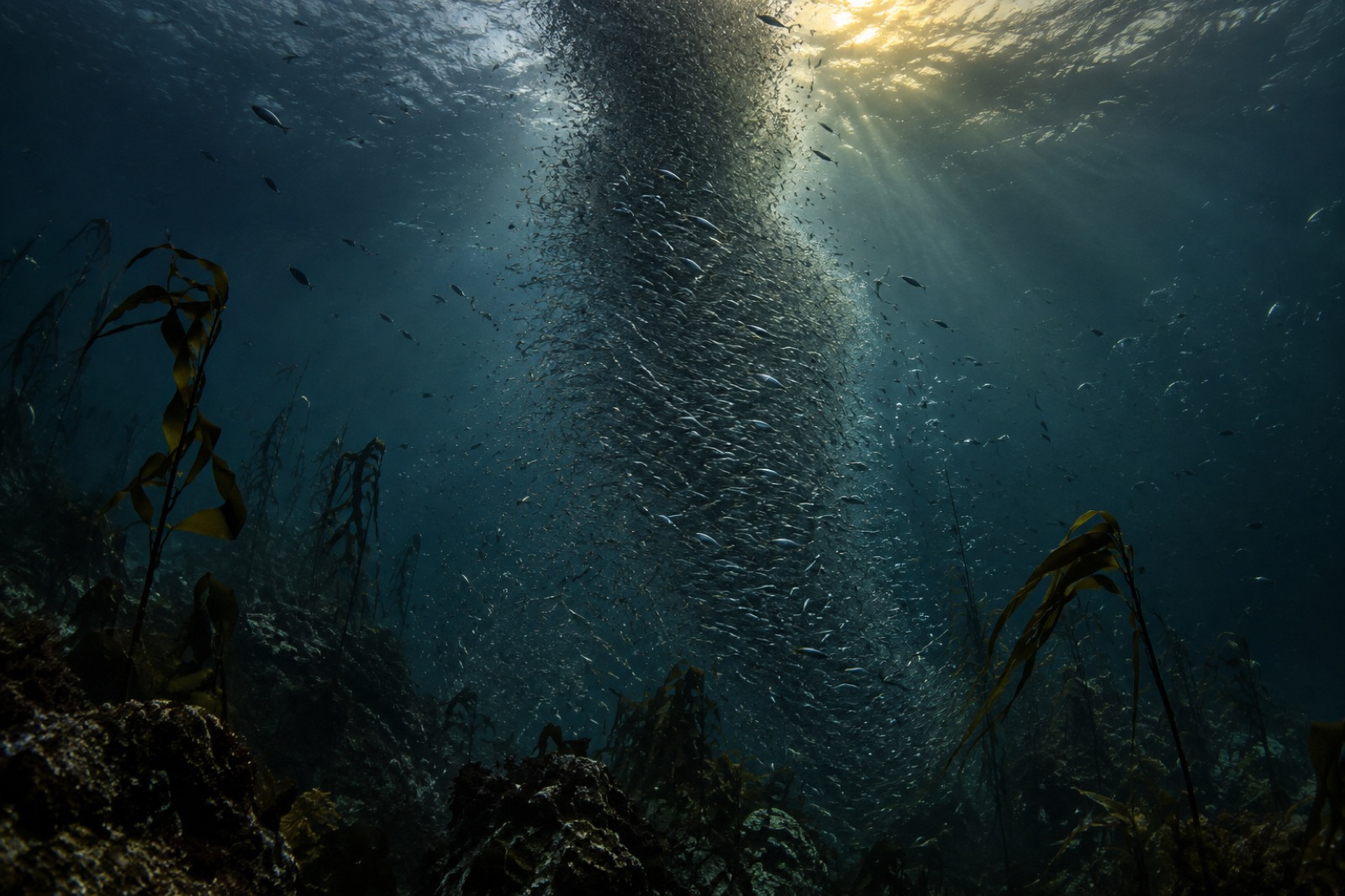
Every evening at dusk, across every ocean on Earth, something happens that dwarfs the wildebeest herds of the Serengeti: countless billions of small animals — copepods, krill, lanternfish, salps, squid — begin swimming upward from the dim midwater toward the surface. By midnight they are feeding in the sunlit plankton pastures they fled twelve hours earlier. Before dawn they turn around and sink back into the dark. This is diel vertical migration (DVM), the largest synchronized movement of biomass on the planet, repeated every twenty-four hours, and it directly feeds — and is fed by — coastal ecosystems like kelp forests.
The commute, in numbers and nerves
The travellers are mostly zooplankton and the small fish and squid that chase them. Many migrate only a few tens of metres; others commute several hundred metres each way, from depths of 300–600 metres — the upper twilight zone — to within a few metres of the surface. For a copepod two millimetres long, a 400-metre climb is the proportional equivalent of a human running more than a hundred kilometres, twice a day, every day, for life.
They do it on a schedule so reliable that sonar operators can set their watches by it. On an echosounder display, the migrating community appears as a deep scattering layer: a dense band of sound-reflecting bodies that rises after sunset, spreads out to feed near the surface at night, and compresses back down to depth at dawn. When this layer was first seen on wartime sonar in the 1940s, operators mistook it for a false seafloor — one that mysteriously disappeared every morning.
Why risk the trip at all?
The surface is where the food is. Phytoplankton — the microscopic plants at the base of nearly every marine food web — need sunlight, so they live in the upper tens of metres. Grazing zooplankton want to be where the grazing is good. But the surface is also where the light is, and light means visibility, and visibility means being hunted. Daytime at the surface is a kill zone for anything small, translucent and edible.
Diel vertical migration is the evolutionary answer to a brutal trade-off: feed where it is rich, hide where it is safe. By feeding only at night and spending daylight hours in the dim, cold midwater where visual predators struggle to find them, migrators get the best of both zones at the cost of the commute. The hypothesis is supported by an elegant natural experiment: at polar latitudes, where the sun barely sets in summer and barely rises in winter, entire plankton communities shift their migration to follow the light cycle rather than the clock — and some stop migrating during the midnight-sun months entirely, when there is no safe darkness at the surface to feed in.
Scientists have proposed additional payoffs layered on top of predator avoidance:
- Metabolic savings. The deep daytime refuge is cold. Cold water slows metabolism, stretching the calories gathered during the night's feeding. Some research suggests this alone can justify the energetic cost of the swim.
- Current surfing. Surface and deep currents often flow in different directions; vertical migrants can ride opposing flows to stay in productive water or return to favourable habitat.
- Surface hygiene. Spending daylight at depth reduces exposure to damaging ultraviolet radiation and, some researchers argue, to surface-borne parasites.
How the migration touches a kelp forest
A kelp forest sits in shallow coastal water — far above the midwater staging grounds of the classic migrators — but the great commute reaches into it in three powerful ways.
1. The night shift washes inshore
Each evening, migrating krill, copepods and small fish that spent the day offshore over deep water rise and can be carried across the shelf by tides and currents. Where they arrive over kelp forests, they meet a waiting night shift: juvenile rockfish, wrasse and other planktivorous fish that shelter in the canopy by day and emerge after dark to feed on the incoming plankton. The diel migration is, in effect, a nightly delivery of food to the reef — a flux of open-ocean production into coastal food webs. We describe the reef's own version of this rhythm in Day and Night in the Kelp Forest.
2. Mysids and the local commute
Kelp forests host their own miniature vertical migrations. Mysid shrimp — small, opossum-like crustaceans — hide in rocky crevices and kelp holdfasts by day and swarm into the water column after dark, sometimes in densities thick enough to cloud a dive light. Juvenile fish time their evening feeding to these swarms. On calm nights, the water above a kelp bed can be busier than the reef below it.
3. The carbon conveyor passes overhead
The deep migrators serve the biological carbon pump as active couriers. Instead of waiting for carbon to sink passively as marine snow, migrating animals eat carbon-rich food at the surface and transport it downward inside their bodies — respiring some at depth, excreting some, and eventually dying at depth. Scientists call this the active flux, and research suggests it may move a significant share of the carbon exported from the surface each day. Some of what kelp forests shed as drifting detritus is captured by midwater animals on these same pathways and carried into the deep ocean — a connection explored in Where Kelp Carbon Goes.
Watching a billion animals commute
The migration is invisible to a snorkeler and obvious to a machine. Echosounders — the same instruments used in acoustic fish surveys — render the deep scattering layer as moving strata of sound. Moored acoustic recorders on the shelf edge capture the layer's arrival and departure as a daily pulse, a rhythm scientists can track across seasons and years. Because the migration's timing and depth respond to light, temperature, oxygen and food, its behaviour is also a sensitive instrument: when the ocean deoxygenates or warms, the layer compresses, shallows or thins, and the record shows it.
On our survey reefs, Tidewright's teams log the scattering layer's vertical position alongside canopy extent and fish counts — one more thread in the three-dimensional picture of a working kelp forest. (As with all Tidewright figures, the data are illustrative of method, not public monitoring results.)
Key takeaways
- Diel vertical migration is the largest daily movement of biomass on Earth: zooplankton, krill, fish and squid rising to the surface by night and retreating to the depths by day.
- The core driver is a trade-off between food and safety — grazing the phytoplankton-rich surface under cover of darkness, hiding from visual predators in cold, dim midwater by day.
- The migration forms the "deep scattering layer" first spotted on wartime sonar — still one of the clearest biological signals an echosounder can record.
- Coastal ecosystems, including kelp forests, receive a nightly subsidy of plankton and small fish; kelp forest residents like mysid shrimp run their own miniature versions of the commute.
- Migrating animals actively carry carbon from surface to depth, making the commute a working organ of the ocean's biological carbon pump.
FAQ
How far do animals travel in diel vertical migration?
It varies enormously by species and region. Some copepods migrate just 10–20 metres; krill and lanternfish routinely travel 200–400 metres each way; a few midwater visitors commute from 600 metres or deeper.
What would happen if the migration stopped?
Surface waters would be grazed less efficiently, midwater predators would lose a major food supply, and the active transport of carbon to depth would slow. The migration is so large that its disruption would reshape food webs from the surface to the deep sea.
Is diel vertical migration affected by climate change?
Yes, in measurable ways. Warming and deoxygenating midwater layers compress the safe daytime habitat, light penetration shifts with plankton blooms and pollution, and altered currents can strand migrators away from feeding grounds. Scientists track the scattering layer as an early-warning signal for these changes.
Can you see the migration while diving?
You can see pieces of it. Night divers in kelp forests commonly encounter swarms of mysid shrimp and emergent planktivorous fish that were inactive by day. The deep scattering layer itself, rising from hundreds of metres, is visible only on sonar — the open-ocean commute happens far below recreational depths.
Do kelp forests themselves migrate?
No — the kelp stays anchored. But the community living in, on and above the forest reorganizes completely between day and night, making a kelp bed one of the most rhythmic places in the ocean.