Science7 min read
The Kelp Forest Food Web: Who Eats What
A map of the kelp forest food web — from drifting fronds and grazing urchins to otters, octopus and rockfish — and why detritus powers most of it.
Dr. Mara Ellison ·
At dusk the kelp forest changes shifts: plankton rises, fish reposition, predators hunt the borders. The daily migrations that run the reef's nightly economy.
Spend one hour in a kelp forest at midday and you meet one community. Come back to the same mooring line at midnight and you meet a different one entirely. The kelp doesn't move, but almost everything else does. At dusk and dawn the reef runs two coordinated shift changes — zooplankton rising through the water column by the trillion, small fishes abandoning the canopy for the water column or vice versa, predators switching on senses tuned for the dark, invertebrates emerging from crevices to graze. Ecologists call these diel movements: migrations timed to the 24-hour light cycle. They are among the largest daily movements of biomass on Earth, and in kelp forests they quietly determine who eats whom, where nutrients go, and why a daytime fish survey describes only half the forest.
The engine of the diel commute is light itself — not as energy for photosynthesis, but as risk. In clear ocean water, a visual predator's hunting success rises steeply with light. For small planktonic animals and small fish, the safest strategy is to feed where it's dim and hide where it's safe, and the daily light cycle forces a trade: the best feeding layers (the sunlit surface where phytoplankton grow, the illuminated reef) are also the most dangerous. The compromise is migration — commute upward or outward at night to feed, retreat to depth or shelter by day.
This logic produces the ocean's signature daily event: diel vertical migration (DVM), in which zooplankton — copepods, krill, larval fish, chaetognaths and their predators — rise hundreds of metres from the dim twilight zone into surface waters after sunset, then descend before dawn. It happens over the continental shelf and the deep ocean, and on kelp coasts its edge effects wash straight into the forest: when the sun goes down, the water column over the reef fills with migrants arriving from offshore depths.
As dusk settles, several things happen over a kelp forest in quick succession:
Dawn runs the film in reverse: the scattering layer sinks, small fish return to structure, grazers tuck back into crevices, and the daytime community of kelp bass, garibaldi and senorita-type wrasses takes over the illuminated reef.
Not every fish migrates — the interesting pattern is who does and in which direction. Studies tracking acoustically tagged fish in kelp systems show three common strategies:
Hold position. Territorial species and ambush predators with a structural home base (a ledge, a kelp-draped reef edge) often stay put around the clock, simply changing behaviour — hovering tighter to cover by day, roaming a wider circuit at night.
Vertical commuting. Midwater-oriented species, especially juveniles, shift depth: tighter to the bottom or the canopy by day, up into the water column at night where plankton pass by. Some move only a few metres; in a 30-metre giant kelp forest, from holdfast to canopy is already a meaningful commute.
Inshore–offshore commuting. Perhaps the most consequential for the kelp bed itself: larger mobile predators — schools of jacks and trevallies, some sharks, sea lions — that hunt the reef edge at night and range offshore by day, or vice versa. Their comings and goings stitch the kelp forest to the surrounding shelf, importing energy captured elsewhere and exporting reef production as body mass that swims away. This is benthic–pelagic coupling in its most literal form: the seafloor and the water column trading through animals that commute between them daily.
The diel commute is not just rearrangement; it is a nutrient conveyor belt. Zooplankton that rise from depth feed in surface waters and, on descending, release faecal pellets and excretion below — moving nitrogen and phosphorus downward. Migrating fish feeding over the reef at dusk defecate and are occasionally eaten there, importing the productivity of the outer shelf into the kelp bed's local economy. Over years, this "active transport" by animals is a meaningful term in the nutrient budgets that our guide to kelp and the coastal nutrient cycle describes, particularly on coasts where upwelling delivers nourishment to the shelf but tidal mixing alone can't cross-subsidise the inshore forest.
Then there is the grazing question. Because urchins and many other kelp grazers do their heaviest feeding at night, the fate of a kelp blade — whether it keeps its frond or is chewed to a stump — is often decided in the dark. Where predator communities keep urchin numbers and boldness in check (the otter-and-urchin story in trophic cascades in kelp forests), the night-time grazing pressure stays at background levels; where predators are gone, night becomes a wave of grazing fronts that can strip a forest. The daily behaviour of grazers and the chronic balance of the food web are the same story read at two clocks.
If the light drops, the other senses take over, and two of them are worth a diver's attention.
Sound. Dusk and dawn choruses are real underwater: snapping shrimp crescendo in the twilight hours, fish chorus at predictable times depending on species and season, and foraging marine mammals add clicks and calls. The emerging science of reef soundscapes finds that diel cycles are the strongest rhythm in kelp forest recordings — and that larvae of many reef species use the sound of a healthy, active reef at dusk as a homing cue.
Light made by life. In the dark, physical disturbance of the water triggers bioluminescence in dinoflagellates and other plankton — the sparkle along a fin tip or a boat wake. On dark nights in summer on many coasts, the kelp forest's night shift literally glows where it's touched. Bioluminescent bacteria colonising drifting kelp fragments and predator flashes hunting at the reef edge both contribute to a language of light that daytime visitors never see.
The practical implications of the shift change are large and still underappreciated:
The kelp forest is often sold as a place; ecologists know it is better understood as two places sharing one address, trading tenants every twelve hours. The canopy you swim through at noon is scaffolding, food and shelter; after dark it becomes a transit hub in the largest daily commute in the coastal ocean.
Yes, though they don't move. At night kelp switches from photosynthesis to respiration — consuming oxygen and releasing CO₂ — so the water inside a dense canopy can become slightly more acidic and oxygen-poor in the pre-dawn hours. It's one of the natural daily swings coastal life is tuned to.
It demands extra training and planning — navigation, lights, a capable buddy — but it rewards you with a different ecosystem: hunting octopus, emerging urchins, bioluminescent sparkle. Many dive operators run guided night dives precisely because the forest changes cast. Our explore section covers preparation for night dives in kelp.
It's the collective echo of millions of small animals — krill, lanternfish and other zooplankton — that stack in dim layers by day and rise en masse at dusk. Named because early sonar operators mistook it for the seafloor scattering sound.
The light-driven logic is universal, but the cast and amplitude vary. In shallow, turbid or strongly tidal systems, tide can rival light as the organising rhythm; in clear deep-edge forests, vertical migration running through the canopy is often dominant.
In principle, yes. Warmer nights, earlier seasonal light changes, and shifting prey phenology can uncouple the timing migrants have evolved around — a mismatch between migration timing and food peaks is one of the subtler climate risks marine ecologists are now measuring.
A map of the kelp forest food web — from drifting fronds and grazing urchins to otters, octopus and rockfish — and why detritus powers most of it.
Dr. Mara Ellison ·
Food produced in sunlit surface water rains down to feed the seafloor, and the seafloor recycles nutrients back up. How benthic-pelagic coupling runs a kelp forest.
Dr. Mara Ellison ·
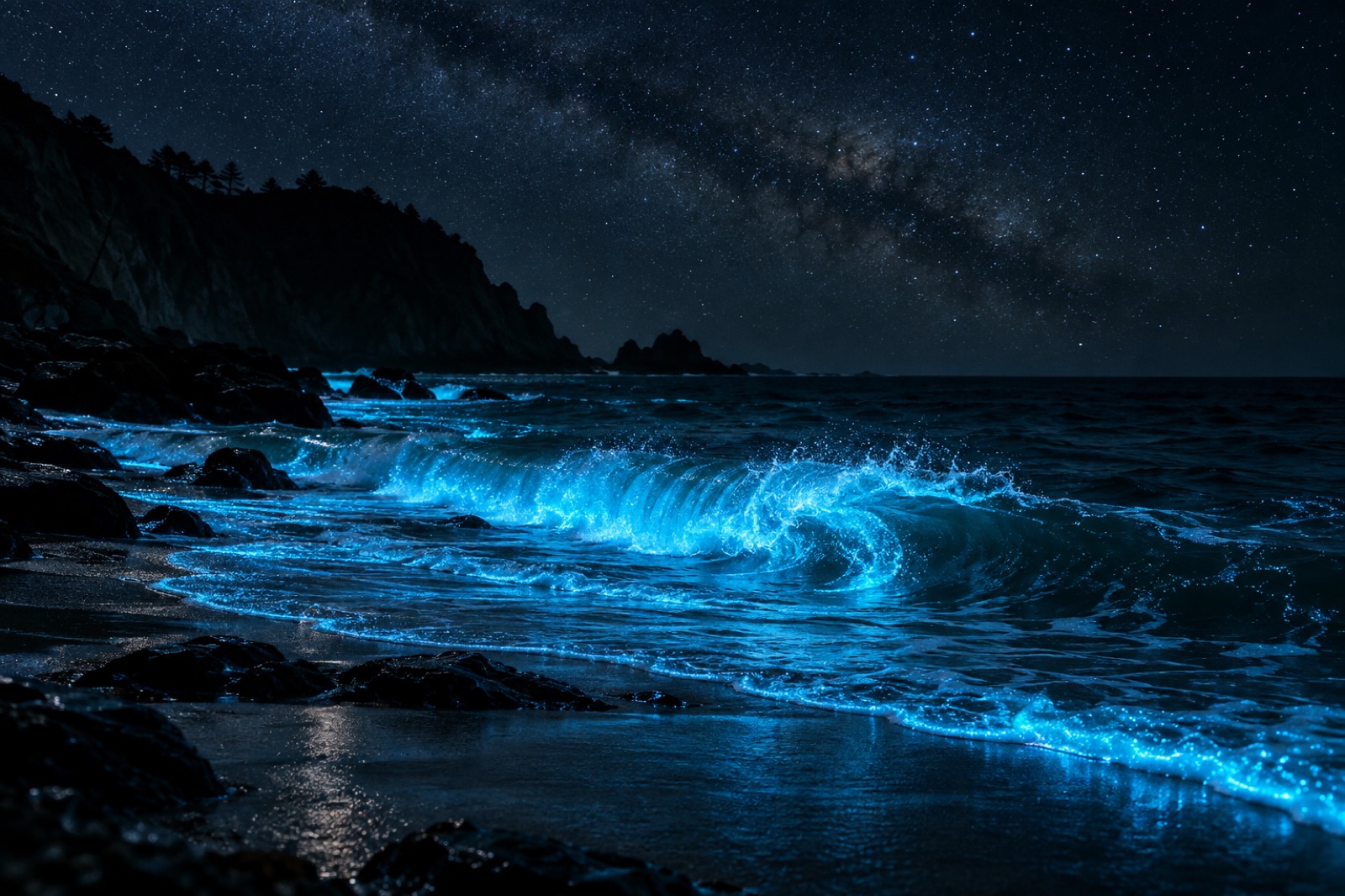
Glowing waves, sparkling wakes and milky seas: the chemistry and ecology of bioluminescence, and how to see the ocean light up yourself.
Dr. Mara Ellison ·