A giant kelp plant can add half a metre of new growth in a day — among the fastest growth rates of any organism on the planet. It achieves this without roots, without soil, and often in water that looks, to the eye, perfectly empty. The raw materials for that astonishing construction project — nitrogen for proteins and pigments, phosphorus for DNA and energy molecules, iron and other trace metals for enzymes — arrive dissolved at concentrations measured in micromoles, and the kelp pulls them directly out of the passing current across every square centimetre of its blades.
Feeding a kelp forest, then, is a story about ocean physics as much as kelp biology: where nutrients come from, how they rise and vanish with the seasons, and how the forest — once fed — recycles its wealth through the whole coastal food web.
What kelp actually needs
Kelp tissue is built from a short shopping list, but the proportions matter.
Nitrogen is the headline nutrient. Every protein, every chlorophyll molecule, every scrap of DNA requires it, and temperate kelp forests are overwhelmingly limited by nitrogen more often than by anything else. Kelps take it up as nitrate (the dominant form in cool upwelled water), ammonium (recycled locally by animals and microbes), and — for some species — urea and other dissolved organic forms. The classic sign of nitrogen hunger is visible in the tissue itself: as nitrogen falls, the carbon-to-nitrogen ratio of the blades climbs, growth slows, and fronds thin and bleach toward yellow-brown.
Phosphorus runs the energy economy — ATP, cell membranes, genetic material. Coastal systems rarely run short of it before nitrogen, but in some regions it co-limits growth, and its supply through upwelling and rivers tracks nitrogen's fairly closely.
Micronutrients complete the list: iron (essential for nitrate-processing enzymes and photosynthetic machinery), manganese, zinc, copper in trace amounts. Iron deserves special mention because remote upwelling systems can be rich in nitrate yet iron-poor, and kelp growth there stalls for want of a metal measured in parts per billion.
Because kelp has no roots, all of this crosses the blade surface directly. Kelp membranes carry transporter proteins that can pull nitrate and ammonium out of very dilute water — and uptake rates rise with water flow, which is one reason kelp thrives in surge and current: waves and flow constantly refresh the thin boundary layer of water hugging the blade, delivering dinner to the doorstep.
Where coastal nutrients come from
Dissolved nutrients in sunlit coastal water are a renewable resource — but only because the ocean keeps delivering them from somewhere else. Four supply lines matter most:
- Upwelling. The great supplier. Wind pushing surface water offshore draws cold, nutrient-rich deep water up onto the shelf — water that has spent centuries in the dark accumulating the breakdown products of everything that ever sank. Pulses of upwelled water are why the west coasts of continents host the grandest kelp forests on Earth; the mechanics are covered in our guide to upwelling.
- Winter mixing and storms. Temperate seas stratify in summer and overturn in winter. Storm-driven mixing recharges the surface with nutrients from below, resetting the coastal pantry for the growing season.
- Rivers and submarine groundwater. Land delivers nitrogen and phosphorus — sometimes helpfully, sometimes catastrophically in excess (more on that below).
- Local recycling. Sea birds, seals, fish schools, and the microbial loop release ammonium and phosphate right where kelp grows. A busy reef is partly self-fertilising.
A fifth supply line deserves an asterisk: internal waves sloshing along the thermocline can pump nutrient-rich water over reefs on tidal rhythms, delivering invisible upwelling without any wind at all.
The seasonal ledger
Ask why temperate kelp often looks magnificent in spring and ragged by late summer, and the answer is bookkeeping.
In winter and early spring, mixing and storms have recharged surface nutrients while light is just returning. Kelp grows explosively, converting nitrate into tissue faster than the water can deliver it. By late spring and summer, warming seals the surface with a stratified cap; the deep nutrient reservoir is still down there, but the elevator is off. Kelp spends the summer drawing down its stored reserves — many kelps bank nitrogen in their tissues and carbohydrates (mannitol, laminarin) as an energy account — and by autumn, plants at the surface fringe are often functionally starving, tissue C:N ratios elevated, blades fraying.
Then the first autumn storms stir the water column, nutrients return, dieback-prone tissue is shed, and the surviving holdfasts and meristems prepare the next season's construction. The whole rhythm is a tide of abundance and famine pulsing through the forest every year — which is also why harvest timing in kelp aquaculture is essentially a nutrient-calendar decision: cut when tissue nitrogen and quality peak, before the summer famine spends them.
How kelp pays it forward: the recycling engine
A fed forest does not hoard its nutrients. Kelp is one of the great recyclers of the coastal ocean, and the flows run in several directions at once.
- Leakage while living. Healthy kelp releases dissolved organic matter — sugars and carbohydrates — across its blade surfaces. This exudate feeds clouds of free-living microbes, the base of the microbial loop that returns energy to the food web.
- Detritus. Blades erode continuously; storms strip them wholesale. This kelp litter is shredded by urchins, amphipods and bacterial films into particles that feed the reef's filter feeders — the flow tracked in where kelp carbon goes.
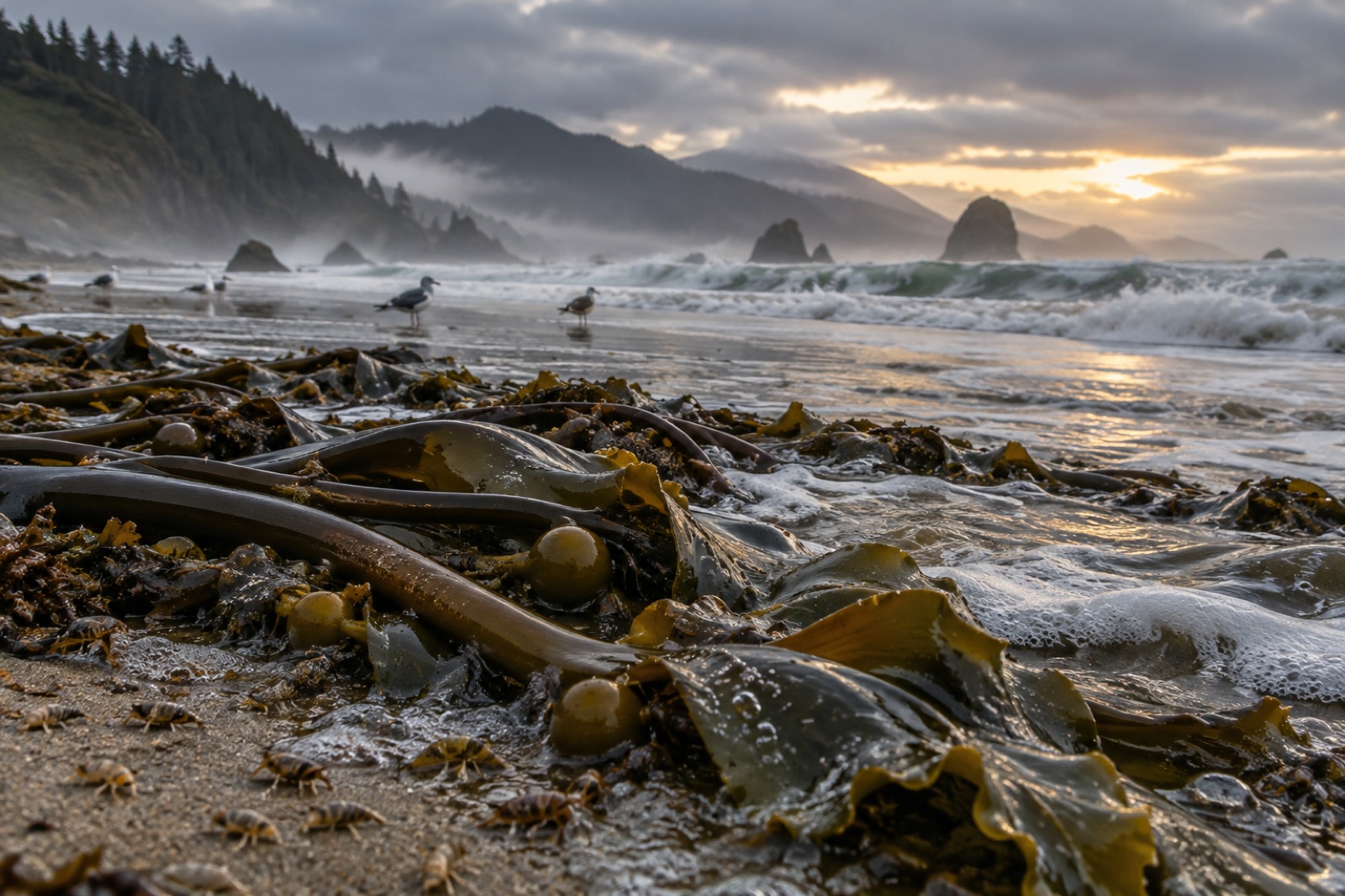
- Drift export. A large fraction of kelp production leaves the reef entirely, washing onto beaches (where it fuels wrack-line invertebrates and shorebirds) or sinking to deep water, carrying nutrients — and carbon — far from where they were captured.
- The return leg. Animals that grazed the kelp excrete ammonium; microbes mineralise detritus back to nitrate and phosphate; the reef's own waste becomes next season's growth substrate. In calm embayments this internal recycling can meet a meaningful share of the forest's demand between upwelling pulses.
Too much of a good thing
If nitrogen were purely a blessing, every fertilised coastline would be a kelp paradise. Reality is crueller. Chronic nutrient overload from agriculture, sewage and coastal development — eutrophication — often hurts kelp forests through the middlemen it feeds:
- Phytoplankton blooms shade the seafloor, stealing the underwater light young kelp needs even while nutrients are abundant.
- Fast-growing green algae outrace juvenile kelp for space on the rock; on a succession timeline, eutrophication keeps the reef stuck in its weedy pioneer stage.
- When blooms die and rot, microbial decomposition consumes oxygen, and low-oxygen episodes compound the stress.
The irony is sharp: kelp needs the nitrogen, but it needs it from below, in pulses, with clear water overhead — while eutrophication delivers it from above, constantly, with shade attached. This is also why cultivated kelp is increasingly valued as a bioremediation crop: farmed kelp absorbs excess nitrogen and phosphorus, and harvesting carries those nutrients physically out of the water. Every tonne of harvested kelp is a measurable quantity of nitrogen and phosphorus removed from the coastal system — one plank in the case for restorative aquaculture, and a service Tidewright's Harvest program designs into farm siting.
Nutrients in restoration practice
For a restoration program, the nutrient cycle is a checklist:
- Site selection starts with supply. Drifter surveys and moored nitrate sensors characterise a candidate reef's upwelling exposure, stratification season and storm recharge before a single line is seeded. A reef with perfect rock and no nutrient supply is a nursery for disappointment.
- Seedstock conditioning matters. Juvenile kelp raised on rich hatchery media carries tissue nitrogen reserves into the field — a starter battery that helps outplants bridge their first low-nutrient weeks.
- Timing follows the calendar. Outplanting on the leading edge of the cool, nutrient-rich season gives recruits a full growing window before summer stratification tests them.
- Monitoring closes the loop. Tissue C:N ratios in sentinel plants are a cheap, sensitive gauge of whether a restored forest is feeding well — appearing in Tidewright's site reporting alongside canopy area and survival (our project figures are illustrative of program methods, not audited field results).
Key takeaways
- Kelp builds its tissue from dissolved nitrogen (nitrate, ammonium, urea), phosphorus and trace metals like iron, absorbed across the whole blade surface; temperate forests are most often nitrogen-limited.
- Upwelling, winter mixing, rivers and on-reef recycling are the four great supply lines; internal waves provide a fifth, tidal one.
- The annual cycle runs from nutrient-rich mixing and explosive spring growth to summer stratification and reserve-spending famine — visible in tissue C:N ratios.
- Kelp returns its wealth through dissolved exudates, detritus and drift export, ultimately fertilising beaches, deep seas and its own reef via microbial recycling.
- Nutrient excess from land harms kelp by shading and oxygen loss, while farmed kelp harvest removes nitrogen and phosphorus — a genuine remediation service.
FAQ
What nutrient does kelp need most?
Nitrogen, in most temperate systems. It is the nutrient most often in shortest supply relative to demand, and its availability tracks growth, pigment health and blade condition. Phosphorus and iron limit growth in particular regions, but nitrogen is the usual gatekeeper.
Does kelp need fertiliser?
Wild kelp relies entirely on ocean supply — upwelling, mixing and recycling. Farmed kelp in ocean water typically needs no added fertiliser either, which is a large part of seaweed aquaculture's environmental appeal. In hatcheries, culture media are enriched so seedstock enters the field nutrient-replete.
How does upwelling feed a kelp forest?
Winds drive surface water offshore, and cold deep water rises to replace it. That deep water has spent centuries collecting nitrate and phosphate from sinking organic matter, so every upwelling pulse is effectively a delivery of fertiliser to the sunlit zone where kelp grows.
Can kelp clean up polluted coastal water?
Kelp efficiently absorbs dissolved nitrogen and phosphorus, and harvesting removes them physically from the system, so cultivated kelp is a credible nutrient-remediation tool. It addresses nutrient pollution specifically — not heavy metals, plastics or pathogens — and works best alongside, not instead of, source control.
Do kelp forests ever run completely out of nitrogen?
They can come locally and seasonally close during prolonged stratification, which is when tissue C:N ratios climb and blades thin. Complete starvation is rare because recycling, internal waves and occasional storm mixing provide relief — but during marine heatwaves, when warm stratified conditions persist for months, nitrogen starvation is a major contributor to forest collapse.