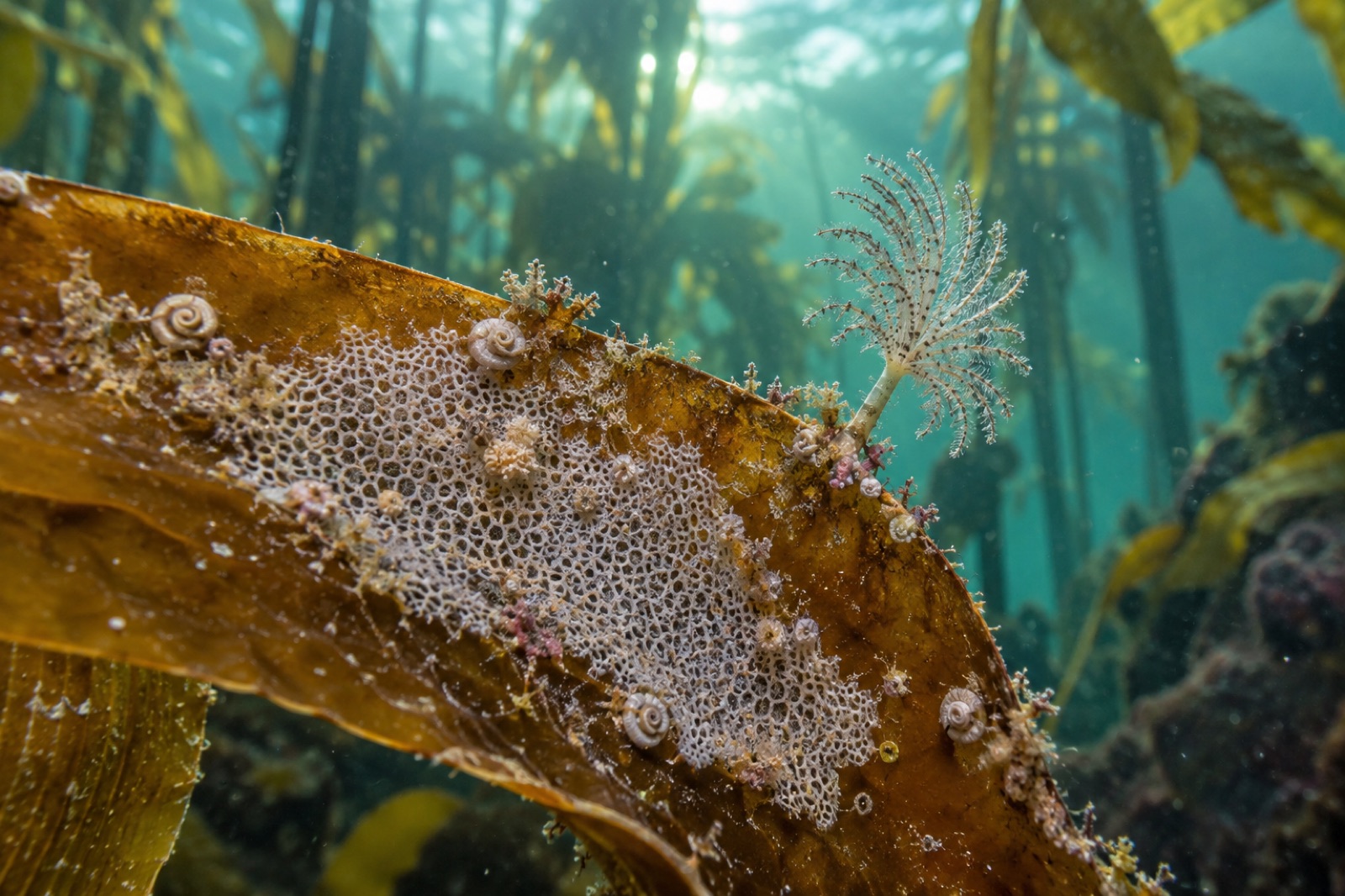
Bite into a raw kelp blade and your mouth puckers — the same drying, astringent grip you get from strong tea or an unripe persimmon. That sensation is chemistry: a class of polyphenolic compounds called phlorotannins, found essentially only in brown algae, that kelp manufactures, stores and deploys as part of a sophisticated defensive economy. For more than half a century, ecologists have studied these compounds as the kelp forest's chemical armour — against grazers, microbes, settling larvae and sunlight itself. The story that has emerged is richer and more conditional than any simple armour metaphor, and it is one of the best case studies in marine chemical ecology.
What phlorotannins are
Phlorotannins are polymers built from a single simple unit: phloroglucinol, a small benzene ring decorated with three hydroxyl groups. Brown algae join these units into chains and branched structures ranging from a handful of rings to dozens, producing a family of compounds that differ in size, linkage geometry and — presumably — function. They sit in the same broad chemical family as the tannins in tea, oak bark and red wine, but brown algae are the only lineage on Earth that builds them from phloroglucinol, a terrestrial-plant-free trick.
The amounts are striking. Across brown algae, phlorotannins commonly make up a few percent of tissue dry weight, and in some species and tissues measured values run far higher — into double-digit percentages. A temperate kelp forest, in chemical terms, is one of the most tannin-dense productive ecosystems known. That investment is the first clue that these molecules do serious work: carbon and energy poured into anything at that scale is not decoration.
Where they live in the plant
Within the blade, phlorotannins are concentrated in specialised membrane-bound vesicles called physodes — visible under the microscope as small, brownish inclusions clustered near cell surfaces. The placement is deliberate: physodes sit where damage starts. Slice a blade and the wound margin browns within minutes as physodes rupture and their contents oxidise and polymerise — a rapid, local chemical response that seals the surface, cross-links proteins and creates a dense, microbe-hostile scar. Divers know this as the brown "bruise" on torn kelp; to a pathogen it is a wall going up at the breach site.
Distribution across the plant is equally strategic. Reproductive tissue and meristems — the growing zones, where a grazer's bite costs the plant most — tend to carry the highest concentrations, while expendable older blades carry less. The plant insures its future first.
The defence story — and its complication
The clean version of the story goes like this: phlorotannins deter herbivores by binding to dietary proteins and digestive enzymes, lowering the nutritional return on a mouthful of kelp and making it taste astringent; grazers learn or innately prefer low-tannin tissue. And there is strong evidence for this version: in feeding assays across many systems, urchins, snails and fishes often avoid diets rich in phlorotannins, and elevated concentrations correlate with reduced grazing in several kelp–urchin systems.
The complication is that "often" is not "always." Consumers adapt. Several small crustaceans — amphipods and isopods that live among kelp fronds — specialise on high-phlorotannin algae and appear largely untroubled; some may even use the host's chemistry as camouflage against their own predators. Sea urchins vary by species and by hunger: a starved urchin eats what stands in front of it, tannin or not, which matters ecologically because the barrens-forming aggregations that strip forests — the dynamics behind urchin barrens — are precisely aggregations of starved animals. Nor is concentration destiny: other defences — toughness, calcification in some browns, and non-tannin compounds — co-vary, and teasing apart which deterrent did the work has kept chemists and ecologists usefully busy.
A further layer: many brown algae run induced defence. Grazing damage — or in experiments, even the waterborne signals of grazing nearby — triggers increased phlorotannin production over days to weeks, concentrating future defence where attack has already occurred. The armour is not just worn; it is reinforced at the points of impact.
Beyond grazers: the wider portfolio
Ask what phlorotannins are "for" and grazing is only the first answer. The compounds' chemistry — a wealth of phenolic hydroxyls — lends them to several jobs at once:
- Ultraviolet screening. Phlorotannins absorb UV strongly, and surface and intertidal brown algae tend to be richer in them than deep-water kin. In shallow forests they act as a manufactured sunscreen, protecting DNA and the photosynthetic apparatus.
- Antimicrobial and antifouling action. Exuded phlorotannins deter bacterial films, fungal pathogens and the settlement of fouling larvae — a chemical perimeter complementing the blade's physical slickness described in life on the kelp blade.
- Wound response. As above: rapid oxidation at damage sites builds a physical scar and an antiseptic field.
- Metal binding. Phlorotannins chelate metals, plausibly buffering the cell against toxic spikes in coastal water.
Defence compounds that double as sunscreen, antiseptic and antifoulant are doing heavy lifting per carbon invested — which helps explain why the investment is so large.
The ecological downstream
Phlorotannins do not disappear when the kelp does. Detached blades and seasonal dieback deliver tannin-rich detritus into the food webs described in the detritus pathways of kelp. Tannins bind proteins in the detritus, slowing microbial decomposition — wrack on the beach rots more slowly than its bulk suggests, and high-tannin detritus can deter detritivores the way it deters grazers. At the ecosystem scale, this shapes who can live on kelp carbon: communities of decomposers and invertebrate detritivores on kelp coasts are filters tuned partly by this chemistry. There is even interest in how tannin-heavy detritus interacts with the long-term fate of kelp carbon — an open question that brushes up against where kelp carbon goes.
Phlorotannins also shape battles between algae. Compounds exuded into the boundary layer may inhibit the settlement or growth of competing turf and microalgae on top of the kelp — one thread in why invading algal assemblages struggle in some intact kelp forests and thrive in degraded ones.
Phlorotannins and people
Because tannins from land plants attract interest as antioxidants and preservatives, phlorotannins have attracted the same questions — as food preservatives, cosmetic ingredients or functional food components (a lane that overlaps with our look at seaweed in cosmetics). In-lab studies report a range of interesting bioactivities for purified phlorotannins, but the honest state of the science is preliminary to promising: lab potency is not evidence of benefit at dietary doses, and no health claims for phlorotannin products are established by the science today. The compounds are real, remarkable, and best appreciated where they demonstrably work — inside a blade of kelp standing in the surge.
Key takeaways
- Phlorotannins are polyphenol polymers unique to brown algae, built from phloroglucinol units, often reaching several percent of dry weight — among the densest tannin loads of any ecosystem.
- They are stored in physodes near cell surfaces, concentrated in reproductive and growing tissues, and oxidise rapidly into antiseptic scars at wounds.
- They deter many grazers by binding proteins and enzymes and by astringency — but adapted small crustaceans and starved urchins largely shrug them off.
- Defence is induced: grazing damage raises production over days to weeks, reinforcing armour where attack has happened.
- The same molecules do multiple jobs — UV sunscreen, antimicrobial perimeter, antifoulant, metal buffer, wound sealant.
- Downstream, tannin-rich detritus decomposes more slowly and shapes kelp-carbon food webs; human health or industrial uses remain promising but preliminary science.
FAQ
Are phlorotannins the same as tannins in tea and wine?
They are first cousins, not siblings. Both are polyphenols and share the astringent, protein-binding behaviour, but plant tannins derive from pathways (like gallic acid) absent from brown algae, while phlorotannins are polymers of phloroglucinol found nowhere outside brown algae. Same sensation, different molecule.
Why do only brown algae have them?
Because the ability to polymerise phloroglucinol evolved in the brown algal lineage and appears to have stuck ever since — almost every brown alga makes them, green and red algae don't. Brown algae are a distinct branch of life (stramenopiles), unrelated to true plants; their chemistry runs on ancestry exported into different solutions. See why seaweeds are green, brown or red for the evolutionary backdrop.
Does eating kelp mean eating lots of phlorotannins?
Some, yes — blade tissue of food kelps contains them, though cultivated food species and blanching/processing moderate levels, and the amounts in a serving of kombu or wakame are comfortably within the "normal culinary tannin" range any tea drinker exceeds. Concerns instead run in the other direction: very concentrated phlorotannin extracts are a different category from cooked kelp, and their supplement-style claims outrun the evidence.
Can scientists see or measure phlorotannins easily?
Yes, with a standard assay. Crushed tissue is extracted and reacted in a colorimetric test (the Folin–Ciocalteu assay is the workhorse) which turns blue in proportion to polyphenol content; calibrated against a phloroglucinol standard, it yields quantitative dry-weight measurements — the basis of decades of comparative ecology. Physodes themselves are visible by microscopy without any chemistry at all.
Do phlorotannins protect kelp from climate stress?
Partially and indirectly. Their UV and antimicrobial roles help with parts of the stress bundle — sun, fouling and pathogens moving under warming — and there is experimental evidence their production responds to temperature and light. But they do not shield kelp from the central climate threat of marine heatwaves: no chemical armour lowers water temperature. They are one layer in a portfolio, not a solution.