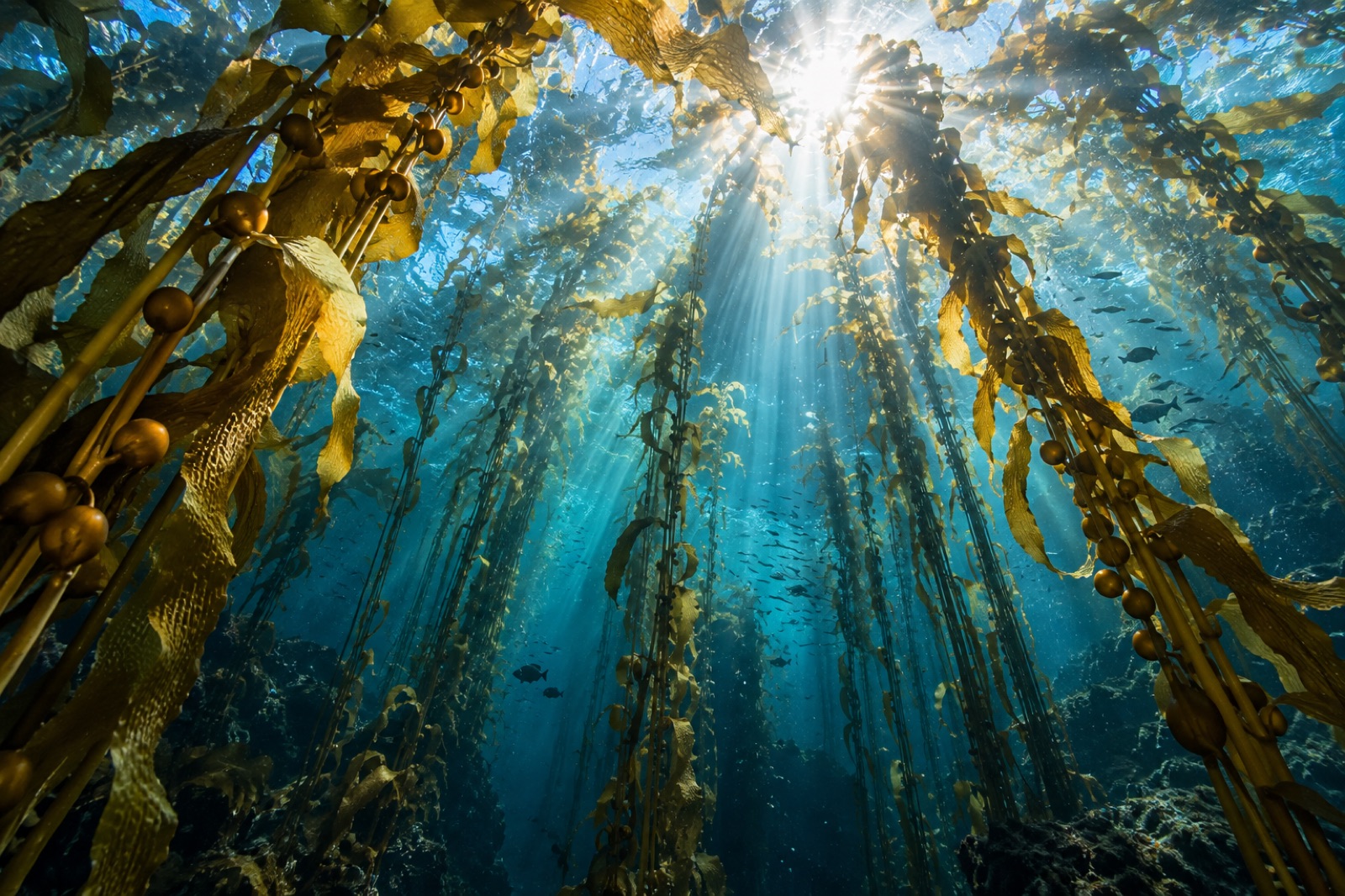
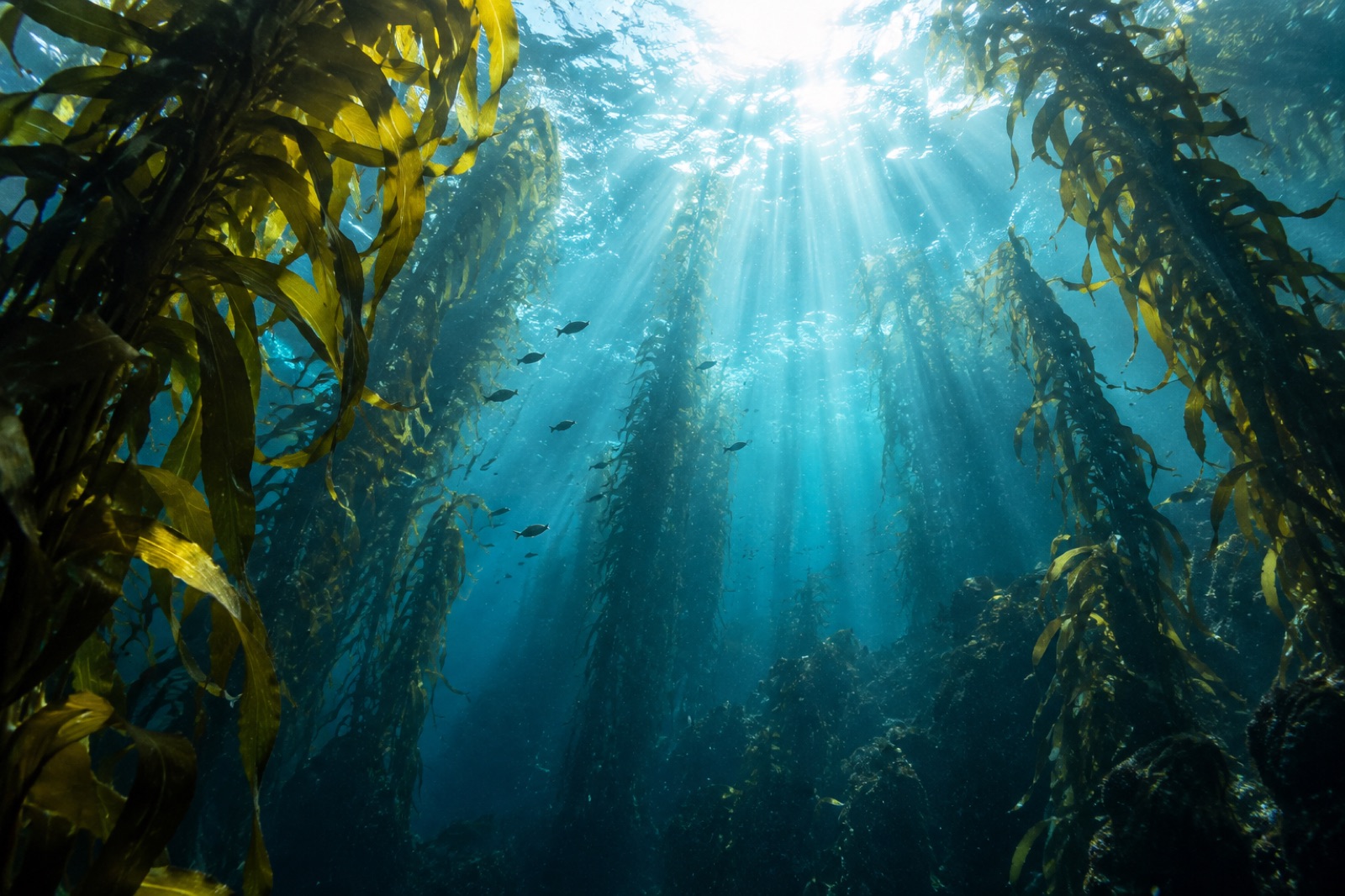
A forest that isn't green still sounds wrong to most people. Forests are green; that is almost the definition. Stand on a California headland at low tide, though, and the forest beneath the surface is unmistakably brown — olive through bronze to dark chocolate, depending on the species, the season and the depth. And that brown is not mud, decay or dirt. It is, quite specifically, the colour of a pigment called fucoxanthin doing work that chlorophyll cannot do alone.
Understanding why kelp is brown takes you through the physics of underwater light, the evolutionary history of an ancient endosymbiosis, and a colour code that marine scientists use daily. It also turns out to matter for anyone trying to map, restore or farm kelp forests — because a kelp's colour is, in a quiet way, a report on its health.
The short answer
Kelp is brown because its cells are packed with fucoxanthin, an accessory pigment that absorbs blue-green light overwhelmingly well and reflects yellow-brown light back. Kelp also contains chlorophyll — it is a photosynthesiser, after all — but the chlorophyll is visually buried under a much larger load of fucoxanthin. What you see from the surface is the accessory pigment, not the engine underneath it.
The deeper question is why a kelp would load its photosynthetic machinery with a pigment tuned to blue-green light at all. The answer lies in what happens to sunlight in the first ten metres of seawater.
What water does to sunlight
Sunlight is a spectrum, and seawater is a ruthless editor of it. Red light is absorbed within the first few metres of even clear ocean water. Orange and yellow go next. By the time you reach twenty metres in typical coastal water, the light field is dominated by a narrow band of blue and blue-green — because those wavelengths, at around 450–500 nanometres, penetrate water best. This is why the open ocean looks blue: blue light is what's left to scatter back. We cover the physics in detail in Light Underwater: Why Depth and Colour Decide Where Kelp Grows, but the key point is this: green light underwater is scarce, and red light is nearly absent below the shallows.
This creates a problem for any photosynthetic organism that evolved to harvest red light efficiently. Land plants, with their chlorophyll a and b, absorb strongly in the red and blue and reflect green — fine on land, where red light is abundant. But a kelp anchored at eight metres of depth lives in a world where the available photons are mostly green-blue. An organism whose pigments are tuned to red light would be harvesting energy in a nearly empty market.
Fucoxanthin: the underwater harvester
Brown algae — the group Phaeophyceae, which includes all the true kelps — solved this with fucoxanthin, a carotenoid pigment related to the same chemical family as the beta-carotene in carrots. Fucoxanthin absorbs light between roughly 450 and 540 nanometres, right in the blue-green window that dominates underwater. It sits in the kelp's chloroplasts as part of "antenna complexes" — protein scaffolds studded with pigment molecules that catch photons and pass the energy inward to chlorophyll a, where the actual chemistry of photosynthesis happens.
The efficiency is remarkable. In the blue-green region of the spectrum, a kelp's fucoxanthin antenna captures the large majority of the usable light that falls on the blade. This is why giant kelp can keep growing — sometimes at up to 60 centimetres a day for Macrocystis pyrifera — in the dim, green-shifted light of the subcanopy where terrestrial weeds would stall.
Why kelp doesn't look blue
If kelp absorbs blue-green light, shouldn't it reflect the opposite — orange or red? Pigment colour logic is not quite that simple in a crowded living cell. Fucoxanthin absorbs in the blue-green and reflects longer wavelengths (yellows and reds) weakly; the small amount of red light still travelling through the blade is mopped up by chlorophyll. What comes back to your eye is a blend pulled toward brown, olive and bronze. Ecologists sometimes joke that kelp is "the colour of the light it can't keep" — humourously inaccurate, but memorably so.
The colour code of the sea
Once you know the pigment story, seaweed colour becomes a readable field guide. Three big evolutionary lineages, three pigment kits:
- Brown algae (kelp, rockweed, sargassum). Chlorophyll a and c plus fucoxanthin. Tuned to blue-green light; dominant in cool, clear, nutrient-rich temperate water. Every true kelp wears this scheme, from sugar kelp to giant kelp itself.
- Red algae (nori, dulse, corallines). Chlorophyll a (and d in many) plus phycobilin pigments — phycoerythrin and phycocyanin — that harvest green and even yellow light with extreme precision. Red algae often thrive deeper than kelp, in the dimmest, purest blue light, which is why the deepest seaweeds on a reef are usually red.
- Green algae (sea lettuce, codium). Chlorophyll a and b, like land plants — they share a direct ancestor with them. Green algae dominate intertidal and very shallow habitats where the full spectrum, including red, still reaches.
This pattern has a name: chromatic adaptation, sometimes called vertical colour zonation. Green seaweeds near the sunlit surface, browns in the mid-depths, reds deepest of all. It was once treated as an iron rule, and modern physiology has softened it — pigments, depth and light quality don't track each other perfectly, and many red algae are abundant in the shallows for reasons beyond light. But the broad pattern holds, and walking a low-tide shoreline with it in mind makes the reef legible in a new way.
Colour as a health signal
For kelp forest ecologists — and for us at Tidewright, where our Holdfast nursery team watches millions of juvenile kelps through their first weeks of life — colour is a diagnostic.
A fast-growing kelp in bright, cold summer water often lightens visibly, developing a golden-olive cast as growth outpaces pigment maintenance and blade tissue is nitrogen-sufficient but dilute. A kelp in warm, nitrate-poor water tends to go the other way: blades darken, then tip-necrose and bleach, breaking down from the free end inward. Bleaching in kelp looks the way it sounds — the brown leaches out, leaving ghost-pale tissue — and prolonged warm water can bleach a whole canopy before the kelp dies outright. This is one of the visual signatures we track from satellites and drones as part of Canopy Ledger's early-warning monitoring: a kelp forest shifting from deep brown to washed-out tan over a few weeks during a marine heatwave is a forest in trouble, months before canopy loss shows up as acreage.
Sporophylls — the reproductive tissue of giant kelp — also go noticeably darker and thicker as they mature, a useful cue when our scientific divers hand-collect them for spore-seeding lines. And some bleached-look kelps are perfectly healthy: the elk kelp and certain deep-water species run naturally pale, which is why local knowledge of "normal colour" matters. At Tidewright's monitoring sites, baseline photographs of canopy colour by season are part of the site file, and deviations get investigated.
The pigment has uses beyond light
Fucoxanthin has a second life in human nutrition and research. It's one of the compounds that makes kombu, wakame and other brown seaweeds aromatically and nutritionally distinctive, and it has been the subject of substantial laboratory research into antioxidant and metabolic effects — though, as ever in nutrition, the leap from cell-culture findings to proven human benefit is large and should be treated with scepticism. What is undisputed is that brown kelps owe their culinary depth partly to the chemistry of their colour.
Key takeaways
- Kelp is brown because of fucoxanthin, an accessory carotenoid pigment that covers the chlorophyll underneath and dominates what your eye sees.
- Fucoxanthin is an adaptation to underwater light. Red light vanishes in the first few metres of seawater; blue-green light reaches deepest, and fucoxanthin absorbs exactly in that window.
- Seaweed colour follows lineage and habitat: green algae near the surface, browns at mid-depths, reds often deepest — the chromatic-adaptation pattern.
- Colour is a monitoring signal. Healthy cool-water kelp runs deep olive-brown; warm, nitrogen-starved kelp darkens, then bleaches. Ecologists and restorers watch this.
- The pigment repeats at the table. The same compounds that tint kelp also contribute to the flavour and interest of brown seaweeds like kombu and wakame.
FAQ
Is kelp actually an algae or a plant?
Kelp is a brown alga, not a plant — it's closer, evolutionarily, to diatoms than to grasses or trees. It has no true roots (its holdfast is purely mechanical), no flowers and no vascular tissue, but it photosynthesizes and builds structure in plant-like ways, which is why the confusion persists.
Why do some kelps look greener or more golden than others?
Species, season and light history all shift the hue. Golden kelp (Ecklonia radiata) on Australian and New Zealand reefs runs distinctly golden-bronze; kelps growing in bright, shallow water often look lighter than their deep-water kin. The pigment spectrum is continuous, and "brown algae" encompasses plenty of olive, russet and near-black.
Do kelps have chlorophyll, and can I see it?
Yes — kelps carry chlorophyll a and c inside every blade cell, doing the core photosynthetic chemistry. You can't see it directly because fucoxanthin visually swamps it, but strip the fucoxanthin away (which happens naturally when a kelp bleaches and partly in lab extractions) and the familiar green shows through.
Is a white or pale patch on kelp always a bad sign?
Usually it signals stress, bleaching or the advance stage of blade breakdown — but not always. Some species are naturally pale, and old blades slough and lighten before they detach. Context matters: a uniform pale patch in mid-summer after a warm spell is much more worrying than the slow end-of-season lightening of an annual kelp.
What is the deepest colour kelp can grow at?
That depends on water clarity and species. In exceptionally clear water, some kelps anchor below 30 metres — we've surveyed kelp to around 40 metres on clear-ocean sites — but most forests live shallower than 25 metres. The deepest photosynthetic seaweeds of all are certain red crustose algae, found below 200 metres in the clearest tropical water, riding faintest blue light.