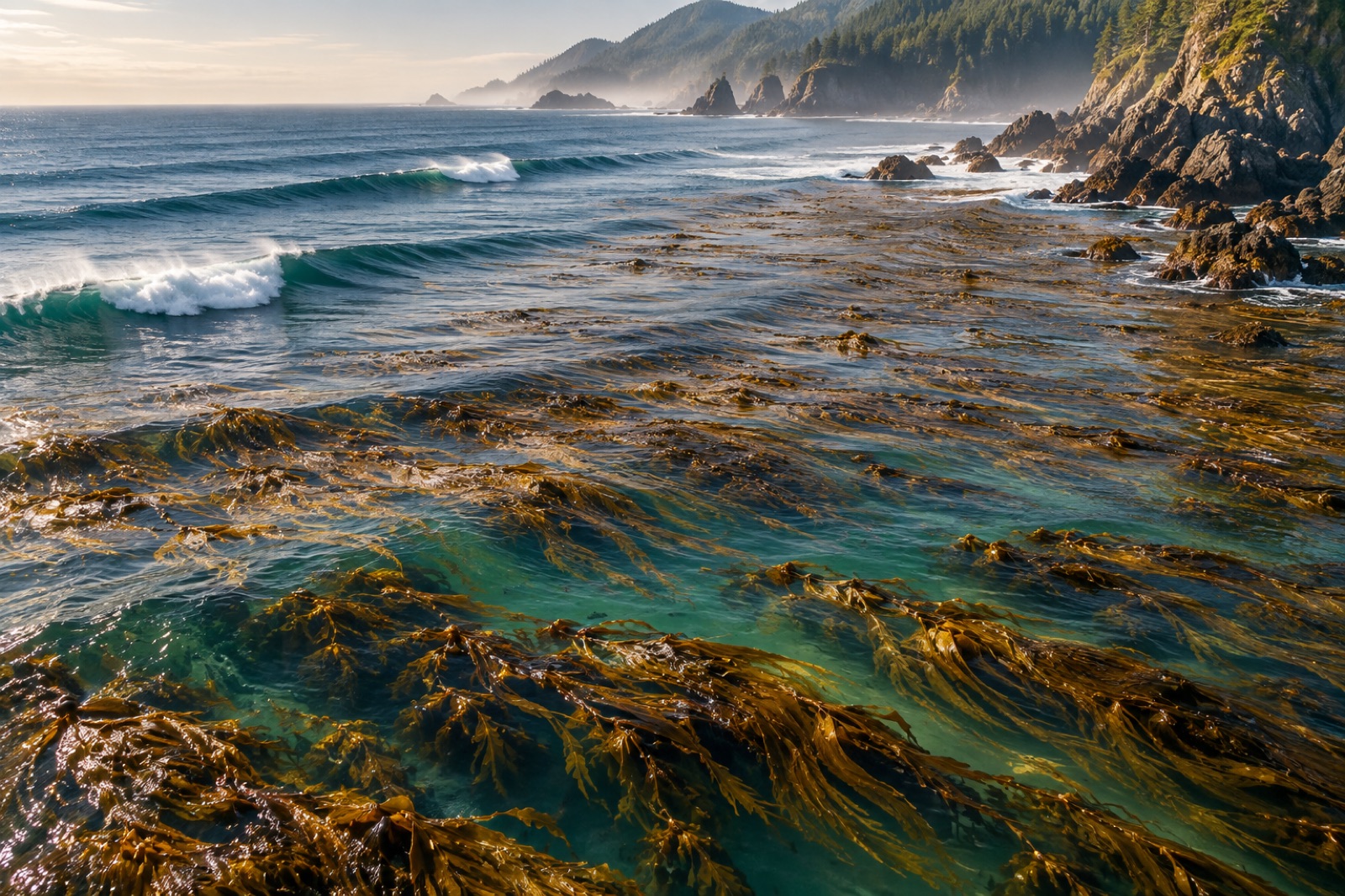
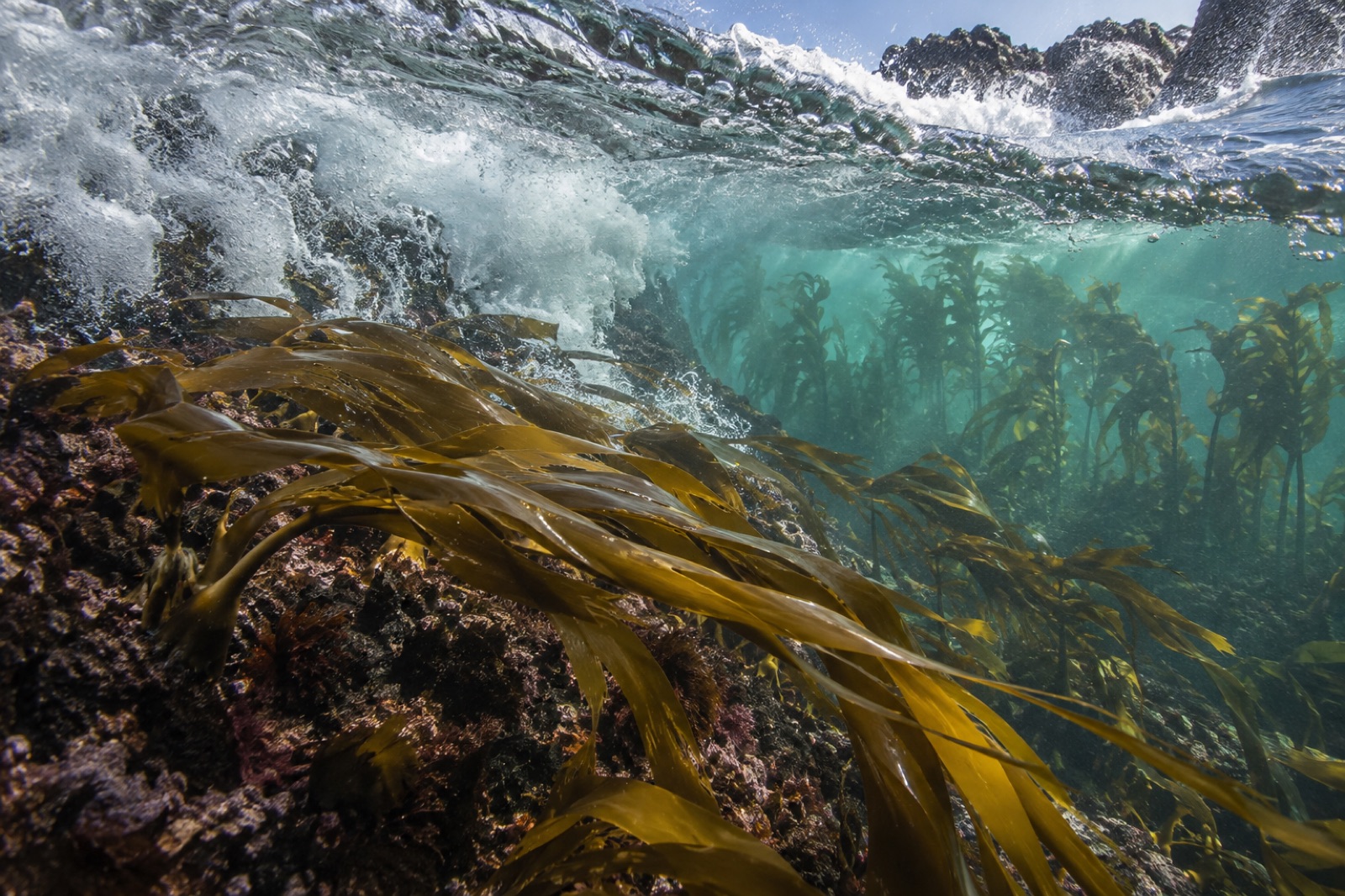
A council engineer staring at an eroding foreshore costs two kinds of intervention: rock, steel and concrete; or something alive that rebuilds itself. Kelp forests are increasingly proposed as the second kind — living breakwaters that shave wave energy before it reaches shore. The idea is not fantasy, but it is also not a seawall. This article sets out how engineers actually quantify wave protection from vegetation, what kelp achieves on that scale, and how to decide where a living breakwater is an honest answer.
If you want the fluid-mechanics side first — how swaying fronds drag energy out of moving water — our companion piece on wave damping physics covers it. Here we ask the follow-up question: how much protection, under what conditions, and for whom?
How Engineers Judge a Breakwater
Coastal engineering has a precise grammar for protection. A breakwater is judged by its transmission coefficient — the ratio of wave height behind the structure to wave height in front of it. A coefficient of 0.5 means half the incident height survives; 0.9 means barely any shelter at all. Engineers then ask three further questions:
- How wide is the protected zone? A thin line of defence that only works directly in its lee is less useful than a broad dissipating field.
- What happens in the design storm? Protection that vanishes exactly when you need it is decoration.
- What does it cost to build and maintain? — including the cost of failure.
Kelp can be assessed in the same grammar, and that is the discipline of thinking this argument needs.
A Porous, Flexible Barrier — Not a Wall
Rigid breakwaters work by reflection: they throw wave energy back seaward. Kelp works by dissipation — thousands of moving fronds converting wave motion into small-scale turbulence and heat. That difference shapes everything.
A damped forest leaves no reflected field to scour adjacent shorelines, which is one of the chronic problems of hard structures. It also means kelp's protection is graded rather than abrupt: wave energy declines steadily with distance travelled through the canopy, so the effective protective unit is not a "wall" but a band of forest, measured in hundreds of metres, fronting the shore you care about.
The numbers that govern damping scale are density (fronds per square metre), canopy-to-surface reach, and the water depth the forest grows in. A forest in eight metres of water with a surface canopy touches the wave motion where it is strongest; the same biomass spread over twenty-five metres of water column influences only the upper, weaker part of a swell's orbital motion. Depth is destiny in protection terms — a point that also governs where kelp grows at all, as our explainer on wave exposure and kelp makes clear.
Where Kelp Sits in the Coastal-Defence League Table
It is worth being candid. Among nature-based defences, the strongest wave dissipators are the intertidal and shallow-subtidal systems:
- Salt marshes and mangroves stand emergent through storms, with dense stems in exactly the depth zone where wave energy concentrates. Metre for metre of cross-shore width, they out-damp subtidal kelp substantially.
- Oyster and mussel reefs add rigid, accreting roughness that both reflects and dissipates, and they sit shallow.
- Coral reefs are the champions: reef flats strip the overwhelming majority of incident wave energy before it crosses the lagoon — but only in warm water.
- Kelp forests occupy subtidal rocky coasts where none of the above can grow. They damp long-period surge and swell-run-up components meaningfully at reef scale, moderate mean currents, and calm the interior of coves. On the league table of raw wave-height reduction per metre they sit lower; on the league table of what can protect a temperate rocky shoreline, they are effectively the only dugout the team has.
That last point is why the concept deserves seriousness rather than hype. For a government or council weighing nature-based options, the accurate framing is: kelp is the available living defence for exactly the coastlines where the alternatives don't apply.
The Design-Storm Problem
Every living breakwater shares an existential weakness that concrete does not: the extreme event you are protecting against is also an event that can destroy the protection. A long swell that a council would love damped is the same swell that rips stipes from holdfasts and clears whole forests in a weekend. Kelp hedges this in three ways:
- Flexibility. Fronds stream and reconfigure rather than resist, shedding load — the biomechanics explored in our piece on kelp's bend-don't-break hydrodynamics.
- Regrowth. Many canopy species carry meristems that survive frond loss; a storm-thinned forest can reclaim its canopy within a season or two — though the protective value during the gap is reduced.
- Self-sheltering. Interior parts of a wide forest face water already slowed by the seaward ranks, so damage concentrates at edges.
The honest engineering conclusion: kelp's protection should be valued as reliable suppression of everyday wave climate — the chop, surge and moderate swell that drive chronic erosion, moorage damage and run-up nuisance — plus a probabilistic contribution in big events, rather than a rated defence against the design storm. Chronic wear costs communities more, in aggregate, than rare catastrophes do, which is where living infrastructure quietly earns its keep.
What a Council Pilot Actually Looks Like
For readers with a shoreline file on their desk, the evaluation pathway is concrete:
- Baseline the wave climate. A modest array of bottom-mounted pressure sensors across the existing (or proposed) forest footprint, run through at least one storm season, gives the transmission data real funds can be committed on.
- Compare control and treatment shores. Adjacent headland-sheltered versus exposed segments serve as natural controls — the same logic behind the before-after-control designs described in our long-term monitoring explainer.
- Model the honest benefit. Feed measured damping into the same run-up and erosion models the council already uses; put habitat, fisheries and carbon benefits into the ledger alongside, not instead of, the wave service. Our impact methodology describes how Tidewright quantifies and labels each of these on restoration sites (all Tidewright-specific figures are fictional, illustrative demonstrations).
- Design for regrowth, not just installation. Where shorelines have lost their forest to urchin barrens or heatwaves, restoring kelp is restoring the breakwater — which is precisely the niche Tidewright's Drifter reseeding vessels were designed to fill, pairing site surveys with seeded lines matched to local wave energy.
The Bottom Line for Living Breakwaters
Kelp forests will not replace a city's storm-surge barrier, and nobody should sell them as such. What they do — verifiably, measurably — is take real energy out of the working wave climate of temperate rocky coasts, at reef-and-cove scale, while doing a dozen other paid jobs at once. In the grammar of coastal protection, kelp is not the wall. It is the wide, self-repairing dissipating field in front of the wall — and for thousands of kilometres of coastline where no other living defence can survive, it is the field or nothing.
Key takeaways
- Engineers judge breakwaters by transmission coefficient, protected footprint, design-storm performance and cost — kelp can be assessed honestly in those terms.
- Kelp dissipates rather than reflects wave energy, so it works as a broad damping band, not a wall — with no reflected field to scour neighbours.
- Per metre, marshes, mangroves, shellfish reefs and coral reefs out-damp kelp — but none of them can grow on temperate subtidal rocky coasts, where kelp is the only living defence available.
- Kelp reliably suppresses everyday chop, surge and moderate swell; in extreme storms it offers a probabilistic, degrade-and-regrow contribution rather than rated protection.
- A credible council pilot pairs a season of pressure-sensor measurements with before-after-control comparison and a full benefit ledger that includes habitat and carbon alongside waves.
FAQ
How much wave height does a kelp forest remove?
Published measurements vary widely with species, density, depth and wave conditions — from negligible effects on short wind-chop to substantial percentage reductions in long-period surge over a few hundred metres of forest. Treat any single number as site-specific; the field-monitoring pathway above is how to get a number for a particular shore.
Can a kelp forest protect against storm surge or tsunamis?
No. At catastrophic-event scale the forest's damping is a small share of the total energy, and the forest itself is likely to be damaged. Kelp's protective value is against the chronic, working wave climate — the swell and chop that erode shores and damage moorings year-round.
Is a restored kelp forest as protective as a natural one?
Eventually, potentially — the damping depends on canopy density and reach, not on whether the forest is wild or restored. The lag is time: a restored forest needs years of self-supporting growth to reach protective maturity. This is a genuine trade-off against hard structures, which are protective on day one.
Could kelp be combined with engineered reefs?
Yes, and hybrid designs are an active research direction — low-crested rock or reef-ball structures that raise seabed roughness and give kelp suitable substrate, with the forest adding flexible dissipation above. The pairing also addresses kelp's dependence on rocky habitat where sediment or sand has buried natural reef.
How does Tidewright incorporate wave protection into projects?
On exposed sites, our survey vessels log fine-scale wave exposure before any seeding, and protective placement — where a new forest sits relative to coves and infrastructure — is one of the design inputs we report to partners. All Tidewright project outcomes are fictional and illustrative; the underlying physics described in this article is real.