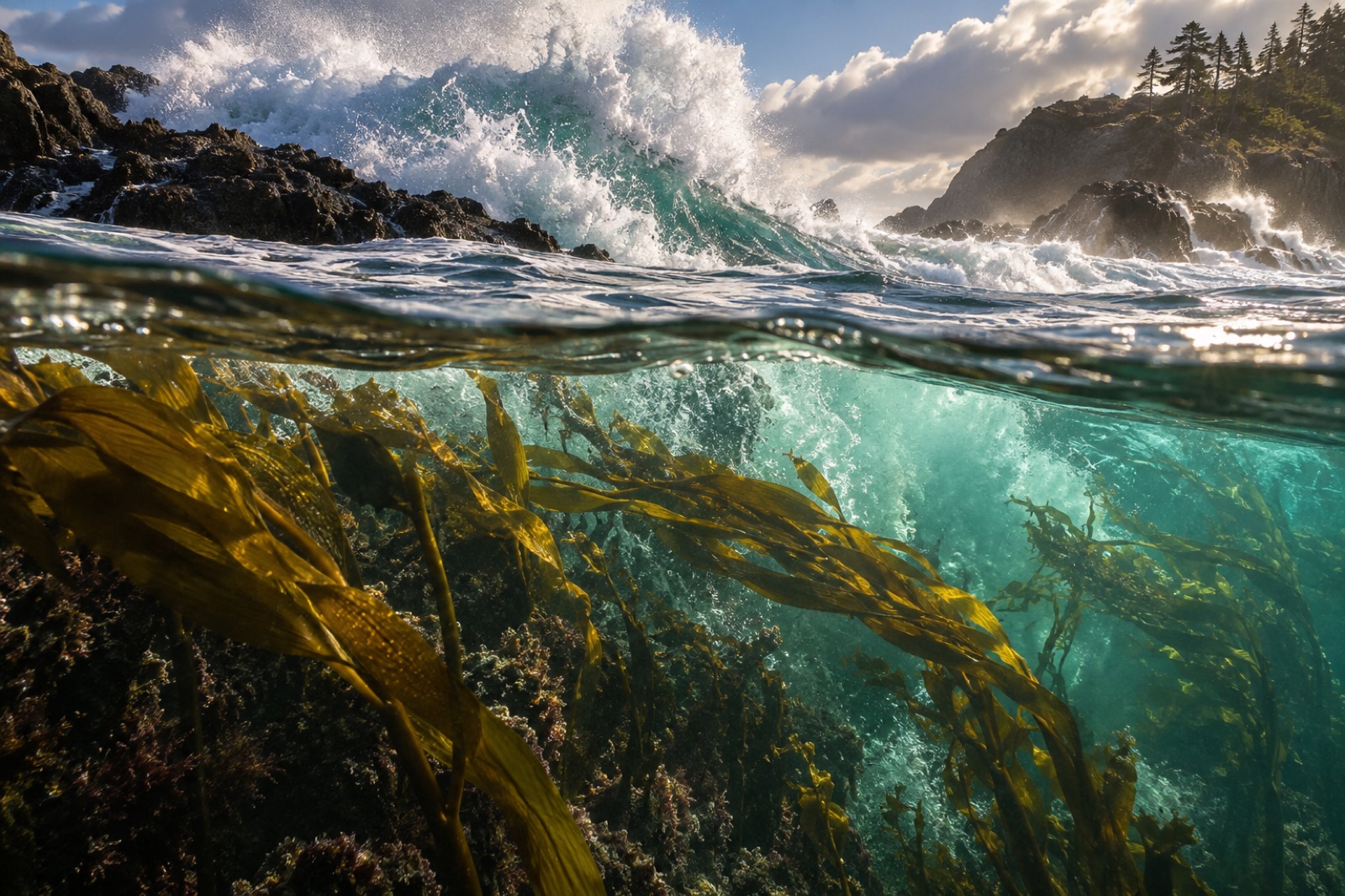
Stand at the edge of a kelp forest during a winter swell and the physics looks suicidal. Wave faces carrying tonnes of water pass over a giant kelp stipe thinner than your wrist, attached to rock by a structure with about the tensile strength of wet cardboard. And yet forests on exposed coasts routinely ride out storms that snap fishing boats' moorings and shift harbour walls. The secret is not strength. It is the opposite.
Kelp's entire structural strategy is substitution: flexibility paid for in weakness, weakness survived by going with the flow. This article explains how that works — the mechanics of drag, the trick scientists call reconfiguration, the material science of a stipe, and the trade-offs that cap how floppy a forest can afford to be. It follows on from our overview of kelp biomechanics and pairs with the ecological side of disturbance in storms and kelp.
The problem: drag scales viciously with speed
The drag a wave applies to anything in the water column follows a cruel equation. Drag force grows roughly with the square of flow velocity and linearly with the area you present to the flow. Double the wave speed and the force doesn't double — it quadruples. A rigid pole-shaped kelp in a 3-metre-per-second orbital flow at the bottom of a wave would face many times the force it sees in a gentle surge, and a moderate swell would find its breaking strength almost immediately.
A rigid underwater forest barely exists for this reason. (A partial exception exists: crustose coralline algae, which handle waves by hugging the rock as a thin encrusting layer — choosing armour over exposure to flow at all.) Kelps instead answer the equation's second term: they change area, dramatically and continuously, and they trade a little strength for a lot of give.
Reconfiguration: shrinking into the flow
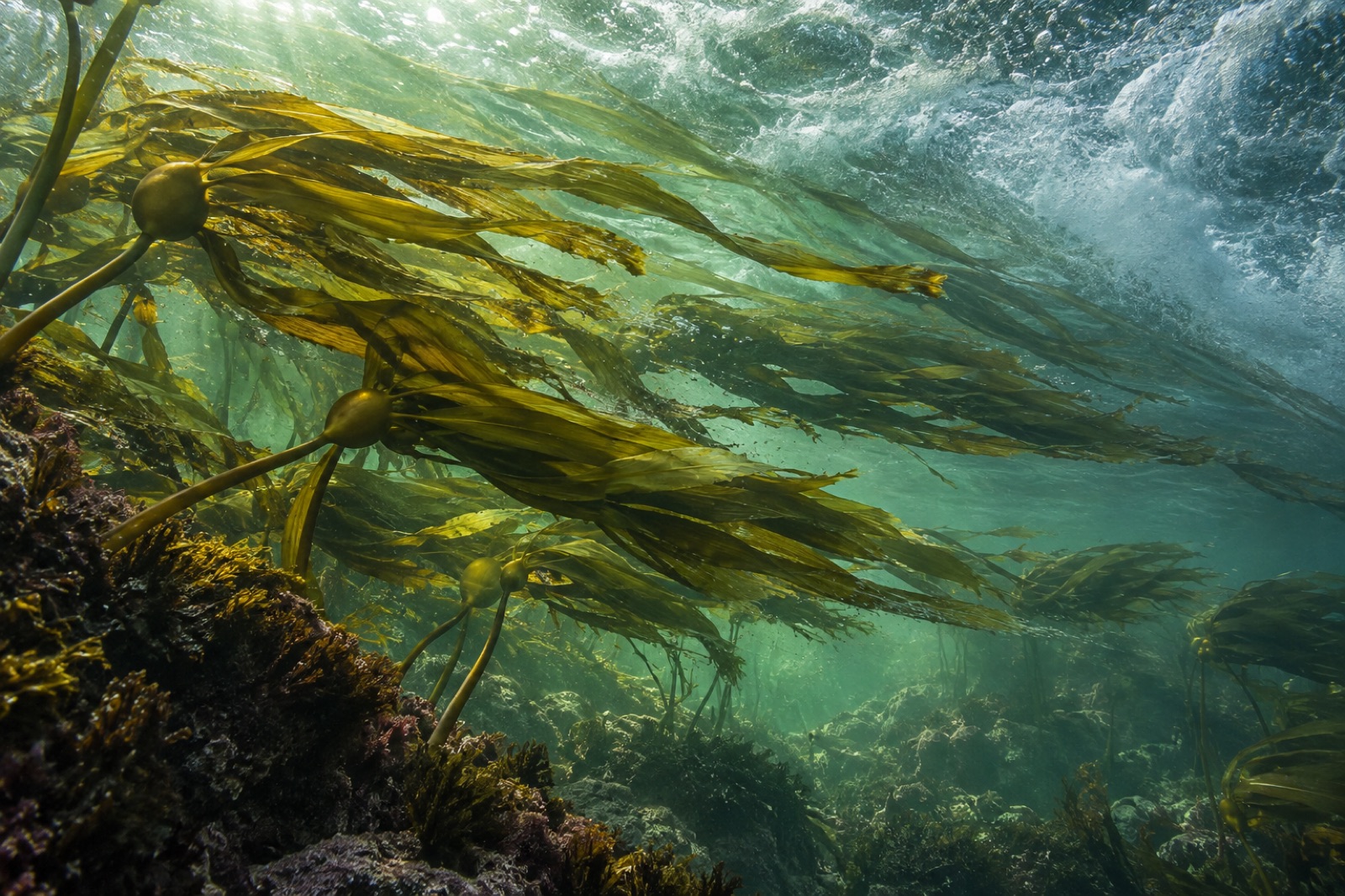
Freeze a wave in mid-pass and photograph a bull kelp from the side, and you will see a plant that has "reconfigured": the blade and stipe streamed along the flow direction into a narrow, cone-like profile; blades stacked and collapsed onto each other; the whole individual half the shape it held a second earlier. Reconfiguration — first formalised in terrestrial plants and later for seaweeds — is dynamic shape-change that reduces projected area exactly when force peaks.
The consequences for kelp are large:
- Projected area collapses when it matters most, just as velocity peaks. A blade that would present a square metre to the current, side-on, presents a fraction of that when streamed.
- Blades stack on each other, so the effective drag of ten blades can approach the drag of a fatter single blade — a phenomenon sometimes termed "interference" or mutual sheltering.
- The whole organism rotates around its base, aligning its long axis with flow, which further lowers the speed-squared component it experiences.
Measured on real plants in wave tanks, reconfiguration cuts peak drag by the vast majority of what a rigid model of the same plant would endure. It is why flexible seaweeds can thrive on coasts where no engineered mast of similar stiffness would survive.
The material: a stipe engineered to stretch
Reconfiguration is only half the story; the material matters too. Kelp stipes and blades are built from a composite of cellulose microfibrils embedded in an alginate-matrix gel — a hydrated, fibre-reinforced polymer. Its signature properties:
- Low stiffness, high extensibility. A bull kelp stipe can stretch substantially before failing, dissipating wave energy as it deforms rather than transmitting it all to the holdfast at the base.
- Viscoelasticity. Kelp tissue's response depends on loading rate: it is stiffer under a sudden tug than a slow pull. Over a wave's seconds-long push, the stipe behaves like a shock absorber, flowing with the load instead of storing it as brittle tension.
- Tapered, stranded design. Giant kelp stipes are bundles of finer elements; bull kelp stipes taper from base to blade; the fronds of many species split into bladelets. Each acts to distribute and localize stress rather than concentrating it at one plane.
The holdfast does its own engineering quietly: a morphology of interlocking haptera wedges into rock microtopography rather than gripping like a bolt. We cover that geometry in holdfast biomechanics and how kelp holds on.
Going with the flow — and the trade-offs involved
Flexibility is not free. A kelp that gives way entirely is a kelp that:
- Loses light. Blades streamed flat along the current present less surface to sunlight, cutting photosynthesis precisely on the bright, storm-lit days when carbon gain is possible. Forests respond by growing blades that flatten and wrinkle (increasing intercepted photons per unit area) and by spacing stipes so canopy layers overlap less.
- Rides rougher waters at greater absolute speed. In breaking waves, orbital velocities accelerate near the seabed at shallow depths — this is why so many kelps retreat out of the shallowest few metres, leaving the surge zone to turf and encrusters, or why some species hug the rock itself.
- Pays in abrasion and tangle. Flexibility means blades and stipes rub against each other and against rock. Wear is a real cost; microscopic tissue damage lets pathogens in, a concern that links biomechanics to kelp forest health.
- Interferes with itself. In dense forests, neighbour kelps collide, entangle, and share loads. Forest-level drag is less than the sum of individual drags — a community effect ecologists call skimming flow: the canopy deflects current over the top, sheltering the kelps below.
There is, in other words, an optimum stiffness for each habitat: flexible enough to survive the design storm, stiff enough to stand blades in the sun. Species sort across exposure gradients partly along this axis — the same physics that arranges the architecture of exposed reef communities.
How scientists measure flexibility at sea
Hydrodynamicists borrow a box of tricks from engineering, each one portable:
- Wave flumes at research stations recreate oscillatory flow at controlled speeds. Species are bolted to force plates or hung from load cells, their drag measured as flow ramps up and down; GO PROs and particle image velocimetry reveal the reconfiguration moment by moment.
- Accelerometers and tilt loggers taped to stipes in the field record how often and how hard kelps flex during real storms. The resulting time series can be correlated with buoy-measured wave height nearby.
- Tensile testers measure the breaking strength and elastic modulus of stipe and blade tissue in the lab, distinguishing the elastic region (recoverable flex) from plastic damage (the fray that precedes failure).
- Drag models fit these measurements back to theory: a flexible body's drag coefficient is no longer constant but falls with velocity — mathematical confirmation of what every underwater photographer watching kelp stream in the wind has seen.
Field measurements from exposed Pacific coasts show that kelp forests measurably attenuate wave energy seaward of the reef edge — the forest is, simultaneously, protection and self-protection.
What flexibility teaches farms and restoration
The storm problem returns in aquaculture, where the engineered structures around the crop are often the weak link. Farm designers borrow kelp's logic explicitly: longlines and grow-line hardware flex and yaw with weather, submerge below the wave base in extreme forecasts, and use parallel redundancy in place of brute strength. Our notes on storm-proofing a kelp farm put flesh on that.
Restoration borrows the same physics in reverse. A restored forest on an exposed headland faces an establishment window in which seedlings are small, holdfasts young, and flexibility an asset they have not yet inherited. Choosing protected pockets for outplanting, matching species to exposure (the giant kelp of open coasts versus the rock-hugging species of surge zones), and timing installations for calm months are, at bottom, applied hydrodynamics.
And for anyone watching the sea, the lesson is worth a quiet minute: when a swell runs through a kelp bed and the canopy lies down in the direction of travel, that flatten — thousands of blades streaming westward off a passing crest — is the mechanical genius of a hundred-million-year lineage, visible from a headland with a pair of binoculars.
Key takeaways
- Drag grows with the square of flow velocity — kelp's answer is not strength but shape-shifting.
- Reconfiguration collapses projected area when waves peak, cutting peak force to a small fraction of a rigid equivalent's.
- Kelp tissue is a hydrated fibre composite: flexible, extensible and viscoelastic, absorbing wave energy as deformation.
- Flexibility has costs — lost light, abrasion, entanglement — and each species occupies a stability-and-light optimum along the exposure gradient.
- Forests gain a group benefit: canopies skim flow over the surface, sheltering the individuals beneath.
- Farms and restoration projects apply the same physics: design with give, not just with strength.
FAQ
Why do kelps not simply evolve stronger tissues and stand rigid?
Because drag scales with the square of velocity, doubling tissue strength buys you only about 40% more survivable wave speed — a losing arms race on an exposed coast. Flexibility, by contrast, cuts the area the flow ever sees. Evolution found the cheaper solution: become more streamlined when it matters, rather than more rigid.
How hard is it to actually measure wave forces on kelp in the field?
Very. Load cells anchored at the holdfast measure total force, accelerometers on stipes measure motion, and researchers still often have to infer peaks from gap-filling models because instruments themselves fail in storms. Wave flumes provide control; field deployments provide truth. Advancement in low-cost inertial sensors is shrinking the gap quickly.
Does reconfiguration work equally well for all kelp species?
No — species occupy different positions along the spectrum. Bull kelp and giant kelp rely heavily on streaming and stipe flexibility; Egregia spreads load across many straps; smaller shrubby kelps of surge channels combine moderate flexibility with short stature. There is no single optimum, only the shape that a particular coastline selects.
Can a restored kelp forest survive a storm in its first year?
It depends on the site, the season and the size of the storm. Young plants have smaller holdfasts and less stored strength; the first year is the vulnerable window. Restoration designers therefore favour sheltered sub-sites, outplant before the calm season, and choose species whose storm response suits the exposure of the reef.
Does kelp flexibility affect carbon storage or other services?
Indirectly, yes. Flexibility protects the canopy that fixes and moves carbon, provides fish habitat, and dampens waves approaching the shore. A storm-decimated forest loses all those services at once; a flexible, storm-resilient forest keeps them running. The physical genius of bend-don't-break is, quietly, a continuity-of-service guarantee.