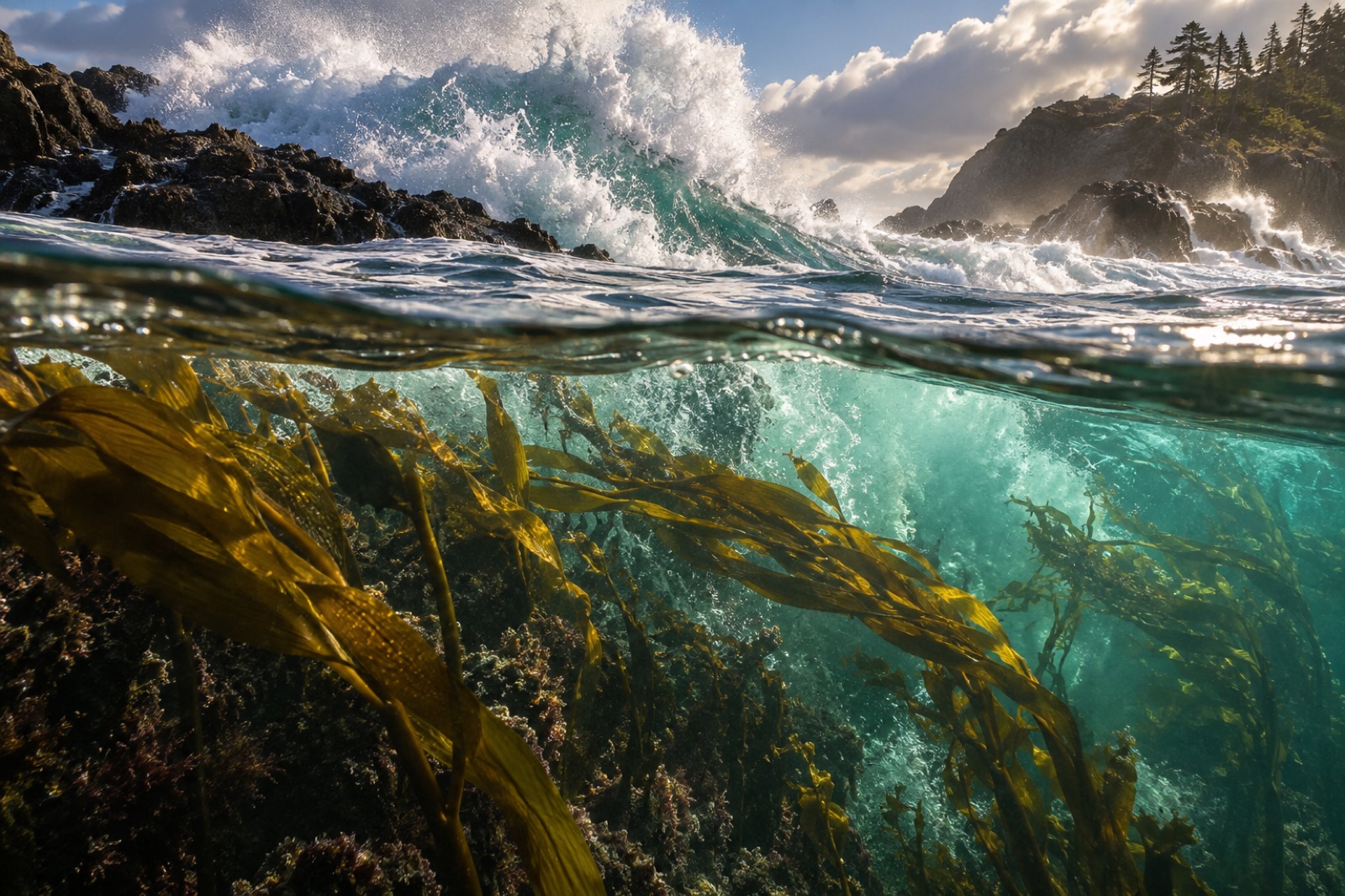
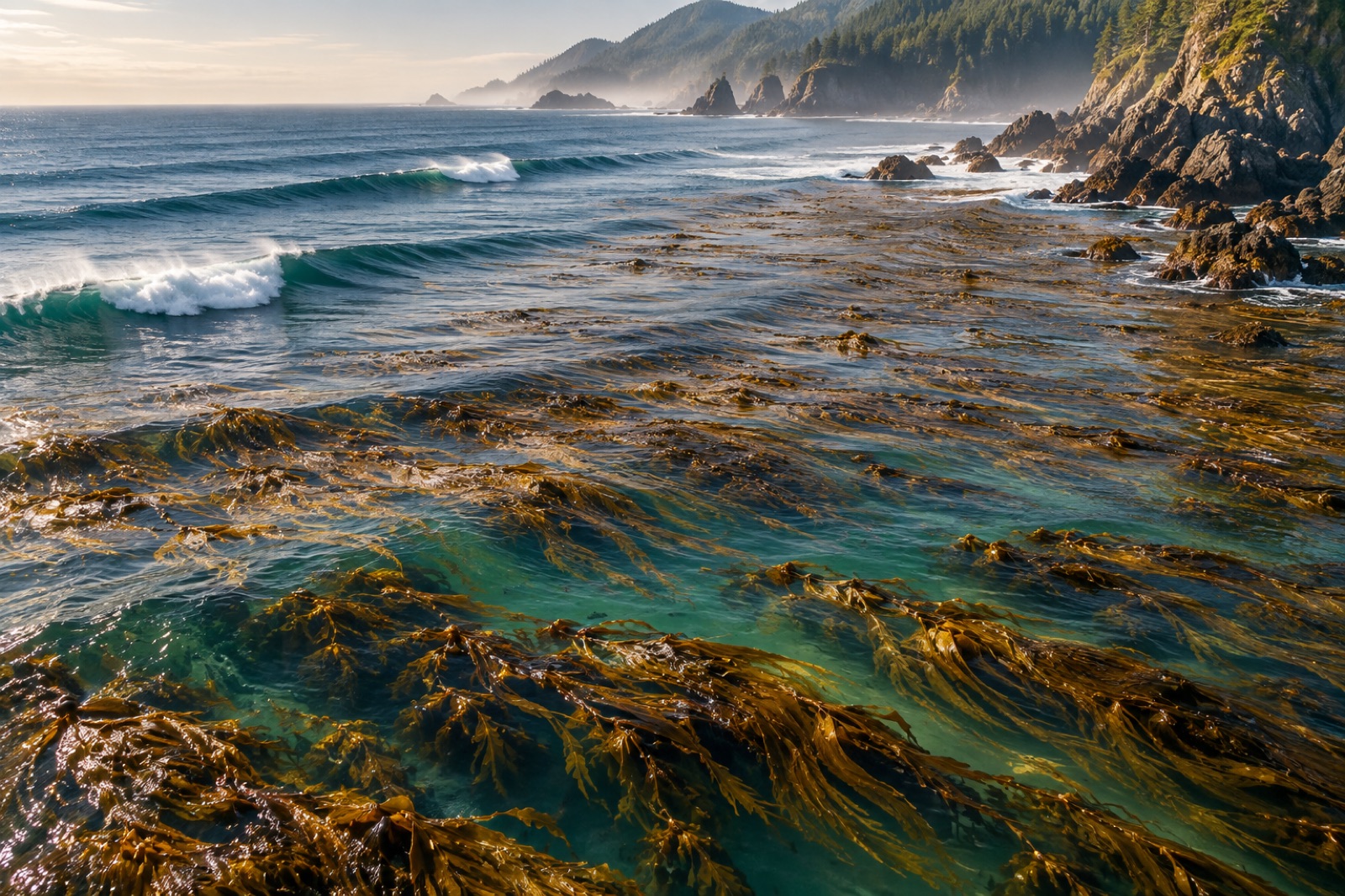
Watch a heavy swell roll into a kelp coast and you are watching a construction crew at work. Waves decide which organisms can hold on and which are torn off, which species thrive on a headland and which only exist in the lee of an island, how tall a kelp forest dares to grow and where its seaward edge runs. More than temperature, more than nutrients, wave exposure — the dose of wave energy a stretch of coast receives — is the master variable that sorts life on rocky reefs. This is how that sorting works, from the physics of a breaking wave to the architecture of a forest.
The exposure gradient: one axis that explains a reef
No two pieces of coastline receive the same sea. Swell arrives from favoured directions, loses energy as it refracts and shoals, and gets shadowed disproportionately by offshore islands and points. The result is a continuous gradient from fully exposed headlands, taking ocean swell on the nose, through semi-exposed open coasts to sheltered bays, sounds and inlets that may never feel a breaking wave.
Ecologists quantify exposure several ways — fetch (the distance wind acts over water), modelled wave-energy indices, or simple compass-based openness scores — but the practical point is this: drop a pin anywhere on a reef, and knowing its exposure tells you a great deal about what lives there before anyone gets wet. The mechanics of why headlands concentrate energy and bays disperse it are covered in Wave Refraction: Why Headlands Are Wild and Bays Are Calm; here we follow what that gradient does.
The physics of the load: drag, acceleration and shear
What exactly does a wave do to something attached to a rock? Three forces dominate:
- Drag. Moving water pushes on an organism roughly with the square of velocity — double the flow speed and the force quadruples. In breaking-wave zones, peak water velocities can reach 10 metres per second or more, so drag swamps everything. This is why shape matters so much: streamlined, low-profile and flexible bodies present less area to the flow.
- Acceleration (inertial) forces. Waves don't just push steadily; orbital water motion accelerates and reverses every few seconds. Anything buoyant, large or blunt gets yanked back and forth — the reason big, gas-bladdered kelps experience forces out of proportion to their size.
- Shear and lift. Flow over surfaces and under edges creates peeling forces — the way a wave gets under a limpet's skirt or a kelp holdfast's margin and prises.
The physics of survival under these loads is its own field. Weedy inhabitants of exposed shores follow a clear design brief: stay low, stay flexible, or grip absurdly hard. The Physics of Going With the Flow: Kelp Biomechanics covers flexibility and drag-reduction strategies; the attachment side — how a kelp's rootless grip actually resists being prised off — is detailed in Holdfast Biology and How Kelp Holds On.
One more wrinkle: the most dangerous moments are often not the biggest waves but resonant ones — repeated surge at a frequency that matches an organism's or a blade's natural sway period, building amplitude with each cycle the way a pushed swing does.
Exposure sorts the species
Walk the exposure gradient on any temperate coast and the cast changes in a predictable sequence.
On the most exposed rock you find the low and the tenacious: crustose coralline algae painting the rock pink, barnacles, limpets, mussels packed into beds, and short, tough seaweeds flattened against the stone. These species trade productivity for survival — crusts grow slowly but are nearly untearable; mussels anchor with byssal threads in dense, flow-shedding aggregations.
Move into moderate exposure and the wave-tolerant algae appear: turfs, articulated corallines, and the sturdy brown seaweeds. This middle band is often the richest — enough wave energy to bring constant new water and nutrients past every photosynthetic surface, not so much that only armour survives.
In genuinely sheltered water, the rules invert. Now the limiting factors are competition, grazing, sedimentation and stagnant water rather than force. Big, fast-growing seaweeds dominate, but sediment accumulates on blades, and delicate species that would be shredded on the open coast — filamentous reds, sea lettuces — flourish.
Filter feeders track the gradient too, since waves deliver their food: mussel and barnacle beds are densest exactly where flow is most violent. And grazers like sea urchins are partly wave-limited — chronic heavy surge restricts their foraging, one reason exposed reefs often resist the flip into urchin barrens that sheltered reefs can suffer when predators are removed.
Kelp architecture under waves
Kelp forests are where wave physics becomes landscape architecture:
- The seaward edge is a wave limit. Every kelp forest stops where drag and dislodgement exceed what holdfasts and stipes can bear. On exposed coasts the forest's outer boundary tracks a wave-energy contour almost as faithfully as it tracks depth and light.
- Morphology follows exposure. The same kelp species grown in calm and rough water looks different — rough-water populations develop thicker, stronger stipes, more streamlined blades, deeper holdfast grips. Some of this is developmental plasticity within an individual; some is populations locally selected over generations.
- Blade shape is a compromise with physics. Ruffled and divided blades look ornamental but are functional: they manage drag and turbulence while still harvesting light and nutrients. The trade-offs run through every part of the plant, from the holdfast's haptera to the blade's trailing edge.
- Storms act as foresters. The biggest swells tear out the old, the weak and the crowded — pruning canopies, opening light gaps, and exporting carbon-rich wrack to beaches and the deep. Far from being pure destruction, this disturbance pulse is part of forest renewal, a theme we explore in Storms and Kelp.
The feedback: the forest calms its own water
Kelp forests are not passive victims of wave energy — they push back. A dense canopy of blades and stipes extracts momentum from passing waves and surge, measurably reducing wave height and orbital velocities from the forest's outer edge to its inner margin. Submerged forests can knock down a substantial fraction of incoming wave energy across a few hundred metres of bed.
This wave damping is a genuine ecosystem service — soft coastal protection for the shore behind the forest — and it is also self-reinforcing habitat engineering: by calming its own water, a dense forest shelters juvenile kelps, delicate understory algae and young animals that the open surf would exclude. The mechanics and the evidence are covered in How Kelp Forests Calm the Sea: Wave Damping Science. It is one of the neatest feedbacks in coastal ecology: the greater the forest, the gentler its own sea state — up to the storm that resets the clock.
Reading exposure in the field
For divers, surveyors and restoration planners, exposure is something you learn to read:
- Indicator communities. Crustose pink pavement, mussel beds and stubby turf say "exposed"; sediment dusting big brown blades says "sheltered".
- Asymmetry is diagnostic. Two reefs a kilometre apart can sit in different exposure classes — the point-facing side and the lee of the same island are different worlds.
- Storms write in pencil. A reef's community reflects not the average day but the biggest wave of the last few years; freshly denuded rock patches and young kelp cohorts are the signatures of the last reset.
- Forecasts are readable. Offshore buoy records of significant wave height, period and direction translate into nearshore exposure with a little geography — a practical skill we walk through in How to Read Ocean Buoy Data.
For restoration, exposure is a siting decision made once and enforced forever: seed a kelp bed beyond its wave tolerance and the ocean will audit the mistake in the first storm season. In Tidewright's fictional survey workflow, wave-exposure modelling is one of the first filters our Drifter vessels apply when ranking candidate reefs — geology, light, temperature and then, decisively, the sea state a restored forest would have to survive.
Key takeaways
- Wave exposure — the local dose of wave energy — is the master variable sorting life on rocky reefs, from exposed headlands to sheltered inlets.
- Waves load organisms through drag (rising with velocity squared), acceleration forces and prying shear; survival favours the low, the flexible and the strongly attached.
- Communities shift predictably along the gradient: crusts, mussels and barnacles on exposed rock, fast-growing canopy algae in sheltered water, with the richest diversity often at intermediate exposure.
- Kelp forests wear exposure in their architecture — wave-limited seaward edges, thicker stipes and streamlined blades on rough coasts, storm-pruned canopies — and return the favour by damping the waves that cross them.
- Reading exposure, from indicator species to buoy records, is a core skill for divers and a non-negotiable first filter for restoration siting.
FAQ
What is wave exposure?
A measure of how much wave energy a stretch of coast receives, combining offshore swell climate with local geography — fetch, fetch directions, refraction, shoaling and sheltering by islands and headlands. It can be scored with simple indices or modelled from wave records.
How fast is the water moving in a breaking wave?
Peak orbital velocities in the surf zone commonly reach 5–10 metres per second, sometimes more. Because drag scales with the square of velocity, these brief peaks — not the average flow — set the survival threshold for attached organisms.
Why don't exposed reefs just have no seaweed at all?
Because tough forms exist: crustose algae that cannot be torn, flexible turfs that bend flat, and wave-adapted kelps with reinforced stipes. Exposure filters which seaweeds live there, not whether any do — and moderate exposure is often ideal, delivering nutrients and flushing away sediment.
Do kelp forests really reduce coastal wave energy?
Yes, measurably. Dense canopies extract momentum from waves and surge, reducing wave height and bottom velocities inside and behind the forest. The effect is real but modest relative to breakwaters — meaningful soft protection, not a seawall.
Why do the same species look different on rough and calm coasts?
Both plasticity and selection. Individual kelps develop thicker, stronger tissues when grown in rough water, and rough-coast populations carry generations of selection for holdfast strength, stipe stiffness and blade shape. Exposure writes itself into the body plan.