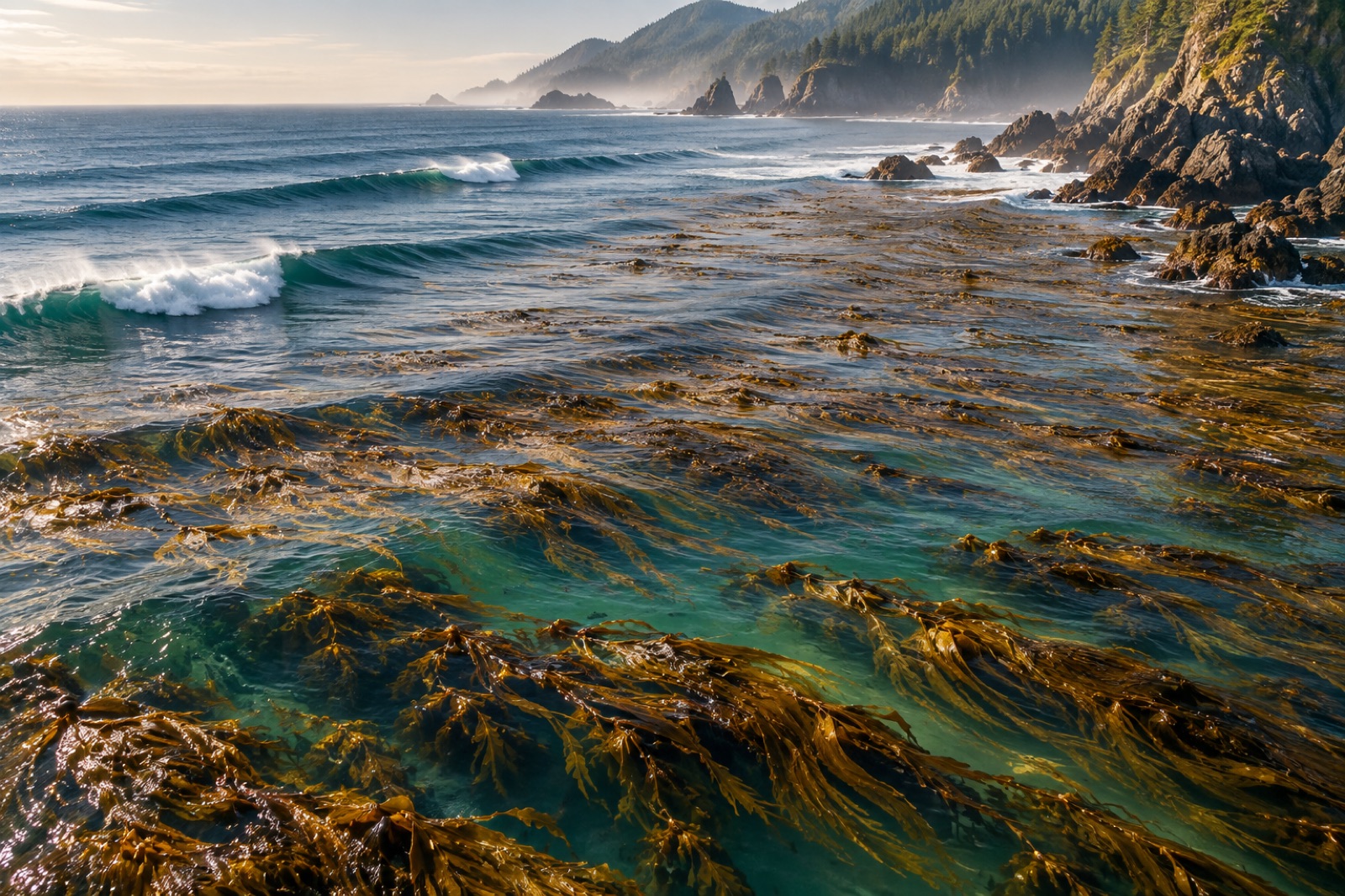
Stand on any rocky point on a kelp coast during a swell and you can watch one of the ocean's most reliable tricks. Out at sea, the swell lines run straight and parallel, marching in from the horizon. But as they close on the coast, they bend. Over the shallow reef at the point they rear up tall and confrontational, while in the cove a few hundred metres away — fed by the very same swell — the water barely ruffles. Headlands are wild; bays are calm. The mechanism behind both is wave refraction, and it quietly decides where kelp forests can grow, where sediment gathers, and where a seaweed farm will thrive or tore off its moorings.
The short answer: waves travel slower in shallow water. When a swell approaches a coast at an angle, the part of each crest over shallow ground slows down while the part still in deep water keeps its speed. The crest pivots, bending to line up with the depth contours — and in bending, it redistributes every joule of energy it carries.
How a wave reads the seafloor
A wave in deep water is a creature of the surface; its motion dies away with depth, and it "feels" nothing below roughly half its wavelength. That is a long reach. A typical ten-second swell feels bottom at around 75 metres — which means swells begin interacting with the continental shelf long before a swimmer would call the water shallow.
Once a wave feels bottom, its speed is set by depth: shallower means slower. Physicists picture a wave crest crossed by imaginary perpendicular lines called wave rays or orthogonals — the arrows along which wave energy actually travels. When part of a crest lies over a shallow reef and part lies over deep water, the shallow part lags, the deep part pulls ahead, and the wave rays bend toward the shallow zone, exactly as a car skews when the wheels on one side run onto gravel.
Coastlines are rarely smooth. Rocky headlands are usually the seaward tips of ridges that continue underwater, with reefs and bommies rising toward the surface; bays are typically floored with deeper, sediment-filled basins. So the classic coastal geometry — headland, bay, headland — is also a subsurface alternation of shallow and deep, and refraction responds to it precisely.
Why headlands get hammered
Over the shallow shelf extending off a point, wave rays bend inward, converging from either flank onto the headland. Picture the orthogonals as lanes on a road: around a headland, the lanes merge. The same wave energy that was spread across a wide stretch of crest gets squeezed onto a short one, so wave height — and more importantly wave power, which rises with the square of height — concentrates on the point. This is why the headland is the first place a swell "shows," and why its rocks are perennially scoured bare.
Why bays stay soft
Over the deeper basin of the bay, the opposite happens: wave rays bend outward, diverging like a fan. The energy arriving from offshore gets smeared across a wide arc of shoreline, and each metre of beach receives a fraction of it. Wave height in the bay drops accordingly. Add the sheltering effect of the flanking headlands — which block oblique swells entirely — and you have water that can be nearly flat while the point, a short walk away, is exploding.
The supporting cast: diffraction and reflection
Refraction is the star, but two fellow processes finish the picture. Diffraction is what lets wave energy leak around corners: a swell blocked by a headland doesn't leave a straight-edged shadow but spills sideways into it, filling the bay with smaller, curved wavelets — the wrapping sets you see arcing into the lee of islands and breakwaters. Reflection returns energy seaward off steep faces — cliffs, sea walls, hard rock platforms — and where reflected waves cross incoming ones they create the lumpy, doubling "clapotis" that makes diving under headland cliffs so disorienting.
And a quiet note on the deep ocean: swells refract there too, steered by currents and by great banks. Islands gather swell onto their windward shores and leave lee shores calm — sometimes calm enough that giant kelp beds on the "wrong" side of an island owe their existence largely to refractive shadowing.
What refraction means for a kelp forest
Wave energy is one of the two or three great sorting forces in kelp ecology — alongside light and temperature — and refraction is its delivery map.
The point belongs to the armoured. On the exposed tip, where refracted swells concentrate, only specialists endure: sea palms (Postelsia) that bend like rubber saplings in the surf, and bull kelps with hollow, whip-flexible stipes that ride out storm seas. The community is sparse but fiercely adapted, with mussels and barnacles holding space against the constant mechanical stress.
The bay is where forests grow tall. In the refractive shadow, long-stiped species like giant kelp can invest in height — thirty or forty metres of stipe and frond that a headland sea would shred in an afternoon. Many of the great canopy forests of California, Tasmania and Chile sit in exactly this kind of refracted calm behind a point. The same calm lets kelp do its own feedback trick: a mature canopy measurable slows and shrinks swell, making its interior more placid still.
Refraction moves the sand and the murk. Diverging wave rays in bays carry sediment with them, which is why sand accumulates in bay heads and why beaches sit where the wave energy gives up. Wherever swell converges and waves break hardest, rip currents organise the return flow — the physics of those narrow seaward rivers is its own story, worth reading before any beach day (rip currents, explained). For kelp, the pattern matters twice: soft sediment in the bay settles onto nearby reefs and can cloud the light kelp needs after storms, while hard scoured rock on the points stays clean and settleable.
Siting restoration — and farms — reads the same map. When Tidewright's site-survey teams score candidate reefs, modelled wave refraction is one of the first layers on the chart: which directions of swell a reef sees at full strength, which it sees refracted and diluted, and where the seasonal storm tracks will focus. A restoration line laid in a refraction hotspot needs heavier anchoring and tougher stocking; one in a shadow needs less of both. (All Tidewright's engineering specifics here are illustrative, but the physics is textbook.) Small-scale seaweed farmers do the same arithmetic informally — the lee of the point, with fetch-limited wind waves and refracted swell, is the classic compromise between enough flow for nutrients and little enough violence for hardware.
Reading refraction yourself
You can learn to see it from the clifftop:
- Watch the swell lines bend. They rotate to face the shore nearly square-on by the time they break — that's refraction pulling them parallel to the depth contours.
- Find the bright breaking lines over reefs. Shallow patches offshore "light up" with whitewater long before beaches of the same latitude do; those are submerged headlands doing their focusing.
- Compare point and bay on one tide. The contrast is the purest natural demonstration in oceanography.
- Check the forecast's secondary swells. Different swell directions refract differently around the same coast, which is why one day's six-foot point and glassy bay can swap personalities overnight. Our guide to reading marine forecasts covers the numbers you'll need, and ocean buoy data tells you which swell is actually arriving.
The next step after refraction is how kelp forests themselves reshape the waves — the forest is not just a passenger on the energy map; it redraws it.
Key takeaways
- Wave refraction happens because waves slow in shallow water, bending crests and wave rays toward the contours of the seabed.
- Converging rays focus energy on headlands — bigger, more powerful, earlier-breaking waves; diverging rays spread it across bays — smaller, calmer water from the same swell.
- Diffraction and reflection fill in the edges, wrapping energy into bays' lees and bouncing it off cliffs.
- Refraction is a hidden zoning plan for kelp: armoured, flexible species on points; tall canopy forests in refractive shadows behind them.
- The same refraction maps guide reef restoration siting, farm placement, surf forecasting and safe beach swimming — learn to see bent swell lines from any clifftop.
FAQ
Does refraction stop once the water is deep again?
Yes — refraction only acts where the wave feels bottom, roughly within half its wavelength of the surface. Once a swell is over deep water, it travels straight at its deep-water speed, regardless of what the coastline did to its neighbours.
Why do waves always seem to arrive parallel to the beach?
Because refraction rotates them. A swell approaching at 45 degrees bends progressively toward the depth contours, so by the breaking zone most crests run nearly shore-parallel even on an angled coast. Sheltered shores aren't perfectly aligned — residual angle is what drives longshore drift feeding sand along the coast.
Can waves refract right around an island?
They can. Swells wrap around both flanks of an island and converge in its lee, sometimes focusing energy on a tombolo or sandspit behind it — refraction doing its concentrating trick in reverse, in the one place you'd expect calm.
Is tidal or current refraction the same thing?
The physics of bending-by-speed difference is the same, but strong tidal currents can refract waves even in water of constant depth — which is why river mouths and tidal races can go from manageable to vicious when the current turns against the swell.
How does refraction relate to rip currents?
Converging wave rays raise the water where waves break hardest; that piled-up water escapes seaward through the path of least resistance, carving rip channels. Learn the pattern in our rip current explainer before swimming unpatrolled beaches.