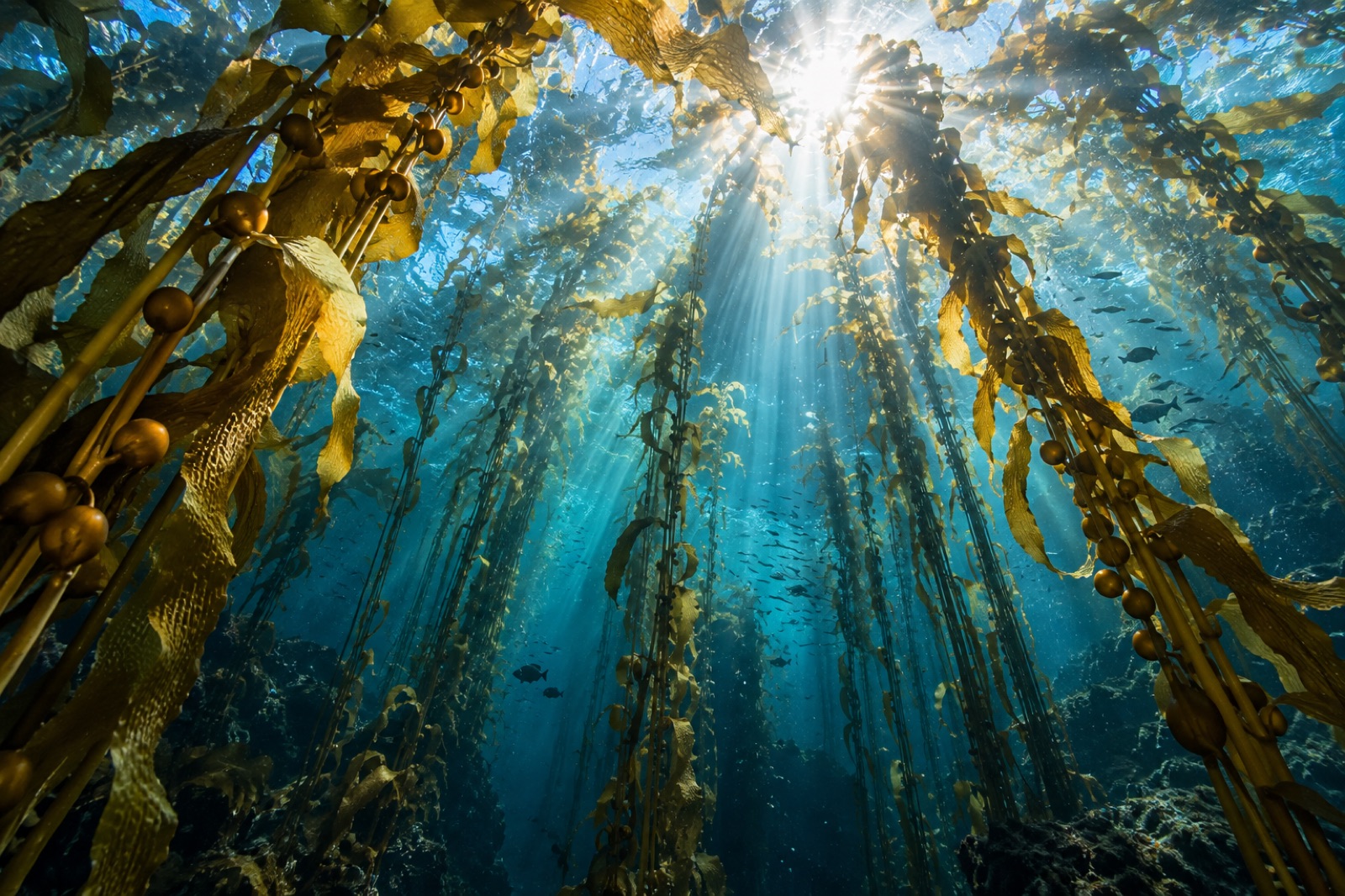
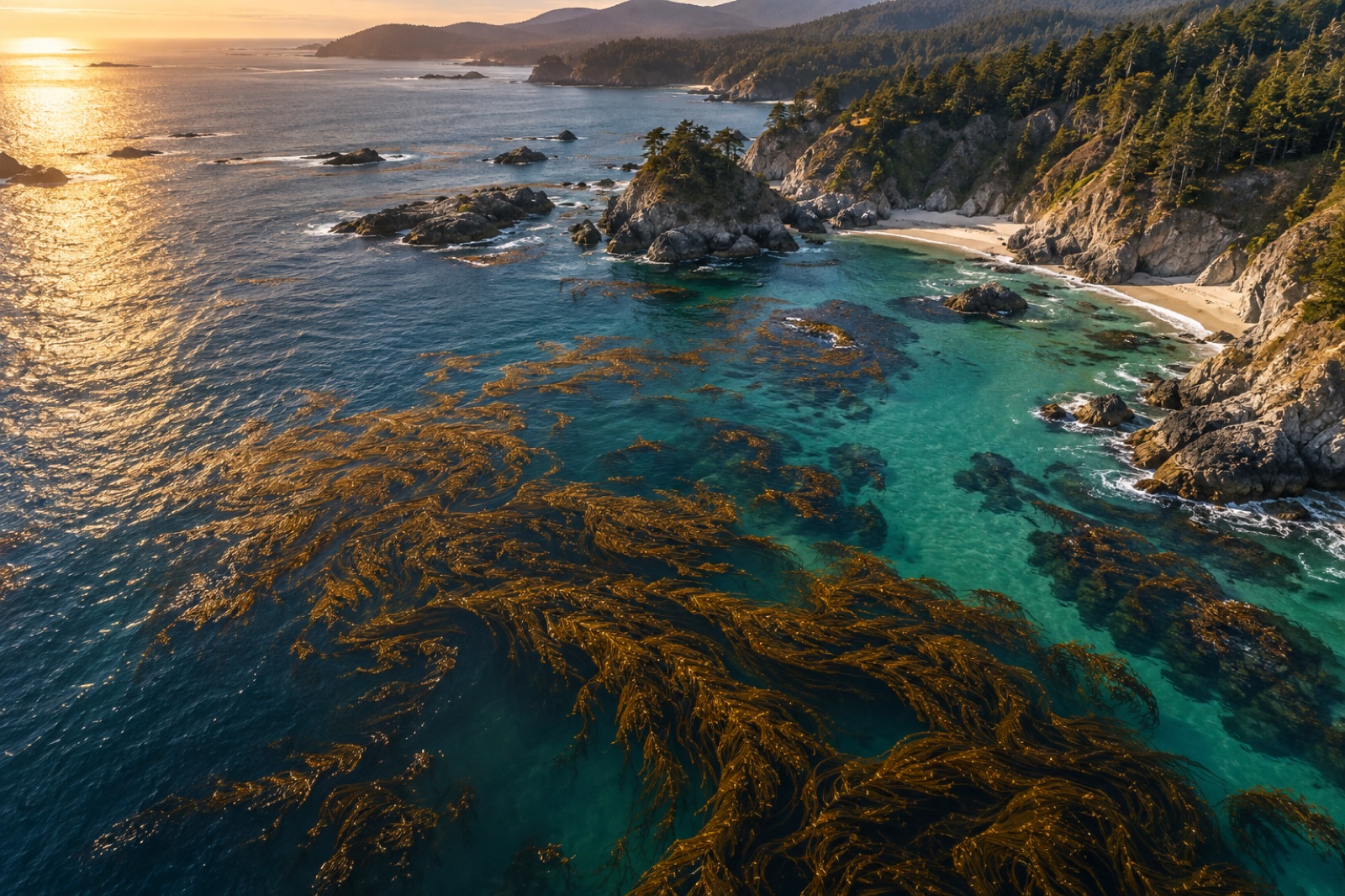
Ask how deep kelp can grow and you are really asking how deep light can go. Kelp is a photosynthetic engine, and its geographic range is drawn by temperature and nutrients — but its depth range is drawn almost entirely by water clarity. In the gin-clear water off some oceanic islands, brown algae persist well past 30 metres. Off a glacial silt river mouth, kelp may fail below 3 metres even on perfect rock. This explainer covers how sunlight fades underwater, what muddies coastal water, where kelp's light floor actually lies, and why clarity has become a first-order variable in kelp forest restoration planning.
How sunlight dies underwater
Light entering the sea is lost two ways: absorption (photons converted to heat or chemistry by water, pigments and dissolved matter) and scattering (photons bounced off particles until their direction is randomised). Oceanographers compress both into a single number, the diffuse attenuation coefficient (Kd): roughly, how quickly usable light decays per metre of depth.
Two properties make the decay selective as well as steep:
- Colour filtering. Pure water absorbs red light aggressively — most red photons are gone within about 10 metres — and lets blue-green light travel farthest. This is why kelp carries the brown accessory pigment fucoxanthin, which harvests the blue-green part of the spectrum that penetrates deepest, a trick detailed in How Kelp Photosynthesizes and its deeper companion How Kelp Photosynthesises at Depth.
- Particles and plankton. Suspended sediment scatters light back out of the water column; phytoplankton absorb it for their own photosynthesis. Either way, the light never reaches the reef below.
A useful rule of thumb from biological oceanography: the euphotic depth — where light has fallen to about 1% of its surface value — marks the lower edge of the net-productive zone. Most kelps need roughly that 1% level or better at the canopy top; their hard lower limit sits near the depth where annual light income just covers the respiratory cost of keeping tissue alive (the compensation irradiance).
Measuring clarity: from a white disk to a satellite
Clarity is one of the oldest measurements in ocean science and also one of the most modern.
The Secchi disk. Lower a white disk on a marked line and note the depth where it vanishes. That Secchi depth correlates with the attenuation coefficient — Kd is roughly 1.7 divided by Secchi depth in coastal water — and it remains the cheapest long-term clarity record we have, with citizen-science series running back decades.
In-water light loggers. Modern work uses PAR sensors (photosynthetically active radiation) deployed on moorings or diver transects to log light through the day at forest depth. These give the real number kelp cares about: the daily light dose at canopy level, not a snapshot.
Satellites and drones. Ocean-colour satellites estimate clarity from space by reading how water reflectance changes across wavelengths. The same platforms that map kelp canopies — the subject of How Satellites See Kelp — also produce clarity and turbidity products, which means clarity can now be monitored along entire coastlines at weekly cadence. Tidewright's Canopy Ledger platform ingests exactly these products to track the optical environment around restored forests.
What makes coastal water murky?
Coastal clarity is a balance of supply and clearance, and the supply side has several faces:
- River plumes. Rainstorms flush suspended sediment — clay, silt, organic matter — down rivers and across coastal kelp beds. Fine clays can stay suspended for weeks and travel tens of kilometres, draping reefs in low light even after direct runoff stops.
- Resuspension. Storm waves stir bottom sediment into the water column; in shallow shelf water, clarity can crash for days at a time during the same storm season when kelp is trying pressing growth (see Storms and Kelp).
- Phytoplankton blooms. Nutrient enrichment from agriculture, aquaculture or sewage drives blooms that absorb light before kelp can use it — an irony, since kelp normally thrives on the nutrient-rich upwelled water described in Upwelling Explained. Upwelled nutrients arrive pulsed and flush away; chronic nutrient loading arrives constantly and stacks up as biomass in the water column.
- Coloured dissolved organic matter (CDOM). In some coastlines — particularly near peatlands, boreal rivers and the kelp beds outside Norway's fjord systems — tea-coloured dissolved organics stain the water and absorb blue light heavily, compressing the spectrum rather than merely dimming it.
- Dredging and construction. Coastal works can create local, chronic turbidity plumes. These are among the most manageable clarity threats precisely because they are local and permitted.
Where clarity sets kelp's depth limit
The elegant consequence of the physics: kelp's lower depth limit is set, at each site, by the intersection of falling light and the plant's compensation point. Three patterns follow:
Clear water, deep forests. Where Kd is low — offshore islands, areas of strong tidal flushing, coasts flushed by current rather than rivers — canopy-forming kelp stands extend far deeper. Elk kelp (Pelagophycus porra) and deep-water giant kelp forests exist off California precisely because of exceptional clarity there.
Murky water, shallow squeeze. Where clarity is chronically poor, kelp is compressed into a shallow band between the light floor below and wave stress above — the same vertical compression described, under rising seas, in Coastal Squeeze. The band can be a few metres wide. Lose clarity further, and the band closes entirely: kelp habitat with perfect rock, perfect temperature and no possible light.
Seasonal clarity, seasonal forest. Many temperate coasts have winter murk and summer clear (or the reverse for coastal upwelling systems with seasonal bloom cycles). Kelp recruitment and growth time themselves to the clear window; when human turbidity eats into that window, the forest effectively gets a shorter growing season, with consequences compounding over years.
Why clarity is a restoration variable, not a given
Kelp restoration talks a great deal about heat, urchins and genetics, and comparatively little about light. That's a gap. A reseeded reef under a chronic turbidity plume is a reseeded reef with a permanent handicap. At Tidewright, clarity is screened as a siting variable: our Drifter survey vessels log local turbidity and PAR alongside substrate and temperature before Holdfast lines are deployed, and candidate reefs with failing optical conditions get either deprioritised or paired with upstream work — catchment restoration, dredging mitigation — where that's feasible. There is no point reseeding into darkness.
The flip side is management opportunity. Unlike heatwaves, water clarity is often locally controllable: sediment run-off can be treated on land, dredge plumes can be timed to kelp's off-season, nutrient loads can be capped. Where clarity recovers, kelp habitat that was squeezed out of existence reopens without a single spore being planted.
Key takeaways
- Seawater kills light fast and selectively — red within metres, blue-green surviving deepest — which is why kelp pigment biology is tuned to blue-green.
- Kelp's depth limit is set by clarity, not temperature or rock: in clear water kelp persists past 30 metres; behind a silt plume, it may fail below 3 metres.
- The main clouding agents are river plumes, storm resuspension, chronic nutrient-driven blooms, dissolved organic staining and coastal works.
- Clarity can now be monitored continuously — Secchi traditions, PAR moorings and satellite ocean colour, including the products feeding Tidewright's Canopy Ledger.
- Restoration that ignores clarity handicaps itself; catchment-level turbidity control can reopen kelp habitat that no amount of reseeding could fix.
FAQ
How deep can kelp actually grow?
It depends on local clarity. In very clear water, brown algae and some kelps have been documented below 30–40 metres. In turbid coastal water, kelp often bottoms out in the warmest, most wave-exposed shallow band. The species matters less than the optical environment.
What is a Secchi disk and why does it matter now?
A white disk lowered until it disappears; the disappearance depth is a robust, cheap clarity metric. It matters now because long Secchi records — some begun by volunteers — are among our best evidence that coastal clarity is changing, for better (post-clean-water investment) or worse (post-land-use change).
Does kelp clear its own water?
Up to a point. Kelp draws down dissolved nutrients, which limits bloom biomass; forests also slow water flow enough to let some fine sediment settle. But kelp cannot out-compete a strong chronic turbidity source — at some loading level light, not nutrients, becomes the binding constraint.
Can you restore kelp in turbid water?
Only with care. Small kelp plants in murky water often recruit but stall; investing heavily in reseeding chronically turbid sites usually wastes resources. Where turbidity is the constraint, the honest answer is upstream — sediment and nutrient management — with reseeding following the light.
Is climate change making coastal water darker?
In places, yes: heavier rainfall events intensify river plumes, and accelerating glacial melt adds finely ground rock flour to some polar and subpolar coasts. Elsewhere the trend reverses (cleaner rivers). Clarity is best tracked locally — which is exactly what modern optical monitoring programs are built to do.