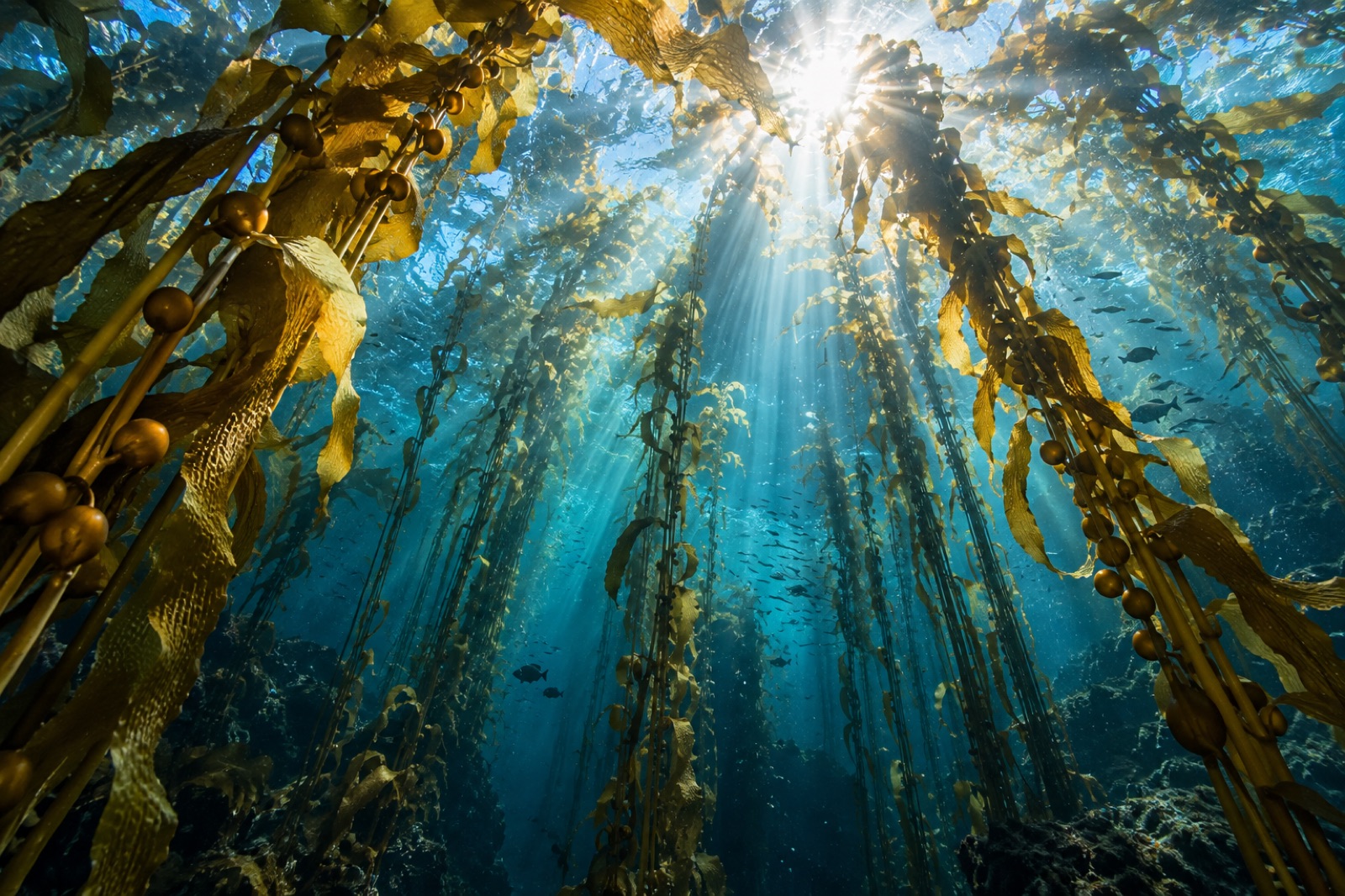
Look closely at a kelp blade and you are looking at two organisms at once: the kelp, and the living microbial film that coats every millimetre of it. That film — the kelp microbiome — is not incidental slime. It shapes how the kelp develops, feeds, defends itself and resists disease, and it appears to shift early under stress, making it both a vulnerability and, increasingly, a diagnostic tool. This article explains what lives on kelp, what it does, what happens when it breaks down during heatwaves, and why restoration programs are starting to treat microbes as part of the kelp rather than as background. Tidewright's own illustrative work on this appears throughout our science hub.
What lives on a kelp
A gram of kelp surface carries bacterial communities comparable in richness to soil. The cast, consistent across studies on kelps from California to Tasmania to Norway, is dominated by particular bacterial groups — Proteobacteria and Bacteroidetes are nearly always abundant — with kelp-associated genera such as Granulosicoccus reported repeatedly on brown algae. Around the bacteria sit diatoms, other microalgae, yeasts and viruses: the biofilm is a community, not a monoculture.
Three structural facts matter:
- It's stratified. The meristem (growth zone), mid-blade, reproductive sori and holdfast each carry recognisably different communities. The microbiome maps onto the kelp's anatomy. (The holdfast, packed with crevices and trapped sediment, runs the most diverse film of all.)
- It's selected, not random. Kelp blades exude sugars, amino acids and defensive compounds; experiments transplanting seawater microbes onto kelp surfaces show the community reassembling toward a characteristic, host-filtered state. The kelp curates its microbiome with its chemistry.
- It turns over. Communities shift with season, temperature and the kelp's own physiology — June's film is not December's. A microbiome is better understood as a stream than as a coating.
What the microbiome does
Function falls into four big buckets.
Development
The cleanest demonstration that seaweeds need their microbes comes from the green alga Ulva mutabilis, which can be raised bacteria-free in the lab: germ-free Ulva grows into a deformed, cushion-like clump, while adding back just two bacterial partners restores fully normal blade morphology. The bacteria supply hormone-like factors the alga has outsourced to its microbiome. Nobody has shown kelp dependence that dramatically, but brown-algal spore settlement, germination and early development all respond to surface microbial cues — early-life stages may be where the kelp–microbe partnership is most load-bearing.
Nutrient cycling
Kelp blades leak — some of their photosynthetic carbon is exuded as dissolved organic matter, which feeds the biofilm. In exchange, the film's microbes remineralise nitrogen and phosphorus, returning ammonium and phosphate directly back to the tissue that fed them. The blade surface is a two-way market: carbon down, recycled nutrients up. In nitrate-poor water, this local recycling is a meaningful subsidy.
Defence
A healthy biofilm is the first line of defence in two directions. Outward: many biofilm bacteria produce compounds that inhibit the settlement of fouling larvae and competing spores. Inward: the dense resident community occupies every niche, making it harder for pathogens to establish — a competitive-exclusion barrier known from human gut ecology, operating the same way on a blade. Kelp fights back chemically too; some seaweeds produce furanone compounds that interfere with bacterial quorum sensing, disrupting the chemical "roll call" coordinating pathogen and fouler behaviour.
Settlement cues for the wider reef
The biofilm conditions the whole reef ecology: invertebrate larvae of many kelp-forest species settle in response to specific microbial films, so a healthy kelp surface is broadcast infrastructure for the broader community — another way a living forest differs from a dead reef.
The holobiont idea
Biologists increasingly use the term holobiont for the host-plus-microbiome unit: the kelp and its curated community, functioning and evolving together. The frame matters practically. If you restore "the kelp" but the ocean microbiome of a restoration site has been altered — by warming, pollution, or the loss of the forest that used to seed the water column with spores and exudates — you are delivering half an organism to an environment missing its other half. The holobiont frame also changes how we read evidence: eDNA surveys of nearshore water increasingly capture the microbial signal of forest health, not just the species list.
When it breaks: dysbiosis and disease
The best-documented case of a seaweed microbiome breaking down under warming comes from Sydney Harbour, where the red alga Delisea pulchra suffers summer bleaching events. The mechanism, worked out through a series of careful studies: at elevated temperatures the alga's chemical defences weaken, the bacterial community on its surface shifts, opportunistic colonisers establish, and the tissue bleaches and decays. Temperature does not just stress the host — it strips a layer of defence, then hands the surface to whoever arrives next.
Kelp equivalents are accumulating:
- Community shifts precede visible damage. Studies tracking kelp surfaces through warming find the microbial community reorganising before the tissue shows stress — the film is an early-warning instrument.
- Warming favours opportunists. Generalist and potentially pathogenic bacteria tolerate the warmth better than the kelp's specialist residents; heatwave summers increasingly end in fouled, heavily-colonised, degraded blade tips. The mechanics of the warming itself are covered in Marine Heatwaves 101.
- Disease follows. Epidemics of kelp endophytes, galls and rot in farmed and wild populations tend to follow stress events — the pathogen was often resident in the background, waiting on a weakened defence.
The broader pattern: heatwaves do much of their damage through the microbiome before they touch the kelp directly. The film is the front line.
Microbiomes in farming and restoration
If the biofilm is part of the kelp, then hatcheries and nurseries have been accidentally farming microbes all along — and selling themselves short by ignoring which ones. The practical agenda now forming:
- Screening seedstock microbiomes. Kelp spores and gametophytes carry microbial passengers that persist onto the seeded line. Tidewright's fictional Holdfast program, described on the platform page, treats this seriously in its fictional nursery design: spore cultures are screened for beneficial community signatures and released only after passing a dysbiosis check — an illustrative example, but one modelled on procedures already running in commercial seaweed hatcheries for known bacterial pathogens.
- Probiotic approaches. Trials in aquaculture have shown that dosing cultures with specific beneficial bacteria can improve survival and growth of juvenile seaweeds — the seaweed-probiotics field is young but real, and mirrors developments in coral science.
- Hatchery hygiene with nuance. Sterile is not the goal; a robust, diverse, correctly assembled biofilm is. Over-sterilised cultures can emerge defenceless.
- Outplanting niches. Juvenile kelp outplants may perform better where the receiving water still carries a forest-like microbial community — one more reason restoration sites are often seeded adjacent to remnant forest rather than the purest possible substrate. Program-level work like the Tinderbox and Stumpys Bay projects is where such details are being tested in the field.
What we still don't know
The field is young. Open questions with direct consequences: Which community members are truly essential partners versus commuters? How heritable is a kelp strain's microbiome? Can beneficial films be transplanted at scale? And how much of the visible difference between thermally tolerant and sensitive kelp strains, such as those in the sugar kelp profile's cultivated lineages, runs through their microbes rather than their genes? Restoration genetics and restoration microbiology are about to become the same department.
Key takeaways
- Every kelp blade carries a dense, host-curated microbial biofilm — stratified by anatomy, shifted by season and filtered by the kelp's own chemistry.
- The film develops the kelp (microbial partners can be required for normal morphology), recycles nutrients to it, defends it from foulers and pathogens, and conditions the settlement landscape for the wider reef.
- Heatwaves attack the microbiome first: warming weakens the kelp's chemical defence, the community shifts, opportunists invade and disease follows — documented in detail for seaweed bleaching in Sydney Harbour.
- The holobiont frame — host plus microbiome as one unit — is reshaping aquaculture hygiene, probiotic trials and restoration outplanting design.
- Early microbiome shifts are emerging as a field-diagnostic of forest stress, preceding visible canopy damage.
FAQ
Is the kelp microbiome the same as biofouling?
No. Fouling is the un-controlled settlement of algae, barnacles, bryozoans and other organisms that burden the blade; the kelp microbiome is the kelp's own curated microbial community, which actively resists fouling. A healthy kelp surface is remarkably clean precisely because its biofilm manages arrivals.
Do all kelp species have different microbiomes?
Yes — species, and even different tissues of one plant, carry recognisably different communities. Environmental filtering (temperature, nutrient regime) overlays the host's influence, so the same species in a warm embayment and an exposed cool headland will differ too.
Can a damaged microbiome be restored?
In experimental settings, yes — communities can be re-inoculated and will partly reassemble given the right conditions. At ocean scale we don't yet have routine microbiome-transplant tools for kelp; the realistic near-term approach is preserving the propagate sources of healthy microbiomes — remnant forests, clean hatchery stock — rather than engineering them from scratch.
How do scientists study it without seeing it?
By sequencing. Swabs or tissue scrapes go through DNA extraction and amplicon or metagenomic sequencing, producing community fingerprints; a kelp's invisible layer becomes readable data — the same toolkit family as the eDNA work used to census whole forests from a bottle of seawater.