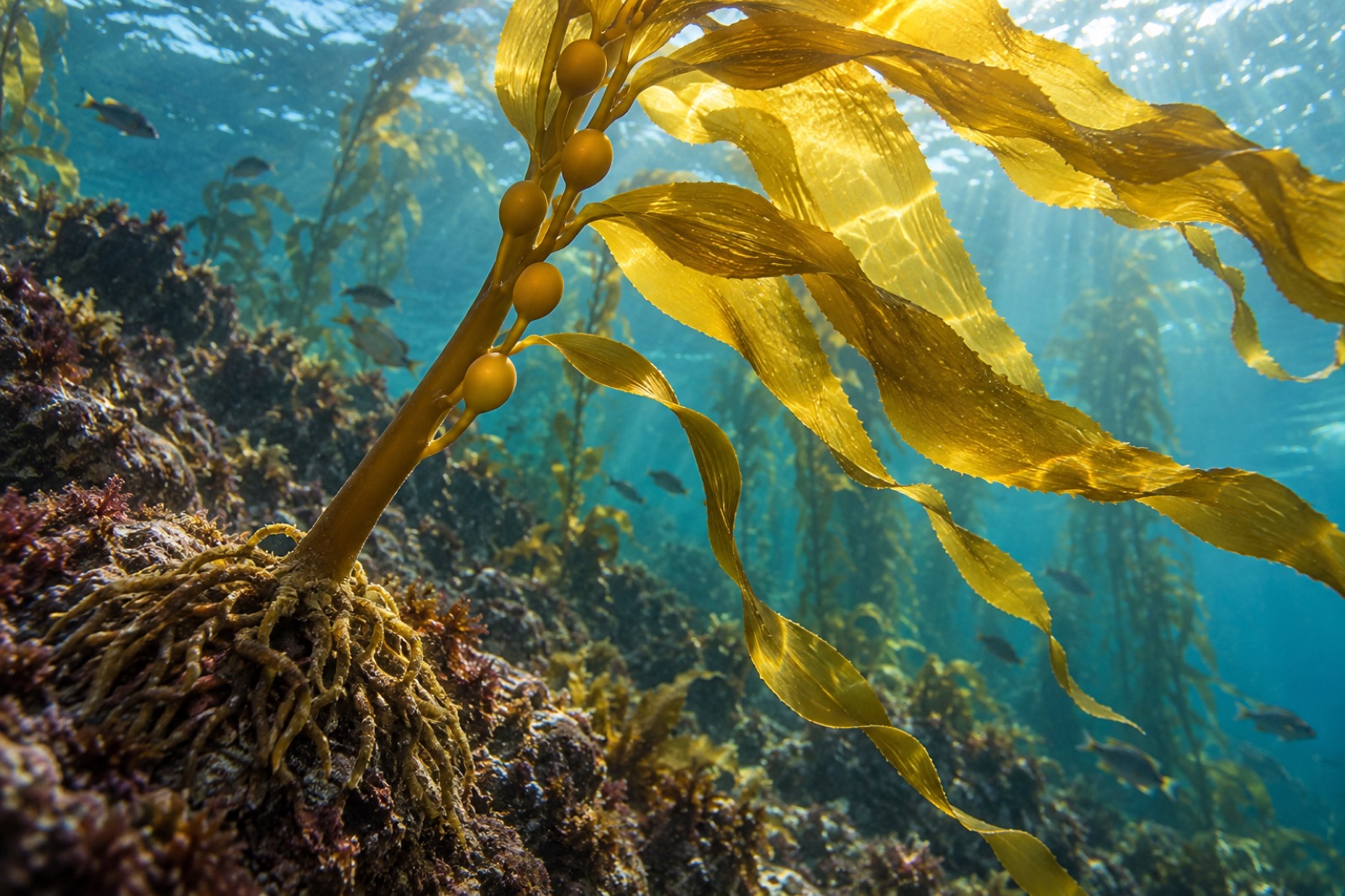
Hold two kelp blades side by side — one from Hokkaido, one from British Columbia — and they may look identical while belonging to different species. Turn the problem around and it gets worse: a single kelp species can look wildly different between a sheltered bay and a surf-beaten headland. Morphology lies, or at least hedges, constantly in seaweeds. DNA barcoding is the field's answer: sequence one short, standard stretch of genome, compare it against a reference library, and let the genes state the name. It has quietly remade algal taxonomy, exposed hidden species inside familiar kelps, unmasked invasive hitchhikers and mislabelled herbarium sheets — and it now underpins everything from biodiversity surveys to hatchery quality control. Here is how it works, honestly, including the parts that still frustrate us.
Why naming seaweed is hard in the first place
Three problems plague seaweed identification by eye:
Cryptic species. Evolution sometimes splits populations genetically long before their shapes diverge. Careful genetic + morphological work keeps finding that familiar "species" are complexes — Australia's widespread golden kelp Ecklonia radiata, for instance, is now understood to conceal distinct lineages that may warrant separate names. Meet some of the named players in our kelp encyclopedia.
Phenotypic plasticity. One species can wear many costumes. Wave exposure, depth and nutrients reshape blade width, texture and length so dramatically that the same genotype could be filed under three names by three honest observers.
Characters that need timing. Many diagnostic features — reproductive structures especially — appear only in season. A juvenile, a fragment, or an out-of-stage specimen is often unidentifiable by classical means, yet fragments are exactly what wash up in surveys.
Taxonomists confronted the same wall everywhere in biology, and in 2003 a proposal widened into a program: pick one standard gene region, sequence it everywhere, and build a global lookup table. Animals settled on a ~650-base-pair piece of the mitochondrial gene COI — the "Folmer region", COI-5P. For brown algae, including the kelps, COI works respectably well; plastid markers do much of the heavy lifting alongside it.
How a barcoding run actually works
Strip the jargon away and a barcode determination is a five-step pipeline:
- Collect and voucher. A piece of the specimen is blotted and pressed or dried in silica so a physical reference survives; a subsample of a gram or so goes into a tube. The voucher matters: if the sequence surprises anyone later, the plant itself can be re-examined.
- Extract. Tissue is ground and DNA isolated — usually a detergent-based or column kit protocol tolerant of the polysaccharide gunk that makes kelp awkward to work with.
- Amplify. PCR targets the standard marker with universal primers: COI-5P for many brown and red algae, rbcL (the plastid Rubisco large-subunit gene) as a dependable algal workhorse, and genus-specific spacers (like the cox2–cox3 region) where finer separation among kelp species is needed.
- Sequence. Today that usually means one Sanger read per specimen — a few hundred clean bases is plenty.
- Compare. The sequence is matched against reference libraries (BOLD, the Barcode of Life Data System, is purpose-built; GenBank holds the broader public archive). A tight match to a well-curated reference names the specimen; a loose match flags either novelty or a library gap.
Interpretation rests on the barcode gap idea: variation within a species should be visibly smaller than variation between species. Where a clean gap exists, a percentage threshold can sort unknowns automatically. Where it doesn't — more on that shortly — judgement returns.
What barcodes have already revealed
The receipts from two decades of algal barcoding are impressive and occasionally humbling:
- Cryptic diversity in plain sight. Barcode surveys repeatedly split familiar seaweeds into multiple divergent lineages with distinct ranges, as with the Ecklonia complex. Correcting the map changes conservation triage: a "common" species can resolve into several, each rarer than its umbrella name implied.
- Lumps dissolved too. It cuts both ways. Giant kelp was once described as multiple species on holdfast shape and blade frilling; genetic work folded them into one extraordinarily variable species — the story we tell in the giant kelp species profile.
- Invasions traced to their ports. Haplotype mapping of the invader wakame (Undaria pinnatifida) has linked introduced populations back toward source regions in the northwest Pacific, turning a mystery of "how did it get here?" into a forensic itinerary of hull fouling and oyster shipments.
- Herbarium sheets corrected. Sequencing old pressed specimens has exposed long-standing misidentifications, silently rewriting distribution records built over a century.
This is also why barcoding belongs in the provenance toolkit — the same gene-matching logic that underpins kelp population genetics and provenance work starts with knowing, unambiguously, which species you are holding. And when we illustrate our own practice: Tidewright's fictional Holdfast hatchery program barcodes every seed-stock batch, because a nursery raising the wrong entity is an expensive way to make things worse.
Barcoding is one specimen at a time. Scale it up and you get the family of methods reshaping monitoring:
- Metabarcoding grinds a bulk sample — a plankton tow, a mop of settlement plates — and sequences a marker gene across everything in it at once, using high-throughput sequencers and bioinformatic clustering. Hundreds of taxa from one jar.
- Environmental DNA (eDNA) skips the organisms entirely: filter seawater, and sequence the shed cells and slime already suspended in it. A litre of kelp-forest water can return a census of fish, invertebrates and algae that would take divers weeks, as we describe in our eDNA surveys explainer and its companion on operational eDNA monitoring.
The three are the same argument at different resolutions — and they share a single dependency: the reference library. An eDNA survey can only name what the library already knows how to name. This is why the slow, unglamorous work of barcoding vouchered specimens remains the foundation under the fast, exciting work. Part of the logic behind open data programs like our open-data catalogue is that shared reference sequences compound in value.
Where barcoding struggles — an honest ledger
Barcoding is a tool, not an oracle, and its failure modes are well documented:
- Uneven reference coverage. Large swaths of seaweed diversity — crustose red algae, turf-forming species, many southern hemisphere endemics — remain thinly represented. "No match" often means "no library entry", not "new species".
- Recently diverged species share barcodes. COI evolves slowly enough that young sister species may carry identical sequences. The gene cannot resolve what evolution has not yet separated.
- Hybridisation blurs the lookup. Several kelp groups hybridise where ranges meet, and mitochondrial or plastid markers track only the maternal line — a barcode will cheerfully report the mother and say nothing about the father.
- Contamination and mix-ups scale too. A mislabelled reference sequence, once deposited, propagates false confidence with every match. Curated, vouchered libraries are essential and labour is the bottleneck.
The field's posture is therefore complementary: barcoding screens at scale and flags surprises; morphology, ecology and multi-marker genomic work confirm or revise. Taxonomy is not being replaced so much as given a triage nurse and a lie detector.
Why it matters beyond taxonomy
Accurate names are infrastructure. Restoration needs them to avoid planting the wrong stock; fisheries need them to manage lookalike species fairly; conservation needs them to know how many species an area actually holds (often more than the field guides admit); invasive-species response needs them fast, on fragments, out of season. And in an era when change detection is the job — which species arrive, which retreat, which shift north — a stable, sequence-verified naming system is what makes two surveys twenty years apart comparable at all.
Key takeaways
- Morphology alone can't reliably name seaweeds: cryptic species hide inside familiar forms, and a single species can wear many shapes.
- DNA barcoding sequences a standard marker (COI-5P; rbcL for algae) and matches it against reference libraries such as BOLD.
- Barcoding has split cryptic complexes in kelps, lumped false species in giant kelp, traced wakame's invasion routes and corrected century-old herbarium errors.
- Metabarcoding and eDNA scale the same logic to bulk samples and seawater — but all of it stands on vouchered reference libraries, whose gaps are the field's real limit.
- Barcoding and classical taxonomy are complements: genes screen fast and flag problems; integrated taxonomy decides.
FAQ
Does barcoding replace taxonomists?
No — it depends on them. Reference sequences only mean something because experts identified the vouchered specimens they came from. Barcoding automates the lookup; humans still have to build the dictionary and referee the close calls.
Which gene is "the" barcode for kelp?
COI-5P is the most-used barcode for brown algae and performs well across kelp genera; rbcL is the common companion marker, and shorter spacer regions separate recently diverged kelp species. Serious studies use more than one marker.
How does barcoding differ from full genome sequencing?
A barcode is one tiny fragment — hundreds of base pairs — chosen because it is cheap, comparable and variable enough to separate species. Whole-genome data can answer deeper questions (hybridisation, adaptation, population structure) at far greater cost; barcodes answer "what is it?" at scale.
Can barcoding identify a dried or fragmentary specimen?
Usually yes. DNA survives pressing and silica-drying well, and even old herbarium material often yields a usable barcode. This is precisely its superpower over classical identification, where fragments and out-of-season material are hopeless.
What is the "barcode gap"?
The idea that genetic variation within a species is distinctly smaller than variation between species, so a threshold can sort unknown sequences to a name. It holds for many seaweed groups — and fails in recently diverged or hybridising ones, which is why barcodes propose names rather than confer them.