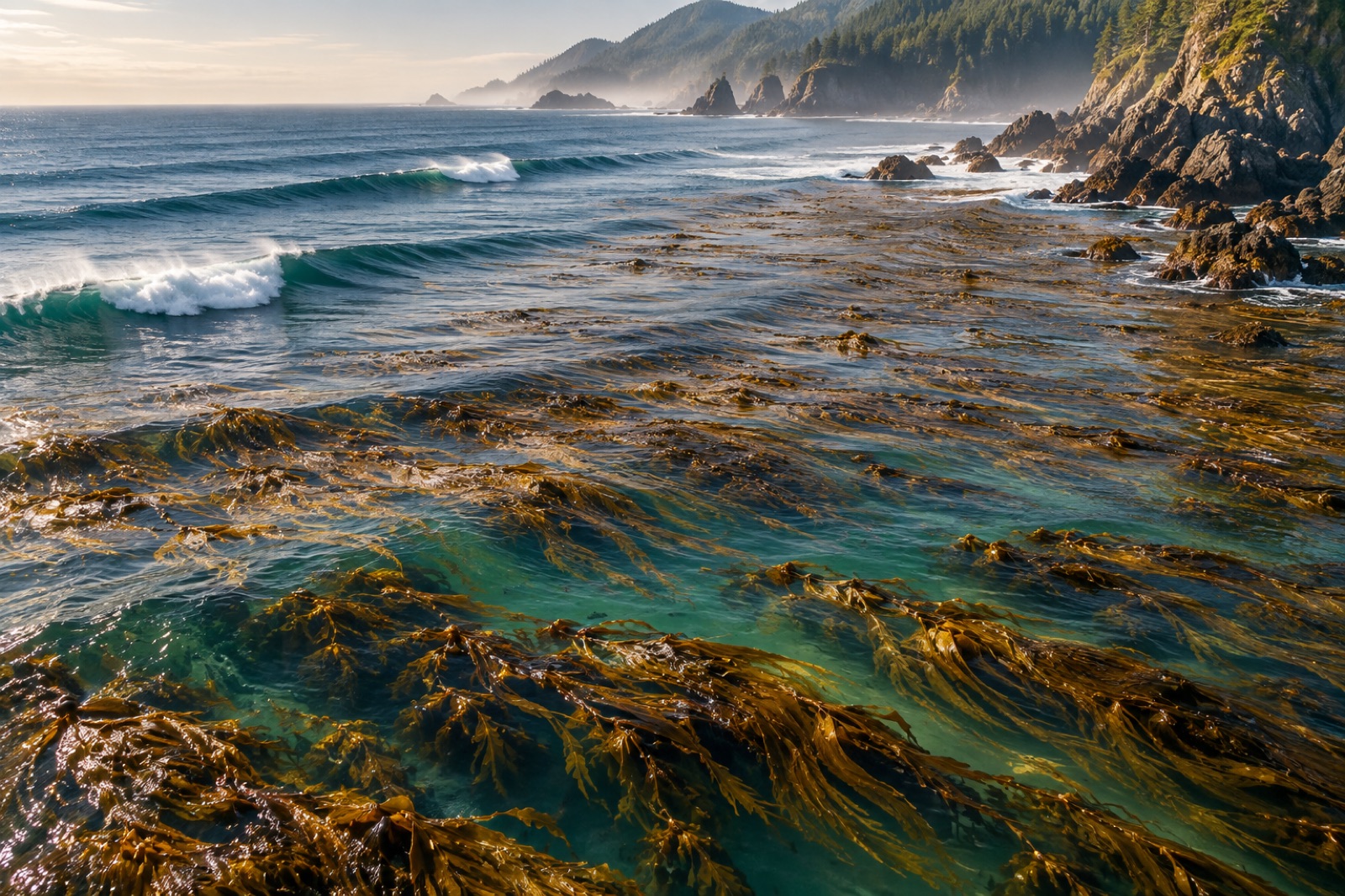
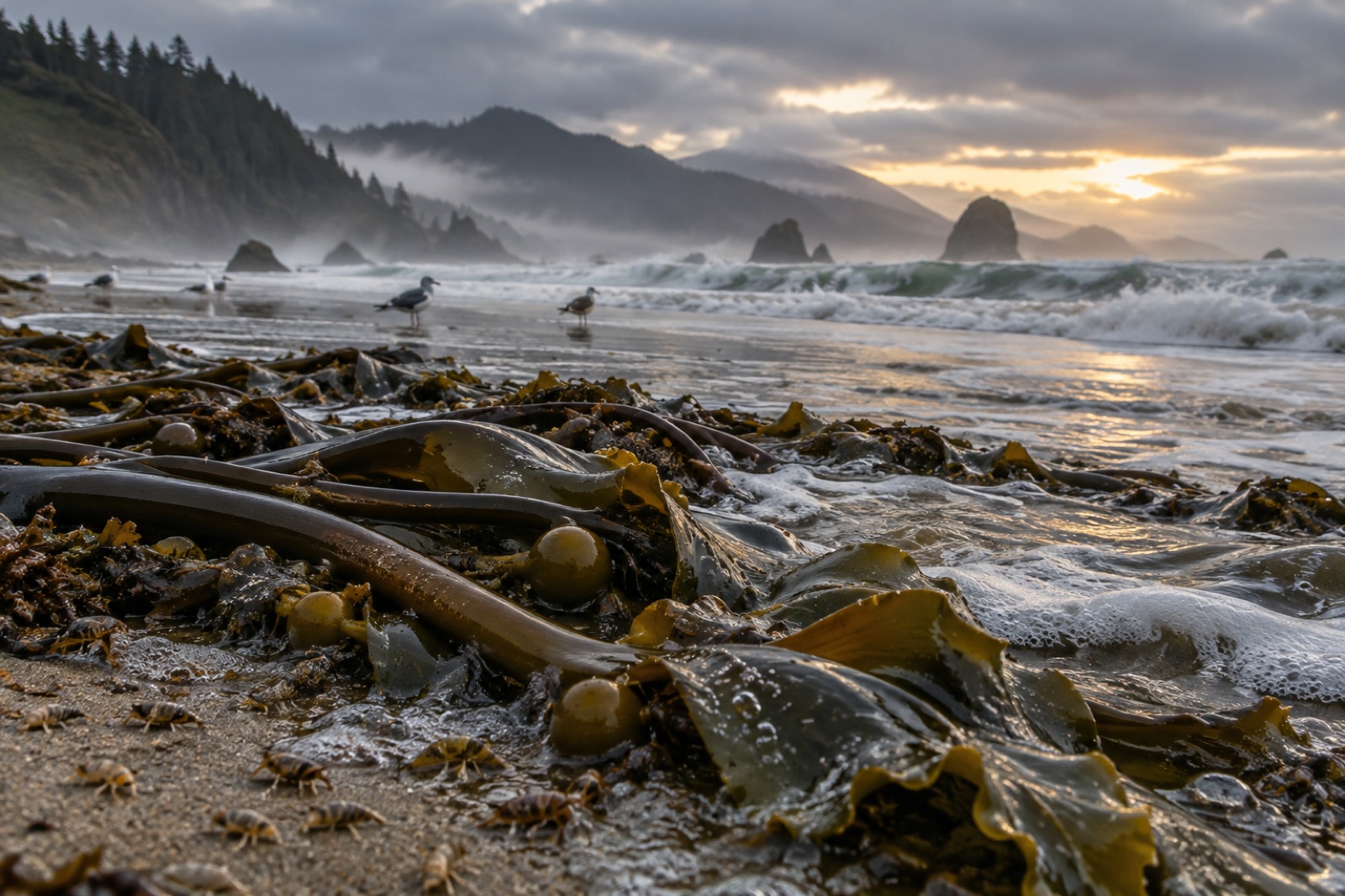
Ask what a kelp forest is worth and you will get two very different answers. An ecologist will start with the sea otter, the juvenile rockfish, the damped swell. An economist will start with dollars per hectare per year — and some serious studies have produced headline numbers in the hundreds of thousands. Both are right, and the gap between them is where good policy either happens or doesn't. This article catalogues what kelp forests actually provide, service by service, and then asks the harder question: what is gained, and what is lost, when we put a price on a forest?
Provisioning services: what the forest directly yields
Seafood and harvest. Kelp forests underpin coastal fisheries worth real money: rockfish, abalone, lobster, crab, urchin roe, and the forage fish that feed them. Juveniles of many commercial species recruit into kelp structure — the fronds and understory are a nursery — so the forest's catch shows up in landings far from the kelp itself. Some forests are harvested directly too: wild kelp cut for food, agriculture and alginate on several coasts, a story told in our species profiles.
Raw materials. Beyond food: alginates for food science and pharmaceuticals, biostimulants, feed ingredients. The ditto is that these industrial flows are comparatively small next to the fishery value.
Regulating services: the quiet engineering
Wave attenuation. A kelp canopy bleeds energy out of passing swell — the mechanics are covered in our piece on how kelp forests calm the sea. The effect is real but modest per unit width: kelp softens chop and small swell rather than stopping storm surf. Coastal-protection value is genuine for sheltered shores and boating infrastructure but should not be oversold as a substitute for breakwaters.
Water quality. Kelp strips dissolved nitrogen and phosphorus from the water column as it grows — a service that matters enormously near estuaries and outflows where nutrient pollution otherwise fuels algal blooms. Restoration projects increasingly count this nutrient-capture service alongside habitat value.
Carbon cycling. Kelp fixes carbon fast; some fraction of its carbon leaves the reef as drift and detritus and reaches long-term stores in sediments and the deep sea — the pathways are mapped in where kelp carbon goes. The honest summary: kelp's carbon flux is large but its secure long-term sequestration fraction is uncertain and site-dependent, which is why blue-carbon claims for kelp must be built conservative side up.
Oxygen and local chemistry. Forests oxygenate the water by day and locally buffer pH — measurable refuges against acidification in some settings, though the buffer inverts at night when respiration dominates.
Supporting services: the architecture everything stands on
Habitat and nursery. A kelp forest is three-dimensional real estate. From the holdfasts' crevice fauna to the canopy's schooling fish — the cast of the kelp forest food web — hundreds of species use the structure at some life stage. Where forests vanish and urchin barrens take over, individual species counts drop by an order of magnitude in some comparisons.
Productivity export. Most kelp production is not eaten on the reef; it is shed. Blades erode, storms rip fronds free, and the resulting detritus feeds filter feeders, beach invertebrates and microbial food webs — the journey continues in drift kelp and wrack. Sandy beach ecosystems kilometres away run partly on kelp calories washed ashore.
Connectivity. Kelp forests sit in networks: larvae drift bed to bed along currents, and each forest is both source and sink. Losing stepping-stone beds can fragment populations even where local conditions remain fine.
Cultural services: the unpriceable core
Diving, kayaking, wildlife watching, photography. Coastal identity — places like Monterey or Kaikōura mean their kelp. Indigenous relationships with kelp country that run to law, food, fibre and story over millennia. Aesthetic and spiritual value that no survey instrument captures. These are real services: people pay to travel to healthy kelp coasts, and communities organise politically to protect them. But they resist honest monetisation, and pretending otherwise is where ecosystem accounting loses credibility.
Putting numbers on it — carefully
Global assessments have estimated per-hectare annual values for kelp ecosystem services in the hundreds of thousands of dollars, dominated by fishery production. Even the authors of such work caution that these are averages across very different systems, built from transfer methods with wide error bars. Used well, a big defensible number moves a budget line: it persuades a treasury that restoration at scale is an investment, not charity — the same logic behind our fisheries partnerships, where recovered nursery habitat has a price a fleet can understand.
Used badly, valuation distorts. Three traps:
- Survival bias. Dollar values reframe conservation as cost-benefit; a forest that "fails" the numbers loses its defence even if its worth is non-market.
- False precision. A single value per hectare flattens irreplaceable local variation — one hectare of the last forest in a region is not fungible with a hectare of an intact coast.
- Extraction framing. Accounting that recognises harvest and tourism but not existence value tells decision-makers the forest's value leaves when people do. It doesn't. A forest unseen still damps waves, exports carbon and holds the web together.
The pragmatic middle path that most marine economists now argue for: use valuation to make restoration legible in budget processes, and use regulation, protected areas (see our primer on marine protected areas) and rights-based protections for the values that don't price. Markets handle the measurable; law handles the rest.
What this means for restoration
The services framing changes how restoration is argued and measured. A restored hectare is not a photo of green canopy; it is a flow of nursery habitat, nutrient capture, export production, dive days and coastline culture, starting small and compounding as the food web reassembles. Restoration projects — Tidewright's included — increasingly report against service categories: fish biomass, water clarity, wrack volume, visitation. That is a better report card than canopy area alone, and it keeps the promise honest.
Key takeaways
- Kelp forests deliver provisioning (seafood, materials), regulating (wave damping, nutrient capture, carbon), supporting (habitat, detrital export, connectivity) and cultural services.
- The largest measurable values are fisheries and nursery habitat; the most uncertain is long-term carbon sequestration.
- Global per-hectare valuations exist but carry wide uncertainty and should move budgets, not replace protection.
- Existence and cultural values resist honest monetisation — markets measure the measurable, law must cover the rest.
- Restoration success should be measured as restored services, not just canopy area.
FAQ
How much is a kelp forest worth per hectare?
Published global estimates place average annual ecosystem-service values for kelp forests in the hundreds of thousands of dollars per hectare, driven mainly by fisheries support. These are broad averages from value-transfer methods with substantial uncertainty — useful for arguing scale of investment, inappropriate for pricing a specific coastline.
Do kelp forests really protect coastlines from storms?
They reduce wave energy meaningfully for chop and moderate swell, but kelp is a soft canopy, not a breakwater — storm waves still arrive. Think of it as taking the edge off, reducing erosion and making nearshore waters more workable for boats and divers, rather than storm-proofing a coast.
Can I invest in kelp forests through carbon credits?
Kelp-derived blue carbon is an emerging, contested market: sequestration pathways are real but their permanence and measurability vary by site, and methodologies are still maturing. Any kelp carbon credit should state its sequestration assumptions and MRV approach plainly. Caution is a feature, not a bug, at this stage.
What services does a kelp forest provide that a fish farm doesn't?
Nearly all of the supporting and cultural ones. Farms produce biomass; forests produce habitat architecture, nursery function, detrital export to beaches, wave structure, connectivity and place-meaning — on top of harvest. The two aren't substitutes, though well-sited farms add some habitat value of their own.
Why not just leave valuation out of it?
Because budget processes run on numbers, and "priceless" often loses meetings to "profitable." Presenting defensible service values alongside non-negotiable ecological protections gets restoration funded in systems that would otherwise defund it — as long as the numbers stay honest about their error bars.