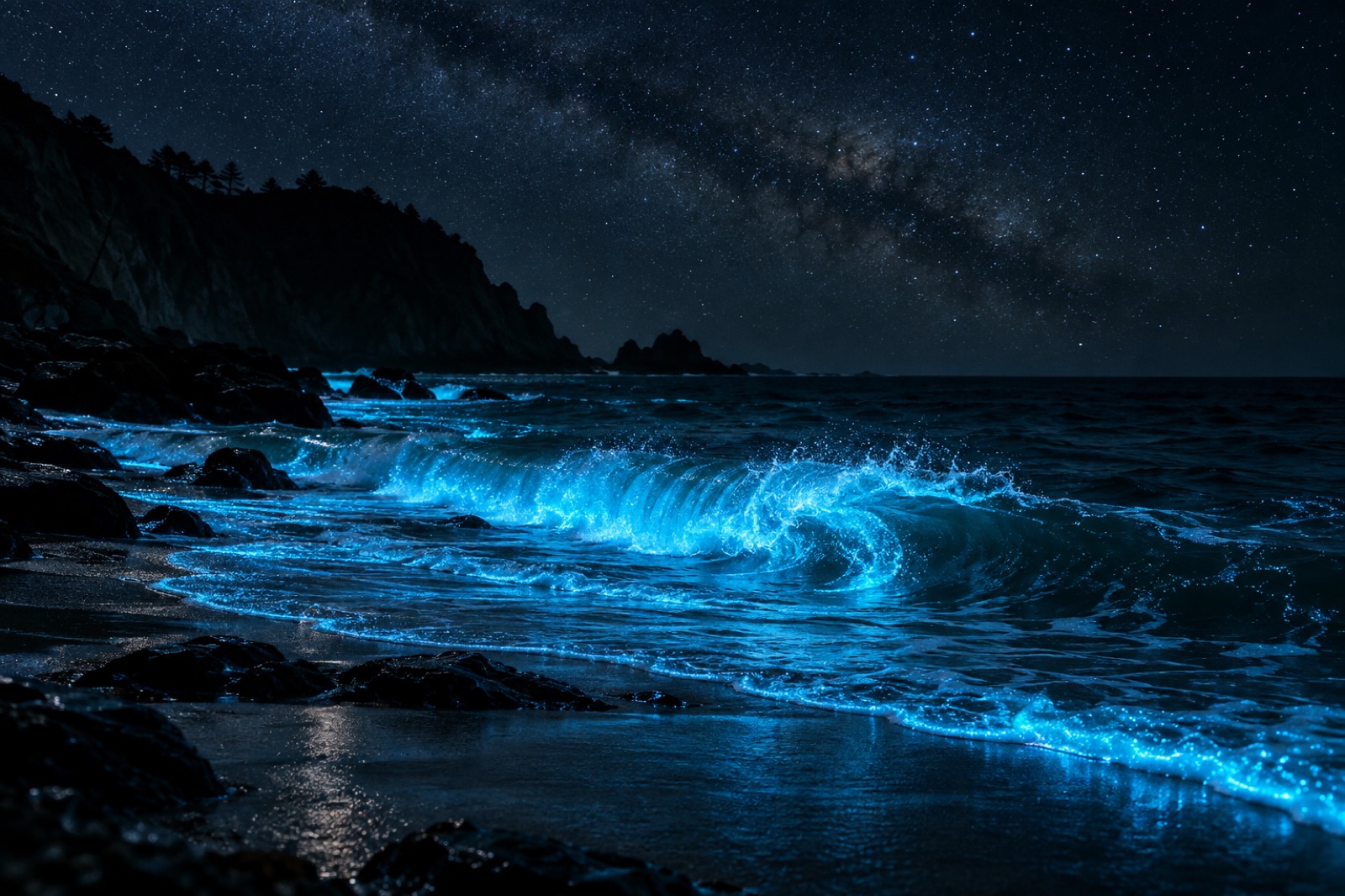
Kick the water gently on the right night and it answers with blue sparks. A wave breaks along the beach and, instead of white foam, it breaks in cold fire. Swirl your hand under the surface and it leaves a trail of light like a careless sparkler. This is bioluminescence — light made by living things — and the sea is its great showcase. In the ocean, bioluminescence isn't a rare curiosity: in the deep sea, the dark habitat that makes up most of the living space on Earth, a large majority of animals can produce light. It is, quite possibly, the most common form of communication on the planet.
Here's what it is, why the sea does it, and — because you're probably already wondering — how to see it.
The chemistry: a cold fire
Bioluminescence is a chemical reaction, not a reflection or a stored sunlight. In essence, a light-emitting molecule called a luciferin is oxidised with the help of an enzyme called a luciferase, and the energy of the reaction leaves as a photon. Inside an animal's light organ this is usually tightly packaged into cells called photocytes, wrapped in reflectors and lenses like a headlamp.
Three engineering details explain everything you see:
- It's cold. The reaction releases almost no heat — which is why a fire that can light a wave doesn't burn the wavemaker. "Cold light" is efficient: very nearly all the energy becomes light.
- It's blue-green. The peak of most marine bioluminescence sits around 470–490 nanometres — exactly the band of blue-green that travels furthest through seawater. In a medium that rapidly swallows reds and yellows, evolution converged on the one colour that carries. (A tiny number of specialists, like the deep-sea dragonfish, work in red — effectively a private channel other fish can't see.)
- It's triggered. For surface bioluminescence, the striking thing is that the light comes and goes: the waves glow, then go dark. Many plankton only flash on mechanical stimulation — a breaking crest, a kicked leg, a passing hull. That's not decoration. It's a strategy, and understanding the strategy is the key to understanding the light.
Why light up? The honest evolutionary answers
In darkness, a photon is a message. Organisms pay real energy to produce those photons, so evolution has kept the trick only where it pays for itself. The purposes catalogued in the sea:
The burglar alarm. This is the leading explanation for the dazzling displays of glowing plankton. A copepod or small fish grazes among dinoflagellates; the dinoflagellates, touched, flash. The flash doesn't help the individual cell — it's likely eaten anyway — but it illuminates the grazer. A bigger predator, patrolling in the dark, now sees a sparkling snack and eats the grazer. The light is a cry for help aimed at the grazer's own predators. Elegant, selfless and effective — and it's why the waves erupt in light where feeding fish are working.
Startle and smoke screens. Many shrimp, squid and jellyfish flash hard on attack, or — like certain deep-sea squid — squirt a cloud of luminous secretion instead of ink: a brief, blinding distraction while the author slips away in a different direction.
Counterillumination — invisibility by glow. Seen from below, any creature silhouettes darkly against the faint, filtered sunlight above. Many midwater fish, squid and crustaceans solve this by lighting their own bellies with rows of photophores, tuned in brightness and colour to match the downwelling light. Properly done, the silhouette vanishes. It's camouflage by lamp — one of the strangest and most beautiful tricks in the sea.
Lures and headlamps. Anglerfish culture bioluminescent bacteria in a baited lure wiggled in front of the mouth. Dragonfish and loosejaws use private channels of red or far-red light their prey can't see. Flashlight fish harbour bacterial headlamps they can blink on and off with a shutter of tissue.
Communication. Some species — deep-sea squid, lanternfish, ponyfish — flash in patterned code; on dark nights, the deep sea is filled with quiet conversations we mostly haven't deciphered.
The plankton that make the waves sparkle
The famous "glowing surf" and kayaks-trailing-light experiences are almost always dinoflagellates — single-celled plankton, a few hundredths of a millimetre across, the same group responsible for red tides. The two famous names:
- Lingulodinium polyedra (often still called Gonyaulax in older guides) — the classic red-tide-and-blue-night species of California and many temperate coasts. By day, dense blooms look rust-red in the water; by night, every wave break ignites electric blue.
- Noctiluca scintillans — the "sea sparkle", a globular dinoflagellate without red-tide pigment, whose blooms produce the ghostly blue-green lightning in breaking waves around the world.
The light comes from microscopic organelles called scintillons: small acid vesicles containing the luciferin, which fire when a mechanical disturbance arrives at the cell membrane. And critically, these organisms flash in a circadian rhythm — they synthesise their light chemistry by day and can only emit at night, which is why the same calm sea may be dark before midnight and come alight after dark even hour by hour.
A curious threshold: bioluminescent bays are rare exactly because they need the physics and biology to conspire — a sheltered, warm, nutrient-fed embayment with narrow exchange to the open ocean, allowing astronomic plankton densities to build up. Where the conspiracy works, the result is wonderlands: kayaks leaving 10-metre lightning trails, fish carving sparking tunnels through the dark — one reason paddling at night over quiet kelp bays and night dives can tip from "nice swim" into something that reorganises your sense of the world.
Milky seas: the strange exception
Everything above flashes — the whole phenomenon is strobes and sparks. Yet there's one form of marine bioluminescence that glows steadily, and it is so strange that for centuries sailors' reports of it were treated as tall tales: milky seas. On rare nights in the Indian Ocean and a few other tropical regions, ships have reported steaming for hours through water glowing a uniform, soft white — like sailing on snow-lit clouds.
The cause appears to be luminous bacteria (chiefly Vibrio harveyi and its kin), which unlike dinoflagellates glow constantly once they reach a certain crowd density — their light turns on by a quorum-sensing chemical vote. Milky seas are the largest bioluminescent events known: satellite sensors have now confirmed and tracked them from space, some covering areas the size of small countries and persisting for days to weeks. Scientists still don't know why bacteria invest so much in sustained light — possibly to attract fish that will swallow and shelter them. It's one of the great live questions of ocean natural history.
Bioluminescence and the kelp forest
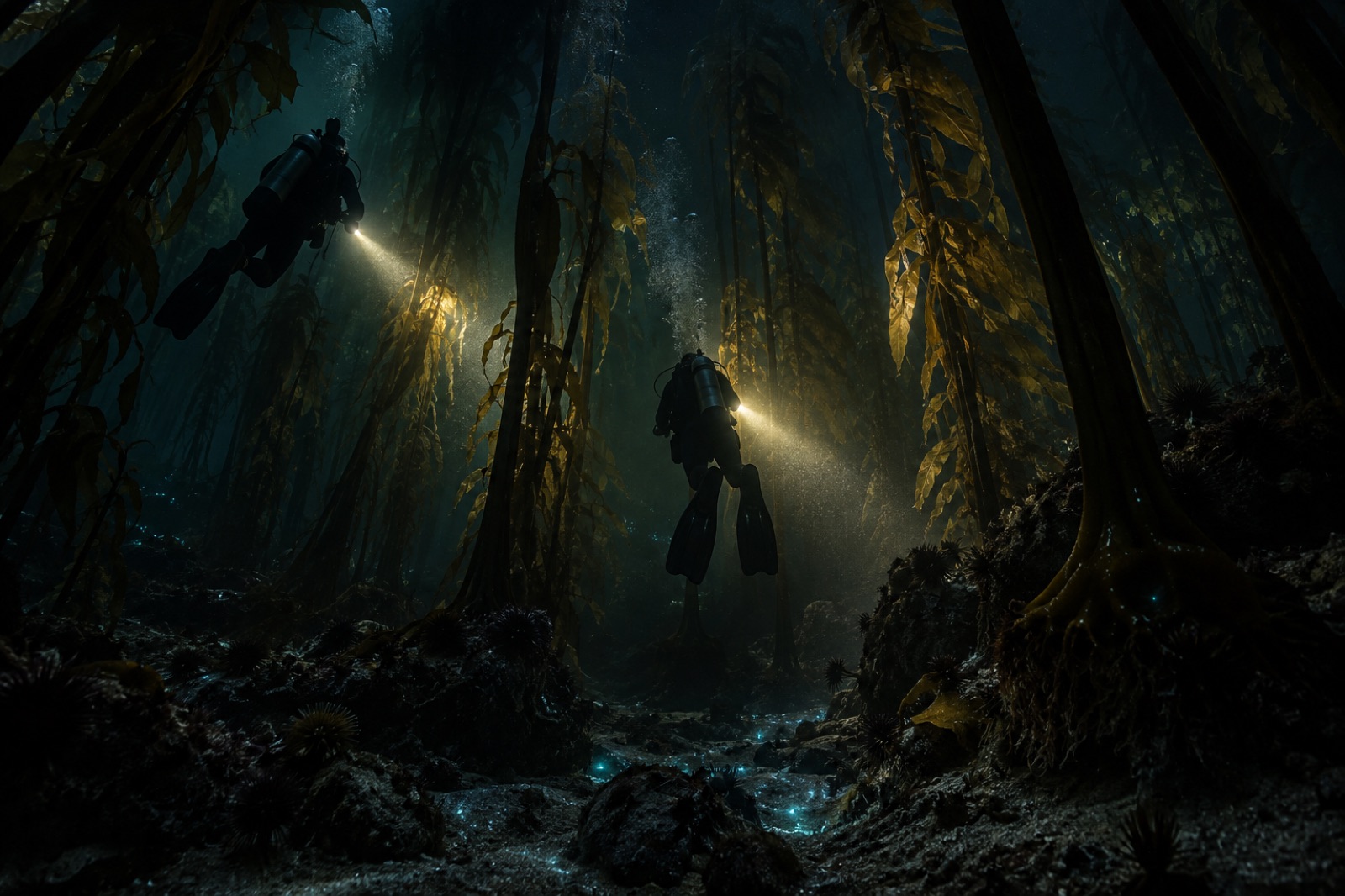
Kelp forests are not a famous bioluminescent habitat, but they sit at the edge of it in two ways. First, kelp forest food webs run on plankton, and during dinoflagellate blooms, night dives in kelp turn theatrical: kelp fronds flash on contact, fin-kicks leave lightning, and the whole forest stands out in sparkling outline. (Seasoned kelp divers will tell you: the night the water lights up roughly cancels every complaint you've ever had about drysuit maintenance.)
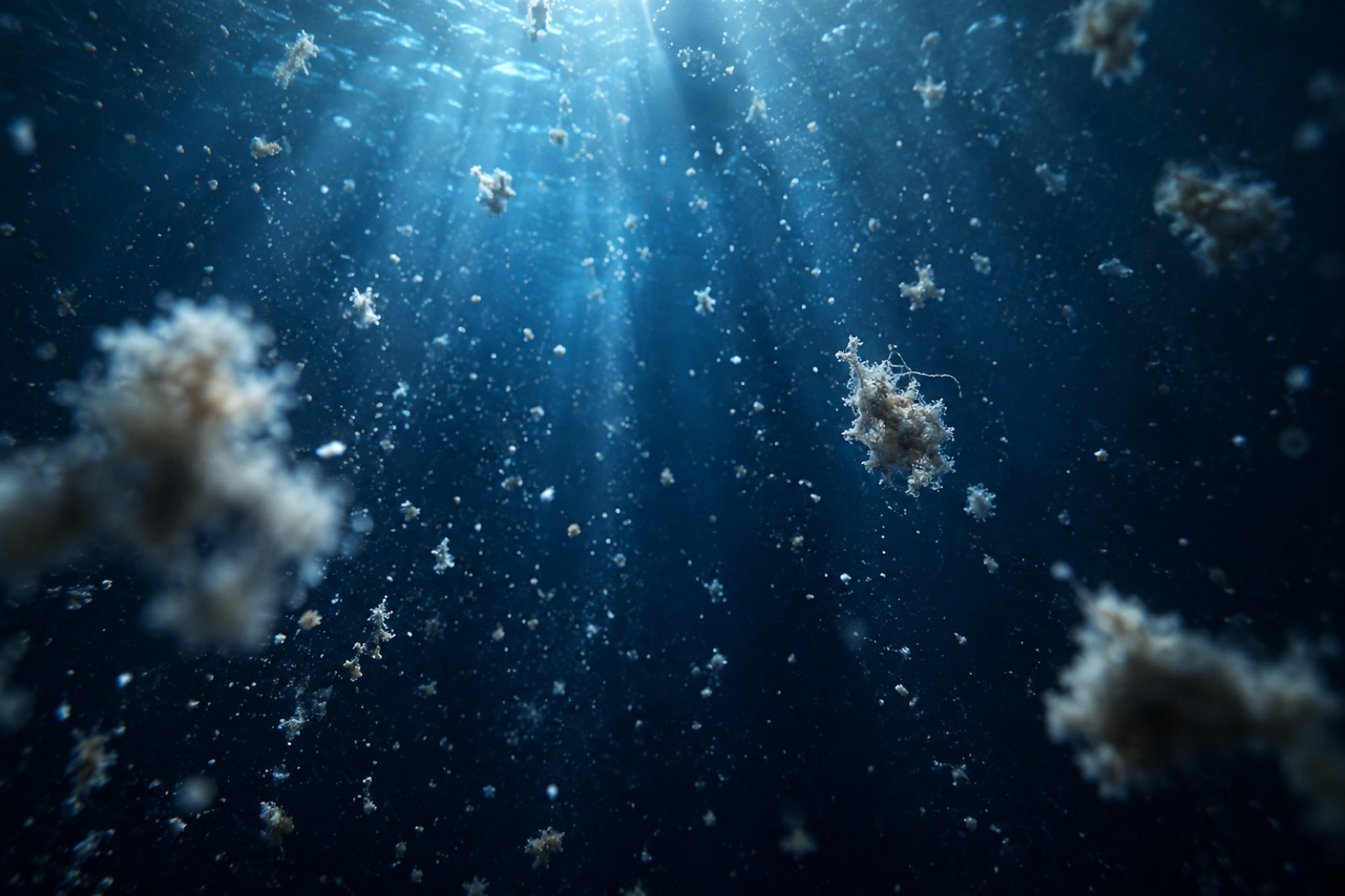
Second, when the bloom season ends, the rain of dinoflagellate cells, zooplankton and their grazers becomes part of marine snow — the sinking organic flux that carries coastal surface energy to depth. Bioluminescence is created mostly where food is concentrated — and faded with it, fin by fin, back down through the food web.
How to see bioluminescence yourself
It's the easiest rare thing in nature, if you plan for it:
- Pursue the red tide. Daytime tells you where glowing plankton are: rust-tinted streaks in the water, brownish curtains around the breakers. Come back on a dark night to the same water.
- Go dark, stay dark. The display is subtle until your eyes fully adapt. Give it 20–30 minutes in real darkness; kill torches and phone screens, or use dim red light. Choose nights in the days around a new moon, or before/after the moon is well up.
- Disturb the water. Everything above runs on stimulation: throw in a pebble, sweep your arm, paddle an oar. Waves, wakes and your own movement write in light.
- Warm, calm and sheltered wins. Late summer and autumn in temperate seas; sheltered bays, coves and harbours where plankton concentrate. Some coasts — Puerto Rico, the Maldives, parts of Australia and New Zealand, California — are deservedly famous, but quiet local bays surprise people all the time.
- Respect the phenomenon. Stay out of the water when authorities warn of a harmful algal bloom (not every red tide is toxic, but some are; check local notices); visit bioluminescent bays with low-impact operators; leave the dark places dark.
Key takeaways
- Bioluminescence is light made by a chemical reaction — luciferin plus oxygen, steered by the enzyme luciferase — cold, efficient and (in seawater) almost always blue-green, the colour that travels furthest.
- In the deep sea, bioluminescence is normal, not rare: a majority of deep-sea animals can produce light, for camouflage, lures, alarms and signals.
- Glowing surf is mostly flashing dinoflagellates (Lingulodinium, Noctiluca), triggers by mechanical disturbance, almost certainly as a "burglar alarm" that betrays grazers to their predators.
- Milky seas — a steady glow produced by luminous bacteria over huge areas — are the exception that proves the rule and have been confirmed by satellites.
- To see it: chase red tides by day, visit on moonless nights, dark-adapt your eyes, and stir the water.
FAQ
What makes the ocean glow at night?
Usually bioluminescent dinoflagellates — microscopic plankton that flash blue when disturbed. The reaction happens in tiny organelles called scintillons, triggered by mechanical cues: breaking waves, swimmers, boats, fish, anything that stirs the water.
Is bioluminescence dangerous to swim in?
Usually not — the most familiar glowing species (Lingulodinium polyedra, Noctiluca scintillans) are non-toxic. However, bioluminescent blooms and harmful algal blooms can look identical from the beach, and some glowing-water events overlap with toxin producers. Rule of thumb: if local authorities have flagged the bloom, admire it from the shore or a kayak.
Why is bioluminescent light blue?
Because seawater transmits blue-green light (around 470–490 nanometres) further than any other colour — reds are absorbed within metres. Evolution converged on the one channel that works underwater; a handful of deep-sea specialists use red light precisely because almost nothing else can.
Where are the best places in the world to see it?
Permanently reliable displays concentrate in a few sheltered, plankton-rich bays (Puerto Rico's bio bays, parts of the Maldives and Caribbean); temperate coasts — California, Australia, New Zealand, Japan, the Mediterranean — produce superb displays during seasonal dinoflagellate blooms, but they're far less predictable and worth tracking through local reports.
Do kelp forests glow at night?
Kelp itself doesn't glow. But when bioluminescent plankton are about, everything moving in a kelp forest — divers, fish, soft colonies, sometimes the brushing fronds themselves — outlines in light. It's one of the great unlisted experiences of night kelp diving, and a fine reason to book one.