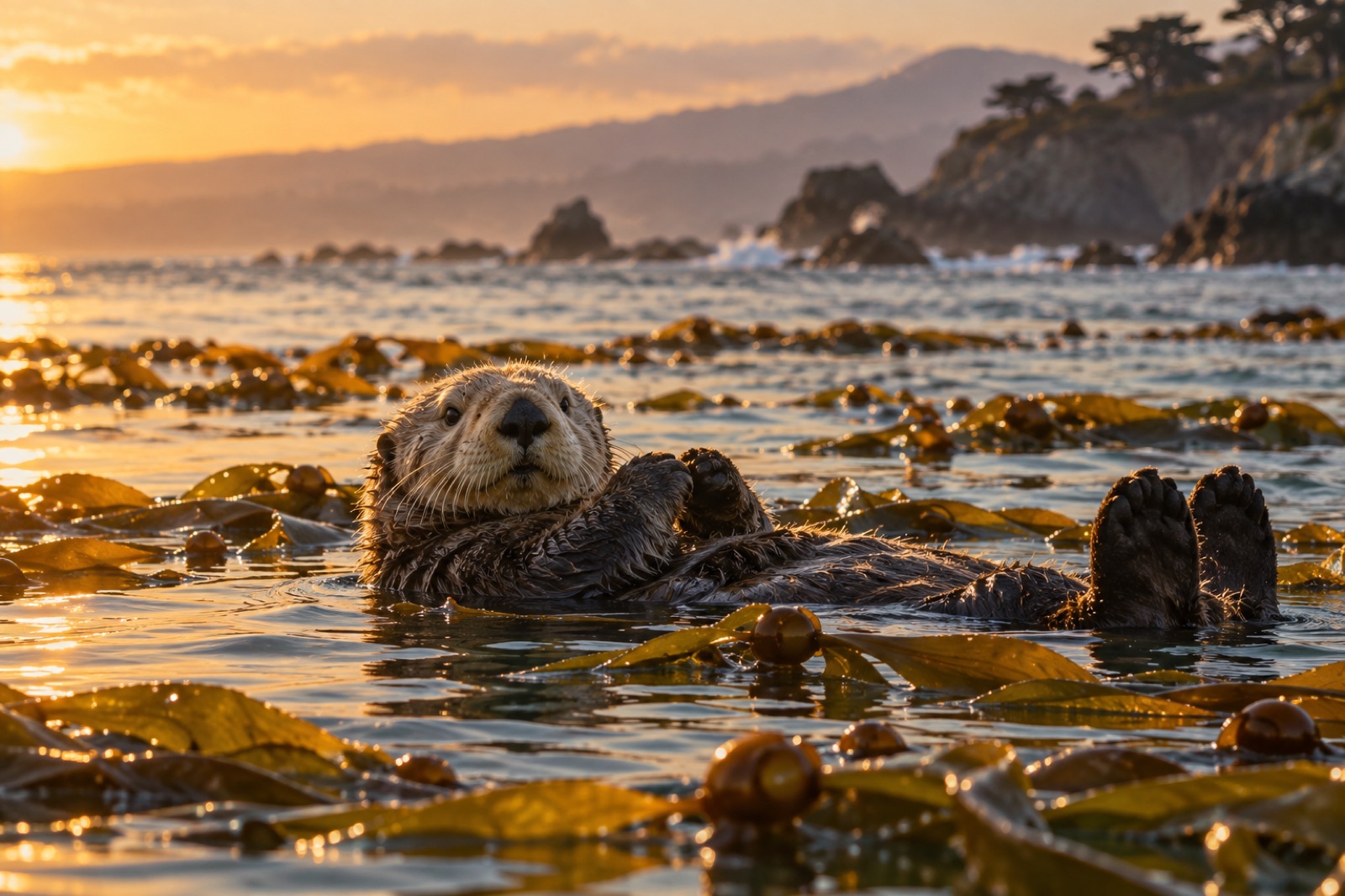
You do not have to get wet to explore a kelp forest. The sea kayak — slow, silent, drawing centimetres of water — is arguably the best observation platform a temperate coast has, better in some ways than a mask: you cover kilometres instead of fin-strokes, you ride the swell the canopy is damping, and many of the forest's most charismatic residents prefer the surface anyway. Otters raft in it. Seals haul up beside it. Herons fish the canopy edges. And on clear, calm water the canopy itself is a lens into the world beneath — the forest visible through the surface like a woodland seen from a slow aircraft. Here is how to read a kelp bed from a cockpit.
Why kayaks and kelp belong together
Four properties make the kayak the kelp forest's natural companion:
- Draught. A sea kayak floats over kelp that would snag a propeller and ground a dinghy. The top of the canopy and the bottom of the hull are centimetres apart and at peace with one another.
- Silence. Under paddle power you are acoustically invisible; wildlife treats a drifting kayak as driftwood. This is why kayakers get closer encounters with otters and seals than any motorised craft.
- Slowness. At kayak speed you actually observe. Transects of behaviour, relationships, feeding events unfold in front of you at walking pace.
- Reach and access. Kayaks launch from beaches that serve no boats. Kelp coasts are full of coves, kelp-fringed points and sea-stack gardens that only a hand-launched craft can visit.
What you can see from the surface
The viewing menu from a cockpit, roughly in order of frequency:
- The canopy itself. Floating kelp fronds are the headline act — bull kelp rafts with their hollow bulbs, giant kelp's long canopy cables — each with its own micro-ecosystem: snails grazing the blades, juvenile fish sheltering underneath, seabirds perched on the fronds themselves.
- Sea otters, where they exist — Monterey Bay, the Olympic coast, parts of Alaska and Russia — wrapped in kelp and cracking shellfish at the surface. Observe them from a proper distance; our sea otter etiquette guide is mandatory reading before your first otter coast.
- Seals and sea lions, who treat kelp beds as lounge and larder. Curious harbour seals will surface at arm's length from a motionless kayak.
- Birds. Kelp beds are feeding infrastructure for cormorants, terns, herons, oystercatchers, bald eagles on northern coasts, and divings birds working the bait fish the canopy concentrates.
- Through the surface it all, on clear days, the reef. In calm, clear conditions — which a canopy actually creates by damping ripple — you can look straight through into the understorey: fish cruising between stipes, urchin aggregations, the forest floor. Polarised sunglasses are the kayak-kelp accessory nobody tells you about; they cut the surface glare and turn the canopy transparent.
Paddle craft: how to move through a canopy without snagging
Kayaking over kelp feels odd the first time — the blades sweep through fronds, the hull slides over cables, and the forest feels grabby. It is not, if you keep a few habits:
- Keep momentum low and strokes shallow. A deep power stroke tangles fronds around the blade; a short, high stroke slips through. Slower is faster in thick canopy.
- Follow the leads. Kelp beds are laced with open channels — surge lanes, sand corridors, current strips. Paddling the leads is easier and ecologically kinder than ploughing the thick stuff, and it's where the wildlife concentrates.
- Skirt the canopy edge when speed matters. The forest–sand boundary is the best travel lane and often the best viewing, since the edge effect concentrates fish and their predators there.
- Respect the canopy as habitat. Skim rather than drag over shallow canopy where you can; avoid paddling through resting wildlife rafts; give hauled-out seals a wide berth. Kelp canopies regrow from damage, but resting animals pay stress costs when crowded. The ethic is the same one our snorkel safety guide sets for swimmers: you are the visitor, the forest is the host.
- Never mistake kelp for anchorage. Kelp is not a mooring point, and wrapping a line or yourself around fronds is asking to go swimming in a jacket.
Reading conditions
Calm is the kayaker's friend, and the canopy both signals and causes it: thick kelp visibly smooths the water, and lumpy, separated water on the lee of a kelp bed tells you about current where the forest is not guarding the sea. Watch for:
- Tide and current around points. The kelp knotweed belt often sits in the very zones where tidal flow accelerates; plan crossings at slack, and expect upwelling-textured water where the current works.
- Offshore wind. The wind that blows a kayak off the coast is the day's governing risk; morning glass is the classic antidote and coincidentally the best wildlife and viewing hour.
- Swell direction. A canopy damps chop, not long-period swell; respect the ocean's pulse and the kelp does the rest.
Where to go
Any temperate kelp coast answers this, but a few classics:
- Monterey Bay, California — the definitive kayak-over-kelp destination: otters, harbour seals, birdlife, huge fringing forests, and multiple launch points with rental operations and guided tours.
- The Channel Islands, California — sea-cave and forest exploration by kayak in water clearer than the mainland's.
- Vancouver Island and the broken-group coasts of British Columbia — kayak camping among kelp, sea stacks and rainforest, with otters back for decades.
- Hokkaido's Shakotan Peninsula — summer glass-bottom-clear water over kombu reefs; short season, unforgettable clarity.
- Tasmania's east coast — golden kelp beds against white-sand coves, best paddled in late summer calm.
- Norway's Lofoten — summer kayaking under mountains and midnight sun, kelp forests in mirror-flat fjord water.
Closer to home, the rule is simpler: find the fringing canopy on a chart, launch from the nearest beach at slack, paddle the edges, and keep your hands in the boat.
Counting as you paddle
Kayaking over kelp sits naturally next to counting it. On coasts like Puget Sound, the annual kelp inventory is literally built by kayakers paddling GPS transects; our citizen science beach guide and the diver-side reef survey article describe how observation becomes data. Tidepools, canopy extent, wildlife sightings — the kayaker's-eye-view is the cheapest useful monitoring platform on a temperate coast, and your summer paddles can feed the same time-series that management runs on.
Key takeaways
- Sea kayaks float, silently and shallow, over kelp forests — often the best surface viewing platform on a temperate coast.
- From a cockpit you can watch otters, seals and birds at the surface and, on calm clear days, look straight through the canopy into the reef below (bring polarised sunglasses).
- Paddle technique in canopy is about momentum and leads: slow, shallow strokes and open channels; skirt the edge when covering ground.
- Kelp is habitat, not an anchor: never tie off to fronds, never crowd resting wildlife, and never treat the canopy as rough water you can power through.
- The same kayak that views the forest can count it; kayak-based citizen science supplies real kelp monitoring data on several coasts.
FAQ
Do I need sea-kayaking experience to paddle over kelp?
Basic competence — self-rescue familiarity, comfortable wet exit and re-entry, and experience in mild wind and waves — is a sensible minimum. The kelp itself is not the hazard; exposure and weather are. Helmets and guided tours remove the experience barrier entirely.
Does kayaking over kelp damage it?
Skimming over a canopy with normal paddle strokes causes minimal harm — kelp fronds bend around hulls and recover from incidental blade contact. The etiquette is about avoiding drag, not tying off, and never paddling through resting wildlife; frond damage regrows, but stressed animals pay.
Can kelp stop a kayak or trap a paddler?
A kayak can lose momentum in thick canopy but cannot be trapped by kelp — fronds are flexible and part under steady pressure. The worst case is an awkward slow section, not entanglement. Swim skills and a PFD, as always, cover the actual risk which is capsize in cold water, not kelp.
What's the best time of day to paddle a kelp forest?
Early morning is the classic answer: calmest wind, best light, most active wildlife, and the clearest surface for seeing through into the understorey. Slack tides around headlands are the timing detail that matters most.
Is kayaking a good way to photograph kelp forests?
Yes — with caveats. The low, stable vantage is superb for canopy, wildlife and sea-stack compositions; the challenge is that saltwater and electronics mix badly. A waterproof case or dedicated housing, a tethered paddle, and a willingness to drift while shooting are the working answers.